


Fri, 17th July Cardiff 23°
Nation.Cymru wordmark
Advertisement

Opinion

Why the lack of diversity in the independence movement is a problem
By NationCymru
Picture Nation.Cymru

Leia Fee

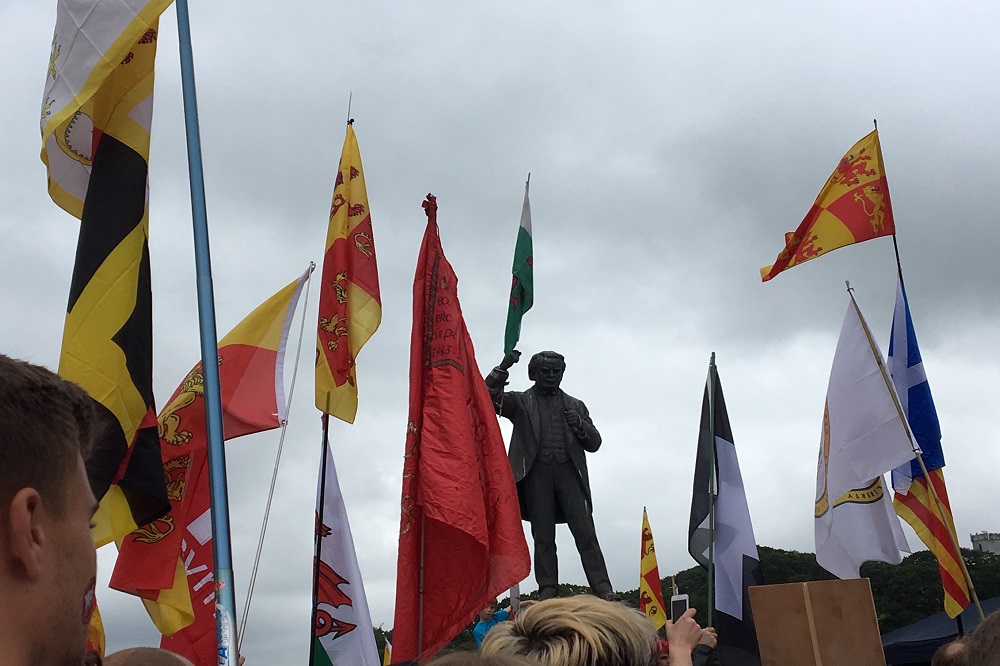
There’s been a lot on Twitter in the wake of the independence marches about how representative the speaker line-ups have (not) been.

To a disappointing degree, this has been met with, “Why don’t [under-represented demographic] get on and do something about it then?”

Sometimes this has degenerated to the point of blaming specific individuals for not single-handedly fixing centuries of racial oppression.

Lack of diversity in the independence movement is a problem and it doesn’t matter whether we personally set up the systematic inequality centuries ago and it doesn’t matter if we personally are not racist.

Being “not racist” is not something we get cups and medals for, it’s the bare minimum for being a decent human.

Being actively anti-racist is way harder than being “not racist” but that’s what we need.  It takes way more work, thought and emotional energy.

It takes a mindful, ego-less acceptance that the society we live in is awash with unconscious bias and structural barriers.

It takes a deliberate and systematic dismantling of those barriers, the willingness to sacrifice a small bit of pride to do it and the perseverance to do it habitually every time.

It’s not particularly emotionally easy.  It takes a small sacrifice of pride to say “I have benefited from a system which elevates my voice in preference to others.”

Does it feel uncomfortable?  Like taking the blame for the sins of the fathers?  It certainly doesn’t feel nice. 

(Don’t get me wrong, I’m not looking for too much self-pity here because I’m pretty certain it feels better than the oppression itself, but even so – humans are hard-wired to recoil from ‘doesn’t feel nice’.)

[mid-content-banner]

Ego

It takes a sacrifice of pride when we’ve promised to organise a panel to state (and mean) “I will not hold this panel unless I can make it representative.”

And to stick with it even if it means our event doesn’t have all of the things that we wanted it to have.  Because it’s not all about us.

If we’re invited on a panel it takes a small sacrifice of pride to give up our voice by saying “I’m not speaking unless there is representation here.”

To recognise that we are not so uniquely vital to the cause that our voice must be heard at the cost of someone else’s.  It’s a kick to the ego, it doesn't feel nice.

If we aim for intersectionality, there will be people who will accuse us of working of a tick-list of demographic qualities rather than choosing the ‘best’ people.  That won’t feel nice.

And then there’s, “Oh but if everyone did those things then we might not be able to do speakers at all!”

Yep.  That could happen if we really mean it when we say, “no diversity, no intersectionality, no panel”.  We might have to admit, “We couldn’t find suitable speakers, sorry.”  A small sacrifice of ego.  Admitting we failed on the diversity front.

Because it is a failure – to believe otherwise can only be to believe that there really aren’t suitable intersectional speakers out there who are worth hearing – and we obviously can’t believe that because we’ve already established that we’re “not racist”, haven’t we?

I’m sure there’s some well-known saying along those lines –  something about admitting one has a problem before being able solve it…  So assuming we admit it, how do we solve it?

Just saying everyone’s welcome doesn’t help. Humans are pattern recognising machines. They won’t believe words, they’ll believe the picture.

So, assuming we’ve established the need for panels, speakers and marketing to reflect the demographic balance we want, not the skewed one we currently have, how do we do it?

This is not trivially easy to achieve.  It can become tokenistic.  We don’t need tropey superhero line ups with four white guys, one black man and one women.

Benefit

We also can’t put an unfair amount of pressure on members of the under-represented demographic to constantly be the face of it.

This can lead to them being held to higher standards of behaviour and input than others, or actively blamed for under-representation if they don’t feel like carrying that pressure.

Some of the members of that group are going to perfectly reasonably turn down the “opportunity” to do the emotional labour of fixing the under-representation problem in addition to surviving within it.

That’s within their right and that small sacrifice of pride is needed once again to swallow any frustration or perceived knock-back and look harder for more people to include.

We must resist the urge to give up and lazily conclude, “Oh well we tried but ‘they’ just weren’t interested.”

We must avoid expecting under-represented demographics to speak only to that aspect of their experience.

Expecting, or BAME women to speak about how being part of that demographic has impacted them rather than their independence aspirations is not representation.

Fixing under-representation is not the job of the under-represented. And certainly not at the expense of the emotional labour it takes to talk about their own oppression rather than the topic at hand.

At first, until we fix this, finding representative speakers will be more work than defaulting to the usual suspects.  We need to be honest when we haven’t achieved it and open to talking about the things we’re trying to do better.

The good news is it will benefit all of us once we achieve it.  We will hear opinions about independence that are different from those we’ve heard before because the people we’re hearing them from are different to the people we’ve heard from before.  We will gain ground in new areas, and support from new people.

We will be moving towards an independent Wales where we don’t replicate the failings of the existing British state.

For the price of a cup of coffee a month you can help us create an independent, not-for-profit, national news service for the people of Wales, by the people of Wales.

Get more trusted Welsh news

Choose Nation.Cymru as a preferred source in Google News to see more of our journalism.

Choose Nation.Cymru as a preferred source in Google News

16 comments

Bryn Colion

Cytuno/Agree ..... but theres a big area of diversity thats not yet tapped...and its the eastern border Welsh .... independence support is lowest here....its crucial there are spokespeople from places like Brecon ..... there even used to be a few tories from East Wales who were pro self rule..but disagreed with plaid cymru's economic principles.......... In other words....there must be more geographical diversity as well as ethnic groups ..... also a few English speakers too are required consdering 25-30% of Wales is English identity

Reply
John Young

Arguing the case for Independence means this is a one issue discussion, are you for or against Independence for Wales. Are you a leaver or remainer. If I was talking to two people and they were a sort of Welsh version of Jeremy Corbyn and Boris Johnson with wholly opposite opinions on how an Independent Wales would be run their opinion on how Wales would be governed is irrelevant. The only opinion relevant to me would be, are you for or against Independence. Likewise, if you are of a particular ethnic group or of a particular sexuality, or whatever, your opinion about how that should be addressed post Independence should be addressed post Independence. There's nothing we can do about any of it in a specifically Welsh context until Wales is Independent. So, again, the only opinion that is relevant at this moment is are you for or against Independence. There may be a thousand different priorities out there but arguing those cases now just dilutes the core message.

Reply
Mr Essex Havard

Completely agree. Another reason for tackling this issue right now is that Welsh Nationalists need to put clear water between them and the way the media define "Nationalist" ie fascist, right wing, white supremecist etc. Welsh Nationalism is inclusive, not exclusive. Let's lead by example

Reply
Norm

''Welsh nationalism is inclusive'' Pull the other one, just look at the Eisteddfod, Plaid Cymru, your independence marches....Welsh nationalism is the epitome of exclusive.

Reply
Richard Penderyn

???? You are having a go at Wales for having a festical in its native language....... thats bizarre ..... many countries do this - Im an English citizen and adore the Eisteddfod!

Reply
Sibrydionmawr

Quite simply if you're having a go at the Eisteddfod because it's only in Welsh, and therefore, to you, exclusive, then you're not going to be very happy outside of the UK are you? Are the Norwegians 'exclusive' because they speak Norwegian? Or the French? I know to some English people anyone who speaks 'foreign' is only doing so to spite the English, and that seems to be what you're doing. Really, you're just an irrelevant prick - it's not all about you, and in 99.9999% of situations in Wales, English speakers have the upper hand and it's Welsh speakers who are marginalised - in their own country! If you dislike the situation so much then either don't come here, or move somewhere else. English supremacists are not welcome.

Reply

In reply to Sibrydionmawr

Norm

Dear oh dear, is this the limit of your tolerance, agree with me or get out? Rather proves the point of the article.

Reply
Royston Jones

Here's the threat to the independence movement spelled out - 'Why aren't we this/that . . . why don't we have speakers from this group/that group . . . why are there so many white heterosexuals here?' Unless the independence movement is welcoming to ALL without LABELLING then it's finished. I say that because it will become a vehicle for fringe groups more interested in promoting an ideology or a minority interest and that will turn off the majority of Welsh people. The KIND of independent Wales we create must be decided AFTER independence by the DEMOCRATIC wishes of the people. Any attempt to set an agenda now risks jeopardising independence, and calls into question the true priorities of those making these demands.

Reply
Sibrydionmawr

Though I agree with the thrust of this article, I can't help thinking that it kind of misses the point somewhat. As the article sort of points out, and as John Young emphasises, the independence thing is just about independence, are you for it or agin it? I think most of us are aware of the many other issues facing minority groups of all kinds, and those should not be neglected, and indeed, if a policy of intersectionality is to be genuine and actually work, then it has to be a seamless operation where all considerations are given equal weight, and where no one consideration can be allowed to trump another, no matter how inconvenient, or apparently 'impractical' this might be. Don't wait to be invited, just turn up and get involved, the more the merrier, and be aware that the (white, straight, male and middle-class) organisers might be wary of sending out specific invitations because it might be interpreted as an attempt at a tokenistic inclusivity.

Reply
Bryn

I agree with this, but when you have very little diversity in your area, it becomes much more difficult. You can't ask people to move into an area just so they can tick the box for you. If I said I won't do this panel because of the lack of diversity then the panel will never happen

Reply
Norm

What do you expect with a blood and soil anthem only sung in Cymraeg and that extols the DNA of our fathers? Just look at all the marches all white Anglophobes who come from areas that never see a black face? If you want to see how inclusive welsh nationalism is take a visit to Llanrwst for our 'nationa;' Eisteddfod

Reply
Dyfrig Jones

I totally agree with the thrust of this argument, but I think that some of the criticism of last Saturday’s march feels a little bit unfair. There were eight speakers, four of them were female, and one of them was from a BAME background. This was a march held in Gwynedd, where 99% of the population identifies as “white” (according to the census). So yes, we should continue to work towards a more diverse movement. And yes, it’d be good if the next march gave greater prominence to BAME voices, and to other marginalised groups. But let’s not create a distorted view of last Saturday’s march as being whiter and more male than it actually was.

Reply
Eric

I'm sure Ms Fee means well but if I were trying to hobble the movement for Welsh independence before it became airborne, I would try to focus it on second-order issues such as ethnic diversity. Only 5% of the population of Wales identify themselves as coming from a non-white background*, so to insist that every panel of less than twenty people must have BAME representation is to insist that BAME people be over-represented. (If, that is, one accepts that the independence movement should have exactly the same ethnic mix as the general population.) On the other hand, 22.5% of the Welsh population of working age have a disability, and they are treated as invisible here. Shouldn't they be included? Or don't they count as "diverse"? Also, I suspect that buzzwords and modish phrases such as "emotional labour", "intersectionality", "tokenistic" and "tropey" are unfamiliar to most people in Wales and may alienate them. There's no point in assembling a panel if no-one wants to hear what it has to say. Incidentally, Ms Fee's points about the sacrifice of pride and ego-less acceptance seem more religious than political. Nothing necessarily wrong with that, of course; but it does make it look as if she is looking for converts rather than supporters. What will "an independent Wales where we don’t replicate the failings of the existing British state" look like? A shining city on a hill? * https://statswales.gov.wales/Catalogue/Equality-and-Diversity/Ethnicity/ethnicity-by-area-ethnicgroup Roughly one in six people in Cardiff is from a non-white background; and about one in 120 on Anglesey.

Reply
Rhosddu

It's a question of priorities, and the priority is the need to end Cymru's colonial status and gain independence. Any other injustices, genuine or not, have to wait their turn. It seems inappropriate, in a relatively non-multicultural society like Wales outside Cardiff, to prioritise an issue that would have little meaning or relevance throughout most of the country. Nevertheless, anyone who believes in Wales, who emotionally invests in Welsh culture, and who supports Welsh independence would be justified in staking a claim to participation in the independence movement, rather than sitting waiting for acceptance and approval from some non-existent 'exclusive' hierarchy in the movement. Our largest immigrant group, the English, now includes a number who have embraced Welsh culture and language and doubtless took part in the marches in Cardiff and Caernarfon, or gave the marches thair tacit support. Nothing to stop anyone else doing the same. As others have commented, the most important thing at stake right now is, "Do you, or do you not, want independence for Wales?" That's the only box that the author needs to give some serious thought to ticking.

Reply
John Young

Some great positive responses here emphasising the fact that the focus needs to be, at the moment, on one thing and one thing only, Independence.

Reply
KK

I couldn't have answered it better myself Rhosddu and the number of those from outside of Wales who have embraced the culture is very important. Whilst I have stated elsewhere that there are those who have shown a somewhat superior attitude it is nevertheless important to remember people like Lari Parc who as an Englishman embraced the language and protested at the lack of Welsh language options available. Mike Parker is also another who springs to mind. It should also be remembered that we created Alun Cairns who quite frankly is such a unmitigated waste of spunk due to the fact that he has never cared about Wales. So as it goes it does level itself out somewhat. With regards to making Welsh independence a viable option for the future, one really needs to engage with Eastern borders as well as those who feel disenfranchised or left behind. For too long, a definition of what national identity is in Wales has often been overlooked or forgotten in towns such as Welshpool, Flint, Mold, Chirk, Monmouth etc. despite the fact that these towns have culturally been significant in history. For example, Welsh football owes a great deal to most of these towns and Paul Jones (football) and Ian Woosnam (golf) readily identified as Welsh despite being born close to or over the border. A greater awareness not just from the movement but also Welsh Government would undoubtedly help. Furthermore, the movement needs individuals who can relate to the people on the street. The oversight of Neil McAvoy is something that urgently needs to be addressed because it could be seen by others as an exclusive movement which appeals only to a select group of people or identity politics. The consequences of not embracing the nation as a whole inevitably results in parties such as UKIP and Brexit filling the void of those left behind in marginalised areas. It is a lesson that the detached main parties have yet to learn as they really don't understand the outside world outside of Westminster. It is imperative that for the independence movement to succeed that it doesn't fall into the same trap.

Reply

Leave a reply

Replying to Eric Cancel

I'm sure Ms Fee means well but if I were trying to hobble the movement for Welsh independence before it became airborne, I would try to focus it on second-order issues such as ethnic diversity. Only 5% of the population of Wales identify t...

Comments are reviewed before they appear.