


Opinion
Why the lack of diversity in the independence movement is a problem
Leia Fee
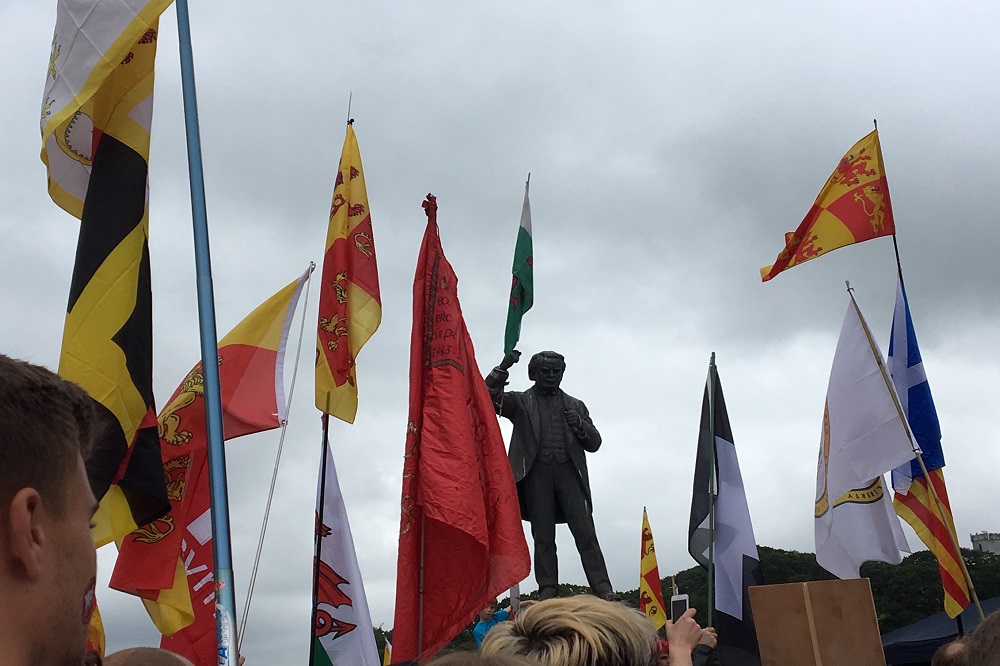
There’s been a lot on Twitter in the wake of the independence marches about how representative the speaker line-ups have (not) been.
To a disappointing degree, this has been met with, “Why don’t [under-represented demographic] get on and do something about it then?”
Sometimes this has degenerated to the point of blaming specific individuals for not single-handedly fixing centuries of racial oppression.
Lack of diversity in the independence movement is a problem and it doesn’t matter whether we personally set up the systematic inequality centuries ago and it doesn’t matter if we personally are not racist.
Being “not racist” is not something we get cups and medals for, it’s the bare minimum for being a decent human.
Being actively anti-racist is way harder than being “not racist” but that’s what we need. It takes way more work, thought and emotional energy.
It takes a mindful, ego-less acceptance that the society we live in is awash with unconscious bias and structural barriers.
It takes a deliberate and systematic dismantling of those barriers, the willingness to sacrifice a small bit of pride to do it and the perseverance to do it habitually every time.
It’s not particularly emotionally easy. It takes a small sacrifice of pride to say “I have benefited from a system which elevates my voice in preference to others.”
Does it feel uncomfortable? Like taking the blame for the sins of the fathers? It certainly doesn’t feel nice.
(Don’t get me wrong, I’m not looking for too much self-pity here because I’m pretty certain it feels better than the oppression itself, but even so – humans are hard-wired to recoil from ‘doesn’t feel nice’.)
[mid-content-banner]
Ego
It takes a sacrifice of pride when we’ve promised to organise a panel to state (and mean) “I will not hold this panel unless I can make it representative.”
And to stick with it even if it means our event doesn’t have all of the things that we wanted it to have. Because it’s not all about us.
If we’re invited on a panel it takes a small sacrifice of pride to give up our voice by saying “I’m not speaking unless there is representation here.”
To recognise that we are not so uniquely vital to the cause that our voice must be heard at the cost of someone else’s. It’s a kick to the ego, it doesn't feel nice.
If we aim for intersectionality, there will be people who will accuse us of working of a tick-list of demographic qualities rather than choosing the ‘best’ people. That won’t feel nice.
And then there’s, “Oh but if everyone did those things then we might not be able to do speakers at all!”
Yep. That could happen if we really mean it when we say, “no diversity, no intersectionality, no panel”. We might have to admit, “We couldn’t find suitable speakers, sorry.” A small sacrifice of ego. Admitting we failed on the diversity front.
Because it is a failure – to believe otherwise can only be to believe that there really aren’t suitable intersectional speakers out there who are worth hearing – and we obviously can’t believe that because we’ve already established that we’re “not racist”, haven’t we?
I’m sure there’s some well-known saying along those lines – something about admitting one has a problem before being able solve it… So assuming we admit it, how do we solve it?
Just saying everyone’s welcome doesn’t help. Humans are pattern recognising machines. They won’t believe words, they’ll believe the picture.
So, assuming we’ve established the need for panels, speakers and marketing to reflect the demographic balance we want, not the skewed one we currently have, how do we do it?
This is not trivially easy to achieve. It can become tokenistic. We don’t need tropey superhero line ups with four white guys, one black man and one women.
Benefit
We also can’t put an unfair amount of pressure on members of the under-represented demographic to constantly be the face of it.
This can lead to them being held to higher standards of behaviour and input than others, or actively blamed for under-representation if they don’t feel like carrying that pressure.
Some of the members of that group are going to perfectly reasonably turn down the “opportunity” to do the emotional labour of fixing the under-representation problem in addition to surviving within it.
That’s within their right and that small sacrifice of pride is needed once again to swallow any frustration or perceived knock-back and look harder for more people to include.
We must resist the urge to give up and lazily conclude, “Oh well we tried but ‘they’ just weren’t interested.”
We must avoid expecting under-represented demographics to speak only to that aspect of their experience.
Expecting, or BAME women to speak about how being part of that demographic has impacted them rather than their independence aspirations is not representation.
Fixing under-representation is not the job of the under-represented. And certainly not at the expense of the emotional labour it takes to talk about their own oppression rather than the topic at hand.
At first, until we fix this, finding representative speakers will be more work than defaulting to the usual suspects. We need to be honest when we haven’t achieved it and open to talking about the things we’re trying to do better.
The good news is it will benefit all of us once we achieve it. We will hear opinions about independence that are different from those we’ve heard before because the people we’re hearing them from are different to the people we’ve heard from before. We will gain ground in new areas, and support from new people.
We will be moving towards an independent Wales where we don’t replicate the failings of the existing British state.

Support our Nation today
For the price of a cup of coffee a month you can help us create an independent, not-for-profit, national news service for the people of Wales, by the people of Wales.
Get more trusted Welsh news
Choose Nation.Cymru as a preferred source in Google News to see more of our journalism.
