


Sat, 18th July Cardiff 24°
Nation.Cymru wordmark
Advertisement

Opinion

Wales needs less 'Yma o Hyd' and more of a focus on shaping our future
By NationCymru
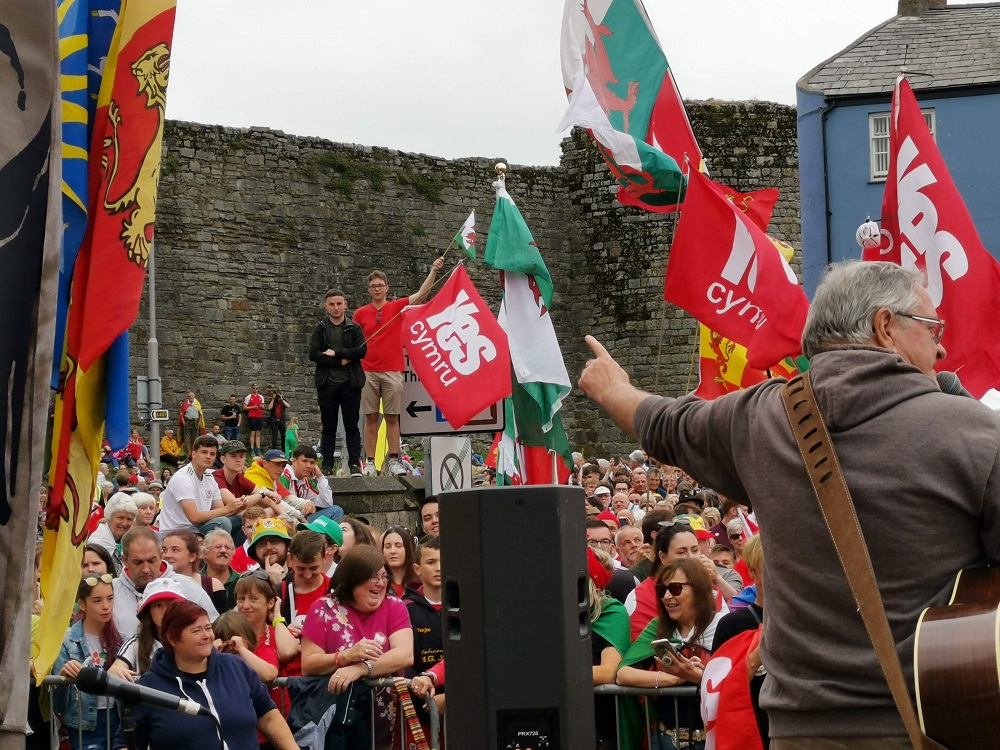
Dafydd Iwan singing at the Caernarfon independence rally. Picture Nation.Cymru

Joshua Declan McCarthy

It probably hasn’t escaped the attention of regular readers of Nation.Cymru that Dafydd Iwan’s 1983 single Yma o Hyd recently became the first song entirely in the Welsh language to briefly top a UK music chart. 

Or at least, that’s the impression you would get from listening to the few struggling voices of the Welsh 'national' media, small and restricted as it is. That’s not to say that Yma o Hyd hasn’t been given its spot on the radio, or that the odd eyebrow in London might not have been raised, but to pretend that this was a momentous event to anybody not already in the Welsh nationalist fold is to be willfully blind. 

Why, then, do we already dedicated to the cause insist that this was such an important moment? What is it in the Welsh national psyche that makes such a small recognition such a big deal? I believe it can be summed up by the song itself.

I consider myself a big fan of Dafydd Iwan.  I’ve spoken English my entire life, but in my attempts to learn the Welsh language, I’ve found his music to be a great help, and I listen to his songs regularly.  I know the lyrics and translations to most of them by heart, and when I stood on the Maes at the Caernarfon independence march, I sang along to Yma o Hyd with as much pride as everybody else.

Yet there is something telling in the fact that this song, above many others, should be considered something close to the anthem of the Welsh national movement. “Er gwaethaf pawb a phopeth, ry’n ni yma o hyd.” Indeed, “in spite of everyone and everything, we ARE still here.”

Yet, is that really saying much?  We are still here, but in truth, barely.  Few of us now speak the traditional language, work the traditional jobs, or adhere to the traditional religion, of Wales.  Is it really such a good thing, that the mere ability to survive, to cling on by our fingernails to the tattered flag of identity, is our greatest source of pride? 

In most countries, the songs of national pride will relay the great deeds of their patriots, retell the great stories of their past, and look to the great potential of their future. Yet to us, the central feature of our nationhood, the rallying cry of our people, is simply that we have not quite been fully extinguished. Not yet, anyway.

This extends further than the lyrics to one nationalist song.  If we look to the national motto of France, we see the famous words “Liberté, égalité, fraternité,” or “Liberty, Equality, Fraternity.”  It’s a powerful motto, a phrase that tries to encapsulate what it means to be French, that expounds in three simple words the values of their nation. 

Compare that to our own dear “Cymru am byth!” “Wales Forever!” The message is exactly the same as “Yma o Hyd.” It doesn’t call upon us to grow or to thrive. It doesn’t tell us anything about who we are or what we believe. It doesn’t rally us to a particular cause. Rather, it once again succumbs to the idea that our greatest strength is our ability to stubbornly remain in place, like a stain that our enemies have long since given up on removing. 

The national anthem is no better, building itself to the equally resigned “O, bydded i’r hen iaith barhau!” Not even asking us to fight for the language, but simply appealing to some unnamed high power that it might eb allowed to endure.

[mid-content-banner]


Ambition

This, I believe, is why seeing Yma o Hyd in the charts roused such a reaction from the Welsh nationalist community.  In Wales, it seems, we can aspire to little more than endurance, subdued and vegitative, with our culture and economy on life-support. 

The merest hint of recognition of our nation by something larger, in this case the British media, was enough to fulfil that deep-set desire for attention that sits at the centre of the Welsh national psyche; like a  centenarian receiving a birthday card from a niece that never visits, we're proud only that someone else has remembered that we're not yet dead.

It is little wonder then, that our big dreams of independence is shared only by a minority of the Welsh public. When we can barely muster a hint of ambition beyond continued survival, how can we ever expect ordinary people to strive for something more? When the Welsh national movement is content simply to exist, how can it expect to grow?

I’m not going to stop listening to Yma o Hyd.  It’s a great song, and it does say something profound about Wales, especially with the new fourth verse.  Yet when I think of how to summon national pride, a pride beyond reminding my international friends that we are not merely an English region, a pride that instead looks to a future where we can grow and contribute as a full and responsible member of the global community, I’m probably not going to pick as the song that represents my feelings. 

It’s time for the national movement to sing a new song, and they need to start doing it quickly, or we may well lose that last comfort of being “Still Here.”

Plaid is a Ifanc Activist, Dafydd Iwan Fan, English-language Monoglot, Student of History and Welsh History at Cardiff University.

For the price of a cup of coffee a month you can help us create an independent, not-for-profit, national news service for the people of Wales, by the people of Wales.

Get more trusted Welsh news

Choose Nation.Cymru as a preferred source in Google News to see more of our journalism.

Choose Nation.Cymru as a preferred source in Google News

19 comments

Jason Evans

The article moans about a song which recognises the struggles of our nation, our culture, our language, highlights that what the people of Cymru/Wales have had to struggle and fight against just to be ourselves, then whinges about our national anthem forgetting that it underlines the love of country, where artists are honoured, reminds us that our ancestors gave their lifeblood and then finally this article finishes offering absolutely nothing in return. Nice one

Reply
Brian Meyrick

A Nation that slavishly followed The English into Brexit!

Reply
Jason Evans

Well done for totally ignoring why people in Cymru/Wales may have voted the way they did. Anyway maybe it was the other way round, either that or we're a nation of prescient superbeings, what you say Dic !!!!!

Reply
Melindwr

Is it necessary that a nation is independent in order that it may justify its continued traditions? There's a question! Is promoting our histories, so that we may retain our unique culture, futile unless we promote political autonomy above all? There's another. The unnerving dilemma for us in Wales is that nationalism and patriotism pull many of us in opposite directions. The patriotism of songs like Yma o Hyd and Hen Wlad fy Nhadau doesn't, in these ambiguous times, equate unequivocally, with the desire for an independent Wales. It does, though, celebrate the struggle of our predecessors, and many now, to nurture the language and the culture (for one cannot thrive without the other), even through the hardest of times, for the sake only of their inherent value. Not all of the people doing that desired, or desire, an independent Wales; not all are, or were, Welsh, even. To paraphrase a great Welsh writer, Gwyn Thomas (of Porth, not Tanygrisiau) : Wales has always expressed itself eloquently through the British Government, no need to tear it apart. We live on a tiny orb, a piece of clinker that is fast running out of the last of its wealth... we've got to huddle together

Reply
Gwyn

Opportunities to express Wales' identity, let alone its needs for natural justice for its people and culture have been pretty thin on the ground in the past. Arguably those sparse opportunities have come when the British establishment (e.g. William Whitelaw and Thatcher) has felt moral pressure, or when the Labour Party felt its vote threatened by Plaid Cymru. Under the current U.K. Tory administration such windows of opportunity are looking vanishingly small, while the threats to our identity and to the wellbeing of our communities are a source of real worry. Those of us concerned with the future of our Welsh Nation's identity as well as with hope and fair treatment for our people increasingly know that independence in the only way forward.

Reply
Penderyn

Leaving all the power and wealth creation to a few people in London is utter lunacy

Reply
Huw Davies

"If we look to the national motto of France, we see the famous words “Liberté, égalité, fraternité,” or “Liberty, Equality, Fraternity.” It’s a powerful motto, a phrase that tries to encapsulate what it means to be French, that expounds in three simple words the values of their nation. " Pull the other one. That is a motto and nothing more. France is a former colonial power, like AngloUK, that still carries on much of its foreign policy in a neo-colonial style. Military activity in francophone West Africa is not for the good of those countries, it is there to protect or possibly promote French business and political influence. Much of the French Empire ( other than North America) was created after the " L,E,F " slogan was promulgated which is of itself ironic. More like the French version of John Bull or God Save the Queen than a sincere expression of an underlying value system !.

Reply
Ken Barker

Looking forward, whilst respecting traditions, is the message I take from Joshua's article, and I couldn't agree more. In terms of what Wales was historically and is now, especially in the development of industry and technology, its languages and cultures are so much more, and more diverse, than they used to be, and we should be proud of the contributions brought to Wales, and celebrate them.

Reply
John Ellis

When I first moved to Wales just over fifty-five years ago, I arrived with the some of the baggage associated with (a) being nineteen and (b) being English. Not, of course, that I realized it at the time! And I'd been in Wales for nearly a decade before a conversation with an eloquent and passionate Cymry Cymreig Swansea University postgraduate student from Cardigan town jolted me into the abrupt realization that actually I had no real idea what the lived experience of being Welsh in contemporary Wales was like for someone who was both Welsh and a first language Welsh speaker. I can accept that Mr McCarthy has entirely genuine good intentions. But he's perhaps not perfectly placed to hammer home his sense of what is and what ought to be in Wales; Welsh folk have had rather a lot of that over the years. In the early '70s I discovered that was a lesson I needed to learn, and I've never forgotten it.

Reply
j umphrys

Dwg Forgannwg a Gwynedd, Gwna'n un o Gonwy i Nedd; O digiä Lloegr a'i dugaid, Cymry a dry yn dy raid.

Reply
Ken Davies

This disappointing view misses the point. The point of Wales is to be part of a nation of several - perhaps an infinite number - of identities bound by a spirit of tolerance and respect. 'Yma o hyd' sings of the success of a culture of harmony and peace hanging on in there despite a powerful dominant neighbour systematically seeking to eliminate it. It is a rejection of power and dominance in favour of a peace loving culture of song and acceptance. Nobody is obliged to live their lives through Welsh but they have the right and the structural means to do so, should they so wish. It is by no means a backward looking philosophy, quite the opposite.

Reply
John

Surely Wales needs to look both backwards and forwards. Looking back to own the historical and cultural context of the steady loss of identity, and looking forward to work to create a new future. There are too many who wear a Welshness of convenience and bring it out only on major sporting occasions or perhaps St David's Day.

Reply
Walter Hunt

"Who controls the past controls the future. Who controls the present controls the past." George Orwell

Reply
Jonathan Gammond

Good to hear a different tune. I couldn't get excited by the news that Yma O Hyd was No.1 in the charts considering the national profile of the charts is so low compared to thirty, forty or fifty years ago. As for relevance, most national anthems are either historical or sentimental dross, some manage to be both. The important part is the quality of the tune. Hen Wlad Fy Nhadau and Jerusalem cross the threshold; many others dont. Just watch the Olympics for proof.

Reply
Sian Ifan

Totally agree 100% with Joshua's excellent analysis of the nationalist acceptance of Dafydd Iwan's song 'Yma o Hyd' as a new nationalist anthem, I myself have always considered that particular song to be, both, delusional and misleading and would consider another of his songs 'Cerddwn Ymlaen' to be more appropriate as an anthem for our continuing cause towards Independence; after all, that is what Independence movements such as Yes Cymru are doing isn't it, 'parading on towards Independence'? But myself, following Dafydd Iwan's blatant treachery to our cause last year in meeting with and shaking the hands of Charles Windsor, I will most certainly never purchase any song of his in future or attend any concert that he may be a participant of.

Reply
Ben Angwin

Agree with the article... rhan fwyaf. Welsh indy movement. It was like when the Hobbits meet Ents and they spend days agreeing to talk. That's not who I am. You gonna do something or write poetry? Bye

Reply
Citizen

"Wales needs less ‘Yma o Hyd’ and more of a focus on shaping our future" - So petulent. Surely Wales can have both - this eithor or business is so silly

Reply
penderyn

“ Plaid is a Ifanc Activist” big typo here I suggest listening to the Dafydd Iwan song “Cerddwn ymlaen” - we walk on

Reply
CapM

I don't think that developing a hunger for an independent Cymru depends on song lyrics. Flower of Scotland is practically all about the distant past and singing it doesn't seem to have harmed the Scottish independence movement. National songs are usually bombastic, jingoistic and self-aggrandizing. Neither Yma o Hyd or HWFN are whereas our near neighbours have a few that tick all those boxes. Someone the other day was banging on that Y Ddraig Goch should be replaced by a Tricolor. Apparently this would give Cymru a modern image and so promote the call for independence. Presumably when the songs and flags have been attended to we'll be independent and those concerned can then get onto designing new uniforms for our traffic wardens.

Reply

Leave a reply

Replying to Ken Barker Cancel

Looking forward, whilst respecting traditions, is the message I take from Joshua's article, and I couldn't agree more. In terms of what Wales was historically and is now, especially in the development of industry and technology, its languag...

Comments are reviewed before they appear.