


Opinion
Wales needs less 'Yma o Hyd' and more of a focus on shaping our future
Joshua Declan McCarthy
It probably hasn’t escaped the attention of regular readers of Nation.Cymru that Dafydd Iwan’s 1983 single Yma o Hyd recently became the first song entirely in the Welsh language to briefly top a UK music chart.
Or at least, that’s the impression you would get from listening to the few struggling voices of the Welsh 'national' media, small and restricted as it is. That’s not to say that Yma o Hyd hasn’t been given its spot on the radio, or that the odd eyebrow in London might not have been raised, but to pretend that this was a momentous event to anybody not already in the Welsh nationalist fold is to be willfully blind.
Why, then, do we already dedicated to the cause insist that this was such an important moment? What is it in the Welsh national psyche that makes such a small recognition such a big deal? I believe it can be summed up by the song itself.
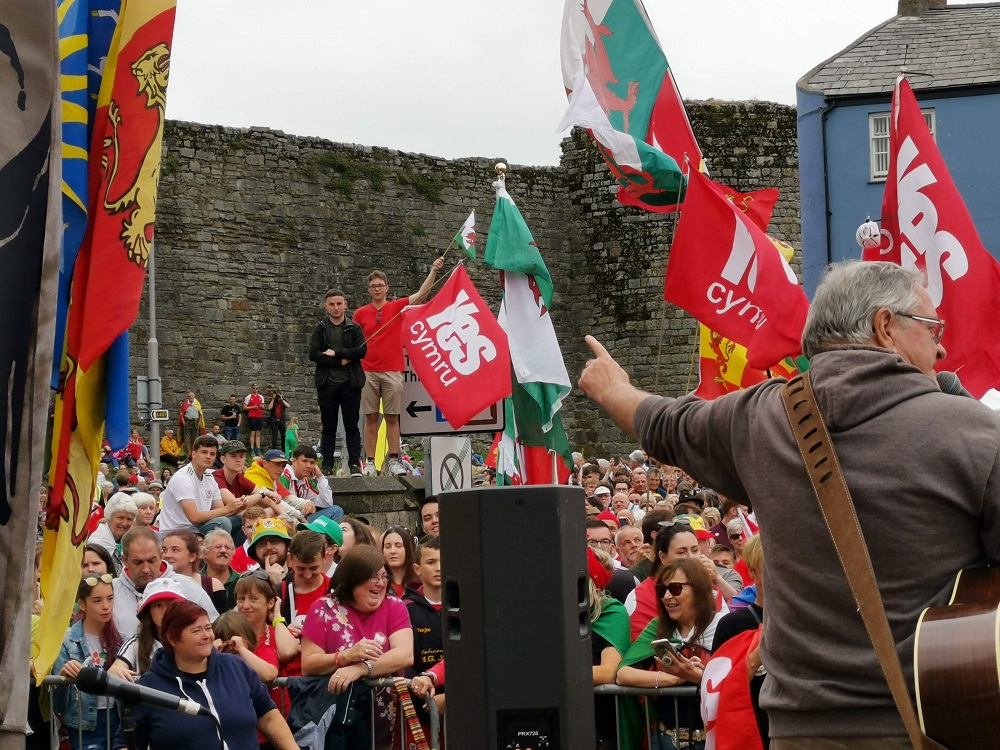
I consider myself a big fan of Dafydd Iwan. I’ve spoken English my entire life, but in my attempts to learn the Welsh language, I’ve found his music to be a great help, and I listen to his songs regularly. I know the lyrics and translations to most of them by heart, and when I stood on the Maes at the Caernarfon independence march, I sang along to Yma o Hyd with as much pride as everybody else.
Yet there is something telling in the fact that this song, above many others, should be considered something close to the anthem of the Welsh national movement. “Er gwaethaf pawb a phopeth, ry’n ni yma o hyd.” Indeed, “in spite of everyone and everything, we ARE still here.”
Yet, is that really saying much? We are still here, but in truth, barely. Few of us now speak the traditional language, work the traditional jobs, or adhere to the traditional religion, of Wales. Is it really such a good thing, that the mere ability to survive, to cling on by our fingernails to the tattered flag of identity, is our greatest source of pride?
In most countries, the songs of national pride will relay the great deeds of their patriots, retell the great stories of their past, and look to the great potential of their future. Yet to us, the central feature of our nationhood, the rallying cry of our people, is simply that we have not quite been fully extinguished. Not yet, anyway.
This extends further than the lyrics to one nationalist song. If we look to the national motto of France, we see the famous words “Liberté, égalité, fraternité,” or “Liberty, Equality, Fraternity.” It’s a powerful motto, a phrase that tries to encapsulate what it means to be French, that expounds in three simple words the values of their nation.
Compare that to our own dear “Cymru am byth!” “Wales Forever!” The message is exactly the same as “Yma o Hyd.” It doesn’t call upon us to grow or to thrive. It doesn’t tell us anything about who we are or what we believe. It doesn’t rally us to a particular cause. Rather, it once again succumbs to the idea that our greatest strength is our ability to stubbornly remain in place, like a stain that our enemies have long since given up on removing.
The national anthem is no better, building itself to the equally resigned “O, bydded i’r hen iaith barhau!” Not even asking us to fight for the language, but simply appealing to some unnamed high power that it might eb allowed to endure.
[mid-content-banner]
Ambition
This, I believe, is why seeing Yma o Hyd in the charts roused such a reaction from the Welsh nationalist community. In Wales, it seems, we can aspire to little more than endurance, subdued and vegitative, with our culture and economy on life-support.
The merest hint of recognition of our nation by something larger, in this case the British media, was enough to fulfil that deep-set desire for attention that sits at the centre of the Welsh national psyche; like a centenarian receiving a birthday card from a niece that never visits, we're proud only that someone else has remembered that we're not yet dead.
It is little wonder then, that our big dreams of independence is shared only by a minority of the Welsh public. When we can barely muster a hint of ambition beyond continued survival, how can we ever expect ordinary people to strive for something more? When the Welsh national movement is content simply to exist, how can it expect to grow?
I’m not going to stop listening to Yma o Hyd. It’s a great song, and it does say something profound about Wales, especially with the new fourth verse. Yet when I think of how to summon national pride, a pride beyond reminding my international friends that we are not merely an English region, a pride that instead looks to a future where we can grow and contribute as a full and responsible member of the global community, I’m probably not going to pick as the song that represents my feelings.
It’s time for the national movement to sing a new song, and they need to start doing it quickly, or we may well lose that last comfort of being “Still Here.”
Plaid is a Ifanc Activist, Dafydd Iwan Fan, English-language Monoglot, Student of History and Welsh History at Cardiff University.

Support our Nation today
For the price of a cup of coffee a month you can help us create an independent, not-for-profit, national news service for the people of Wales, by the people of Wales.
Get more trusted Welsh news
Choose Nation.Cymru as a preferred source in Google News to see more of our journalism.
