


Tue, 21st July Cardiff 21°
Nation.Cymru wordmark
Advertisement

Opinion

The Welsh Government must focus more on language attitudes
By Stephen Price
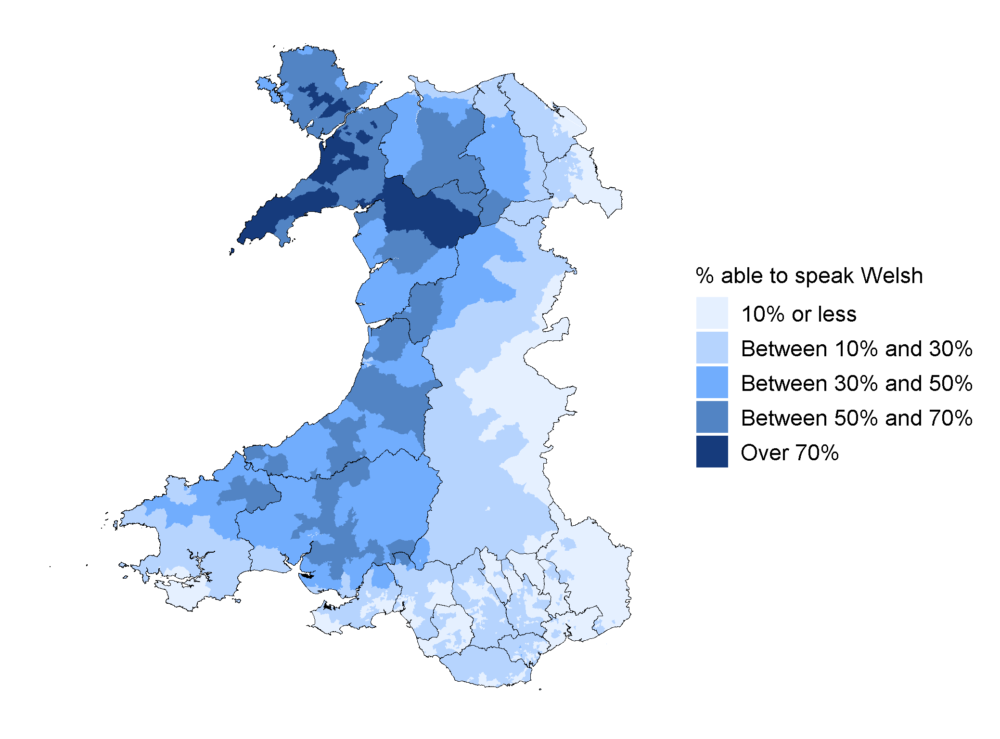
Census 2021 data map. Image: Welsh Government

Meilyr Jones, Language Attitudes Research Team, Bangor University

The Welsh Language Use Survey data shows low rates of language use among Welsh-speaking adults.

This is a particular area of concern in government policy, as the Cymraeg 2050 strategy aims to double the percentage of daily use of Welsh.

The reluctance to use Welsh illustrated here is also reflected in decreasing intergenerational family transmission, a domain that is possibly the single most important contributor to the survival of a language.

Research has highlighted that the government’s over-reliance on education as a language revitalisation tool, without initiatives addressing language use, especially in the family, could lead to a situation similar to the one facing Irish.

Importance of attitudes

Revitalizing a minority language must encompass shifting language attitudes.

While policy makers behind the current Welsh Government language strategy Cymraeg 2050 identify “normalising perception and use” as a key challenge to be addressed, the Cymraeg 2050 strategy does not discuss the need to improve attitudes per se.
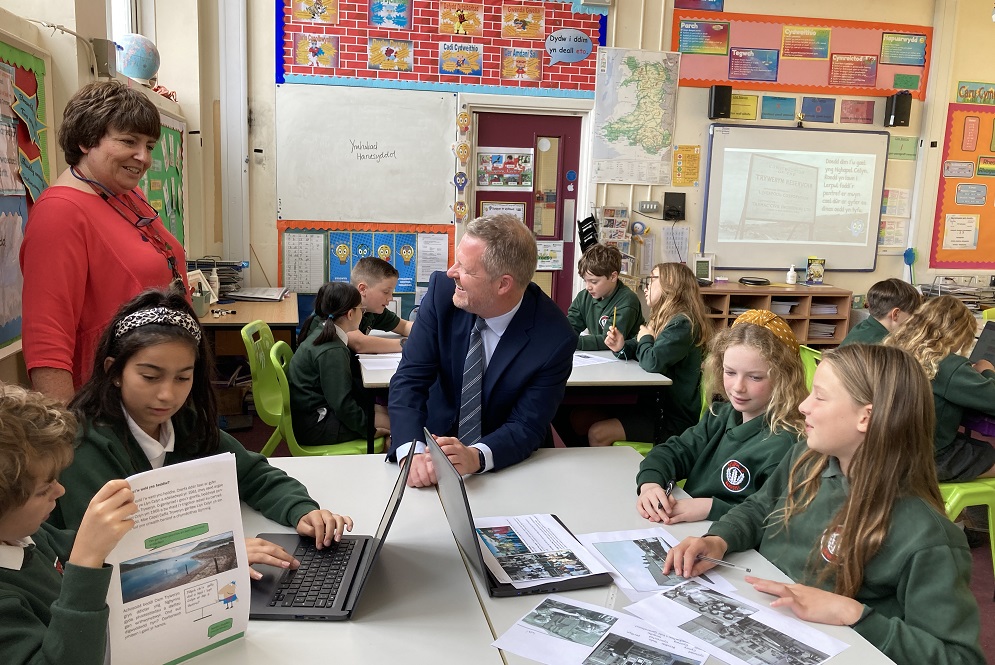
Minister for Education and Welsh Language, Jeremy Miles as he visited a Cardiff school to see children learning with the new Curriculum for Wales.

Nevertheless, attitudes play a central role in successful language maintenance, which is why we believe that more focus must be put on improving language attitudes in Wales.

In our research, we explored the relationship between explicit and implicit language attitudes and exposure towards Welsh in north-west Wales.

Comparing speaker background data from the Language and Social Background Questionnaire with results from the Attitudes towards Languages (AToL) Scale and an Implicit Association Task.

The Role of Early exposure

Our results show that speakers hold more favourable explicit attitudes towards Welsh than English.

Therefore, contrary to the current landscape of declining use and exposure towards Welsh in Wales, bilingual speakers’ explicit attitudes towards Welsh remain positive.

Speakers with higher exposure to Welsh at primary school age have more favourable attitudes towards Welsh than those with lower exposure who favour English.

These results show the importance of language exposure in fostering positive implicit attitudes towards Welsh.

Our results suggest that early exposure may do more than give children the necessary language skills required for use — a role which education, too, can successfully fulfil.

What early exposure may be providing above and beyond language skills is the modelling of Welsh language practice in a broad range of community contexts.

This tallies with research in other areas — such as physical activity and sleep patterns — where behaviour modelling has been found to play a fundamental role in influencing children’s behaviour.

Implications

The lack of modelling that some children experience is therefore particularly pertinent when considering the context of declining exposure to Welsh due to a decrease in social use and intergenerational family transmission.

Welsh in the workplace

Considering the Welsh Government’s current target to double the use of Welsh in areas such as the workplace and social situations, this suggests that arresting the decline of social use of Welsh and, in particular, intergenerational transmission within the family, is critical for improving implicit attitudes towards Welsh and should be considered a priority for Welsh Government language policy.

Doing this in areas such as north-west Wales that are currently undergoing language shift ought to be of utmost importance to policymakers.

If current patterns of decline continue, a decrease in exposure could lead to less favourable implicit attitudes towards Welsh, thus highlighting the importance of home and community exposure for the future vitality of Welsh.

Improving implicit attitudes towards Welsh is significant from a language revitalisation perspective as implicit attitudes seem to be better predictors of habitual behaviour than explicit attitudes, that is, how likely the speaker is to use the language.

Therefore, we suggest that implicit attitudes and their potential impact on use should receive more attention by Welsh researchers and policymakers alike.

Future work on language attitudes should include both direct and indirect methods, particularly in other areas of Wales where exposure towards Welsh is lower, and in the assessment of language vitality in general.

Find out more about Bangor University's Language Attitudes Research Team here.

For the price of a cup of coffee a month you can help us create an independent, not-for-profit, national news service for the people of Wales, by the people of Wales.

Get more trusted Welsh news

Choose Nation.Cymru as a preferred source in Google News to see more of our journalism.

Choose Nation.Cymru as a preferred source in Google News

19 comments

John Ellis

'The Welsh Language Use Survey data shows low rates of language use among Welsh-speaking adults.' Certainly this appears, anecdotally, to be considerably true around where we live, on the eastern side of y Dyffryn Clwyd. Quite a high proportion of people here are able to speak Welsh, but nevertheless English is very much the normal language of day-to-day discourse. But that seems, again anecdotally, to be rather less the case on the other side of the vale, where Welsh seems to be more routinely used - even though these places are less than ten miles from where we're living. We seem to be in something of a linguistic borderland.

Reply
Another Richard

It's hard to disagree with this, once one has worked out what it actually says. But what to do about it? I hope practical policy prescriptions will be forthcoming. Incidentally I've mentioned here before the lack of encouragement for using Welsh in everyday life, citing the absence of Welsh-language menus in cafés and restaurants. So I'm pleased to report I came across one last week, at Pantri Blakeman in Blue Street, Carmarthen - though I haven't had a chance to dine there yet.

Reply
pauline humphreys

Go there. A wholly Welsh experience. Food is lovely too.

Reply
Another Richard

Diolch! Will do!

Reply
Linda Jones

As an aside I would like to see more classes free of charge to learn the Welsh language. Maybe held in council hubs. None in Cardiff

Reply
Rhufawn Jones

The report states the obvious. Of course more language exposure increases the attitude towards the language. That's a no-brainer. It misses the elephant in the room though, or rather, refuses to deal with it, namely: that a language, particularly a minority (or minoritized!) language must have a geographical base. The Fro Gymraeg is hemorrhaging, and as a result, Welsh looses its status as the dominant community language, and intergenerational language transmission weakens. The reasons are numerous and complex, for example - idolization of tourism and under investment in other sectors such as social enterprises; house-building as an ideology (that all growth is good) whether they are needed or not, leading to a huge influx of non-Welsh speakers, the majority of whom refuse to integrate; lack of legislation in the housing sector; limited powers in the Welsh Language Measure that exempts businesses. These are issues too controversial for the Welsh Government to deal with so instead they focus on vague targets that sound positive like a million Welsh speakers without mentioning how they're going to achieve that. Losing territory and cynefin is an awful thing. Heidegger, for example, describes language as 'the house of being'. Depriving people of this 'home' can lead to trauma. It uproots them, makes them homeless and exiles. This is well documented among colonised people. But I don't expect the Welsh Government to understand, or even care, about that.

Reply
Robert Tyler

100% correct. Even now the language as a community language could be saved, just about. That, however, would require some considerable political will. Not a hope.

Reply
Riki

Exactly, the government are seeing out of peoples past and future for a quick buck. They are of-course doing it because they have one hand tied behind their back by Westminster. We are exactly where they like us! At the end of the table on our knees grovelling.

Reply
Benjamin

This is an issue over & over with Cymraeg. Endless talking. Welsh even has a verb for committee (pwyllgora). If you want to survive stop making committees for everything and get busy

Reply
Garycymru

Another glaring point is the open abuse that we can receive for speaking Welsh. I live in a border town, and I've been learning Welsh for 3 years. There have been numerous occasions this year alone where I've been conversing with someone only to hear "why don't they respect our culture and learn our language" or a favourite comment seems to be "it sounds like they're clearing their throats". Our local community page on Facebook recently had someone complaing that Aldi supermarkets do their tannoy announcements in Welsh first. Issues like this need stamping out, but I'm sceptical that any new committee formed will actually deal with the racial hatred we endure in our own country.

Reply
Jiru S

The Welsh flag features a beautiful red dragon. Red dragons are exclusive to Wales, and everybody knows that these dragons only speak Welsh, so if you wish to communicate with a dragon, you must speak to it in its own language. If I had known this when I was a child in the non-Welsh speaking part of Wales, I would have been desperate to learn and use Welsh - not for pragmatic purposes, not for transactions (which is what most current learning materials focus on), but because Welsh is magical, cool, special. Just as Japan has Manga, which draws in thousands of learners, so Wales has dragons. Not just dragons, of course, there's a whole mythology out there, and then there's Wales itself, with its breathtaking beauty. When the people of the dragon speak in the dragon's language, they become special. If you really want to change attitudes to using Welsh, make it cool!!

Reply
Garycymru

Quite correct! Unfortunately, there has been a "self loathing" bred into the Welsh that helps prevent some people, even using the Welsh they have. This will take time and effort to remove.

Reply
Riki

Couldn’t agree more - I don’t think I have ever come across another people whom seem to care more for the opinion of a foreign people than that of a future for theirs

Reply
Riki

Agree, we can’t though because the only time anything from Wales gets to leave this island. its only ever with the permission of English first and that’s even if it remains true to Wales. A lot of it gets anglicised to the point it being unrecognisable and past of as being English in origin.

Reply
Garycymru

When you find out how much wales contributes go recent Hollywood movies, but isn't allowed a mention in the credits it kind of hits home.

Reply
Padi Phillips

It strikes me that much of the problem is that many of us aren't proud of our language and our ability to speak it, and though we may have the legal right, in limited contexts, to receive services in Cymraeg, in practice this is often a very frustrating experience. There is also a kind of belief, and almost unconscious acceptance among a sizeable proportion of the population that Cymraeg is somehow less respectable than English. I'm not talking here of those of us educated and who have been activists at some point in our lives, but ordinary speakers of Cymraeg who just happen to speak it because they happened to be born in an area where it is spoken, to parent to whom it was their mother tongue. In other words, the very people who need to feel that they and their language are valued, and that it is something to be celebrated. It strikes me that our small country could learn something from both the LGBTQ+ community, and the Norwegians. Both celebrate who they are on a special day, and in the case of the LGBTQ+ community, part of the reason for that celebration is to counter decades, if not centuries of marginalisation. I'm sure there are some in the Labour Party who would have kittens at the thought of a Welsh Pride day, but why not? Why shouldn't we celebrate who we are, despite of everyone and everything? March 1st is a great day to celebrate our patron saint's day, but is it really inclusive? St David, is after all a Christian saint and though that tradition is important, we now have Welsh people with very different religious traditions. With that in mind, I suggest a completely secular celebration is needed, so why not celebrate Glyndwr Day as that special day? There is much else that needs to happen to 'normalise' Cymraeg among young people who don't come from an are or family where Cymraeg is a living community language, and the government needs to cough up some cash so that this can be done through popular culture that involves young people. It would help massively if the Senedd had control over broadcasting in Wales, as then specific programming could be made that breaks down the linguistic boundaries in youth culture - most Welsh speaking young people are already there, but what about those young people in anglicised Wales who quite possibly don't see Cymraeg as relevant to them, it's just a rather boring and irrelevant subject they have to do because it's on the curriculum. Programmes on TV that cover both linguisitic traditions could bridge that gap, and show young people in anglicised Wales that Cymraeg could have a relevance to them too.

Reply
Riki

And why pray tell would they do that? It’s all lip service, that’s all it’s ever been. They consistently blow their cover when they refuse to put in safeguards in regards to preserving native place names. and look how they side with companies who skirt the laws that were supposedly put in place to protect the language.

Reply
Riki

The other major contributing factor that no one dares address is how prevalent English is in our entertainment. What is the point of learning our language when the majority we then go on to consume is all in English! It defeats the point completely. The only way the trend reveres is if someone has the bottle to put their foot down and demand a cap on English language programming. And let’s be honest, that will never happen for fear of being called anti-English, in reality it shows nothing more than the efforts to recover the footing of OUR Language.

Reply
Simon

Welsh is one of thousands of languages across the world being put aside in daily businesses and day-to-day interactions between family members and in communities. This can be for reasons of inclusion, when others only speak or understand English. However, I think some of this might also come from the expectation that everyone is to speak English in business. Why is this? As a mine engineer and, given the nature of where commodities are located, many video calls and face-to-face meetings are conducted with people who do not have English as a first language. The decent and empathetic thing to do is at the least commence the meeting with some basic greetings in their preferred language. Why does this courtesy not extend to business conducted with Welsh firms or interactions with partners from Welsh companies? In most cases I believe its because international clients and business leaders are not aware that Wales has a language distinct from English. Perhaps this new Labour government in Westminster will work this the Senedd to put in place a more rigorous promotion of Cymru and Cymraeg with our international business partners.

Reply

Leave a reply

Replying to Garycymru Cancel

Quite correct! Unfortunately, there has been a "self loathing" bred into the Welsh that helps prevent some people, even using the Welsh they have. This will take time and effort to remove.

Comments are reviewed before they appear.