


Tue, 21st July Cardiff 27°
Nation.Cymru wordmark
Advertisement

Opinion

The English speaking Welshman
By Mark Mansfield
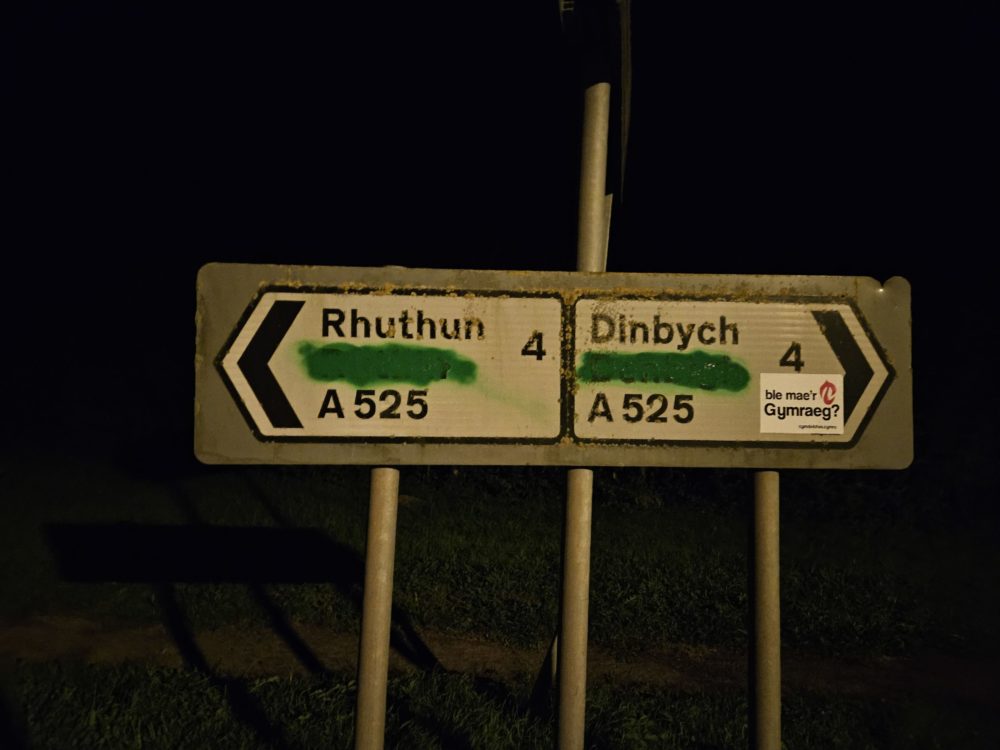
Signage targeted in Denbighshire. Image: Mudiad Eryr Wen

Lewis Norton

Recently, a youth Welsh independence group took it upon themselves to deface road signs in Denbighshire, covering the English versions of Welsh place names.

Their rebellious display against what they call “failed attempts at forced assimilation” divides opinion.

While met with applause from Welsh independence supporters online, it hits home for me as one of the various reasons why the Welsh independence argument is potentially doomed to fail.

Quite simply, the narrow focus on the Welsh language by many is what will continue to see many English speakers disenfranchised by calls for independence.

[mid-content-banner]

Lay of the Land

Whether it is liked or not, English is the language spoken by the overwhelming majority of Wales, with only 17.8% speaking Welsh. Especially in the areas of “British Wales”, English is spoken on a monolingual basis.

In Denbighshire, where the incident occurred, 22.5% of the population reported that they could speak Welsh in the 2021 Census.

This figure gets considerably lower in nearby areas such as Wrexham (12.2%) and Flintshire (11.6%), and even lower in places like Monmouthshire (8.7%) and Blaenau Gwent (6.2%).

Welsh speaking has declined in proportion across most of Wales, and remains heavily concentrated in the west of Wales, generally the further from the Anglo-Welsh border you are, the more likely you are to speak Welsh.
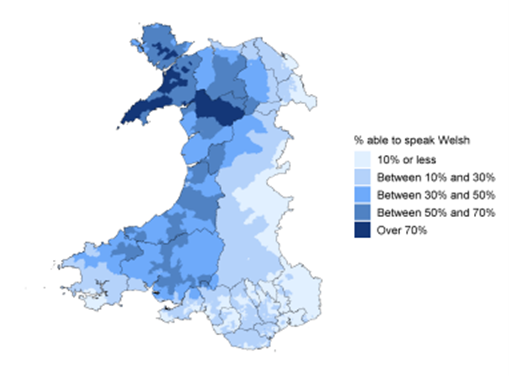
Percentage of People (3+) able to speak Welsh, by LSOA, in the 2021 Census Image Welsh Government.

Of course, it is not just the language that divides Wales geographically. More broadly those areas speaking less Welsh tend to be those who identify less as Welsh. In the 2021 census, many of the areas identifying the least as “Welsh only” were on or near the border, including Flintshire (34.7%), Monmouthshire (41.9%), Powys (42.0%), and Denbighshire (44.7%).

The debate here isn’t about the importance of the Welsh language, as a budding Welsh learner I am eager to see the language not only protected but expanded.

But all the more I am eager to not see others be disenfranchised from learning the language themselves, or feel less “Welsh” simply because they cannot speak the language.

How then, can the blockage of the primary language of the large majority not be seen as an attack?

Divisive Past

The incident got me thinking, and as I shared my core thoughts online that acts like these only serve to fuel the fires of Welsh being seen as a divisive tool, it struck me how many saw this as controversial.

While we are in a better place now, the perceived divisiveness of Welsh is not a myth made up by ‘colonists’, but is a very real reason why at times, Wales’ road to increased self-determination has faced setbacks.

Devolution faced these setbacks, particularly in 1979 when it was soundly defeated in a referendum, in part because many English speakers feared that a Welsh Assembly would be dominated by Welsh speakers who would seek to impose the language upon them.

These same issues have more broadly played their part in the evolution of Welsh nationalist thought, and specifically the thoughts of Plaid Cymru. The divisiveness of the Welsh language caused Plaid Cymru to change course in their intellectual upbringing.

Plaid Cymru evolved from a movement born to preserve the language, to a party which from 1968 has adopted the policy of bilingualism to combat their confined support in Y Fro Gymraeg, an issue that arguably still lingers.

Most striking in this process was Plaid’s disassociation from the Welsh Language Society around this time, for similar reasons as have been discussed in relation to the defacement, over fears of alienating the masses and creating hostility to the Welsh language.

Whether through big acts like this, or small ones such as their bilingual name “Plaid Cymru - The Party of Wales”, their development acts as a display of how the divisive potential of the Welsh language is real, and how Welsh nationalists need to continue to recognise this and adapt, if they want their dream of an independent Wales to be realised.

If we compare to our friends across the British Isles, Scotland enjoys the benefits of not having language and culture being the core of their independence movement.

The distinct elements of their history compared to ours, such as their separate institutions, has allowed them to focus more on statehood, an area less emotionally driven than that of one’s culture, language and religion.

An independence campaign fought on erasing the English language is a campaign doomed to failure.

Everyone's Wales

What does it mean to be Welsh? Is it from being born here? Or living here for a significant time? Having Welsh ancestry? Speaking the language? Would you go further by saying a real Welsh person
would only want an independent Wales?

Depending on your criteria, you may well consider me, and many like me in Wales, to not be Welsh.
I speak English, have significant English ancestry, and come from a significantly anglicised area of Wales.

But I have lived here all my life (except for University), I consider myself primarily Welsh and not British or English, and I am slowly learning the Welsh language, even if at present I’m not very good!

Perhaps most key, is I am not yet convinced by Welsh independence. English speaking and not pro-independence; should I hand in my Welsh identity at the door?

But like many of you, I will cheer against anyone playing England at football. Isn’t that what being Welsh is all about?

Divisive arguments around issues of the Welsh language, whether that be road signs, or recognising Cymru as the only name for the country, are counter-intuitive and undermine the cause of Welsh independence.

Using my surroundings as an example, people here still call Conwy “Conway”, they still call Bannau Brycheiniog the “Brecon Beacons”, and Eryri National Park is still called Snowdonia National Park.

Telling the English-speaking Welshman what he must call places, and what language he is to read on a road sign, and making that a dividing line in Welsh identity, is a strategy that ought to be abandoned by anyone serious about a self-governing Wales.

Lewis is a recent BA Politics graduate from the University of York and incoming Welsh Government and Politics MA student at Cardiff University

For the price of a cup of coffee a month you can help us create an independent, not-for-profit, national news service for the people of Wales, by the people of Wales.

Get more trusted Welsh news

Choose Nation.Cymru as a preferred source in Google News to see more of our journalism.

Choose Nation.Cymru as a preferred source in Google News

74 comments

S Duggan

Yes, scrubbing off the English names from signs isn't going to work. If they want more Welsh spoken and less English it's a long term process and it begins by getting people who speak little or no Welsh, near the border - keen to learn the language. Help them to speak it and keep the language alive not deface signage.

Reply
Annibendod

I think you're right there. A huge amount of goodwill exists towards Cymraeg in Wales. It's far better to ramp up efforts to help people learn.

Reply
Cwm Rhondda

The Welsh independence movement is solely about Welsh independence. The Welsh independence movement isn't about promoting the Welsh Language, it's about gaining Welsh independence. The movement to promote the Welsh Language is Cymdeithas yr Laith. I support Welsh independence because I want to see Cymru flourish and become the country we all know it can be (and I'm sick and tired of watching successive British government ruin our public services and communities).

Reply
Stevie B

Being Welsh has got nothing to do with speaking the language, if you are born in Wales you are Welsh. The 'I'm a first language Welsh speaker' individuals who try and say they are more Welsh than monoglot Welsh born, English speakers are a divisive minority. They are more than happy to cheer a goal or try scored for Wales by a monoglot English speaker!

Reply
Annibendod

It's also a worn out old stereotype.

Reply
CapM

The article seems to be a collection of arguments gathered together to justify an opinion already held. As opposed to an analysis of arguments from all sides in order to arrive at an opinion. As an example "More broadly those areas speaking less Welsh tend to be those who identify less as Welsh. " The populations that identify as Welsh only to the greatest degree are in the South Wales valleys Merthyr 70+%, Rhondda Cynon Taff and Caerffili 69+% These are areas with low %s of Welsh speakers. https://stateofwales.com/2023/03/census-2021-wales-identity/#:~:text=Merthyr%20Tydfil%20(70.1%25%20Welsh%2D,(69.2%25%20Welsh%20only). Why more people don't learn to speak Cymraeg is a complicated and many faceted issue however if a pill were available that enabled someone taking it to become fluent in an additional language instantly the vast majority of Cymry would chose Cymraeg. .

Reply
Mawkernewek

The problem I have with the article is it dances close to or even tacitly embraces old myths about the Welsh language being 'divisive'.

Reply
CapM

Yes. But at least it didn't include the- I walked into a pub and they switched to speaking Welsh!

Reply

In reply to CapM

John Ellis

This thread evokes all sorts of memories for me! Your comment reminds me of my very earliest days living in Wales, as an undergraduate student who hailed from Manchester and was then newly at university in Ceredigion. I was talking to my mother's oldest friend from their schooldays when she suddenly asked me, 'John, what do you think of the Welsh?' The backcloth to the question was that, having prospered mightily, she and her husband had bought themselves a holiday home in north Ceredigion. Since individual people vary so enormously, I always find that sort of question perplexing, but, searching around, I ventured the opinion that, at least in comparison with most Manchester folk, Id found 'Cardis' to be rather reticent and unusually polite and courteous. My mother's old friend had a very different view: 'Joe and I think that they're very rude', she retorted. That was so far in contradiction with my own impression that I asked 'What on earth's made you think that?' 'Well', said she, 'whenever we go into the village shop, they start talking Welsh, and It's so very rude! It's obvious that they just want to shut you out'. I suggested the bleeding obvious to her: that the people in the shop would have also been speaking Welsh BEFORE she and her husband came through the door. But the notion that there are people in the UK - at least in certain parts of it - who might not customarily speak English in normal discourse appeared to be totally beyond her grasp. That sort of mindset baffled me back then, and it baffles me no less now.

Reply
Padi Phillips

I think you need to go away and read a few books written more recently than the mid 19th century. I think you'll find that racial theories have progressed a little.

Reply
Mawkernewek

I'd love to know where you got the idea that 1st born sons were intrinsically better people? Does it also work for daughters as well?

Reply
Rhian Davies

Hi, well why don't you explain - you've given me the charge, but not explained what I've done wrong? What's so wrong with my analysis here please? This is not a racial theory, it's lived experience!

Reply
Linda Jones

I would suggest some English only speaking Welsh people fear being treated as second class citizens in an independent Welsh speaking Wales. So yes I would agree the language issue is divisive and detracts from the real purpose of independence ie the building of a prosperous, independent Wales. I support the Welsh language (even though I don't speak it) but I do not support it being weaponised.

Reply
CapM

The people who "weaponise" the Welsh language are invariably those who are unsympathetic to say the least to Cymraeg. They are the ones that mobilise whether it's road signs, bilingual leaflets, Welsh medium schools, S4C, or anything else where they think Cymraeg should be excluded from. The Welsh language bogeyman is invariably wheeled out by those who are against independence and devolution or are fundamentalist Labourites from at least since the Kinnock's in the 70s. .

Reply
Padi Phillips

Seriously, even in a country with a semi-democratic system it would be impossible for a minority to dominate a majority, and it's not the English speakers who are treated as second class citizens, as any speaker of Cymraeg who had tried to access services in that language will attest. However, the great thing about languages is that they can be learned by pretty much anyone who wishes to learn. It's not even that hard, though it does require application, determination and patience. The building of a prosperous independent and Welsh speaking Wales are not mutually exclusive and I can't envisage it ever being the case that Welsh would be enforced, or required for every job, though as time goes on and the need to provide a truly equal level of service to both linguistic communities skills in Cymraeg will become increasingly valuable, and for an increasing number of jobs, essential.

Reply
Linda Jones

I agree. Speaking English became a requirement to secure a job in Wales back in the day but in the future the same could happen in reverse. It is already the case with many employers including the BBC, speaking Welsh is a requirement. Many English only speaking Welsh people fear this becoming widespread. Also learning Welsh for adults isn't that easy, for many the cost is prohibitive. Maybe the Senedd could put their money where their mouth is and fund free adult courses in Welsh.

Reply

In reply to Linda Jones

Padi Phillips

I think it's a bit of a myth that being able to speak Welsh is a requirement to work for the BBC though I'm sure there are specific roles where it's an essential requirement. It's also probably listed as a desirable skill, which isn't that uncommon - most local authority vacancies list being Welsh speaking as a desirable quality, just as there are some local authority vacancies where Welsh is a mandatory skill. Some people complain about this, but the requirements of jobs demand that those who hold them be Welsh speaking as the postholder will be dealing with Welsh speakers. Someone who doesn't speak Welsh simply wouldn't be able to do the job. I'm always torn by demands for free Welsh lessons, as I am for anything free. I certainly think classes should be affordable, and that realistic concessions should be available for those who cannot afford the full cost, but I'm open persuasion. There is also the budgetary consideration, and short of Starmer & Reeves doing the right thing and taxing the obscenely rich, public finances are likely to shrink, not grow so that funding is available for such a free scheme. I do agree about the Welsh Government's lackadaisical approach to Cymraeg. More provision could be provided in the workplace, though those schemes often fall short when it comes to support outside of the class. Context is everything when learning a language, and by far the most effective method is learning by doing, which is both challenging and rewarding in equal measure, but ultimately wholly worthwhile. Some employers where the language of internal administration obviously require staff who speak Welsh, and many of those are up against skills needs that don't always match up. The former Cantref housing association (now 'merged' with Wales & West) operated internally in Welsh, but had a very progressive approach to staff recruitment. Applicants for jobs with specific technical skills could apply so long as they agreed that if successful they would learn Welsh to an agreed standard within a period of time, and those with some ability to speak Welsh were encouraged to apply for jobs, as the organisation provided opportunities to improve fluency. All in all a very progressive policy, which I suspect is no longer the case under Wales & West.

Reply

In reply to Padi Phillips

Rhosddu

Anyone in Wales can do the learnwelsh.cym course for £50 a year if they book before the end of July, or £100 a year if they miss that deadline. It's very professional and caters to all levels of previous competence or lack of it. Employers in the public sector pay the fee and give their staff mornings or afternoons off to attend the weekly course. It's funded by the Welsh Government,.

Reply

In reply to Rhosddu

Padi Phillips

Sounds good. It would be even better if it was also offered as a funded training option through JobcentrePlus as being Welsh speaking is a plus in many, if not most jobs in Wales.

Reply

In reply to Linda Jones

Erisian

I'm paying £50 for 105 hours of Welsh Language tuition. (3 hours a week over 35 weeks. This includes a 50% early booking discount.) The printed version of the course book is £10 - but a free PDF also available. 48p an hour is about as close to free as you can get.

Reply
Dewi

No Welshman is more or less a Welshman for language only. Nobody suggests this and the author (and some commentators above) are being disingenuous. However, being Welsh depends upon the existence of the Welsh language. If you speak it or not, you need it to exist and flourish. We all own it. You can neither be a Welsh speaking Welshman nor a non-Welsh speaking Welshman if the language is gone. We all need the language to exist or we'll become a Cumbria.

Reply
Dai

Well put. A distinctive English language Welsh identityis predicated upon the existence of the Welsh language. Wales doesn't make sense without it - if it goes you may as well divide the country up and amalgamate with neighbouring English regions.

Reply
Crwtyn Cemais

Yn union! ~ Quite!

Reply
Crwtyn Cemais

Neu 'West Anglia'....~ Or 'West Anglia'...

Reply
Crwtyn Cemais

Dewi, mae eich llygad yn ei le... ~ Dewi, you are spot-on...

Reply
Annibendod

I'm sorry Lewis, this is an argument that's as old as houses. I've heard this in various guises since before you were born. My grandfather grew up in the Rhondda in in the 1930's. His parents were 1st language Welsh speakers from Cardigan. They were told not to speak Welsh to their kids because the way modernise was to be a monoglot English speaker. I know, seems insane now doesn't it. He spent years trying to learn his mother tongue. Going back a little further and David Lloyd George was pursuing the Cymru Fydd home rule campaign and it was declared that the English speaking people of Glamorgan would not tolerate being ruled by Welsh speakers. This is an old, confected narrative that has been used again and again to divide us. In fact, it is in dire need of being debunked. The fact is it has been passed on and passed on so much that it has become the bogey man that you have perceived as a concern. It has somehow turned into some perverse "received wisdom" in far too many parts of Wales. I remember being referred to as "one of the Welsh kids" growing up in 1980's Pencoed. I've been lectured on it by friends' parents. More recently we had the not very much missed late anti-Welsh bigot and his conspiracy theory website, Jaques Protic (anyone remember that?), spewing his bile about the crach all over the internet. I'm sorry, I don't mean to be disrespectful but the narrative is pure bovine manure. Yes, Plaid was born out of the movement to fight for the language and language rights were at the heart of it. I'm proud of that history. Without those people who fought for our language, this child of English monoglots would not have received a Welsh Medium education. Rather than reinforce a culturally chauvinist narrative what should happen is that it should be thoroughly debunked as the utter tripe it is. On a happier note, in 2018 a very large survey was run on the Welsh language in Wales. The sample size was more than 11,000 people. Of those who did not speak Welsh, 82% thought more should be done to preserve the language. 64% said they wished that they could speak it. Now that is far closer to the truth than a 150 year old scare story. The fact that the Welsh Govt's woeful record on the language since then gets so little attention is shocking.

Reply
John Ellis

You remind me of something which I read only a few years back: of a now elderly bloke who lamented his lack of Welsh, which he attributed to the fact that his parents, first-language Welsh speakers, had been tenants on a large rural estate. Their landlord employed an English agent, part of whose job was to go from house to house collecting the rent from the estate's tenants. The agent so regularly derided the elderly bloke's mother for being an ignorant peasant who couldn't speak the king's English properly that when he was born she persuaded her husband that they should bring him up speaking nothing but English so that he wouldn't be subject to that same stigma.

Reply
Annibendod

This is pure guff. Are you a fifth columnist?

Reply
John Ellis

'Quite simply, the narrow focus on the Welsh language by many is what will continue to see many English speakers disenfranchised by calls for independence.' I'm not sure that the issue is quite as stark as this writer suggests i8n the course of presenting his case here; but I do believe that a return to obliterating English on road signage - especially now that both languages are utilized on signage - is likely to prompt non-Welsh speakers living in Wales towards the conclusion that the movement to secure greater autonomy for Wales is the exclusive preserve of those who are most zealous to advance the knowledge and use of the Welsh language. Which isn't the case, because the two really and truly aren't one and the same.

Reply
CapM

Any "narrow focus on the Welsh language" is in reality by the few rather than by the many. I don't think stunts like painting road signs make much difference to whether non-Welsh speakers feel disenfranchised regarding independence or not or to what degree. If a non-Welsh speaker is contemplating supporting Cymru becoming independent they will already have a sense of Cymru being a different country to Great Britain and will know that Cymraeg is a very significant part of that difference.

Reply
John Ellis

I wouldn't really disagree with any of that. I'm just speculating that insofar as there may be a 'silent majority' - or even maybe a significant silent minority! - of monoglot English speakers for whom greater autonomy for Wales isn't perhaps a major issue, but who also aren't wholly opposed to the notion, any sense that this is primarily a movement for Welsh speakers may not be helpful for the cause.

Reply

In reply to John Ellis

CapM

The insistence that independence is "primarily a movement for Welsh speakers" is in reality practically entirely pushed by those who actively do not want Cymru to be independent in any shape or form. When it's made, that deceit and those making it should have their agenda exposed..

Reply

In reply to CapM

John Ellis

'...  is in reality practically entirely pushed by those who actively do not want Cymru to be independent in any shape or form.' I think that you're right! So it strikes me as prudent to avoid - when it can be avoided! - 'feeding the beast'.

Reply

In reply to John Ellis

CapM

You'll need to explain to me your logic for how avoiding exposing deceit and those that employ it is the better option.

Reply

In reply to CapM

John Ellis

Simply by identifying what appear to be achievable goals in small, incremental steps, and patiently pursuing those. Having achieved one - and the encouraging reality is that several have already been achieved - it's then possible to move on to focus on the next one. Prejudice in certain quarters of Anglophone Wales against 'Welshies' and 'nashies' may be bigoted and ignorant, but it still exists. In my experience at least it's pretty small-scale and latent at present, but there's no point in risking inflaming it unnecessarily.. And it has the potential to be inflamed. I remember the story of the first ysgol gynradd in Cardiff to be established. It was, I believe, in Ely, when the buses bringing the pupils in on the first day were stoned by locals. I heard recently that a very young Eluned Morgan was a pupil there back then, though maybe she lived so close that she didn't need to use the school bus. I think that it'd be unwise to assume that those days have passed beyond any possibility of recall. In my constituency in the north-east the Reform UK candidate at the recent Westminster election polled roughly twice the number of votes that the Plaid candidate received. We need to read the runes and take heed of what they suggest.

Reply

In reply to John Ellis

CapM

Basically your logic for the better option is Such people can be nasty and if we try and stop them spreading deceit they will get physically nasty . Therefore it's better to not confront them and let them carry on with their aim of convincing more people with deceit. It looks like the logic that would certainly get the approval of potential throwers of stones at school buses.

Reply

In reply to CapM

John Ellis

My 'logic' is based on the principle that politics is always 'the art of the possible' and additionally on the notion that, like it or not, there are what I at least reckon to be witless and venal views around, which are (a) more widespread than I would wish and (b) can fairly readily be inflamed in circumstances which lend to their inflammation. As indeed we saw when Cameron, focused on assuaging the English nativist faction of the Tory party, called a referendum on Britain's EU membership which he was convinced would lead to a 'remain' vote. But it didn't; it just triggered the even more vituperative outbreak of nostalgic nativist 'John Bull' nationalism which dominated UK politics during the succeeding years. It's one thing to hold people of this sort in contempt, but quite another to permit the contempt to influence your tactics to such an extent that you don't take these forces, and the clout which they've proved that they can have, seriously. Like it or not, you need a strategy that takes their clout seriously and prompts you to shape your tactics in the light of it.

Reply

In reply to John Ellis

CapM

From my - liars should be called out - you've employed a non sequitur and arrived at - "It’s one thing to hold people of this sort in contempt, but quite another to permit the contempt to influence your tactics to such an extent that...." Then doubled down on your "logic" - Don't upset the liars or they'll turn nasty. Isn't the softly softly "logic" just a euphemism for timidity, appeasement and going quietly into the night.

Reply

In reply to CapM

John Ellis

I'd argue that you're over-thinking this. You and I are in agreement that we'd prefer that there weren't people of this particular mindset lurking around in Wales. But the reality is that there are. It isn't even beyond the bounds of possibility that, come the next Senedd election and given the current rather dismal state of the Conservative party both in Wales and beyond, that Reform UK will improve its position at the expense of the Tories, making, in certain areas, more significant gains in support than Plaid manages. Failure to take that possibility into account in terms of political strategy and tactics strikes me as, to put it gently, imprudent.

Reply

In reply to John Ellis

CapM

Familiar with?! https://workcompass.com/the-cia-guide-from-1944-on-how-to-sabotage-and-slow-down-an-organisation/ Make speeches. Talk as frequently as possible and at great length. Illustrate your points by long anecdotes and accounts of personal experiences.Refer back to a matter decided upon at the last meeting and attempt to reopen the question of its advisability. or perhaps an ex-teacher.

Reply

In reply to CapM

John Ellis

I think that you might be dipping your toe into conspiracy theory there; I don't come at this with any particular conjured and contrived agenda of the sort that your link article envisages! Just with nearly seventy years - I started young! - of watching the political scene, and of observing how trends in public opinion tend to shift and move. Sharpened by quite a few years - during my years back in England - of actually being politically active at the local level. Ultimately disillusioning, but that would take me off topic. An instance of the sort of factor that I have in mind was Cameron's decision to promise a referendum on the UK's EU membership. He had no wish whatever to see the UK quit the EU, and his judgement was that the electorate wouldn't vote for that. But, like Wilson in 1975, he thought a referendum would resolve internal party issues, and he had the additional challenge of Farageism on the hard right to factor in. But it all went wrong because he'd misjudged the psychology and the instincts of rather a lot of voters, and we ended up with the apparently irremediable tragi-farce of Brexit. My point is simply that it's unwise to assume that the electorate will react or behave as you assume - or, maybe, that you'd rather like to think - that they will. Or, for that matter, that they won't be swayed by political arguments that strike you yourself as incredible and therefore unlikely to gain popular traction. Because they might. And the degree of support in Wales for Reform UK in last month's Westminster election gives some plausibility to that possibility.

Reply

In reply to John Ellis

CapM

Make speeches. Talk as frequently as possible and at great length. Illustrate your points by long anecdotes and accounts of personal experiences. from The CIA guide on how to sabotage and slow down an organisation If you haven't read the guide then you're a natural!

Reply

In reply to CapM

John Ellis

Now you're just repeating previous posts.

Reply

In reply to John Ellis

Padi Phillips

The 'possible' is always what people make it. If humans put something in place, then humans can dismantle and change things.

Reply

In reply to Padi Phillips

John Ellis

That's true enough, as far as it goes. But you need first to assess the strength and the extent of your opposition, and then shape your strategy accordingly. Which calls to mid, from my former more pious days, the maxim from St Luke's gospel: '“... suppose a king is about to go to war against another king. Won’t he first sit down and consider whether he is able with ten thousand men to oppose the one coming against him with twenty thousand? If he is not able, he will send a delegation while the other is still a long way off and will ask for terms of peace.' I certainly wouldn't go so far as to advocate sending a delegation to Reform UK to ask for terms of peace; but I do think that it's well worth taking into account what strength they might be able to muster in Wales in the right circumstances. I think that it might be greater than some folk assume.

Reply

In reply to John Ellis

CapM

I don't think you're CIA. Even they have a sense of self awareness!

Reply

In reply to CapM

John Ellis

Have you always been like this, or is it a disposition which has gradually flowered over time?!

Reply

In reply to John Ellis

Padi Phillips

People in Ely have been known to stone buses for other reasons... If anything, the approach to the Welsh language is either indifferent or very positive. I think that unduly worrying about what others, especially the English think has held us back as Welsh people for far too long. In these situations, it's always best I think, to assume that those who are indifferent are always, potentially at least, hostile. The very stance of indifference is hostile when it comes to the Welsh language and things like independence. I'm not saying go out and deliberately antagonise people who are indifferent, but ignore them, and don't worry too much over what they might think. That kind of attitude was the reaction of many 'respectable' Welsh people to the publishing of the Blue Books, and look what mess that got us into rather than a much more robust response involving a backbone.

Reply

In reply to Padi Phillips

John Ellis

I think we're well past the point by now when there's any serious antipathy towards Welsh-medium education. Tactful perseverance is actually what I'm advocating. Nor am I unduly bothered about what 'the English' think. I'm more concerned about the views of the Anglophone Welsh, who after all comprise, by quite some measure, the majority of our population. I think that, though you might perhaps be a tad over-pessimistic, there might indeed be something in your suggestion that 'those who are indifferent are always, potentially at least, hostile.' That hazard is precisely what I have in mind.

Reply

In reply to John Ellis

Padi Phillips

I was thinking more of those who have migrated here to Wales. Among the anglicised Welsh support for the language remains at the 80% mark that has been sustained for decades. The antipathy comes from among the remaining 20% and most of those probably don't care one way or another. The vocal minority can be safely ignored as they soon reveal themselves to be barking mad, offering no rational basis for their hatred of Cymraeg. Anyone who supports their position can also be safely ignored.

Reply

In reply to Padi Phillips

John Ellis

'I was thinking more of those who have migrated here to Wales.' You do have a point and in my own experience. Way back in my student days when first living in Wales, I recall a fellow undergraduate - a Geordie whose surname, ironically, was 'Wales' - who made a point of ripping up every Welsh language periodical in the student common room and binning them. When I aught him at it one day queried his frenzied antipathy, he was entirely unable to offer a rational explanation for it. But while I've found similar - if less pugnaciously expressed! - attitudes among English people who own second homes or who habitually holiday here, I don't remember experiencing them among English folk who've permanently moved into Wales. Incomprehension, yes, for sure: 'we all speak English, so why do they get so het up about all this'; and even more often a total uncomprehending but ostensibly tolerant indifference. Whereas I've fairly often encountered monoglot English speakers in the more wholly English-speaking areas of eastern Wales who express visceral opposition to a focus on supporting the Welsh language - even to the eccentric extent of opposing devolution because they suspect it as a devious plot to 'impose' the Welsh language on everyone else. That's not at all to try to dismiss your experience - we all take as we find. But mine, over the years, seems to have been different.

Reply
Bethan

Rascals.

Reply
Johnny Gamble

Why? Nobody in India objected to Bombay reverting to Mumbai, Calcutta to Kolkata and Madras to Chennai.

Reply
Huw Webber

I suggest the author looks up and studies decolonization as a graduate topic. Of course, the languagr issue no longer divides the cross party nationalist movement in the same way that it used to.

Reply
TJ Palmer

I was born in Llanbadog formally known as Llanbadock originally known as Llanbadog. If you drove through at 30mph you would not be able to read all that before the sign had passed and the road-sign would be bigger than the village itself. We really only need put the one proper name on signs and undoing some of the medieval tampering isn’t a threat to you. Your argument about majority versus minority language use should be tempered by the fact that Chinese is the planets majority language which is far more difficult to learn than Cymraeg. Despite the consensus you will find that there are plenty of us bi-lingual people in Gwent who mainly use English as a courtesy.

Reply
John Ellis

I agree with you in the context of the particular example which you cite. There's neither sense nor reason in preserving alternative names when the difference is merely that of a mangled and idiosyncratic Anglicized spelling and an accurate Welsh one. In part, that has already come to pass: we no longer see 'Llanelly' and 'Dolgelley'. I see no reason why the same shouldn't happen in your part of the world as well in respect of Llanvapley, Llanvaches, Llanvetherine and even Llanveynoe - as well as the daft equivalence of Rhuthun/Ruthin just a few miles from where I now live. But when the traditional English and Welsh names of towns and villages are wholly or largely distinct and different in origin - as, say, in the case of Abertawe/Swansea, Porthaethwy/ Menai Bridge, Caergybi/Holyhead and Y Bontfaen/Cowbridge, I think a case can then be made for retaining both. Not least because people will continue to use their preferred version, come what may.

Reply
Ann

I agree. We were out on Penrhyn Gŵyr on Saturday and it really struck me how silly some of the signs were! Rhosili or Rhossilly (with an i on the end on some), Port or Porth Einon or Port Eynon, Oxwich is just Oxwich as it has only ever had an English name!

Reply

In reply to Ann

John Ellis

Are signs for 'Rhossilly' really still in place? I lived for four years in Brynmill (another odd Welsh/English conglomerate name!) fifty years ago, and new road signs for 'Rhosili' were even then being erected. I thought that particular linguistic oddity would have been history by now.

Reply
Another Richard

There's Llanbadog/Llanbadock then there's Swansea/Abertawe or Fishguard/Abergwaun. As John Ellis says, there's a place for both. Chinese is not the world's majority language, as only 16% of the world's people speak it, and it is not a single language but a collection of dialects, some mutually incomprehensible. About 900m - 1 in 9 people globally - speak Mandarin. It is irrevelant to discussion about Wales. Wales could learn a lot from Finland about giving two national languages parity of esteem, and recognising that both are essential to the nation's sense of itself.

Reply
TJ Palmer

https://en.m.wikipedia.org/wiki/Mandarin_Chinese The variations are all known as Mandarin Chinese and the simplified version used by foreigners for business is the less common Standard Chinese. My point is valid, as if it follows that if Cymraeg should give way to English then every other language should be replaced by Chinese (in any variety) due to numbers therefore the OPs argument doesn't work. In most counties there are places that have English or Cymraeg names that don't translate or that locals have rejected the now garbled spelling (Varteg people rejected Farteg!) and no one knows the original. Let the people who live there pick one and be done. Pontypool is slowly becoming Pont-Y-Pŵl though and no one minds but internet forms all dictate that it’s still Pontypool and so it may take a while. Likewise we still have many generations of people that never learned Cymraeg so English is jolly useful to know, of course the two languages will be around for a long time. Parity may be a long way off.

Reply
Padi Phillips

Finland does not give both Swedish and Finnish parity of esteem over the whole country. Less than 10% of Finland's population are Swedish speaking, and in the area where Swedish predominates, only Swedish will appear on signage. In areas where there is a mixed Swedish/Finnish population, signage is bilingual. It is only in Helsinki/Helsingfors where you will find bilingualism of the kind you refer to, as it fitting to a capital where there is more than one official language. The Aland Islands, constitutionally part of Finland are Swedish speaking, but the islands are autonomous in a way that Wales can only be envious of.

Reply
CapM

"Wales could learn a lot from Finland about giving two national languages parity of esteem, and recognising that both are essential to the nation’s sense of itself." I don't doubt there's a lot that Cymru could learn from Suomi. Not least it's establishing its independence from two empires, Swedish and Russian. Also for being a republic and having no need of a monarchy. I think you're wrong with the suggestion that there is "parity of esteem" which would be something intangible. However both Finnish and the very much minority language Swedish are official languages of Suomi as are English and Cymraeg in Cymru. Regarding national languages, learning from Suomi is more applicable to the UK which would mean the UK government designating English and Cymraeg (and others) as official languages of the UK. "Parity of esteem" would of course still be intangible but likely less intangible to the east of Clawdd Offa.

Reply
Steffan ap Huw

I have to assume you're trolling. The ignorance on display here is almost beyond comprehension!

Reply
GaryCymru

This article does strike a chord with me, as currently, I'm somewhere inbetween where the writer mentions. On one side I'm entering year 3 of Welsh, with a class with more English colleagues taking part, than Welsh. On the other side, I live in a border town, where I have been openly mocked and abused for speaking Welsh by English people. Using language to alienate will end in tears.

Reply
Annibendod

You are quite right Gary. As others mention above, weaponising the language is divisive. From my perspective as a fluent but school taught 2nd language speaker who grew up in a small anglicised Glamorgan town, is that it was those who were anti-Cymraeg who successfully weaponised it and passed on their prejudice to such an extent it became a perverse "received wisdom". It worked to derail the Cymru Fydd movement. Can you imagine where we would be now had that succeeded instead of failing on account of confected fears and stirred up cultural chauvinism. Another problem with this is the concurrent argument that the Welsh Government wastes millions on Cymraeg. Usually the complainants are bigots regurgitating nonsense. I however, do agree that the Welsh Government are wasting money insofar as their efforts are not leading to increased community use and I believe that this generation are whitnessing the final days of Welsh speaking majority communities and the Latinization of Cymraeg - dead in communities, used only in schools and academic institutions. Radical support measures are needed if we want to turn this around but year after year all we get are fine words and token gestures. Money spent on managed decline. Par for the course with the present incumbents sadly.

Reply
Another Richard

You are right. There is nothing to celebrate in a million people learning to say "bore da" if the language is dying in the community.

Reply
Padi Phillips

If Cymraeg is to endure as a community language, something radical will indeed need to happen. I personally think the 'Million Welsh speaker by 2050' nonsense needs to be debunked for what it is, and new legislation brought in that repeals the current ineffective legislation and a simple piece of legislation enacted in their place. We need legislation that simply states that in Wales, everything possible should be bilingual, and that means from the greeting you get from call handler in a utility call centre to the label on the tin of baked beans in a supermarket are bilingual. Added to this, radical plans to change the language of internal administration from English to Cymraeg would change the fortunes of the language massively, and form the basis of a renaissance of Cymraeg as a living everyday language. We could choose to go the way of Irish, or Latin, but I personally would prefer it emulated the way of Hebrew has become a national language. To achieve some of that will take time, resources and something of a plan. The resources exist, and the time is of course now, but the plan, and a will to implement it seem to be lacking.

Reply
Crwtyn Cemais

Dim ond 3 gwlad? Peidiwn ag anghofio Cernyw...mae hyd yn oed y Wladwriaeth Brydeinig wedi cydnabod yn ddiweddar pobl Cernyw fel cenedl lleiafrifol. ~ Only 3 countries? Let us not forget Cornwall...even the British State has recently recognised the Cornish people as a national minority.

Reply
David

As stated some of the arguments in this article are based on shaky logic. However, the point about Scotlands push towards independence being based on State institutions is valid. One of the most important things we can do to increase the likelihood of independence is to further develop separate institutions in the public and third sector

Reply
J Jones

Wales Online ran this argument for the Welsh Not supporters after the Eisteddfod, with the expected response. What struck me most was the shocking standard of English by those who, I assume, had gone through a monoglot education in that language. They are thankfully a minority, but proof that Saunders Lewis was correct in stating that they had lost their native language without gaining the ability to communicate in another.

Reply
Padi Phillips

 The whole narrative of the article is based on some preconceptions that are variously outdated or overwhelmingly debunked, as well as inaccurate. There are a very few Welsh speakers who for who knows what reasons see fit to doubt whether those Welsh people who don't speak Welsh are as Welsh as those who do, just as there are those detractors who almost froth at the mouth over the Welsh language issue. Both are dinosaurs. Some hack Labour politicians have in the past sought to create division and hatred over the language non-issue, and anyone with half a brain could work out that in even in the semi-democratic government institutions we have, a minority would not rule over a majority. Even Labour politicians these days are usually cautious of not being too dismissive of Cymraeg, though there are still the micro-aggressions, such as the Secretary of State for Wales routinely ignoring the existence of Cymraeg in her regular communications to the electorate and in her replies to correspondence in Cymraeg, to which she replies in English. On the whole, Welsh Labour stifles the progress of Cymraeg through poor and divisive legislation, and then poor enforcenent of that legislation, plus a glacier like implementation of policies, as well as kicking policy into the long grass with madcap schemes to arrive, somehow, at a situation where there will be a million Welsh speakers by 2050. Anyone who thinks about this for a moment will realise that there is little substance to the policies and that in reality they are just elaborate fob-offs, which the parchusiaid seem to have swallowed whole. By the time they wake up it will be far to late to smell the coffi. Hence campaigns against road signs. They are not a threat to anyone who speaks English, nor should they be seen as such, but rather a protest at the continuing marginalisation of our national language. Things have moved on, and as you say, no one should be defined according to whether they speak Cymraeg or not. Cymraeg belongs to all of us, whether we speak it or not. Even in the unlikely event of Cymraeg replacing English in everyday life in the currently anglicised areas, the ability to speak fluent English would not disappear. The writer of the article is apparently highly educated and is studying for Masters degree. Why then did he submit this sub-par sixth form essay so full of inaccuracies, fallacies and outdated arguments?

Reply
Crwtyn Cemais

Cytunaf - yn enwedig gyda'r paragraff olaf ond un ~ I agree - especially with the penultimate paragraph.

Reply
Mawddwy

I opened the article in anticipation of a fresh take. I close it bitterly disappointed. Sori Lewis.

Reply

Leave a reply

Replying to John Ellis Cancel

I wouldn't really disagree with any of that. I'm just speculating that insofar as there may be a 'silent majority' - or even maybe a significant silent minority! - of monoglot English speakers for whom greater autonomy for Wales isn't pe...

Comments are reviewed before they appear.