


Opinion
Politicians have the power to rejuvenate the economy - so long as they have the courage to do so
Martin Shipton
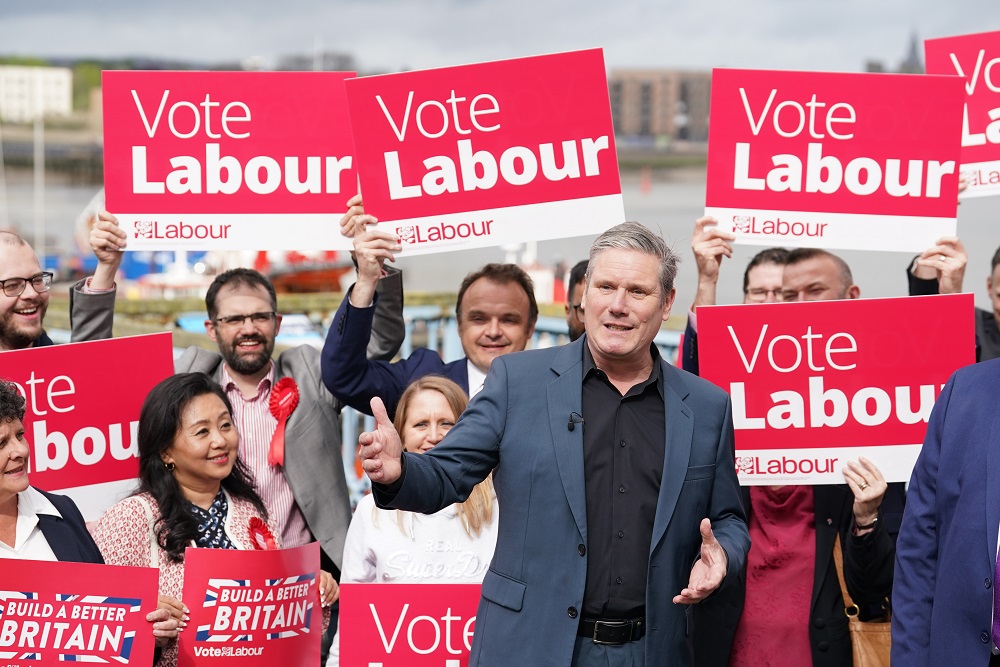
The electoral prospects for the Labour Party are extremely good. But that doesn’t mean that the economic problems we are saddled with are on the way to being solved.
There’s little doubt that the UK Conservative government is past the point of no return and is heading for the exit. Perhaps prematurely, the battle to succeed Rishi Sunak is already underway. Suella Braverman couldn’t have made it clearer that she wants to succeed him as party leader. Hard right Tories who are even madder than her would like to topple Sunak in the New Year, but Braverman knows that, for her, such a move would be political suicide.
She’d be taking over a party that seems doomed to suffer a humiliating defeat - and however late to the table she’d have taken over, she’d be swept away within months with no chance of a comeback.
Her game plan is to use culture war issues like small boats to woo the hard right party membership in readiness for a post-election leadership challenge. Her strategy depends on a Starmer victory that raises people’s hopes only for them to be dashed by a lack of ambition to make radical change. Disillusioned by Labour’s failure to deliver, Braverman imagines herself being swept into Downing Street after a single Starmer term.
[mid-content-banner]
Margaret Thatcher
Rewinding to the present, it’s clear that Starmer’s praise for Margaret Thatcher is a short-term cynical measure aimed at persuading older Tory voters that they won’t be supping with the devil by transferring their allegiance to a Labour Party led by him.
While praising Thatcher will upset many Labour supporters, especially those in places like the south Wales Valleys who are old enough to remember the economic devastation her policies caused in the 1980s, Starmer’s advisers will have calculated that few will abandon the party when victory is at hand and they realistically have nowhere else to go. Sorry, Plaid Cymru, but you’re only in contention in a small number of Westminster seats.
Unexpected events excepted, we can see how next year’s general election will play out. The only point in doubt is how big Labour’s majority will be. What matters is what comes next.
There are already worrying signs that Braverman’s hoped-for scenario might work. Starmer, and his Chancellor-in-waiting Rachel Reeves, have been dampening expectations by rowing back on promises that had previously been made, like the £28bn per year to be spent on green investment projects.
[lower-mid-content-banner]
Impregnable
They’re trying, of course, to make themselves impregnable to allegations from the Tories that they’ll be a spendthrift administration that will wreck the economy. Given the incompetence and corruption that we’ve got used to under the Conservatives, such attacks would be unlikely to gain traction during the general election campaign.
What will be much more damaging to the longevity of Starmer’s premiership will be the imposition of continuing austerity - a direction in which he appears to be headed.
The starting point for a Labour government will not be good. As pointed out in a recent book published by the Resolution Foundation think tank called Ending Stagnation - at whose launch First Minister Mark Drakeford made a speech - the UK’s economy has been stagnating for years.
The book includes a series of dispiriting statistics quoted by the Financial Times’ chief economics commentator Martin Wolf in a column about it: “Between 2007 and 2021, UK output per hour rose by 7%. Between 1993 and 2007, in contrast, it rose by 33%. Median real hourly wages rose by 8% between 2007 and 2021. Between 1993 and 2007, in contrast, they rose by 28%. Again, according to the OECD, real gross domestic product per head in the UK rose 6% between 2007 and 2022. This was better than in Italy, where GDP per head actually fell 2% over this period. But between 1992 and 2007, real GDP per head rose by 46% in the UK. The UK’s economic dynamism has evaporated.” There are more statistics along the same lines.
Inequality
Lynne Jones is a former Birmingham Labour MP who lives in the Brecon and Radnorshire constituency. In an article co-written with former investment banker Vincent Gomez for the website Labour Hub she said the Resolution Foundation book attributes the dire state of the UK economy to a decade and a half of stagnant incomes and a generation and a half of high inequality.
They continued: “This, they say, is a ‘toxic’ combination posing risks not only to our prosperity but to our social fabric: living standards are set to decline further even as the tax take increases. They argue that we must stop living off our past and invest in our future which will require much higher and sustained public investment to both address the legacy of underinvestment and deal with the challenge of net zero.
“It would be good to hear politicians making these important points!.Of course, we cannot expect to hear them from the Right, whose belief in unfettered market forces is quite undimmed by the practical experience of what market-based ‘reforms’ have done to the UK.
“Unfortunately, we do not hear them from opposition parties who, in their effort to give no red meat to the media, have steadfastly refused to say anything that might be seen as controversial and turned against them. This means that even obvious – and obviously important – facts about the nature of money and how it is created get no mention.
Precious pounds
Indeed, Keir Starmer’s speech at the launch of the book quoted, with approval, Thatcher’s mantra: “There is no such thing as public money - only taxpayers’ money”. Invoking some vague concept he called ‘securonomics’, Starmer said he would approach the public finances - spending decisions - like ‘it’s spending the precious pounds of the people we serve - which it is’.
“That is not only wrong, but dangerous. He is right to suggest that resources should always be deployed wisely and carefully, which has been far from the case in recent years. However, by not challenging and actually endorsing Thatcher’s claim that spending can only be financed by taxpayers’ money, Starmer is perpetuating the economic framework responsible for the state we are in today.
No wonder Martin Wolf remarked afterwards that ‘What will happen under him [Starmer] will make no appreciable difference. The system we run is just not capable. A change in government without a comprehensive rethink of our economic system is going to get us nowhere.’
“The UK is, and has been for over 50 years, the sovereign issuer of a ‘fiat’ currency which means it can take advantage of the ability to invest without necessarily requiring additional taxation or worrying about future debt.
The Bank of England, like other central banks, is capable of creating money – and has done so recently and in huge quantities via Quantitative Easing (QE reached £895bn). More recently in 2020, we saw that the UK was the first developed country in the world to adopt direct monetary financing to fund Government spending during the coronavirus crisis when the Bank of England expanded the facility to accommodate lockdown spending by central Government.
“Future debt is a non-issue. Today’s debt is around 100% of GDP and this has caused much hand-wringing. But in fact much of this debt is – thanks to £895bn of QE – debt which the government ‘owes’ to the Bank of England, an entity which it owns. It is ‘debt’ which the government ’owes’ to its own subsidiary. It may be a political issue, but it is not an economic problem.
“Constraints on government spending, such as the ‘fiscal rules’ adopted by the present government and now to be ‘iron clad’ by Labour, are artificial and self-imposed. It is the exact opposite of being ‘responsible’ to follow them when this deprives us of the investment we need.
Myths
It is time to tackle these myths and misunderstandings and address the real constraints. The UK Government can and does vote money into existence. But they cannot vote, for example, scientists, construction workers, nurses, childcare places, etc, into existence. Debt resulting from any public spending today cannot lead to bankruptcy for our children and so tax rises are not inevitable if government plans public spending increases that will create those tangible assets we so desperately need.”
It seems to me that if Quantitative Easing - sometimes referred to simply as printing money - helped sustain the economy during the banking crisis and the pandemic, as it did, why can it not be used now to rebuild our economy, tackle inequality and free us from the blinkered devotion to austerity that is making life so difficult for so many?
Politicians have the power to rejuvenate the economy - so long as they have the courage to do so.
Support our Nation today
For the price of a cup of coffee a month you can help us create an independent, not-for-profit, national news service for the people of Wales, by the people of Wales.
Get more trusted Welsh news
Choose Nation.Cymru as a preferred source in Google News to see more of our journalism.
