


Thu, 23rd July Cardiff 22°
Nation.Cymru wordmark
Advertisement

Opinion

Politicians have the power to rejuvenate the economy - so long as they have the courage to do so
By Mark Mansfield
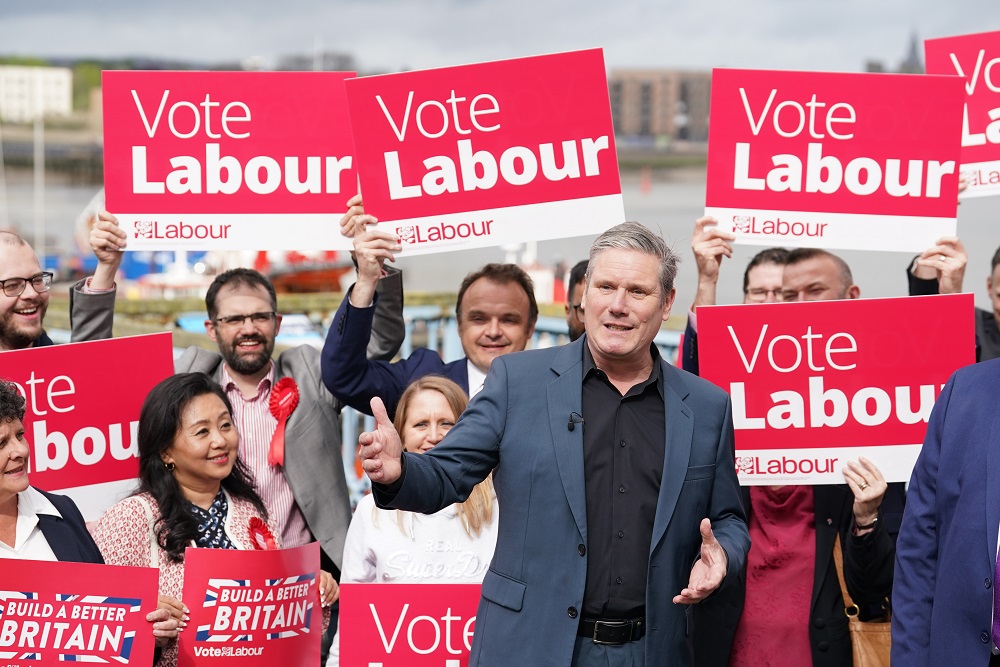
Labour leader Sir Keir Starmer. Photo Gareth Fuller PA Images

Martin Shipton

The electoral prospects for the Labour Party are extremely good. But that doesn’t mean that the economic problems we are saddled with are on the way to being solved.

There’s little doubt that the UK Conservative government is past the point of no return and is heading for the exit. Perhaps prematurely, the battle to succeed Rishi Sunak is already underway. Suella Braverman couldn’t have made it clearer that she wants to succeed him as party leader. Hard right Tories who are even madder than her would like to topple Sunak in the New Year, but Braverman knows that, for her, such a move would be political suicide.

She’d be taking over a party that seems doomed to suffer a humiliating defeat - and however late to the table she’d have taken over, she’d be swept away within months with no chance of a comeback.

Her game plan is to use culture war issues like small boats to woo the hard right party membership in readiness for a post-election leadership challenge. Her strategy depends on a Starmer victory that raises people’s hopes only for them to be dashed by a lack of ambition to make radical change. Disillusioned by Labour’s failure to deliver, Braverman imagines herself being swept into Downing Street after a single Starmer term.

[mid-content-banner]

Margaret Thatcher

Rewinding to the present, it’s clear that Starmer’s praise for Margaret Thatcher is a short-term cynical measure aimed at persuading older Tory voters that they won’t be supping with the devil by transferring their allegiance to a Labour Party led by him.

While praising Thatcher will upset many Labour supporters, especially those in places like the south Wales Valleys who are old enough to remember the economic devastation her policies caused in the 1980s, Starmer’s advisers will have calculated that few will abandon the party when victory is at hand and they realistically have nowhere else to go. Sorry, Plaid Cymru, but you’re only in contention in a small number of Westminster seats.

Unexpected events excepted, we can see how next year’s general election will play out. The only point in doubt is how big Labour’s majority will be. What matters is what comes next.

There are already worrying signs that Braverman’s hoped-for scenario might work. Starmer, and his Chancellor-in-waiting Rachel Reeves, have been dampening expectations by rowing back on promises that had previously been made, like the £28bn per year to be spent on green investment projects.

[lower-mid-content-banner]

Impregnable

They’re trying, of course, to make themselves impregnable to allegations from the Tories that they’ll be a spendthrift administration that will wreck the economy. Given the incompetence and corruption that we’ve got used to under the Conservatives, such attacks would be unlikely to gain traction during the general election campaign.

What will be much more damaging to the longevity of Starmer’s premiership will be the imposition of continuing austerity - a direction in which he appears to be headed.

The starting point for a Labour government will not be good. As pointed out in a recent book published by the Resolution Foundation think tank called Ending Stagnation - at whose launch First Minister Mark Drakeford made a speech - the UK’s economy has been stagnating for years.

The book includes a series of dispiriting statistics quoted by the Financial Times’ chief economics commentator Martin Wolf in a column about it: “Between 2007 and 2021, UK output per hour rose by 7%. Between 1993 and 2007, in contrast, it rose by 33%. Median real hourly wages rose by 8% between 2007 and 2021. Between 1993 and 2007, in contrast, they rose by 28%. Again, according to the OECD, real gross domestic product per head in the UK rose 6% between 2007 and 2022. This was better than in Italy, where GDP per head actually fell 2% over this period. But between 1992 and 2007, real GDP per head rose by 46% in the UK. The UK’s economic dynamism has evaporated.” There are more statistics along the same lines.

Inequality

Lynne Jones is a former Birmingham Labour MP who lives in the Brecon and Radnorshire constituency. In an article co-written with former investment banker Vincent Gomez for the website Labour Hub she said the Resolution Foundation book attributes the dire state of the UK economy to a decade and a half of stagnant incomes and a generation and a half of high inequality.

They continued: “This, they say, is a ‘toxic’ combination posing risks not only to our prosperity but to our social fabric: living standards are set to decline further even as the tax take increases. They argue that we must stop living off our past and invest in our future which will require much higher and sustained public investment to both address the legacy of underinvestment and deal with the challenge of net zero.

“It would be good to hear politicians making these important points!.Of course, we cannot expect to hear them from the Right, whose belief in unfettered market forces is quite undimmed by the practical experience of what market-based ‘reforms’ have done to the UK.

“Unfortunately, we do not hear them from opposition parties who, in their effort to give no red meat to the media, have steadfastly refused to say anything that might be seen as controversial and turned against them. This means that even obvious – and obviously important – facts about the nature of money and how it is created get no mention.

Precious pounds

Indeed, Keir Starmer’s speech at the launch of the book quoted, with approval, Thatcher’s mantra: “There is no such thing as public money - only taxpayers’ money”. Invoking some vague concept he called ‘securonomics’, Starmer said he would approach the public finances - spending decisions - like ‘it’s spending the precious pounds of the people we serve - which it is’.

“That is not only wrong, but dangerous. He is right to suggest that resources should always be deployed wisely and carefully, which has been far from the case in recent years. However, by not challenging and actually endorsing Thatcher’s claim that spending can only be financed by taxpayers’ money, Starmer is perpetuating the economic framework responsible for the state we are in today.

No wonder Martin Wolf remarked afterwards that ‘What will happen under him [Starmer] will make no appreciable difference. The system we run is just not capable. A change in government without a comprehensive rethink of our economic system is going to get us nowhere.’

“The UK is, and has been for over 50 years, the sovereign issuer of a ‘fiat’ currency which means it can take advantage of the ability to invest without necessarily requiring additional taxation or worrying about future debt.

The Bank of England, like other central banks, is capable of creating money – and has done so recently and in huge quantities via Quantitative Easing (QE reached £895bn). More recently in 2020, we saw that the UK was the first developed country in the world to adopt direct monetary financing to fund Government spending during the coronavirus crisis when the Bank of England expanded the facility to accommodate lockdown spending by central Government.

“Future debt is a non-issue. Today’s debt is around 100% of GDP and this has caused much hand-wringing. But in fact much of this debt is – thanks to £895bn of QE – debt which the government ‘owes’ to the Bank of England, an entity which it owns. It is ‘debt’ which the government ’owes’ to its own subsidiary. It may be a political issue, but it is not an economic problem.

“Constraints on government spending, such as the ‘fiscal rules’ adopted by the present government and now to be ‘iron clad’ by Labour, are artificial and self-imposed. It is the exact opposite of being ‘responsible’ to follow them when this deprives us of the investment we need.

Myths

It is time to tackle these myths and misunderstandings and address the real constraints. The UK Government can and does vote money into existence. But they cannot vote, for example, scientists, construction workers, nurses, childcare places, etc, into existence. Debt resulting from any public spending today cannot lead to bankruptcy for our children and so tax rises are not inevitable if government plans public spending increases that will create those tangible assets we so desperately need.”

It seems to me that if Quantitative Easing - sometimes referred to simply as printing money - helped sustain the economy during the banking crisis and the pandemic, as it did, why can it not be used now to rebuild our economy, tackle inequality and free us from the blinkered devotion to austerity that is making life so difficult for so many?

Politicians have the power to rejuvenate the economy - so long as they have the courage to do so.

For the price of a cup of coffee a month you can help us create an independent, not-for-profit, national news service for the people of Wales, by the people of Wales.

Get more trusted Welsh news

Choose Nation.Cymru as a preferred source in Google News to see more of our journalism.

Choose Nation.Cymru as a preferred source in Google News

13 comments

Padi Phillips

We all need to remember the stuff about Quantitive Easing and how the Bank of England, (or any central bank for that matter) can just magic into existence huge amounts of money that can be used for beneficial purposes without it becoming a threat to the financial viability of the country when we hear the inevitable naysayers, psyched up on Tory BS, such as "The country can't afford it" or "There is no money" and remind them just how money can indeed be magicked into being, as Martin reminds us in this most timely of articles. Indeed, right now perhaps Tory BS should be one of the least of our worries, as it's almost certain they are on their way out, and it is Labour BS we need to worry about when they start to come out with the self-same mantras as the Tories have been spinning for the best part of half a century now. We now know that there are such things as magic money trees, only we need to make sure that any magic money is spent on making our NHS fit for purpose, our schools and education the best they can be and investment in the economy, such as decent training and retraining opportunities so that our economy functions as well as it can. As it seems at present, we are unlikely to get what we need, so we need to be prepared to remind Starmer, and in particular the MSs who represent us in Cardiff Bay, particularly if they represent Welsh Labour. At the same time, we need to ramp up arguments for Welsh independence, as it is most likely now that this is the only way in which we are likely to see any substantial improvements in all those things dear to us.

Reply
hdavies15

Quantitative Easing may have benefitted some of us with depleted interest rates etc but that was a bi-product, The reality was that government projects and bailing out of failing banks and institutions were soaking up funds and government did not fancy the interest bills on their borrowing at the existing interest rates. So things got "eased". However that easing coincided with that other great deception - austerity - where service were chopped back yet the overseeing bureaucracy grew. Classic symptoms of authoritarian vigilance.

Reply
Rhy5

There’s no magic money tree - witness the markets’ reaction to Kwasi Kwarteng’s budget.

Reply
Annibendod

Wales' relative economic peak was tied to coal and heavy industry. This coincided with culmination of a generational political struggle of the labour on whose backs the industrial ascendancy of the British Empire was built. As the Labour Party took up its century long mantle as the majority party in Wales, so did the Welsh economy begin a hundered year long relative decline. That is, the GDP/capita of Wales fell behind the UK average with the gap opening up almost linearly decade on decade. That is the fact. The elephant in the room is that this is entirely a consequence of the way in which the UK economy has been managed and the choices made by Government. Now, as interesting as the subject of Modern Monetary Theory is (which is what Martin Shipton alludes to here), what matters insofar as Wales is concerned is that in any consideration of what a future Labour UK Government has to offer, is will they alter the structural inequalities that lie at the heart of the UK economy? Will we Cymry be empowered with regards to our economic, cultural, political and educational development? I do not see encouraging signs on that front. If they will not use the political power that we have long entrusted to them then it is time, in the immortal words of Zach de la Rocha, to take the power back. Yes Martin, Plaid Cymru are not currently threatening to take more than a handful of seats, but the calculus of independence is shifting. Things sometimes do happen slowly at first and then all of a sudden. It was in fact how it happened for the SNP after all. If Braverman is waiting for the disillusionment of a wasted Labour term to turn her fortunes ... how will that play out an a Scotland and Wales so sick to death with bad politics, poverty and underinvestment? Fe godwn eto.

Reply
Karl

Labour was a majority party , but not always in government. Let's not spread the mythical lie of the right wing English press. When you live in a fake union where we have no veto, you have little influence on Westminster decisions or which party is in control.

Reply
Annibendod

Remains as such in Wales. It is the only form of political consent Wales has ever given for the UK. Yet the biggest growth in support of our Statehood is coming from Labour supporters so perhaps this claimed consent is looking decidedly tenuous. Your point about power is the most pertinent. Since 1922 the Welsh electorate has returned a plurality of Labour MP's in every General Election. Yet for the heavy majority of this time we have been governed by the Conservative Party. Now, on account of Labour's vote in Wales, it can be extrapolated that we consent to this via Labour's manifesto commitment to Unionism. However, it leaves any Conservative Government with no mandate for their policies in Wales. One would imagine that any Tory with a semblance of respect for democracy would seek to govern in Wales with the consent of the democratically mandated Welsh Government in accordance with the Sewell Convention. Yet in this Parliament, the Tories have not only ripped up the Sewell Convention but unilaterally annulled Welsh Law using perogative Henry VIII powers. That we do not protest this fact is to our shame. It does serve as a sharp reminder of the urgency with which our Statehood is necessary.

Reply

In reply to Annibendod

Padi Phillips

I agree with you on so many of the points you make, but isn't the apparent lack of protest down to a general feeling of, not apathy, but a feeling that no matter what anyone does, things will remain much the same, no matter who is in government. Labour is the default political party in much of Wales, largely because no one in good conscience could vote for anyone else bar perhaps Plaid Cymru. Both Labour and Plaid are struggling against a lack of hope in much of Wales, and both parties are shamefully silent over Westminster's push-back, which I believe will continue under Starmer.

Reply
David Smith

See above reference to the Resolution Foundation and these comments by radical accountant Richard Murphy - a former Treasury advisor to George Osborne when Chancellor Richard Murphy @RichardJMurphy The Resolution Foundation’s proposed method for ending stagnation would deliver a massive recession instead https://taxresearch.org.uk/Blog/2023/12/09/the-resolution-foundations-proposed-method-for-ending-stagnation-would-deliver-a-massive-recession-instead/ The Resolution Foundation’s new report on the economy proposes that UK government’s should run fiscal surpluses in most years. These would suck money out of the economy. It implies that this must be done because governments must save for proverbial rainy days. This is the type of thinking that gave us the Great Depression, and if adopted it would do so again. The report is profoundly wrong in its thinking and would be deeply dangerous if a government adopted it as policy.

Reply
Charles Coombes

Whatever happened to the far left and socialism in the Labour Movement? It moved to Plaid Cymru and so did my vote.

Reply
Padi Phillips

Plaid Cymru hardly constitutes the 'far left' unless you're an unhinged Tory or Reform supporter, or maybe a Daily Mail (and papers of that ilk) reader. To paraphrase Tony Benn, Plaid is a party with socialists in it. More accurately, Plaid is largely a social democratic party, though it does also have its small collection of tories.

Reply
hdavies15

Sadly Plaid is what I characterise as "wet left" happy to talk about all sorts of change but seldom offering clear pathways to achieving those goals. Bit like most other parties really. Only redeeming feature is that they remain Welsh, well a bit Welsh, anyway.

Reply
Linda Jones

We do need a rethink on our economic policy, monetarism doesn't work. I doubt Starmer and co are up to the job. I suspect a low turnout at the next election will be the result of us having an elected dictatorship in Westminster. No one speaking up for working people so no one to vote for for the many. A threat to democracy? Yes

Reply
Shan Morgain

so long as they have the courage to do so It is not courage that is lacking in our leaders. It is interest. Tories are only interested in redirecting public money to their own pockets and their top-wealth allies, plus they enjoy ensuring many people are crushed and suffering. It gives them a warm glow of superiority. Labour know that if they try to put popular policies on equality, public ownership, cleaning up fraud and forcing the rich to pay up, and QE to support investment, then they will be smeared mercilessly by Tory owned media. They will be portrayed as profligate with the national budget. The only way to gain power is to stay quiet, and not frighten the Big Money.

Reply

Leave a reply

Replying to Padi Phillips Cancel

I agree with you on so many of the points you make, but isn't the apparent lack of protest down to a general feeling of, not apathy, but a feeling that no matter what anyone does, things will remain much the same, no matter who is in govern...

Comments are reviewed before they appear.