


Sat, 18th July Cardiff 22°
Nation.Cymru wordmark
Advertisement

Opinion

Basic income could prevent the coronavirus pandemic causing an economic collapse

By NationCymru
Photo by Toa Heftiba on Unsplash

Tegid Roberts

If ever there was a time to trial basic income in Wales and the UK, this is it.

Covid 19 [aka SARS - Cov 2] similar to SARS is very potent, easily transmitted and as the south-east Asian countries have shown requires dramatic intervention to reduce infection levels.

Currently, UK policy for the population is to self-isolate as much as possible. We must reduce our social contact which means fewer cafe, restaurant, theatre and cinema visits and a considerable number of people will have to work from home.

If social distancing becomes government policy and all schools, universities and many workplaces close after a period of time citizens will run out of money. The average financial buffer the UK population has is less than two weeks’ worth of money per household.

Take for example the 3.3m people in the construction industry, 40% of them self-employed, who are all reliant on cash. If the government forces construction sites to close, businesses will go into administration within weeks and shed thousands and thousands of jobs.

Wales, where 99.9% of companies are small or medium-sized enterprises, is in particular danger. Many will be unable to continue to pay wages if the worst happens.

So what to do?

Well, a basic income of £500 a month for one year for 5 million people would be £30B which is 1.5% of UK GDP. A good deal of it would be spent and recycled back into the economy and the taxes recouped via VAT, national insurance and income taxes via the products and services it's spent on. The majority of people will pay priority bills and food shopping.

But isn’t Ā£30B too expensive for an economy in such poor shape?

Well, compared to the bank rescue package totalling some £500 billion announced by the British government on 8 October 2008, as a response to the global financial crisis. Few questioned that initiative and it certainly stabilised the liquidity of the financial markets.

So in comparison to £500bn, £30bn to help five million of the population looks affordable.

[mid-content-banner]

Ā 

Borrowing

But what if we wanted to apply a basic income to the entire population of working age?

The UK working-age population is 42 million. A basic income for all at £500 a month for a year would be £252 Billion or about 13% of UK GDP.

Again, a lot of that goes straight back into the economy and a proportion goes back into the public purse. At that UK government debt rises to about 92% of GDP, which is still a lot lower than the historical peaks in the 1810s and 1918, 1945. See the graph below.
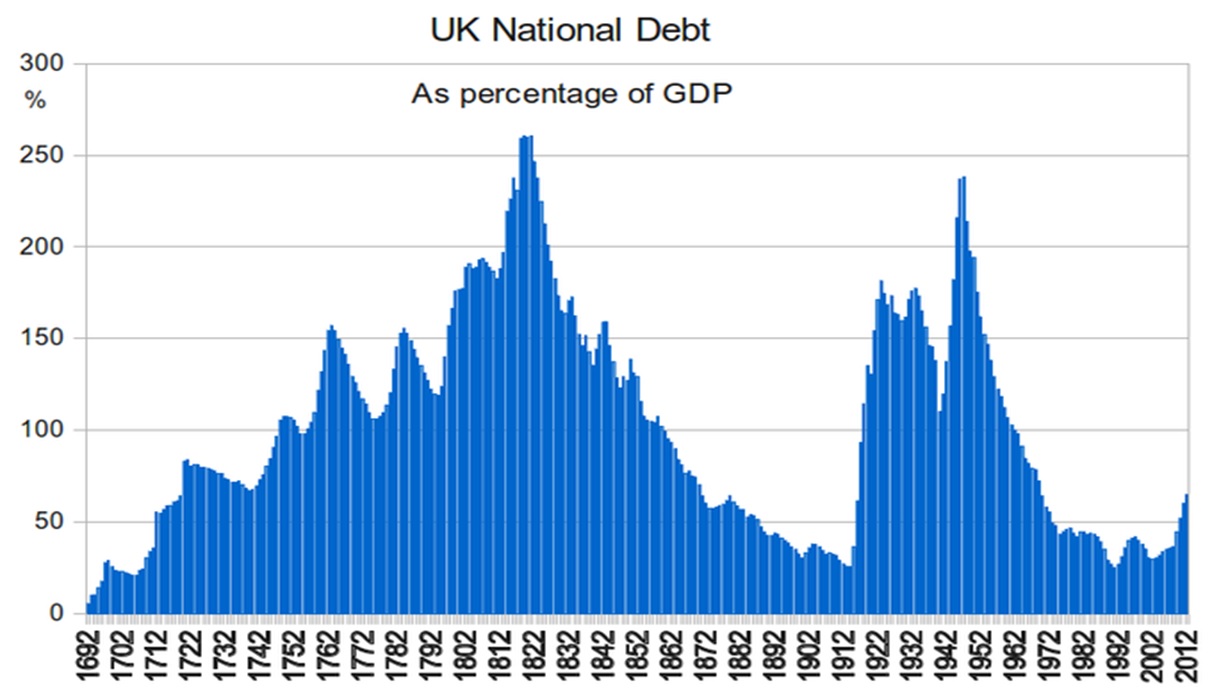
UK national debt as a percentage of GDP

So what do the figures look like on a Welsh basis? Wales has 1.9 million people of working age so applying that same £500 per month would cost £950 Million per month.

Currently, the Welsh government does not have the borrowing powers to apply such a large initiative and would have to rely on the UK government to finance it. It is possible that local authorities in Wales can borrow money but to what level and for how long is debatable.

Implementation

Currently, in Europe, Ireland appears to be the only country that is taking fast action on supporting workers in the economy. They have already announced that they will pay £185 per week for six weeks to every employed, self-employed or unemployed person of working age in Ireland. Implementation is already in place and ready to go.

How would we implement this in the UK and get the money into the hands of those that need it?

To implement such a scheme in the UK would require the government to verify each person’s national insurance number and allocate a bank account to pay the amount into.

If a bank account isn't available then cash can be paid directly via post office mechanism.

Most families in the UK already receive a child benefit amount via direct debit each month so the government could increase the child benefit paid to include a basic income for that cohort of people immediately and pay weekly.

So to summarise: a basic income scheme will be necessary as work dries up and companies can no longer afford to pay their staff. Government at the state level have the resources and precedent for such a large fiscal intervention as it has had to do when we were at war with the rest of Europe three times.

Increasing debt to GDP by 13% for a relatively short time is fiscally peanuts in comparison to the total collapse of our real-world economy because of a global pandemic that requires immediate and very rapid action.

And with modern banking technology, it can be implemented rapidly.

For the price of a cup of coffee a month you can help us create an independent, not-for-profit, national news service for the people of Wales, by the people of Wales.

Get more trusted Welsh news

Choose Nation.Cymru as a preferred source in Google News to see more of our journalism.

Choose Nation.Cymru as a preferred source in Google News

15 comments

David Smith

Very helpful, cogent case presented. Lets hope HMG are listening!

Reply
Cerydd

Yes. Far better than supporting airlines so that they can go back to polluting the atmosphere as soon as Covid19 subsides.

Reply
Huw Davies

Those same airlines whose chiefs are probably still drawing eye watering salaries for doing not a lot other than passing the grief ( not sharing it) down to their teams of staff. There is something quite revolting about business "leaders" howling for aid when they've been shafting the tax regime throughout all their good years. Granted something has to be done but the current business models favoured by these multinationals is now proved to be not fit for purpose so more state ownership especially in areas of key services is the way to go. Right now re-nationalisation might be feasible as most of these lame ducks are at rock bottom share prices. And no need to pay silly money to get rid of fat cat CEO's either. A dose of their own medicine would do nicely.

Reply
j humphrys

Yep. As most know, Norway has a civil servant running their huge SWF, not a silk suit. Free enterprise is great for the production of useful goods, and I believe supporting this is v. important. But the land, power and water etc, should belong to the Welsh people. The sooner we get things like the turbine scam buried, the better?

Reply
John Young

Not the same scale as the airlines example but this is a thread that was started today by someone on the Swansea City non-football forum. *************************************************************************** So my missus works for a charity where kids come to visit and stay and learn about the countryside they now have zero bookings until September. They have all been asked to cut down their hours understandably which they all have. My missus has gone down to 4 days and then will go down to 3...etc some have been asked to just come in 1 day a week so everyone is really going for it. Personally I think they are fecked but they are giving it a go. My missus who is the office manager and has had to adjust all this has found out that the 2 highest paid people the director and her side kick will stay on full pay! Fecking vile b@stards basically they know it's going to the wall and are just keeping the cream for themselves until it closes. *****************************************************************************

Reply
Sibrydionmawr

I think you've made an excellent case for a basic income, surely this is something that's time has come? Disregarding the current crisis, anyone who has even only been keeping a half open eye on the economy will know that retail is currently in crisis and shedding jobs like there is no tomorrow with big chains like Dixons Carphone announcing the closure of all their shops with the loss of nearly 3000 jobs. And there are other chains in a similar predicament. Amazon have already opened their first unstaffed supermarket in the UK and it's only a matter of time before the current big players start to implement similar technology in their shops, with a concomitant shedding of staff. There is rightly much criticism of zero hour contracts, but the real issue is one of exclusive contracts which amount to virtual slavery. A worker is effectively 'on call' to an employer, but yet receives no payment for being available, Increasingly more workers are falling into the category of the precariat, a sector of the workforce who would benefit massively through the implementation of a universal basic income. Zero hour contracts, far from being outlawed, should in fact be strictly regulated, basically making the abusive elements of these types of contracts illegal - such as the requirement for workers to be available exclusively for a single employer - it's all very well for an business to call on staff as and when it needs them, but staff are also entitled to be able to work when it suits them too, and should therefore be free to honour bookings as and when they receive offers of work from any employer in their portfolio of employers, or indeed, decline any offer without penalty. Anyone who has ever worked a zero hour contract knows there are peaks and troughs - times when there is so much work offered that it needs to be declined, and virtual droughts when work is scarce. It is at times like this that a universal basic income would make huge amounts of sense. The cost of a system of UBI would be, as the article pointed out, very high, but not as high as some naysayers might try to predict, and though high in cost, would be far from unaffordable - after all wars are far more expensive. And, as the writer pointed out, the actual cost to the taxpayer wouldn't be as high as the figure paid out as much of it would come back in the form of taxes on purchases, and of course on earned income, which would attract a far smaller tax threshold than is currently the case. So much for focusing on the negatives, the cost. But what about the positives? As people like Yanis Varoufakis has pointed out, a UBI would allow workers to genuinely allow workers to say no to employers demands where they felt the demand unreasonable. This would help immensely in resetting the power imbalance that exists between workers and employers, something long overdue. An employer has always been able to refuse to offer work without sanction, and UBI would allow a worker to refuse work without sanction, other than the loss of potential earnings, of course. UBI would allow people to be more venturous, as, no matter what, there would always be the UBI payment to fall back on if the venture failed - and most successful entrepeneurs will have failed more than once, and then picked themselves up again. Some would choose to forego formal employment and focus on working on projects that are currently in the twilight zone of the voluntary sector where those volunteering are either retired or unemployed with all sorts of bizarre requirements to fulfill. all when they are making a valuable contribution in many cases to society that would cost huge sums were wages or a salary being paid for that work, often crucial work of huge social value. Some would concentrate on self improvement and perhaps for a time not be available to the workforce, thus allowing someone else an opportunity. The time for UBI is now. We are already in a time where the expected work norms of the late 19th century no longer make any kind of rational sense, so why is there still an expectation on workers to live up to those norms? Or the unemployed commit to a ridiculous treadmill existence staring at a computer screen for a large part of a 35 hour working week due to the whim of a maniacal despot sociopath? Even the unemployment figures can't be trusted, and in reality the figure is at least three times the official level. Nor can the statistics for those in work be trusted, as many of the jobs created have been zero hour jobs, where workers are in the perverse situation where they are officially employed, but don't necessarily have work, or payment for work. And even when that work is regular and full time, wage rates are so low that workers have to claim Universal Credit with it's madcap conditionality. For Wales particularly a system of UBI could be just what is needed to transform our economy for the better, as it would immediately throw down the gauntlet to myriad employers who think they can abuse their workforce through paying them poverty pay in industries such as tourism. The entrepeneurship encouraged by a system of UBI may well lead to the formalising of the alternative economy already in existence through necessity in our poorer regions, thus boosting the local economy and the overall tax take. Of course there would be some losers, and in general the Basic Income Earth Network has calculated that their suggested system of UBI would see those on £40k and upwards lose out on a system of UBI in that they would be paying more tax than they received in UBI, but anyone on that kind of money, and more, really doesn't need any more, and is certainly far from being in poverty - and they'd still be getting their UBI payment

Reply
Huw Davies

You are right. Some radical change in direction of travel is needed. We are still in the age of the smart arse lawyer creating new kinds of "innovative" contracts for employers to deploy enabling them to salami slice further any residual security of contract that a rank and file employee might enjoy. This has to be overturned. This is not some outrageous fantasy of a ideologically obsessed ( pseudo) socialist but the conclusions drawn by a guy who spent most of his working life trying to make teams work effectively. Anyone who thinks that having people "on the hook" waiting hopefully for a call to work is frankly stark raving bonkers and unfit for leadership or stewardship of a business. Effective businesses that fill a real need in any market rely on well developed teams, at all levels, to deliver the product/ service. Many of these fly by night outfits that run on zero hours/exclusive contracts are living on the edge anyway, selling products/ services that are passing fads, with inflated margins while the going is good feeding straight into the ownership coffers . I haven't spent hours reviewing UB schemes but anything along these lines is better than the chaos currently in vogue ( and I'm NOT talking about Covid19). The whole income/taxation matrix could be reshaped along with its interface with the benefits system. I hear people say "...well we've only just embarked on a new benefits system..." and I say, "...yes, but it is patently obvious that it is about as fit for purpose as a one legged man in an arse kicking competition, so dump it and do some good. " An effective system of UBI would free up more people to engage in their own enterprise rather than be contracted to a large corporate entity. At least there would be scope for choices, and might finally help realise the vision that small is really beautiful !

Reply
Ann Owen

I like the thinking but £500 a month(?) isn't going to cover rent, food, fuel costs for many people I know. And these people don't have back up money in spite of being in work or self employed - not because of their own ineptitude but because wages are low for the employed or margins are low for the self-employed so can't build a reserve.

Reply
John Young

The general thinking behind UBI schemes is that it frees people up to take a job that doesn't pay a lot. Currently, if you're offered a badly paid job you'd say I can't take it because my Universal Credit would be stopped. The UBI would be that guaranteed safety net which you can top up with work.

Reply
Plain citizen

This is one of the most interesting articles on the subject of ameliorating the economic hardship of the pandemic I've seen. Mainstream economists are starting to advocate 'helicopter money' as being the only way to help poorer people where QE which just inflated rich companies asset prices so obviously failed.

Reply
Huw Davies

QE may have been intended on well meaning grounds but it was evident very quickly that all it did was revive the values of large corporates whose gratitude was seriously underwhelming as they pursued their complex tax mitigation/avoidance/evasion strategies yet more aggressively. That Osborne and Cameron, followed by others, failed to claw much back is testimony that this was a grand wealth grab from the public purse into private coffers.

Reply
Eos Pengwern

A Citizen's Income has been the policy of Gwlad Gwlad from the very beginning: here is an article about it written in November 2018, but it's still the cornerstone of our manifesto: https://gwlad.org/en/2018/11/29/english-a-citizens-income-for-wales/ As for putting a CI into immediate effect as an emergency measure - what Milton Friedman called "helicopter money" - there's a lot to be said in its favour but it's hard to see how the Welsh government could do this in isolation and it would be difficult even for the UK government. At the very least you'd need control over your own currency so you could manage the money supply - something Wales does not have - and you'd need a low enough debt-to-GDP ratio that the markets didn't respond by devaluing your currency to the point of worthlessness. All in all it's an object lesson in the importance of sound fiscal policy in the 'good times' so you have firepower when the 'bad times' come. Gordon Brown's fiscal incontinence weakened the UK's ability to rebound from the 2008 Financial Crisis; and the basket-case economy that the Welsh Labour government has bequeathed Wales leaves us in a weak position to deal with this. Hopefully we can learn some lessons for next time - the benefits of independence and the importance of good economic management.

Reply
Walter Hunt

A ᅯ500pcm UBI is woefully short of what is needed for many effected by this crisis. Aid needs to targeted and immediate. "Helicopter money" is an interesting idea for a one-off post-pandemic economic stimulus, but now? If businesses are forced to close to enforce social distancing or just go bust in the economic downturn then putting any amount of cash in consumers' hands won't help those businesses or their workers.

Reply
Sian Caiach

A universal basic income would certainly help by giving a guarantee of a modest income in these times, irrespective of current employment status or other income. It has been a manifesto policy of Gwlad Gwlad from the beginning, but we realise it is not an automatic economic panacea, and our discussions on the issue have been useful. In a time of stability are some drawbacks and possible problems with eligibility and possible exploitation. In a time of crisis they would be very difficult to manage. Yes, we should already have rolled it out and dealt with the problems. In this moment of chaos there may be little political consensus in favour of it across the UK as a whole. One of the problems we have discussed at length is bringing in this policy on a Wales only basis after Independence, definitely something you would not wish to do in a world wide crisis. It should help the poorest and most vulnerable to avoid the current pitfalls of the benefit system, prevent dire poverty, and encourage others to develop personal skills and enterprise. However, without other economic controls. the extra income could simply and often be skimmed off by the usual scumbags who exploit the poor and vulnerable, making universal income a benefit primarily for the "better off." As a "Covid-19 bonus" it may not be enough to prevent those who totally lose their income to pay for their regular outgoings, accommodation and utilities and fails to address existing personal debt levels. A crisis, especially one where the ultimate threats to individuals ,society and economy are still predicted at a "best guess" level , may not be the ideal testing ground. However, across the Western world . new policies are and will be rolled out to try and mitigate the social and economic problems of the Covid crisis, and some of these may well better inform future actions, especially if the crisis lasts for some months or even years. At the moment the UK Government has little control over its own economy, other than trying to throw money into saving businesses and jobs. We have yet to see how beneficial the promised UK support is. The Welsh Government has very little opportunity for independent action. A basic citizens income is a good idea, but practically now may not be the best time to introduce it. But in this time of chaos and uncertainty, it may be a straw the UK government feels it should grasp?

Reply
Meilyr Tomos

There’s a lot of ā€˜elastoplast’ in existence in the form of rebates on water, electricity, comms, council tax, for those with low incomes. These are essential for people on universal credit and legacy benefits. Historically, prior to privatisation of the utilities, there were ā€˜social tariffs’ There’s a lot to figure out here.

Reply

Leave a reply

Replying to Huw Davies Cancel

QE may have been intended on well meaning grounds but it was evident very quickly that all it did was revive the values of large corporates whose gratitude was seriously underwhelming as they pursued their complex tax mitigation/avoidance/e...

Comments are reviewed before they appear.