
Opinion
Basic income could prevent the coronavirus pandemic causing an economic collapse

Tegid Roberts
If ever there was a time to trial basic income in Wales and the UK, this is it.
Covid 19 [aka SARS - Cov 2] similar to SARS is very potent, easily transmitted and as the south-east Asian countries have shown requires dramatic intervention to reduce infection levels.
Currently, UK policy for the population is to self-isolate as much as possible. We must reduce our social contact which means fewer cafe, restaurant, theatre and cinema visits and a considerable number of people will have to work from home.
If social distancing becomes government policy and all schools, universities and many workplaces close after a period of time citizens will run out of money. The average financial buffer the UK population has is less than two weeks’ worth of money per household.
Take for example the 3.3m people in the construction industry, 40% of them self-employed, who are all reliant on cash. If the government forces construction sites to close, businesses will go into administration within weeks and shed thousands and thousands of jobs.
Wales, where 99.9% of companies are small or medium-sized enterprises, is in particular danger. Many will be unable to continue to pay wages if the worst happens.
So what to do?
Well, a basic income of £500 a month for one year for 5 million people would be £30B which is 1.5% of UK GDP. A good deal of it would be spent and recycled back into the economy and the taxes recouped via VAT, national insurance and income taxes via the products and services it's spent on. The majority of people will pay priority bills and food shopping.
But isn’t £30B too expensive for an economy in such poor shape?
Well, compared to the bank rescue package totalling some £500 billion announced by the British government on 8 October 2008, as a response to the global financial crisis. Few questioned that initiative and it certainly stabilised the liquidity of the financial markets.
So in comparison to £500bn, £30bn to help five million of the population looks affordable.
[mid-content-banner]
Borrowing
But what if we wanted to apply a basic income to the entire population of working age?
The UK working-age population is 42 million. A basic income for all at £500 a month for a year would be £252 Billion or about 13% of UK GDP.
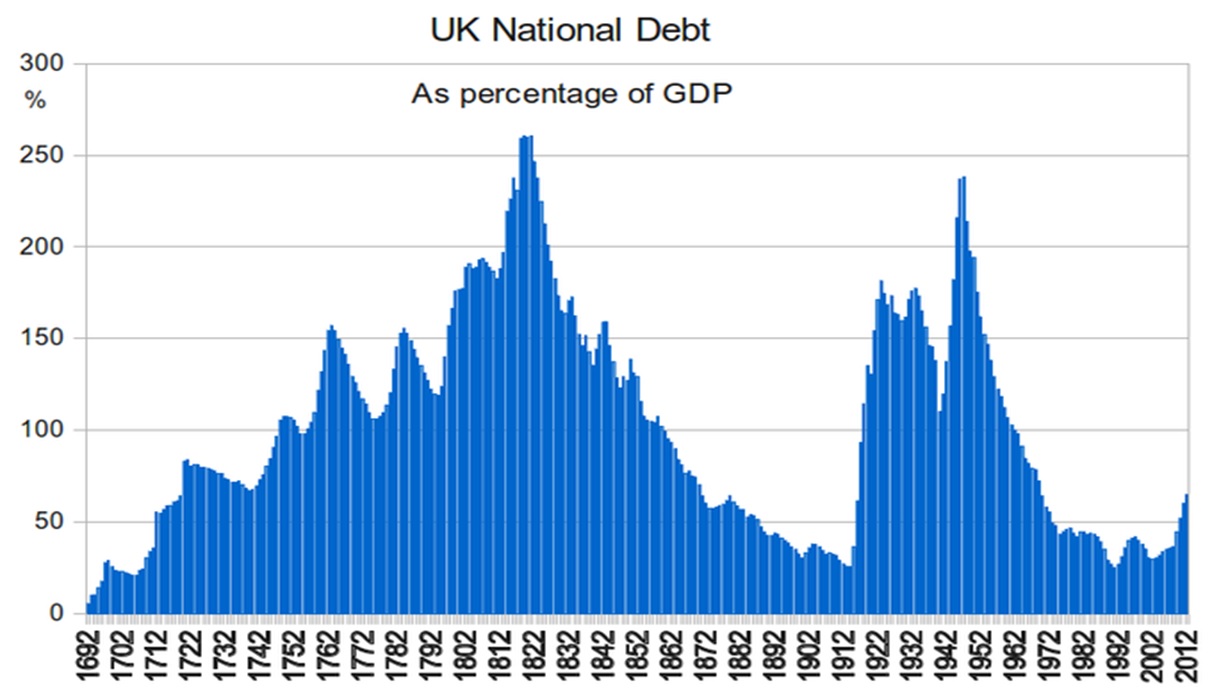
Again, a lot of that goes straight back into the economy and a proportion goes back into the public purse. At that UK government debt rises to about 92% of GDP, which is still a lot lower than the historical peaks in the 1810s and 1918, 1945. See the graph below.
So what do the figures look like on a Welsh basis? Wales has 1.9 million people of working age so applying that same £500 per month would cost £950 Million per month.
Currently, the Welsh government does not have the borrowing powers to apply such a large initiative and would have to rely on the UK government to finance it. It is possible that local authorities in Wales can borrow money but to what level and for how long is debatable.
Implementation
Currently, in Europe, Ireland appears to be the only country that is taking fast action on supporting workers in the economy. They have already announced that they will pay £185 per week for six weeks to every employed, self-employed or unemployed person of working age in Ireland. Implementation is already in place and ready to go.
How would we implement this in the UK and get the money into the hands of those that need it?
To implement such a scheme in the UK would require the government to verify each person’s national insurance number and allocate a bank account to pay the amount into.
If a bank account isn't available then cash can be paid directly via post office mechanism.
Most families in the UK already receive a child benefit amount via direct debit each month so the government could increase the child benefit paid to include a basic income for that cohort of people immediately and pay weekly.
So to summarise: a basic income scheme will be necessary as work dries up and companies can no longer afford to pay their staff. Government at the state level have the resources and precedent for such a large fiscal intervention as it has had to do when we were at war with the rest of Europe three times.
Increasing debt to GDP by 13% for a relatively short time is fiscally peanuts in comparison to the total collapse of our real-world economy because of a global pandemic that requires immediate and very rapid action.
And with modern banking technology, it can be implemented rapidly.

Support our Nation today
For the price of a cup of coffee a month you can help us create an independent, not-for-profit, national news service for the people of Wales, by the people of Wales.
Get more trusted Welsh news
Choose Nation.Cymru as a preferred source in Google News to see more of our journalism.