

Culture
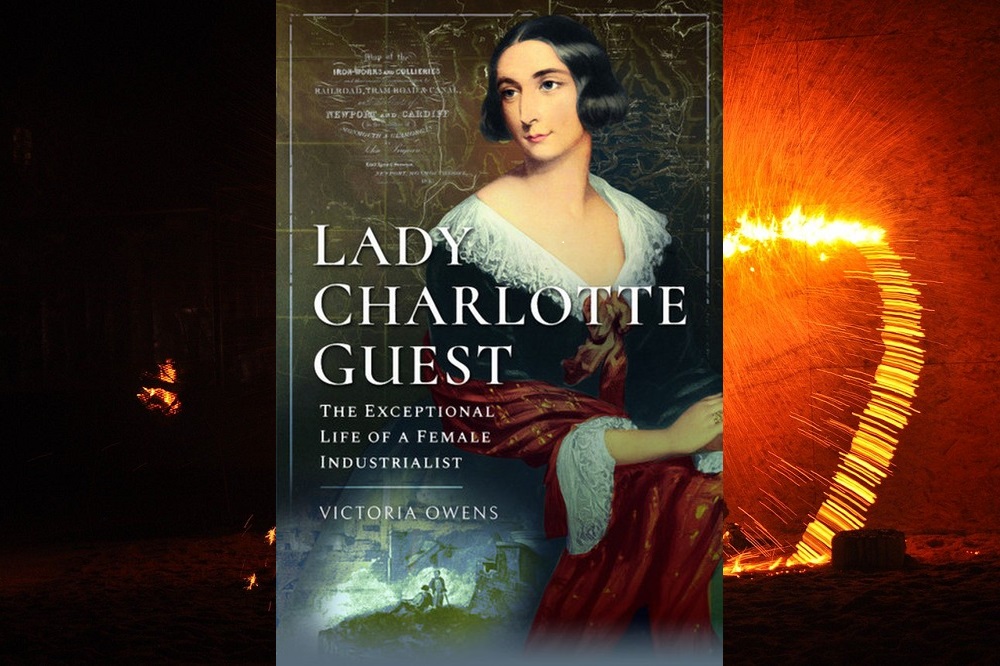
Review: Lady Charlotte Guest is an elegantly written portrait of a remarkable female Industrialist and patron of Welsh literature
Jon Gower
Visiting the Dowlais Ironworks in 1852 a reporter for the Bristol Times and Mirror, whilst reeling from the stench and filth of the nearby village, managed to stay on his feet long enough in order to interview the works’ manager John Evans. He also deftly profiled Lady Charlotte who
Though a fine, handsome and fashionable woman, her ladyship takes interest even in the minutiae of the works, and has so keen an eye to the mainpoint, that though she might possibly startle at the question ‘what is the price of pigs? [bars of pig iron] she knows what the price should be?’
Dowlais pumped out iron for much of the world, from Imperial Russia to colonial India. As that firebrand historian Gwyn Alf Williams once put it in a fine joke, re-versioned in this book, when Anna Karenina lays down her head on the railway track at the end of Tolstoy’s novel she would have inevitably have done so on rails made in Dowlais.
Mabinogion
Lady Charlotte Guest, wife of Dowlais iron-master Sir John Guest is best known to us for her pioneering work in translating the Mabinogion but Victoria Owens presents us with another facet to her life, namely as an industrialist. This was not through choice but rather of necessity, following her husband’s death in 1852 and even though she had taken a keen interest in the day-to-day tasks associated with the ironworks’ administration she was taking charge at a time when the market for iron was volatile to say the least.
A works that in its heyday had employed no fewer than 7,300 men was beset with problems such as motive power. So the young widow found herself bargaining for locomotives to replace Dowlais’ disintegrating fleet. There was even one called Ivor.
And on top of that coal was in short supply as was iron ore. So she faced a phalanx of problems at a time when there was industrial unrest as well, her anxieties about workers’ discontent compounded by the fact that she was dealing with the men who owned and ran the other iron manufactories of Merthyr and powerful coal owners who had multiple grudges to bear.
You could count the women helming manufactories at the time on one finger. But Charlotte had loved the Dowlais works ever since she had first sight of the immense furnaces blazing under a night sky, and so she resolved to help them survive despite the plethora of challenges. She knew her stuff and had already translated works about iron working such as On the Use of Hot Air from French, in so doing giving her a capacious knowledge of smelting, the vagaries of furnaces and the various hot and cold processed employed at the time, as well as studying steam engines.
[mid-content-banner]
Stylish
When she met John Guest Charlotte was a stylish and energetic woman, skilled at shooting and billiards as well as appreciative of the arts. They got married seven weeks after their first meeting and the much younger woman, from a very different background was to bear him 10 children in what was to be a mainly happy relationship. Despite her growing maternal responsibilities she also found time to engage energetically with Welsh culture, learning the language from the local vicar and eventually mastering the language to the extent that she could translate the tales of the Mabinogion. As she once said of herself ‘Whatever I undertake, I must reach an eminence in.’
Her interest had been piqued in Welsh literature when she and her husband attended meetings of Cymdeithas Cymreigyddion y Fenni, the Abergavenny Welsh Society. Egged on by some of her friends in the clergy, such as the Rev John Jones, best known under his bardic name Carnhuanawc, Charlotte undertook to not only translate and annotate the Welsh texts herself but also to publish them at her own expense. These appeared in a series of seven parts between 1838 and 1849 and subsequently in a fine, three-volume set. This was very well received. A review in the Morning Chronicle thought it a real feast. ‘It is with no miser’s hand that the table is spread and the materials provided for the literary banquet at which we are here made guests’ while Charlotte found herself being described as a ‘patroness of Welsh literature.’ Other versions of the tales of Pwyll, Culhwch and Gwydion et al. were produced, including Knightly Legends of Wales or the Boys’ Mabinogion published in America as well as an English-only one for the general reader.
Blue Books
Charlotte Guest’s energies were undeniable. She found time to establish new schools at a time when education in Wales was under attacks by a trio of Government Inspectors in their reports commonly referred to as the Blue Books and she organised night classes for adults. As a works’ owner she introduced individual pay instead of men being paid in groups, which served to encourage pay-day drinking and requested monthly reports from all the different managers to give her an overview of all that was going on. She beneficently took a number of workers and their families to London to see the 1851 Exhibition and set up Reading Rooms for their improvement. She was an enlightened boss.
After withdrawing from the task of running Dowlais she started to collect ceramics, accumulating a collection that served as the basis for that of the Victoria and Albert museum. The woman’s restless energy fair crackles through the pages of this painstakingly researched book by Victoria Owens which breathes life into its subject just as Charlotte herself did for medieval texts, establishing the Mabinogion as one of the finest folk tales in Europe. But as this elegantly written portrait amply proves, there was much, much more to her than that.
Lady Charlotte Guest: The Exceptional Life of a Female Industrialist is published by Pen & Sword Books. You can buy a copy here...

Support our Nation today
For the price of a cup of coffee a month you can help us create an independent, not-for-profit, national news service for the people of Wales, by the people of Wales.
Get more trusted Welsh news
Choose Nation.Cymru as a preferred source in Google News to see more of our journalism.
