


Fri, 17th July Cardiff 29°
Nation.Cymru wordmark
Advertisement

Culture

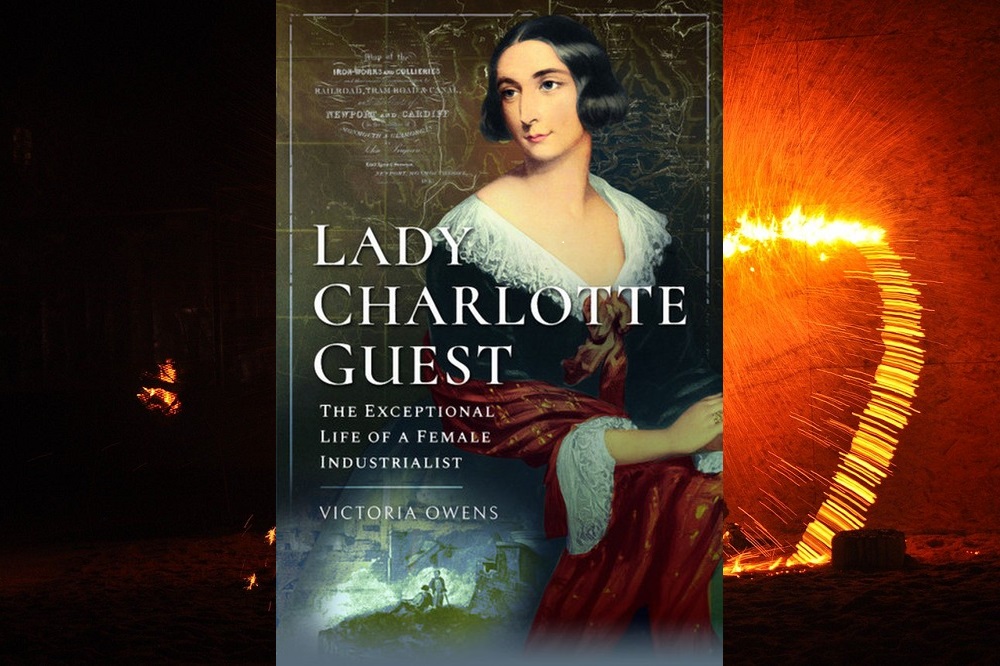
Review: Lady Charlotte Guest is an elegantly written portrait of a remarkable female Industrialist and patron of Welsh literature
By Mark Mansfield
Lady Charlotte Guest

Jon Gower

Visiting the Dowlais Ironworks in 1852 a reporter for the Bristol Times and Mirror, whilst reeling from the stench and filth of the nearby village, managed to stay on his feet long enough in order to interview the works’ manager John Evans. He also deftly profiled Lady Charlotte who

Though a fine, handsome and fashionable woman, her ladyship takes interest even in the minutiae of the works, and has so keen an eye to the mainpoint, that though she might possibly startle at the question ‘what is the price of pigs? [bars of pig iron] she knows what the price should be?’

Dowlais pumped out iron for much of the world, from Imperial Russia to colonial India. As that firebrand historian Gwyn Alf Williams once put it in a fine joke, re-versioned in this book, when Anna Karenina lays down her head on the railway track at the end of Tolstoy’s novel she would have inevitably have done so on rails made in Dowlais.

Mabinogion

Lady Charlotte Guest, wife of Dowlais iron-master Sir John Guest is best known to us for her pioneering work in translating the Mabinogion but Victoria Owens presents us with another facet to her life, namely as an industrialist.  This was not through choice but rather of necessity, following her husband’s death in 1852 and even though she had taken a keen interest in the day-to-day tasks associated with the ironworks’ administration she was taking charge at a time when the market for iron was volatile to say the least.

A works that in its heyday had employed no fewer than 7,300 men was beset with problems such as motive power. So the young widow found herself bargaining for locomotives to replace Dowlais’ disintegrating fleet. There was even one called Ivor.

And on top of that coal was in short supply as was iron ore. So she faced a phalanx of problems at a time when there was industrial unrest as well, her anxieties about workers’ discontent compounded by the fact that she was dealing with the men who owned and ran the other iron manufactories of Merthyr and powerful coal owners who had multiple grudges to bear.

You could count the women helming manufactories at the time on one finger. But Charlotte had loved the Dowlais works ever since she had first sight of the immense furnaces blazing under a night sky, and so she resolved to help them survive despite the plethora of challenges. She knew her stuff and had already translated works about iron working such as On the Use of Hot Air from French, in so doing giving her a capacious knowledge of smelting, the vagaries of furnaces and the various hot and cold processed employed at the time, as well as studying steam engines.

[mid-content-banner]

Stylish

When she met John Guest Charlotte was a stylish and energetic woman, skilled at shooting and billiards as well as appreciative of the arts.  They got married seven weeks after their first meeting and the much younger woman, from a very different background was to bear him 10 children in what was to be a mainly happy relationship.  Despite her growing maternal responsibilities she also found time to engage energetically with Welsh culture, learning the language from the local vicar and eventually mastering the language to the extent that she could translate the tales of the Mabinogion.  As she once said of herself ‘Whatever I undertake, I must reach an eminence in.’

Her interest had been piqued in Welsh literature when she and her husband attended meetings of Cymdeithas Cymreigyddion y Fenni, the Abergavenny Welsh Society. Egged on by some of her friends in the clergy, such as the Rev John Jones, best known under his bardic name Carnhuanawc, Charlotte undertook to not only translate and annotate the Welsh texts herself but also to publish them at her own expense. These appeared in a series of seven parts between 1838 and 1849 and subsequently in a fine, three-volume set. This was very well received. A review in the Morning Chronicle thought it a real feast. ‘It is with no miser’s hand that the table is spread and the materials provided for the literary banquet at which we are here made guests’ while Charlotte found herself being described as a ‘patroness of Welsh literature.’ Other versions of the tales of Pwyll, Culhwch and Gwydion et al. were produced, including Knightly Legends of Wales or the Boys’ Mabinogion published in America as well as an English-only one for the general reader.

Blue Books

Charlotte Guest’s energies were undeniable.  She found time to establish new schools at a time when education in Wales was under attacks by a trio of Government Inspectors in their reports commonly referred to as the Blue Books and she organised night classes for adults. As a works’ owner she introduced individual pay instead of men being paid in groups, which served to encourage pay-day drinking and requested monthly reports from all the different managers to give her an overview of all that was going on. She beneficently took a number of workers and their families to London to see the 1851 Exhibition and set up Reading Rooms for their improvement. She was an enlightened boss.

After withdrawing from the task of running Dowlais she started to collect ceramics, accumulating a collection that served as the basis for that of the Victoria and Albert museum. The woman’s restless energy fair crackles through the pages of this painstakingly researched book by Victoria Owens which breathes life into its subject just as Charlotte herself did for medieval texts, establishing the Mabinogion as one of the finest folk tales in Europe. But as this elegantly written portrait amply proves, there was much, much more to her than that.

Lady Charlotte Guest: The Exceptional Life of a Female Industrialist is published by Pen & Sword Books.  You can buy a copy here...

For the price of a cup of coffee a month you can help us create an independent, not-for-profit, national news service for the people of Wales, by the people of Wales.

Get more trusted Welsh news

Choose Nation.Cymru as a preferred source in Google News to see more of our journalism.

Choose Nation.Cymru as a preferred source in Google News

15 comments

Shan Morgain

I'm afraid if this review reflects the book, it does not impress. (I have researched Charlotte Guest for almost 10 years.) Notably Guest did not only publish an English translation of the Mabinogion. Her first two editions were bilingual Welsh English text. ////////// It's a plus that her position as a leading industrialist is promoted, in the leading industry of her times. Also she steered this massive Dowlais industry through one of its toughest periods. But she did not only take on the Dowlais ironworks as a widow. She was an active industrial partner with her husband John Josiah, for most of their long marriage. She had her own separate office to his./// I do not recognise the 'eminence' quote given (see my Index of her journals on my research website, date 27/04/1839, click my name here) ////// Guest did not simply 'withdraw' from Dowlais after the difficult years. She quite properly handed it on to her eldest son Ivor, remarried to an scandalously younger Englishman, and took up a new English life.///// Unfortunately her third edition Mabinogion was English text only. This was ambiguous: it was a cheaper book and reached a wider audience but made the Mabinogion look like an English literature. This added to the English profile she inevitably gave it by being an aristocrat of the English nobility, censoring the huge contribution by Welsh scholars who collaborated with her, and never mentioning the previous pioneering work by William Owen Pughe.////// I would recommend Angela John and Revel Guest's biography, the earlier edition "Lady Charlotte" if possible otherwise 'Extraordinary Life". Also "The history of the Dowlais iron works, 1759-1970". This new book doesn't seem to be very accurate nor aware of the Welsh- English politics of Guest's life. I have a paper about Guest on Academia.

Reply
#1Chris

Thanks Shan, I shall give your site a look. On first click it looks fascinating and indicates how much you have embraced the culture. You referred to yourself the other day as honorary Welsh. I think you are justified in dropping the honorary should you wish to. Whatever the anglicisation of later copies, Lady Charlotte contributed hugely to the recording of and knowledge of our heritage. without her collated Mabinogi(on) I doubt many of us English speaking Cymry would have heard of the stories. The Red Book of Hergest in the original Welsh being too challenging a read for us monoglot. Reading Lady Charlotte’s book in my teens was my first exposure to the Mabinogi and kicked off a lifelong fascination with OUR history and culture (not the one inflicted on us in school). She was a worthy champion of our nation, even if it drifted off in later years. Given the times she lived in, a certain amount of compliance with the Empire status quo would be the only way for a female aristocrat to thrive in England

Reply
Shan Morgain

Diolch Chris. The site has some good stuff but I have had to neglect it to get my PhD done (on the Mabinogi). Next year it will be my main concern. It's a great shame William Owen Pughe died 1835 just when he finished his Mabinogion, which was already booked at the printer. His version was also Welsh and English. He had published parts in journals, the first in 1895. The project was backed by both Welsh and English scholars. Unfortunately his son and heir Aneirin did not follow through. He had his own magnum opus, but also lacked the entrepreneurial nerve to risk the finance on paying the printer up front (my interpretation). Had the Mabinogion come from this strongly fused Welsh/ English matrix, and led by the Welsh, I think it would have been much better.

Reply
Mandi A

Thanks Shan. I spent an interesting half hour in the bitchy-scratchy world of feminist Arthurian Celtic Studies. Good luck there ! We should mention not only the conditions of John Guest's wills but the predatory actions of Lord Aberdare taking not just her husband's parliamentary seat but his business empire with it, made it a good time to move on from Merthyr. The current Lord Aberdare was met with in the recent debacle over the National Library of Wales of which he was a Trustee (I think he was due to stand down.) Nothing much changes in Wales while we have aristocratic landowners to deal with.

Reply
Shan Morgain

 feminist Arthurian Celtic Studies - nothing to do with me. My work is literary analysis of the Mabinogi, politics of Welsh-English development.

Reply
Richard

The "eminence" quote appears in the Dictionary of National Biography entry for Lady Charlotte (she appears there under her second married name of Schreiber). It immediately precedes "I cannot endure anything in a second grade" which is the first sentence in the entry for 27 April 1839 on your website. I hope this clarifies the matter.

Reply
Shan Morgain

The article above gives this:  As she once said of herself ‘Whatever I undertake, I must reach an eminence in.’ I doubt Guest said that as the grammar is wrong (hanging participle) and Guest was far too highly educated to make such a mistake.///// The full quote does not contain the word 'eminence'. Here it is. 'I cannot endure anything in a second grade. I am happy to see we are at the head of the iron trade. Otherwise I could not take pride in my house in the City and my Works at Dowlais, and glory (playfully) in being (in some sort) a tradeswoman. Then again, my blood is of the noblest and most princely in the Kingdom, and if I go into Society, it must be the very best and first. I can brook no other. If I occupy myself in writing, my book must be splendidly got up and must be, as far at least as decoration and typography are concerned, at the head of literature.' [REFS. Phillips 1921, p. 15./ Davies, S. 2004 p.170. From the orig. journal. See also 5 July 1838./ White 1995 p. 245 n. 12 cites Bessborough.]

Reply

In reply to Shan Morgain

Richard

It is not a hanging participle. The sentence, minus the comma, can be found via Google books on p89 of Lady Charlotte Guest's journals 1833-1852 as edited in 1950 by the Earl of Bessborough. It is immediately followed by the sentences you quote beginning "I cannot endure..."

Reply
Mandi A

This piece fails to mention the main point of the review at this juncture - that this biography has just been awarded the Wales Non-Fiction Book of the Year. Welsh publishing struggles enough without this sort of yawning gap. Lady Charlotte was one of several outstanding intellectual women of her day such as George Eliot, Harriet Martineau and the circle around JS Mill, Florence Nightingale, Josephine Butler, and many others. Taken together, they present an alternative view of Victorian society. Queen Victoria herself, once free of her husband, did much to promote intelligent women.

Reply
j humphrys

Betsy Cadwallader?

Reply
Mandi A

So many examples my brain is hopping. Scientists, doctors, college founders, headmistresses, academics, Mary Somerville, Emily Davis, Dorothea Beale (founded Cheltenham Ladies College in 1853). Another perspective - will be interesting to see if this is covered in the book - the railways were opening up Wales to visitors, artists, writers, climbers, etc. Industrialists were building their holiday homes all over the place. As the main purveyor of railway lines, perhaps Mr Guest encouraged his wife to publish to promote his business. Celticalia and landscape painting were high fashion, George Borrow was writing Wild Wales, Matthew Arnold, Peacock, Wordsworth

Reply

In reply to Mandi A

Shan Morgain

John Josiah (husband) and Charlotte (wife) were joint founder members of the influential Cymdeithas Cymreigyddion y Fenni  in 1833, a society to promote Welsh culture. Two years later she spoke of making a collection of Welsh legends after conversation with a visitor Elijah Waring. In 1837 she met with Carnhuanawc, Tegid, and Arthur Johnes, and they planned the book. I don't get the impression that John Josiah was the initiator, and his encouragement was a matter of supporting her chosen project. She was passionately interested in legends and an accomplished linguist before she came to Wales.

Reply
Vaughan

Going off at a tangent somewhat but still on the subject of mid-nineteenth century Merthyr Tydfil I can strongly recommend the unpublished doctoral thesis of Keith Strange entitled "The Condition of the Working Class in Merthyr Tydfil c1840 - 1850" I presume it is still available on request for perusal at Swansea University library where I viewed it many years ago.

Reply
Mandi A

Available from eTHos British Library thesis service free download ETHOS ID 380893

Reply

Leave a comment

Comments are reviewed before they appear.