


Opinion
YesCymru needs to learn the lessons of Cymru Fydd and put unity over division
Ifan Morgan Jones
The resignation of YesCymru Chair, Siôn Jobbins, won’t have come as a complete surprise to anyone who has been paying attention to the increasingly hostile debate at the heart of the movement over the past few months.
Much of this debate is nothing unique to YesCymru – the tug o’ war at the heart of the movement is the same one ongoing pretty much everywhere in western politics, from Yes Scotland to the Labour Party to the Democratic Party in the US.
It’s not even the first time internal wrangling within YesCymru has lead to the resignation of a Chair – the same thing happened back in 2018.
The circumstances in Siôn Jobbins’ case were slightly different, however. Behind the mention of organisational challenges and personal health in his statement, one could detect the familiar refrain of someone stuck in the middle who was simply completely fed up with the unremitting hostility of online discourse.
As someone who founded Nation.Cymru four years ago and has worked on it since then on top of a full-time job, I know the feeling full well. After yet another pile-on, subtweet and hostile DM, it’s very tempting to throw your hands in the air and ask ‘I don’t have to do this – so why am I doing this to myself?’
This isn’t always the fault of those on both sides of the argument. Social media thrives on division and misunderstanding. The battlefield is strewn with straw men. Twitter in particular simply does not allow for reasoned debate within 280 characters.
And someone posting what they think is pointed but constructive criticism may not realise that their message is the straw that breaks the camel’s back that sends the person seeing that message over the edge.
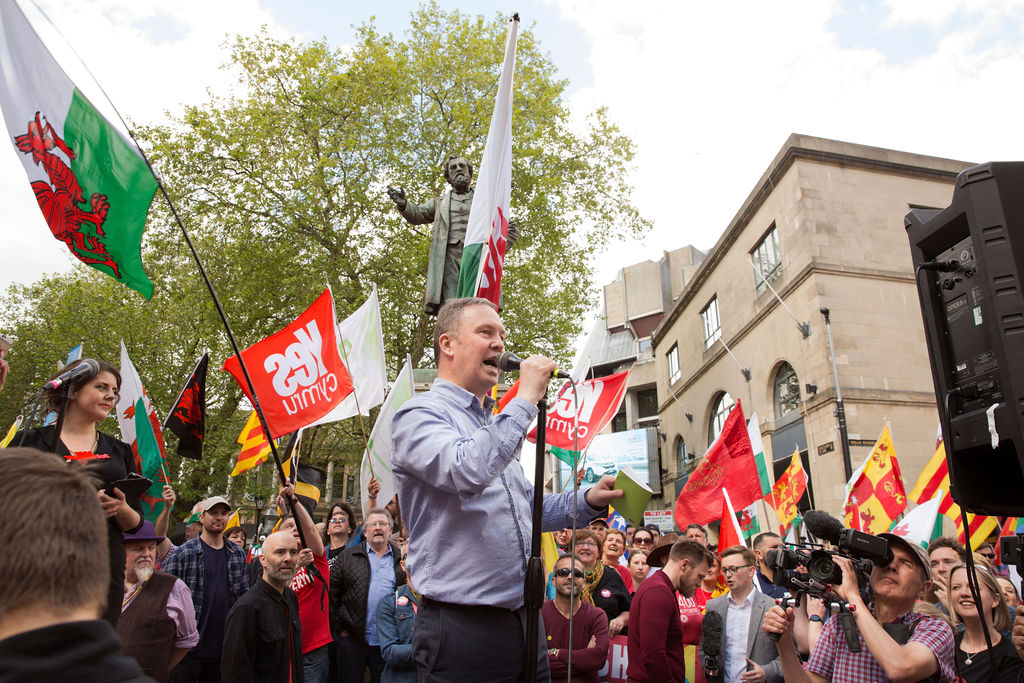
This has all been exacerbated by the pandemic, which has forced YesCymru off the streets – where everyone was marching quite literally All Under One Banner - and into online echo chambers.
I’ve followed many a long thread about YesCymru on Twitter and asked myself, ‘What exactly are they arguing about? And what exactly do they want done about it?’ And had honestly no real idea.
The number of messages I’ve received from confused members suggests that I’m not the only one who hasn’t quite grasped why everyone suddenly seems to hate each other, either. There’s a fundamental lack of communication going on, and what is doesn't seem geared towards reaching any sort of mutual understanding.
As ephemeral as social media is, however, the stakes for YesCymru are very high. It is no exaggeration to say that of the movement doesn’t seek some kind of unity soon then it could flare out as quickly as it had begun.
[mid-content-banner]
Divides
Welsh history is littered with examples of how proto-independence movements came off the rail very quickly. Perhaps the most prescient in the case of YesCymru is that of the Cymru Fydd movement in the 19th century.
The organization was founded in 1886, led by MP Tom Ellis, who had declared his support for self-rule for Wales during his successful election campaign in Meirionnydd in the same year.
There was also a great deal of support for the movement among some of the most influential Welsh political actors and thinkers of the age – future Prime Minister Lloyd George, national newspaper publisher Thomas Gee, and academic John Morris Jones all attended a conference to officially establish the movement in 1894.
As well as devolving power from London for Wales, Cymru Fydd wanted to set up branches in all parts of the country in order to put pressure on parliamentary candidates to support their objectives.
As Dewi Rowland Hughes said: “… the strategy was to form the nation itself into one major pressure group - a national pressure group.” Sounds familiar?
But within a few short years, the movement fell apart, in that case mostly because of geographic divides. The northerners distrusted the southerners and vice versa, and this hindered any attempt to unite them.
The death knell was a meeting in Newport in 1896 which was packed with opponents of a united Cymru Fydd movement to skew the vote. But the real dividing line was ideological – those in the south east whose concerns were primarily economic were reluctant to work with the rural 'cultural' leaders of the north west.
With the failure of Cymru Fydd, any secure hope of Welsh autonomy died out until the 70s of the following century.
And in hindsight, many of the arguments seem altogether of their time, without an ability to think long term. Personal dislike of the central actors such as Lloyd George himself coloured many peoples’ objections. There was a focus on what divided them, rather than what they could all gain by setting their differences aside.
And Cymru Fydd didn’t even have to worry about social media!
Unity
Imagine if Cymru Fydd’s plan had come to fruition back in the 1890s – over a hundred years before the people of Wales voted for autonomy again. Think of the opportunity that was lost there, that would not be offered again for a generation.
Will YesCymru become another Cymru Fydd? That’s not guaranteed at the moment. Perhaps the movement will pull itself back together, as it did in 2018.
But for the moment it is standing very close to that same ledge, with differents factions busily burning the bridges that would it allow it to retreat from that precarious position.
If they don’t want to tumble over that cliff, those in YesCymru need to seek proper dialogue on the issues that divide them.
There are no doubt wider political forces that will divide people. But as the experience Cymru Fydd shows, there are always wider, divisive political forces at play at any time.
But they come and go, and the key to the survival of any national movement is to be able to bridge them.
I would make three suggestions for YesCymru, based on the experience of Cymru Fydd:
- On a personal level, people need to start showing each other a level of respect, grace, and - even where they fundamentally disagree - stop thinking the worst of each other.
- Accept that people in leadership positions may not always get it right, and they can be criticised for that. But they are often doing this for free, and because no one else stepped forward to do the same job. There should be a fundamental acceptance that they are, at least, trying their best. Criticism, particularly personal criticism, hurts and good people, like Siôn Jobbins, lost. The Welsh national movement doesn’t have that big a subs bench – YesCymru can’t afford to lose its Siôn Jobbinses.
- The movement’s leaders should make sure that the movement is as transparent as possible and as democratic as possible. This isn’t just because as much participation from members as possible is good in and of itself, but it also rids us of the kind of conspiracising, finger-pointing and shenanigans that collapsed Cymry Fydd.
Everyone in YesCymru should remember that they are there because they all ultimately have the same central goal.
That central idea has been strong enough to make YesCymru the fastest growing political movement in Wales, with more than 18,000 members.
It has grown so quickly because those members come from all different backgrounds, parties, identities, age groups and ideologies, not despite it.
If YesCymru can get through this difficult patch, it can emerge out of the online echo chamber, and get back to marching All Under One Banner again.

Support our Nation today
For the price of a cup of coffee a month you can help us create an independent, not-for-profit, national news service for the people of Wales, by the people of Wales.
Get more trusted Welsh news
Choose Nation.Cymru as a preferred source in Google News to see more of our journalism.
