
Opinion
Yes, there is a way out of the crisis currently enveloping Welsh universities!

Richard Wyn Jones
Remarkably enough, the recent announcements by various Welsh universities that they intend to cut jobs – and even close entire departments – seem to have come as a shock to many politicians and commentators.
One can only assume that they must have been planting their heads deep in the sand choosing not to see what has long been obvious to anyone paying the slightest attention.
Namely this: the current funding model for our universities has completely failed and without a change in policy, the only possible response from these institutions was to institute very significant cuts.
In a column that I contributed to the June 2024 issue of the Welsh language current affairs magazine, Barn, I prophesied the following.
Assuming that universities will want to rid themselves of around 10% of their staff, which seems a reasonable assumption, there is no way that that can be achieved without significant compulsory redundancies and the closure of departments.
We can gain a sense of the likely scale by recalling that, in 2022/23, Swansea employed 3,860, Aberystwyth 1,860, Bangor 2,090, Cardiff 7,075, Trinity Saint Davids 1,635, etc.
Thus, the human impact is set to very significant.
[mid-content-banner]
Fire sale
The communities that depend on these institutions are certain to be further damaged by a fire sale of the ‘surplus’ properties currently owned by universities – further fuelling the decline of town and cities that already find themselves in a pitiful condition.
As I work at Cardiff University, an institution which has now announced that it wants to axe 400 academic posts and which is 'consulting' about closing whole departments, this is a prediction that suddenly feel frighteningly real.
Adding to the personal sense of foreboding is that fact my university office is part of a building that the university has recently decided it wants to offload as soon as possible. It probably goes without saying that my colleagues and I currently have no idea to where we will be moving next.
Bearing in mind that Cardiff is much the largest of our universities, it is perhaps not surprising that the most dramatic news to date has come from this institution. But let's be clear, this is only the beginning of the story in Cardiff.
At least as many of our professional support colleagues will eventually lose their jobs. Furthermore, very significant job losses are occurring in other universities across Wales, whether that has been publicly announced or is being achieved through stealth.
So, for example, Bangor has made it known that it is seeking to axe 200 posts while it is understood that Aberystwyth has already secured around 100 job losses via its voluntary severance scheme – again with more to come.
[lower-mid-content-banner]
Inevitable
All of this represents the inevitable and completely predictable result of political decisions taken in Cardiff and London not to allow fees to increase for almost a decade. And let no one deceive themselves into believing that the current round of cuts will be enough to stabilize the situation of our universities and allow them to regain their feet.
The failed financial model remains unchanged. If universities continue to lose money on average on every domestic student – the current, ludicrous state of affairs – further contraction is inevitable.
What has been the political response to the news that major cuts are under way – with more the offing?
To be fair, several politicians – for example, Cefin Campbell and Rhun ap Iorwerth on behalf of Plaid Cymru, and Lee Waters on Labour's backbenches – have spoken out sensibly.
By stark contrast, however, the response from the Labour front benches has been crushingly disappointing.
 Ministers have sought to deny that they have anything to do with whole the situation. Bearing in mind that it is they who are responsible for determining the maximum amount that universities can charge in fees – which accounts in turn for the bulk of their income – this is shamefully misleading.
To repeat: the current crisis in our universities is a direct result of political decisions. Of course, the leaders of our universities have their faults.
With Cardiff's current leadership choosing to implement cuts with all the sense and sensitivity of Elon Musk’s D.O.G.E, my colleagues and I are all too painfully aware of those.
Nonetheless, the financial challenge would remain whatever leadership group was in charge.
The other claim heard from the Welsh Government is that there is simply no more money, meaning that there is nothing that they can do to support our universities beyond the very small additional amounts that have already been announced.
Misleading
Given that we are all aware of the dire state of our public services, this may appear to be a more plausible argument. Once again, however, the government's argument is misleading.
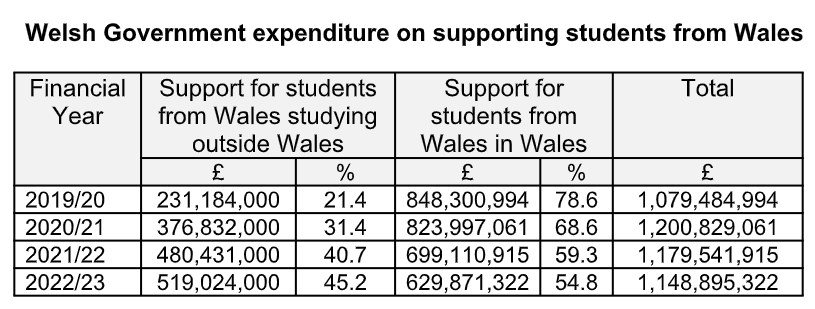
The Welsh Government currently spends money on higher education via two main routes. Firstly, approximately £200 million per year is provided directly to Welsh universities through the allocations of the body now known as ‘Medr’. But secondly, as can be seen in the Table, well over five times more than that is spent every year on supporting the current generation of students from Wales.
Of the £1.15 billion in question, over £0.5 billion is spent on supporting students who study outside Wales, the majority in universities that are no better than what is available in Wales - specifically the universities of Chester, John Moores (Liverpool) and the West of England (UWE).
Combining expenditure on universities and supporting students, the total spent by the Welsh Government on higher education is comfortably over £1.3 billion a year - a significant chunk of its annual budget of around £26 billion.
If that money were to be spent in more imaginative and strategic ways, this represents more than enough to maintain a genuinely excellent higher education system in Wales while also supporting Welsh students.
Student support
Indeed, if the crisis currently engulfing Welsh universities wasn’t enough reason to look again at the current funding arrangements it is worth recalling that Welsh Government’s system of student support is failing on its own terms as well.
Thus, students from poorer backgrounds in Wales are less likely to go to university than students from the same backgrounds from England.[1] Furthermore, students from Scotland leave university with, on average, £20,000 less debt than students from Wales even though their course tend to last longer.[2] These outcomes represent truly terrible public policy.
There is nothing inevitable, then, about the current crisis in Welsh universities. The resources exist to allow for a very different outcome. What is currently lacking is the political will and vision to change course.
[1] See both https://ifs.org.uk/sites/default/files/2024-03/Major-challenges-for-education-in-Wales-IFS-REPORT_0.pdf and https://epi.org.uk/wp-content/uploads/2024/02/UK-Nations-post-16-Report-1-FINAL.pdf
[2] See https://ifs.org.uk/publications/scottish-budget-higher-education-spending
Support our Nation today
For the price of a cup of coffee a month you can help us create an independent, not-for-profit, national news service for the people of Wales, by the people of Wales.
Get more trusted Welsh news
Choose Nation.Cymru as a preferred source in Google News to see more of our journalism.