Opinion
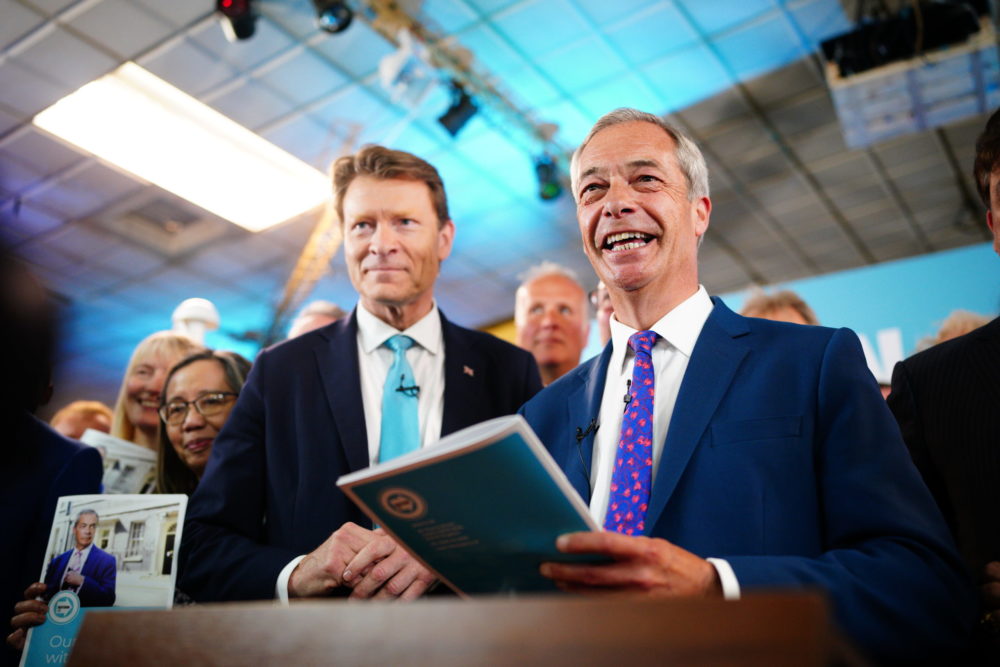
Without revealing any policies specific to Wales, Nigel Farage has destroyed our political dynamic
Martin Shipton
So far as Welsh politics is concerned, 2024 is likely to be remembered as the paradoxical year in which, despite a landslide general election victory, Labour’s grip on power was left tottering.
A number of factors have come together to imperil the party’s 102-year dominance in Wales, but if one person is to be identified as the primary cause of this historic development, it is surely Nigel Farage.
The rise of Reform UK, Farage’s own creation and successor to the Brexit Party, which he also founded, has succeeded in disrupting what had become a complacently tired pattern of political support in Wales.
A few figures illustrate the change that has occurred. They also point to the scale of the challenge Labour faces to retain its hegemony after the next Senedd election on May 7 2026.
At the last Senedd election in 2021, Labour secured 39.9% of the constituency votes and 36.2% of the regional votes.
The second-placed Conservatives won 26.1% of the constituency votes - and 25.1% of the regional votes - giving Labour a comfortable cushion of nearly 14 percentage points over its nearest rival.
Plaid Cymru came third, with 20.3% and 20.7% in the constituency and regional ballots respectively.
The other parties were way behind, with Reform UK in eighth position on just 1.6% of the constituency vote and 1.1% of the regional vote.
[mid-content-banner]
Rebrand
Reform had been launched just four months before the Senedd election, as a rebrand of the Brexit Party, which had achieved its aim of seeing the UK leave the UK. Despite fielding a full slate of candidates in the constituencies and the regions, Reform was virtually invisible during the campaign and clearly seen as an irrelevancy by the electorate. Needless to say, the party was way off winning a seat.
If it was to succeed in the future, its only option was to reinvent itself with a message other than Brexit.
In that May 2021 election Labour, as it habitually did, benefitted from the “first past the post” electoral system used to elect two-thirds of Senedd Members and picked up exactly half the 60 seats.
Things had changed by the time of the UK general election 36 months later.
Labour's share of the vote in Wales had dropped slightly from the Senedd election to 37.0%, with the Conservatives still in second place, despite dropping to 18.2%. Reform leapfrogged Plaid Cymru to come third with 16.9%, little more than a single percentage point behind the Tories. Plaid dropped back from its Senedd election performance to 14.8%, although in fairness its vote was just under five percentage points up on what it had been at the previous general election in 2019.
The Liberal Democrats were on 6.5%.
[lower-mid-content-banner]
Disproportionate
Because of the grotesquely disproportionate outcomes caused by first past the post - used, of course, to elect all MPs in a Westminster election - Labour won 27 of the 32 seats (84.4% of the total), Plaid Cymru 4 and the Lib Dems 1. The Tories lost all their seats and Reform also missed out, although its candidates came second in 13 seats, with its strongest showing in Llanelli, where it was just 1,504 votes behind the re-elected Labour MP Dame Nia Griffith.
In the few short months since the general election, Reform’s star has ascended further as the UK Labour government’s popularity has plummeted. A Beaufort Research poll on Senedd voting intention undertaken for Nation.Cymru in November showed Reform on 24%, just three percentage points behind Labour on 27%, six points ahead of Plaid Cymru on 18% and seven ahead of the Conservatives on 17%.
A YouGov poll released on December 1, also gauging support at a Senedd election, showed the four leading parties grouped closely together, with Plaid in the lead on 24%, a single percentage point ahead of both Labour and Reform on 23%, with the Conservatives on 19%.
Before examining the causes and possible implications of what’s going on, from a democratic point of view it’s positive that the outcome of the Senedd election isn’t a foregone conclusion and that Labour has its work cut out if it is to remain in power. The support of the electorate should always be earned rather than taken for granted, and governments should be judged on the delivery or otherwise of their promises, not on their rhetoric.
But what do the figures show us, and can we be sure that votes at the next election will be cast following proper consideration?
Competitive
What they do confirm is that the more competitive nature of Welsh politics has been determined by the loss of support to Reform sustained by both Labour and the Tories. At the same time, the loss of support by Labour to Plaid Cymru has been on a much smaller scale. This suggests to me that Plaid remains handicapped by the long-standing perception held by many non-Welsh speakers that it is a party predominantly for Welsh speakers. By contrast, in Scotland the SNP is consistently leading in polls for the next Scottish Parliament election a few months after getting a pasting at the general election.
There’s no escaping the fact that Reform’s rise in Wales is due to the charisma of Nigel Farage. He’s no longer talking about Brexit - there’s nothing to boast about - but he’s still banging on about migrants arriving in small boats, even if few of them make their way to the parts of Wales where Reform is picking up most support.
Apart from somehow cracking down on immigration - which is a non-devolved issue anyway - Reform has yet to announce any policies specifically for Wales. So far its spokespeople have adopted a policy of not responding to journalists who seek such clarity.
This is hardly surprising, given that the performance of UKIP - its grandmother party from which Farage broke away after one of many internal rows - was always unconstructive and performative in the European Parliament.
Childish antics
Most of us can recall the childish antics of UKIP MEPs in the chamber at Strasbourg, such as turning their backs when the European anthem was played. Few can remember any positive contributions they made in debates aimed at improving the lives of ordinary people.
Those considering voting for Reform in 2026 should bear in mind that the party specialises in disrupting rather than constructing. Its elected members, from Farage down, are much more comfortable when heckling those in power than in setting out in coherent detail what they would do in government.
Farage and his lieutenants have made it clear that he’d like to be UK Prime Minister after the next general election, due in 2029 at the latest. In the meantime, they have the Senedd election to fight, in less than 18 months time.
The introduction of the closed list PR electoral system has made it likely that no party will come close to winning a majority of seats.
Polling trends
Looking at current polling trends, one potential outcome could involve a coalition or other collaborative arrangement involving Reform and the Conservatives. That would provide a headache for Farage, for his chosen emissary in Wales (I don’t buy the suggestion that Farage will stand for the Senedd himself) and Darren Millar, the Tory Senedd group leader. It would be likely to provide a huge headache for Wales too, as a party with no burning ambition to govern found itself struggling with the mechanics of government.
The likelihood is that senior civil servants would have to run the show in an even more overt way than they do at present.
The fact is that many people will seize the opportunity in 2026 to use their vote as a protest against the Welsh Government, the UK Government and even the previous Tory government in Westminster.
That shouldn’t deter the traditional parties from developing policy agendas that set out their ambitions for Wales - or from taking to task rivals who offer soundbites rather than strategies. But they’re up against it.
The elite who hold the wealth have refined the art of posing as populist champions and getting people to vote against their own best interests.
Sadly, many of those who were meant to defend the interests of ordinary people have been blown off course, thus placing us in danger of being delivered into the hands of charlatans.
Support our Nation today
For the price of a cup of coffee a month you can help us create an independent, not-for-profit, national news service for the people of Wales, by the people of Wales.
Get more trusted Welsh news
Choose Nation.Cymru as a preferred source in Google News to see more of our journalism.