


Opinion
Will Gething in power herald the rise in Wales of Reform UK?
Martin Shipton
Let’s hope it’s not an omen that the first poll published in Wales after Vaughan Gething’s election as Welsh Labour leader put Reform UK in second place on 24% - four points ahead of Plaid Cymru and as many as 11 points ahead of the Tories. Labour was in the lead on 39%.
There’s a major caveat - the Deltapoll sample was tiny, with just over 100 voters from Wales in a Britain-wide poll, so firm conclusions can’t be drawn. But it’s worth making two points. The percentage level of support shown for Reform in Wales was higher than in any other part of Britain.
And lest we refuse to believe that people in “progressive” Wales would vote in such numbers for a party to the right of the Conservatives, we must remind ourselves that Reform UK’s previous name was the Brexit Party, which in 2019 topped the poll in Wales at our final European Parliament election before Brexit with 32.46% of the vote.
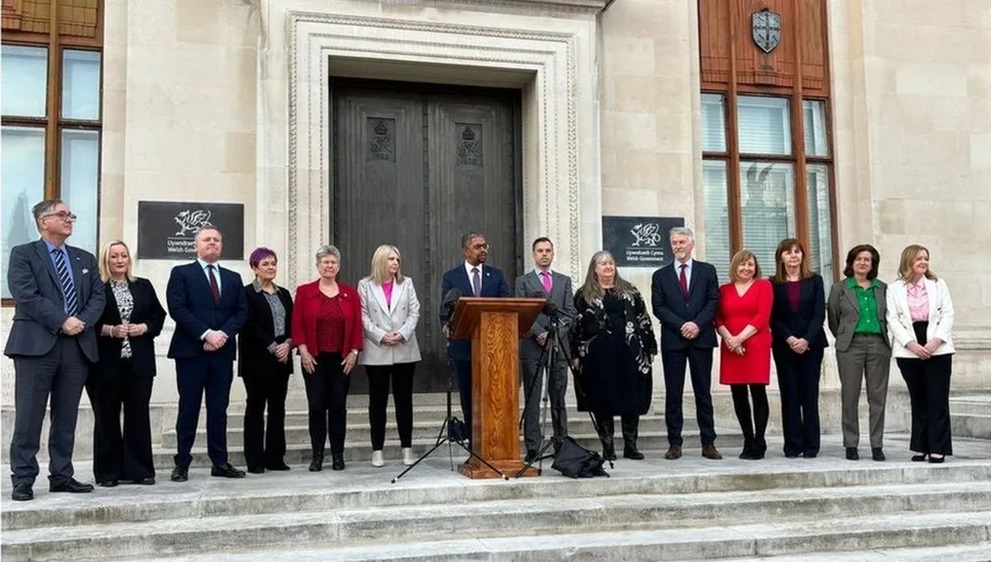
There’s something else that needs to be said. Who would believe, looking at the official photograph of Vaughan Gething’s Cabinet outside the Cathays Park HQ of the Welsh Government, that this was a happy, enthusiastic team eagerly anticipating the challenges ahead and confident in the knowledge that within months they would be working in tandem with an incoming Labour government at Westminster?
The only one actually smiling is Lynne Neagle, who when first elected in 1999 could never have dreamed that one day she would find herself in charge of the Education portfolio.
[mid-content-banner]
Discomfort
The fact is, as we know, that most members of the Cabinet would rather Mr Gething was not First Minister, and while for one reason or another they have agreed to serve under him, they have a great sense of discomfort and even disgust at the way he was elected, with a £200k donation from a convicted criminal. They know that this issue is not going to go away and that it will haunt Mr Gething in the way Partygate haunted Boris Johnson.
Not one of them doubts that Labour will win the general election when it comes later this year, but they understand that having Keir Starmer in Downing Street will deprive them of the ability to blame Westminster whenever things go wrong.
While Wales’ performance in the three crucial policy areas of health, education and the economy has undoubtedly been disappointing throughout the period of devolution, each of the three previous First Ministers - Rhodri Morgan, Carwyn Jones and Mark Drakeford - have had individual leadership skills that for much of the time allowed them to mitigate the reputational damage for Welsh Labour.
They were also helped by the lack of credible opposition and a major event like Covid which, whatever the serious errors that are now becoming clear, allowed Mr Drakeford to display a reassuringly professorial style in contrast to the offkey flamboyance of Boris Johnson.
Mr Gething’s egregious rise to power has deprived him of any similar political credit, and he can expect to take the full brunt of criticism from whatever quarter it comes.
[lower-mid-content-banner]
Embarrassment
For several years Wales’ poor performance in the international PISA tables that measure teenagers’ basic educational skills have been an embarrassment. Things have now got worse, with a devastating report from the Institute for Fiscal Studies that bluntly states how school education reforms in Wales have failed and need to be reversed.
Mr Gething’s decision to put Ms Neagle, a novice in the policy area, in charge, does not suggest any determination to take the criticisms seriously and do something about them. It will be Mr Gething, as well as Ms Neagle, who takes the flak.
We shall also have to see what impact the new First Minister will be able to have on the continuing crises facing the NHS in Wales, both in terms of waiting times and the performance of individual units that have fallen far short of expectations and in some cases are not trusted to run themselves. In the run-up to the next Senedd election in 2026, these matters will intensify in their political significance.
In the short term, Mr Gething faces the likelihood of a legal challenge to the Welsh Government’s Senedd reform plans relating to gender balance and gender self-identification. His choice may come down to performative politics (making a grand gesture while secretly accepting you’ll lose) or political expediency (making a U-turn and annoying those you were trying to please), both of which have their drawbacks.
It’s after Labour wins the general election that there will be a new dynamic in UK politics. The likelihood is that Labour will win with a handsome majority, allowing the party to implement whatever plans it wants to without fear of being ambushed by its opponents.
There will be high expectations about what can be achieved, with people expecting a short-term improvement to their living standards. Yet statements made by both Keir Starmer and his Shadow Chancellor Rachel Reeves have suggested that there will not be any radical change.
Together with other Labour politicians they have trotted out economically illiterate Tory mantras like “There is no magic money tree” and “We’ve maxed out the nation’s credit card”, with the clear intention of justifying continuing austerity and dampening hope for real change.
Margaret Thatcher
At the same time we have seen Margaret Thatcher hailed by members of the Shadow Cabinet as a visionary and mourned heroine from the past. Such rhetoric isn’t pitched at Welsh Labour’s core working class supporters in Valleys communities or even at its middle class professional voters in Cardiff and elsewhere, both sets of whom will find the attempt to rewrite history as insulting to the communities that suffered because of Thatcher’s policies.
It’s pitched at others who don’t share the values that underpinned the Labour Party when it was established - predominantly, the pursuit of a fairer deal for ordinary workers.
Mr Gething is, in fact, a perfect fit for this new and perverse form of Labourism. He likes to claim that he was helping a company in his constituency, but there’s no getting away from the fact that he lobbied (he doesn’t like the word, but I can't think of a better one) the regulator NRW, asking it to go easy on his donor’s polluting firm. The look will not improve with age.
My fear is that by the time of the next Senedd election in 2026, many voters in Wales who have been disillusioned by both the Tories and Labour will be tempted by the superficial allure of populism and vote for Reform UK.
The possibility of that will rise if Richard Tice is replaced as Reform’s leader by the party’s owner (what democratic party has an owner?), Nigel Farage.
Support our Nation today
For the price of a cup of coffee a month you can help us create an independent, not-for-profit, national news service for the people of Wales, by the people of Wales.
Get more trusted Welsh news
Choose Nation.Cymru as a preferred source in Google News to see more of our journalism.
