


Fri, 17th July Cardiff 24°
Nation.Cymru wordmark
Advertisement

Opinion

Why the next Senedd could be the least representative of women ever
By Mark Mansfield
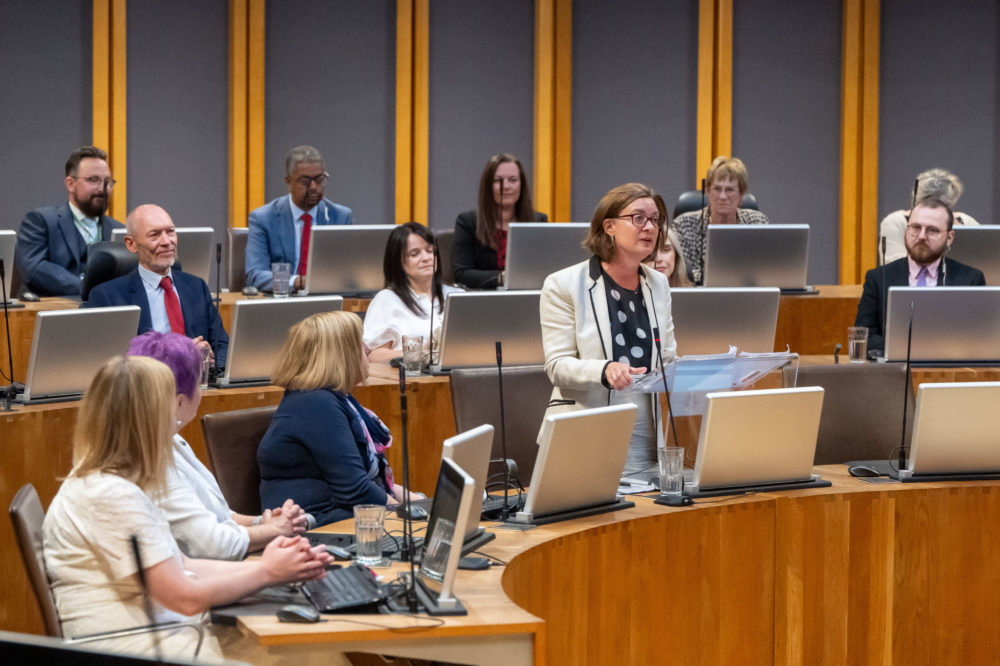
Eluned Morgan. Photo Comisiwn y Senedd / Senedd Commission

Jessica Blair, Director of ERS Cymru

The Senedd hit the headlines back in 2003 when it became the first legislature in the world to reach 50:50 gender parity between men and women.

It was a proud moment for our country and showed Wales leading the way in ensuring democratic institutions truly represent the people that they serve.

However, now that legacy is under threat.

Just over a year out from the next elections, the Senedd could once again make the news on its gender balance - but for all the wrong reasons. That is, unless political parties step up.

[mid-content-banner]

GuidanceĀ 

Earlier this week the Welsh Government published long awaited guidance around diversity, which includes a range of measures from gender quotas, diversity plans and the collection and publication of diversity data.

Those of us with a long memory may recall some of this was part of a bill to introduce statutory gender quotas.

That Bill was dropped in September, and in its place we now have this guidance.

The key difference here is that last year’s bill would have made gender quotas mandatory, while this new guidance leaves it up to political parties to decide whether or not to adopt these measures - meaning that some may choose to ignore them altogether.

The risk here is that many will choose to do the latter.

The Senedd’s positive record on gender parity has historically been the result of parties voluntarily utilising measures like all women shortlists, zipping and the twinning of constituencies. All of which are strategies that basically ensure there’s a good number of female candidates in places where they are more likely to win seats.

That is what led to the record breaking numbers we saw in 2003. But dig below the surface and the reality is that only a couple of parties have used measures like this, and by chance they have done well at Senedd elections, essentially inflating the success of voluntary positive action.

[lower-mid-content-banner]

Fragmentation

The risk now is that few parties will introduce the measures recommended in the guidance, and with polls showing a real split in voter intention it is likely the next Senedd will be made up of more parties.

As a result, if these polls bear fruit then this fragmentation could lead to a Welsh Parliament that is less representative of women than ever before.

In addition to the measures on gender balance, the guidance also includes recommended provisions to improve broader diversity in the Senedd. Suggesting parties measure and publish data around the diversity of their candidates, and take diversity and inclusion seriously through a specific strategy.

This is absolutely where parties can do better, particularly around ethnicity and the representation of disabled people.

Currently, 5% of MSs come from an ethnic minority background, slightly lower than the Wales average, and there is no data around those who identify as disabled whatsoever.

Quotas

The reality is that grasping the nettle on measures like quotas, better data, and tackling the culture within parties to offer support to a more diverse range of candidates will benefit us all.

Apart from 2003 in Wales, women have been underrepresented in every other previous parliament across the UK.

We know that having diverse and equal representation leads to better decision making.

Wales is a diverse country and studies show that political institutions with gender parity can be viewed as more legitimate, with their decisions seen to be fairer.

In short, those sitting in the Senedd Siambr should truly reflect the broad life experiences and perspectives of all people in Wales.

With this guidance published the responsibility is now squarely on political parties to step up and ensure Wales doesn’t squander its world-leading legacy when it comes to gender balance in its parliament.

They must take on this responsibility, commit to introducing these measures to ensure that equal representation is a basic requirement of our democracy rather than just another missed opportunity.

For the price of a cup of coffee a month you can help us create an independent, not-for-profit, national news service for the people of Wales, by the people of Wales.

Get more trusted Welsh news

Choose Nation.Cymru as a preferred source in Google News to see more of our journalism.

Choose Nation.Cymru as a preferred source in Google News

31 comments

harrisR

"In short, those sitting in the Senedd Siambr should truly reflect the broad life experiences and perspectives of all people in Wales" Life experience currently as career/ professional politicians with salaries & lifestyles way beyond the expectation & experiences of most of Wales? "Only Connect"? Not so much. But then, that's what this Project was always all about. And please, not the all evasive slippery graduations of "gender", it's sex.

Reply
Another Richard

To be properly representative, half the members of the Senedd should be below average intelligence, and 28% of the male MSs should have criminal convictions. The self-evident (one would hope) absurdity of this statement shows up the absurdity of assuming that the Senedd should be an actual microcosm of the people of Wales. What really matters is not what the Senedd looks like, but whether it makes wise, well-informed decisions in the interests of the people of Wales. Anything else is a distraction.

Reply
Badger

Then you wouldn't mind if they were all under 21.

Reply
Rob

It would not be ideal, but if thats what the Welsh electorate vote for than so be it.

Reply

In reply to Rob

Badger

They can only vote for the candidates that are standing so that's not possible unless it was mandated. But perhaps it could be mandated because young representatives could be paid less so that would be better taxpayer value for money. And as the OP points out, if candidates don't need to be truly representative of the electorate there's no reason why we shouldn't do this.

Reply
Undecided

Nonsense article. All in favour of diversity; but good, competent diversity with real life experience as others have said. The legitimacy of the Senedd depends upon the quality of its members not quotas, data or guidelines. In that respect, we are very poorly served at the minute. Many (of both sexes) can barely string a sentence together.

Reply
Badger

Everyone has real life experience. Or do you mean your life experiences so your interests can be disproportionately represented?

Reply
Undecided

Nope. I mean people who have actually worked in relevant sectors and can bring real expertise, rather than political researchers who become Councillors via the wider public sector and then an MS or MP.

Reply

In reply to Undecided

Badger

You seem to be confusing democracy with technocracy. We don't need experts in their fields. We don't need "wise heads". There should be plenty of civil servants to do all that. We need people like all of us to represent all of us in government. Who is going to represent young people if everyone is over 60 with 40 years of "real experience" under their belt?

Reply

In reply to Badger

Undecided

You appear to be advocating that a large measure of control should be handed to unelected civil servants, so I would suggest that the confusion between democracy and technocracy is yours. Also, I said nothing about age. I’d be quite happy to have to have a young entrepreneur in the economic development brief.

Reply

In reply to Undecided

Badger

But that's how government works. When you hear Rachel Reeves disproportionately increase the NI burden on lower paid mainly younger workers instead of removing the NI discount enjoyed by mainly older workers earning over £50k it's because the unelected Treasury mandarins, mainly older people earning over £50k, are telling her that's the only option. And the elected representatives, mainly older people on over £50k, are buying it. If a much greater proportion of elected representatives were young people the Treasury mandarins might have a harder time pushing through decisions that suit them.

Reply

In reply to Badger

Undecided

I don’t deny the influence of mandarins but a bit too Yes Ministerish for me.

Reply

In reply to Undecided

Badger

There are 514,395 civil servants in the UK. Who do you think is really running the show?

Reply

In reply to Badger

Undecided

But only just over 5000 in Wales (as of September last year) with far from a majority doing policy here and at UK level. The answer to your question is that officials advise and politicians decide. Sometimes the boundaries get blurred; but it’s called democracy.

Reply

In reply to Undecided

Badger

Politicians can only decide based on what they're advised but if the choices are arranged to nudge them in a certain direction who's really in charge? If Rachel isn't given the option of removing the NI discount enjoyed by those earning over £50k but instead is given a range of NI or income tax options that hammer the poorest, what's she to do other than pick the least worst of those options? Which will no doubt be the one the civil servants intended for her to pick by intentionally coming up with worse options to make the one they want to do look better while allowing the politicians to feel like they're stopping worse from happening. Yes Minister was a documentary.

Reply

In reply to Badger

Undecided

Ministers have other sources of advice beyond the civil service and often act upon it. I grant you the standard of politicians is poor overall, but the better ones are not automatons. In any event, I suggest we call it a draw!

Reply

In reply to Undecided

Badger

This is too important to agree to disagree. Blaming bad governance on the quality of politicians is exactly what the unelected mandarins want because it lets them get on with their agenda while the little people are distracted by elections and all the political shenanigans. To prove the point look at Boris Johnson and Levelling Up. For all his faults I do believe he had genuine intentions to help the little people in the north of England. He arrived in Number 10 with an unambiguous democratic mandate to "Level Up" the UK. I believe he asked the civil service to deliver this. I believe they assured them they were on it. But what happened? Absolutely nothing except some pork barreling and a network of cycle lanes. They humoured him by spending some money in completely inconsequential ways. But why did they do nothing? There's only three possible reasons for that. Either it wasn't possible, or they didn't know what to do, or they didn't want it to happen. Well we know it's possible because the Germans did it when they reunified East and West Germany. And Whitehall is stocked with the brightest and best from Eton and Oxbridge. The idea that they wouldn't know what to do is surely for the birds. Which leaves only one reason. They didn't want it to happen. Why would any central government choose to keep the regions and nations in relative poverty to the rich centre? That's the big unanswered question that cuts to the core of all the UK's problems.

Reply

In reply to Badger

Undecided

Ok, we continue then. On levelling up , I agree it was possible; but the standard bidding process was rolled out because that’s what they had done before. Not very imaginative; but not sabotage either. The key point is that Boris (and his lack of attention to detail) failed to drive the agenda. That was essential given the disparity between London and everywhere else - and it contrasts sharply with Germany in 1990s to borrow your example. On governance (in Wales), I found Lee Waters’ recent podcasts interesting. Much of it was familiar complaints about dysfunction, frustration and limited capacity in the Welsh Civil Service; but what he failed to acknowledge was that it is devolved politicians who have created this system over the last 25 years. I see that as their failure, not a mandarin plot. We are drowning in ineffective legislation and ā€œconsultā€ around in circles, pandering to the usual suspects whilst avoiding tricky decisions. Politicians initiated most of it.

Reply

In reply to Undecided

Badger

"the standard bidding process was rolled out because that’s what they had done before" In what world was that going to produce a permanent uplift in GDP per capita, closing the gap between the poorest areas and the UK capital? It's a fundamentally flawed proposal. Any benefit from handouts ends when the handouts stop. Are you in the "they had no idea how to do it" camp?

Reply

In reply to Badger

Undecided

I agree that the bidding process was never going to produce a significant impact upon GDP nor the gap between London and the rest. I wouldn’t say I’m in the ā€œno ideaā€ camp – I’m more in the ā€œdid know, but didn’t do itā€ space. German reunification is a good example – it was a long-term, properly funded project overseen by the Handelsblatt. Levelling up was neither as a fragmented programme. But that was more down to political leadership (or the lack of it) than anything else.

Reply

In reply to Undecided

Badger

I don't see how political leadership can be blamed. Johnson's mandate was very clear, the civil service should have just got on with it providing Johnson with regular updates and escalating blockages to him. The only criticism of Johnson in this could be if the civil service came up with a bold ambitious plan and he didn't approve or prioritise it, or the Treasury rejected it and Johnson failed to overrule them. So the fact remains that either the civil service weren't up to the job or they didn't want it to happen. Of course it may just be they were angry at him for Brexit (the extra work caused by insourcing all that governance from Brussels, not out of a love for Europe) and sat on his other pet project out of spite. But that's just as revealing because they should see the benefits of closing the GDP per capita gap between London and the regions and nations. It would make the UK richer and reduce the benefits bill allowing taxes to be reduced. It should be an exciting opportunity to fix what they've always wanted to fix. You don't stop throwing buckets of water on your burning home just because your enemy arrives with more buckets. Which leads us back to the question, why wouldn't the civil service want it? Why would they want to keep the UK less rich than it might otherwise be? Why are they working against the best interests of the UK?

Reply

In reply to Badger

Rob

Are people prevented from standing because of their age? Are women prevented from standing in elections, or ethnic minorities? If a significant proportion of the electorate are getting neglected by their government then they are free to stand for election themselves.

Reply

In reply to Rob

Badger

Once upon a time the law did require that MPs had to be rich male landowners. And those rich male landowners inevitably developed laws, processes, customs and cultures that benefited rich male landowners. And most of those laws, processes, customs and cultures persist today, not least because that's the whole point of the so-called natural party of government - the Conservative and Unionist party - to resist change. So you cannot be surprised that politics and government works in ways that discourages those who aren't rich male landowners even if they are technically free to stand. You will be part of the problem if you scoff at the word "progressive" because that's what being progressive means - to change things so they work for everyone and not just work rich, male landlowners. But of course, the rich male landowners won't be happy about that.

Reply
Y Cymro

Look , you can't force the Welsh electorate to vote for you solely because you are female. Gender should not come into it. It's how good a politician you are that matters. Are you capable in your position, honest, hard working, and is she or he in it for the right reason rather than self-interest. Today too many seek election only become obsessed with celebrity rather than those who they were elected to serve. Us the long suffering public. They should remember that when they appear on Ch 5's Jeremy Vine show or as sitting MPs jet off to Australia to feature in I'm A Celebrity Get Me Out Of Here for four weeks only to donate their £4k MP monthly wage but pocket £150k+ tax free. Less they forget. We pay your wage. You serve us not we you. So do your bloody job!

Reply
Che Guevara's Fist

Do you honestly think that a man is better suited to represent women and their concerns than another women? This whole "merit" thing is a red herring conjured up entirely by those who are terrified of losing positions of privilege over others.

Reply
Rob

No, this who 'merit' thing is based on common sense, I really couldn't give a damn about the gender of my Senedd member as long as they are able to do the job properly, furthermore not all men are privileged. Eluned Morgan, Liz Truss, Margaret Thatcher, Theresa May etc, exactly how are women prevented from positions of power?

Reply
Stevie B

We need people elected on merit and ability not on gender.

Reply
Rob

People should be elected on merit and on the ability to do the job. Quota systems or reverse discrimination do more harm than good. Not just in gender but also in race. Look at the USA, every time a non-white or female candidate is in a position of power Trump supporters claim its because of 'DEI'. Its the same in South Africa, the Springbok captain Siya Kolisi opposes racial quotas in rugby. Do sexist and racist attitudes exist - Yes, but lets not give these bigots and racists any ammunition. Plenty of women have stood in the Senedd before and will no doubt do so again. I could not care if my Senedd member is a male or female as long as they have the ability to do the job and speak up for my constituents, which is all that matters.

Reply
Keith Parry

People of ability and merit are needed in the Senedd not duds to make up the numbers. Positive discrimination puts the duds in place of the people of ability as has been seen a number of times in the Plaid Cymru selection processes.

Reply
Badger

I don't understand this argument. It shouldn't be difficult to find good candidates to fit a quota so why is "ability and merit" at risk?

Reply
MarisoI Evans

Hey, now thew supreme court has chosen cruelty towards trans women, you can all stop shrieking about this now. All 250,000 UK trans women (of which about 15,000 are in Wales according to Census 2012) are broken and struggling now as the implications for their further degradation of rights has become known. Congrats cruel people. You have won. The trans comunity is bereft and despairing. Which after all is what you wanted, yes? To make the lives of people different to you miserable?

Reply

Leave a reply

Replying to Undecided Cancel

Ministers have other sources of advice beyond the civil service and often act upon it. I grant you the standard of politicians is poor overall, but the better ones are not automatons. In any event, I suggest we call it a draw!

Comments are reviewed before they appear.