


Opinion
Why the monarchy needs saving - from its admirers
Patrick McGuinness
One of the arguments to which republicans are most susceptible when it comes to defending the existence of the royal family is the claim that they are above politics. This, along with claims about the unifying power of royalty and the alleged billions they bring in tourist money, is part of the arsenal of clichés with which royalists block any sensible debate about the future of the monarchy.
Every republican knows these moves: by the end of the debate, the monarchist will typically reach for their ‘gotcha’ moment and say something along the lines of ‘Well, OK, then you’re suggesting we vote for a head of state?’, then suggest a range of more or less implausible candidates designed to make voting sound like an absurd and dangerous practice.
In the dentist’s waiting room this week, as I waited for my appointment (crowns seemed to be the order of the day, not to say the week, not to say the month), I watched – having no alternative – a few minutes of the wall-to-wall, channel-to-channel coverage. Gyles Brandreth (we get the ‘national treasures’ we deserve) was being interviewed about matters of protocol, and someone whose name I didn’t catch was giving a history of the palatial room in which some ceremonial stuff would take place. The cameras cut to various scenes and vox pops, and then to more details of who would be where, what they’d wear, the significance of this or that medal, symbol, title, etc.
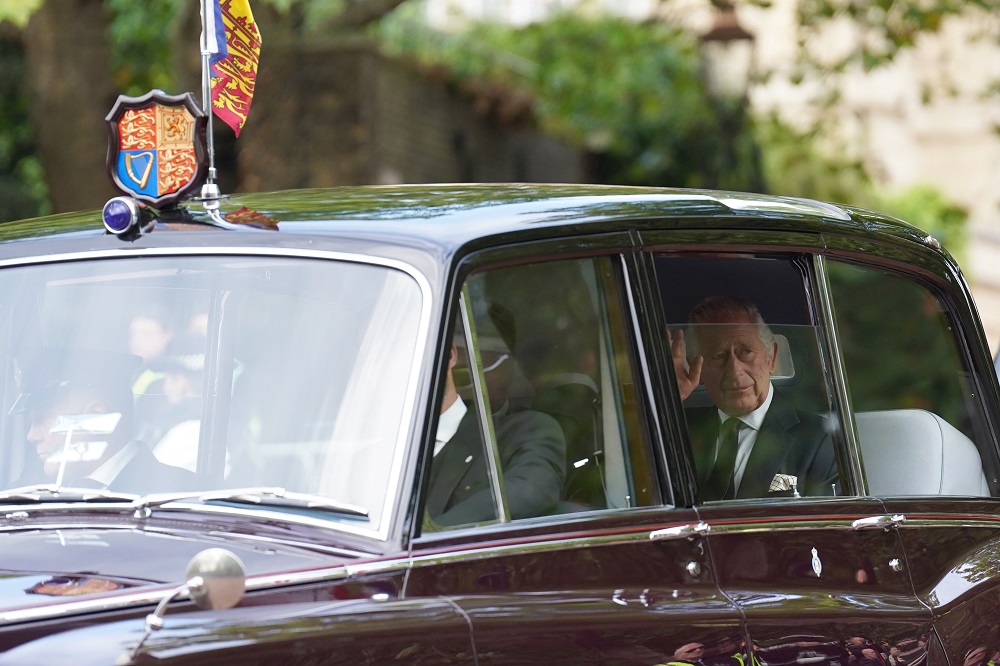
This blanket rolling coverage – day after day of genuflecting chatter, coercive sentimentality and carefully-choreographed grieving – extends across the airwaves as the queen’s coffin, like some sombre Deliveroo, makes its way across the country. With royalty, symbolism is power – not some apolitical fairyland where day-to-day politics doesn’t go. It is mired in it. See, in this context, the under-reported sacking, by Charles’s office, of 100 staff at Clarence House, or the way in which – for a royal family so invested in heritage and inheritance – he pays no inheritance tax.
[mid-content-banner]
Hard power
National mourning is normal and necessary, but there is simply no point in pretending that any element of this ongoing performance of real and symbolic power is anything other than profoundly political. From the monarch’s death in Scotland, ensuring that Scotland would be front and centre of the ‘national’ drama at the most constitutionally threatening time for the British State, to the immediate announcement, by Charles, that he was conferring the title of Prince of Wales on his son, everything about the death of Elizabeth and the proclamation of the new king is political. It has direct political ends, and immediate political effects.
Not only is it political, but it is a chance for the state to flex its muscle, to remind us that the ‘soft’ power of the monarchy is, in reality, and in the hands of an authoritarian government, hard power. From the arrest of protestors, the closing of foodbanks and the cancellation of cancer appointments, to the comical Carry On Grieving antics of Wetherspoons switching off its condom machines (and calling them ‘sheaths’), Center Parcs booting people out mid-holiday, and the British Cycling Federation advising people not to cycle on the day of the funeral, we are witnessing political power exerting itself at every level.
The best symbol of the ‘hard’ edge of ‘soft’ power is the clip I overheard, in the dentist’s waiting-room, in which the staff at the royal parks asked people to stop leaving Paddington teddies and marmalade sandwiches outside royal residences: soft toys in a hard climate, food for the dead while the living have their foodbanks closed. The paradox of the monarchy is that it claims to connect us with our history while requiring infantilism and immaturity from people and institutions.
The BBC, so keen to show us ‘both sides’ of the debate that it let Farage lie about Europe during the Brexit referendum and pitted Nigel Lawson, a chancellor of the exchequer who didn’t understand money, let alone climate change, against scientists, seems reluctant to show us both sides of this one.
Time for debate
Queen Elizabeth was 96. If, as a republican, I feel for her as a royal, it is because she began her reign with Churchill and ended it with the barefaced liar Boris Johnson. She believed in something to which she was bound, having, in her own way, no choice. She carried out her work (the word ‘duty’ is the preferred one, the mysticism and abstraction of having more of of a regal ring) as well as she could, and better than most. She attended her husband’s funeral with dignity while the politicians who lied to her held parties.
In her final years, she watched the UK being torn out of Europe and lose its place in the world, her parliament degraded, and the public sphere poisoned by shameless corruption. The Conservative party heaped more indignity on the poor woman than any republicans ever have: in her final days, she had to meet an outgoing prime minister who lied to her face, and an incoming one who wanted, once upon a time, to abolish her.
The late queen had no choice but to stand by while a substantial section of the media hounded a black princess for the apparent crime of taking her distance from a toxic pantomime in which that very same media caused the death of her husband’s mother. It’s going on now: anyone looking at Twitter or the tabloids will see that, far from showing ‘respect’ for the queen, her death is being used to fuel culture wars, promote racism and imperial amnesia, and to continue going after Meghan Markle.
The monarchy has of course been at the mercy of the media and politicians since George V changed the family’s name from Saxe-Coburg-Gotha to Windsor in 1917, fearing anti-German feeling. But when this charade ends, which it will, there will be time to have the debate about whether Britain needs a monarchy. In this debate, republicans must be able to give their views without fear of abuse or arrest, of being trolled and harassed by newspapers which, in the 1930s, ran headlines like ‘Hurrah for the Blackshirts!’.
Republicans and royalists should start marshalling their arguments, but what is clear from the last few days is that the monarchy is not above politics. For now, both sides, as well as the undecided, should be able to agree on one thing: if this country is to grow up, the royals need to be saved from their admirers.
Support our Nation today
For the price of a cup of coffee a month you can help us create an independent, not-for-profit, national news service for the people of Wales, by the people of Wales.
Get more trusted Welsh news
Choose Nation.Cymru as a preferred source in Google News to see more of our journalism.
