


Sat, 18th July Cardiff 24°
Nation.Cymru wordmark
Advertisement

Opinion

Why the future of Welsh politics will be shaped by social media advertising
By NationCymru
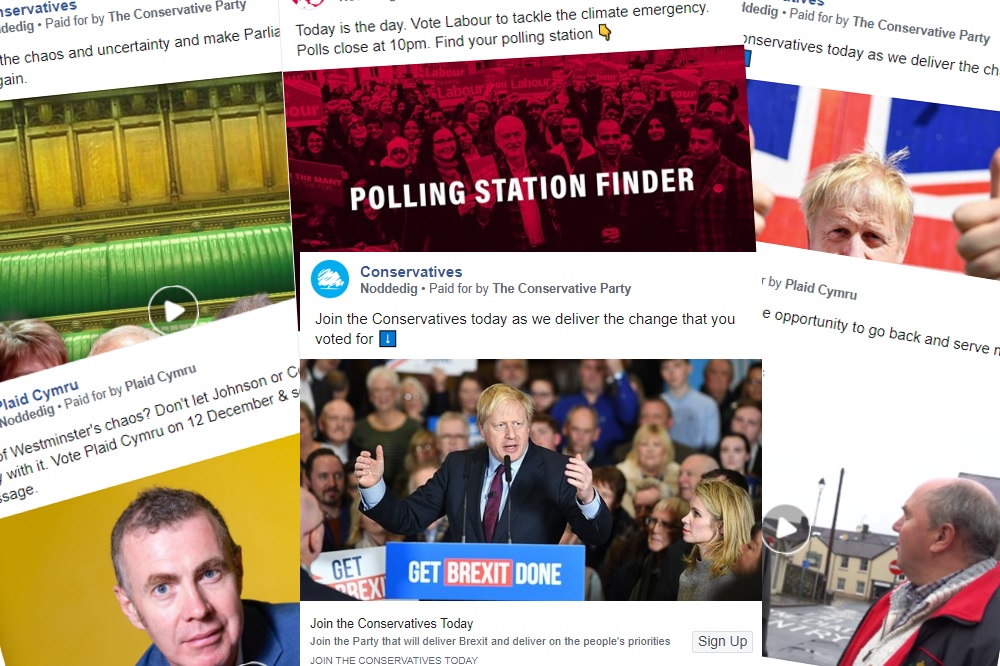
Some of the political advertisements shown on Facebook over the last few weeks

Clive King

Who paid for your vote?

I stopped taking any interest in day-to-day UK politics in September 2019. I left Twitter, skipped the BBC web site articles on the rolling coverage of Boris Johnson, Jeremy Corbyn et al.

Why? Well, it wasn’t because I lost interest in politics. It was because I felt that there was a bigger picture that I missed out on. Something else was going to decide the next election and it wasn’t the weekly sparring between the party leaders at PMQs.

I felt I had to get far away from the daily mud-slinging to stand a chance seeing what it was.

Instead, I read widely and talked to lots of interesting people. I don’t for a moment delude myself that I now have insight into the entirety of UK political life and what drives it, but two threads have caught my attention.

First, money. £5 million in donations were given to the Tory party in one week in November, but only £200k to Labour in the same week. The largest donation at the time to the Conservative was from Peter Hargreaves, co-founder of an investment platform, worth over 3 billion.

Second, technology. A million pounds buys a lot of targeted Facebook imprints. And online messaging through social media is now key to winning elections.

[mid-content-banner]

Influence

Neither is new, but both now have a massive impact on who we in the UK choose to elect to Westminster.

Labour went into the election with an advantage on the doorstep but their army of pamphlet deliverers and canvassers withered against targeted advertising delivered via Facebook and other social media platforms.

The power of political social media advertising is that it doesn’t just appear as advertising but is then spread through likes and retweets.

“I don’t trust politicians,” voters think, “but if their message comes to me via my friends on social media who are like me, I will absorb the message as if my friends wrote it.”

And there is no room for nuance in the world of online political advertising. The mental void which Labour’s messages used to inhabit was filled with simple and clear sound bites such as “get BREXIT done” and “oven-ready”.

Online political advertising works. I strongly recommend watching Carol Cadwalladers’ TED talk and Leighton Andrews TEDx talk, below (Disclosure: the writer co-ran this event). If they are only half accurate in what they say, then voters in the aggregate are heavily influenced by effective political messages.

Of course, as a leader of a political party, Jeremy Corbyn provided generous material for opposing parties to scare voters rigid with such crafted sound bites.

Online targeted political advertising, reinforced by print media, scared voters about a future Labour government setting off down a path of haphazard nationalisation, supporting terrorists, and doing/not doing BREXIT as appropriate.

Shape

And so, to Wales. The importance of online advertising through social media sites present an obvious challenge to anyone who wants to win the hearts and minds of the people of Wales.

Will Plaid Cymru or Yes Cymru be showered with money by millionaires with which they can reach voters online with clear messages on Westminster and Independence?

Or will politics in Wales over the next 10 years be shaped by very rich people who live outside the country donating to the Conservative party, whose weapons-grade online warfare will continue to the shape of Welsh Politics as a side effect?

My guess is the latter.

It’s unlikely that the current party of Government at Westminster, the primary beneficiary of private donor’s money and effective online political message dissemination, will seek to make significant legislative changes in the next five years to even up the funding and online messaging balance.

Whether party donors, Facebook, Google and friends will have their wings clipped, with a ban or restrictions on political advertising, could be determined by the outcome of the 2020 US presidential election in November.

In fact, the US election could well have a bigger impact on the future of politics and well-being in Wales than the 2021 Assembly elections.

For the price of a cup of coffee a month you can help us create an independent, not-for-profit, national news service for the people of Wales, by the people of Wales.

Get more trusted Welsh news

Choose Nation.Cymru as a preferred source in Google News to see more of our journalism.

Choose Nation.Cymru as a preferred source in Google News

17 comments

Vicky Moller

scary and true, The only safe route out of this trap is awoken and to be awoken, empowered voters. Voters taking more notice of human networks than virtual. Ceredigion is a well networked socially active county. Hopefully an example of the way to go. And yes we need to use IT networks too, using money and human nodes to amplify where we lack money. We should learn from success, tanker turners like Neil McEvoy. We live in terrifying times i feel that the public know it in their bones and are hungry for real leadership,.. locals they can trust,

Reply
The Bellwether

Hmm... Leighton Andrews is probably not the best presenter for these listicals although, chwarae teg, he does his best! An ex-politician from an essentially moribund party whose use of social media is ham-fisted and underinvested (compared to the Tories). Cue the dead parrot sketch.

Reply
Maureen Branstone

Well I don't know what social media Mr King subscribes to, but my Facebook and Twitter were dominated by Labour supporting ads and comments to the extent that I thought they might get close to winning the election, and there have been plenty of commentators making similar remarks. How wrong was I - and much relieved too. Social media is where people get information from like-minded people, and it has become an echo chamber. And a nasty one at that - so much vitriol. I think the result is much more down to bad policies that became increasingly unrealistic the more Labour threw into their manifesto - money really would have to grow on trees for all the things they wanted to spend money on. That and complacent MPs who have neglected their "safe seats" for too long. It is easy to say big money is what dominates elections, but let's not forget that there are over 60 million people in the UK, so £5 million is 8p to spend on each one. Hardly extravagant.

Reply
Clive King

Hi Maureen. That is interesting. All I saw was Tory ads on Youtube [ As I mentioned I had left Twitter and Facebook ]. I did get up to 2 phone calls a day from the Lib Dems which got annoying. What you see depends on your online profile and where you live.

Reply
Huw Davies

As is the case with most products and services I find myself just ignoring political messages, or even worse for them asking questions ( of myself) like "what fibs or big lies is this cnut trying to float past me now ? " The day of taking anything at face value is long gone. Ask non-voters, the great abstention class and they'll tell you their main reason for shunning the process is that they don't trust any politician. So all the e-spam, junk mail and other comms ( only 2 or 3 phone calls from oily little geeks ! ) was to no avail. As for political donations the best you can make is to a charity whose aims you broadly share that doesn't have an expensive bunch of directors !

Reply
Michael CROWLEY

You are correct Maureen , The Week before the election YouTube vids were festooned with Labour advertisements , one in particular was the ad which showed events from the Miners strike , it depicted Boris Johnson as the spiritual successor to Margaret Thatcher and basically asked Labour voters to not vote Tory because of events more than 35 years ago ! As for FB , the Labour party asked activists and Labour supporters to Bombard FB with Anti Tory , ( Most often the Death of the NHS ), posts , particularly after the Dismal performance of Jeremy Corbyn on the Andrew Neil Interview .. I've got several Labour supporting friends on Fb and they were relentless in posting Memes and political propaganda .

Reply

In reply to Michael CROWLEY

jr humphrys

Boris Johnson did very well on the Andrew Neil interview. Neil didn't catch him out once!

Reply
Ken Barker

As you say, "where you get information from like-minded people" - almost an echo chamber. We and our political friends need to be aware of, and smarter, about social media messages; how we encourage new audiences in a world where media messages seem to divide us into two or more social / political communities.

Reply
Leigh Richards

It will indeed, and those of us who want to see Wales taking its place in the world as a progressive independent nation have to be active on social media - taking our message directly to the people of Wales via Facebook, Twitter etc. We can't leave the field of social media to the wealthy right wing British nationalists who bought brexit for the leave campaign and who bought the recent UK GE for the tories

Reply
Simon Gruffydd

The truth is opposite to what is stated here. The reason the Conservative party attracted more big spenders is because they were the safer bet to place their investment. (Money buys influence.) If the Labour had been poised to win, big money would have been tipped in their balance. Labour lost because their platform was confused not credible. No amount of advertising spending would significantly alter that fact. Ditto Plaid Cymru. If they persist with their progressive globalist policies, no amount of spending on advertising will change their fortunes. Unlike the author of this article, I don't believe people, (by and large), are that stupid.

Reply
Clive King

Thank you Simon for your thoughts. I am not sure why you read into it that I thought voters are stupid. Space is the enemy of accurate and the world is always more complex than you can fit in 600 words. You rightly point out some aspects for which there was not space. My possibly flawed logic is that if voters are not influenced by advertising, then why do parties and groups with an interest in the outcome put so much money into messaging voters and it happens world wide. As you say money buys influence and pretty much all of us are influence by advertising, even if we don't like to admit it. The comment on human nature rather than a judgement on stupidity. Anyway, thanks for your comment and have a great 2020.

Reply
Huw Davies

The more pertinent question might be: "how can social media advertising be effectively deployed to deliver regular factually correct messages to the audience", and, "to what extent does it form a valid component in our chosen communications strategy". Finally "what are the other components of such a strategy and how should they be organised and delivered"

Reply
A Prophecy is buried in Eglwyseg

Emmigration will be banned, save the wealthy. The internet will be closed, save America. Scotland lost Bannockburn, but not Burns Night. Glyndŵr was an English peasant, Agincourt becomes a charade of intent. Hide your history, it is about to be rewritten. Wales is Cornwall and Cornwall is forgotten.

Reply
Taz

I would argue that the paid for advertising campaign that the Tories subjected us to was more a substantiation of their made up truths, they were reinforcements of the lies, which had already permeated the voter consciousness. To look at digital adverts as being the major culprit is to misunderstand the role of digital advertising for political ends. Where Labour with its thousands of Momentum activists were on the doorstep, the Tories (this holds true for the alt.right in 2016 American election and the ethno-cleansing ideology in the 2019 Indian election too) the power of social media groups such as those offered by Facebook and Whatsapp had played a pivotal role in that first convincing of the voters. The paid for adverts came later and were nothing more than a reminder. The work was done at social media groups level, throuh private messaging and in a very non-aggressive way for an aggresive bunch. The left won the social media war it claims, but actually, shouting loud and calling the right of centre voters, Tory scum or brexiter-scum were just the sort of aggressive posturing that the political centre saw as an aggressive new, not to be trusted, left-wing political problem. The Tories started their campaign after the Theresa May hung parliament debacle. They slowly chiselled away at Corbyn's supposed populism, brought on the tar or anti-Semitism with a new found enthusiasm and the rest is history. Much greater understanding of digital campaigning and digital trends are required, and with that the admission that the election had been lost on 'mobile' digital platforms, more so than the old fashioned large computer or television screens. A concentrated digital approach that is capable of changing within minutes to counter situations is required, allied with easy to explain, popular policies that do not preach or make someone feel in the naughty, would be required to win the next election. No point in these massive phonebanks operated at the Unite headquarters by Labour, train the same army to sound less radical, come across as nicer, and most importantly, instil in them the ability to listen to those who are at the opposite end of the political spectrum - this would go a long way. When you talk with a pint in hand rather than megaphone shouting down, the individuals listen more and listenng individuals win elections.

Reply
max wallis

Carole Cadwalladr's case which Clive recommends is ignored by the above commentators - the editorial presentation giving prominence to the far weaker one of Leighton Andrews (how many clicked on his picture rather than her link?). Carole's argument is that Facebook has subverted our democratic electoral system - criminally subverted it through collaboration with undeclared spending including foreign funds going into Facebook advertising. The controlling shareholder Zuckerberg holds the Facebook evidence, but refused to disclose spending on the Brexit referendum to our Commons Committee. The Electoral Commission started action against Aaron Banks and Nigel Farage (in a picture with Trump and others) . We know the DUP laundered £100k - small compared with Banks and Farage's sums - and that the post-election fines have been trivial. The £-millions into Facebook advertising were invisible - and not seen by all you commentators, as it was directed to those cohorts of Facebook-users (analysed by Cambridge Analytica's criminal misuse of 87 million Facebook profiles) who were likely to be susceptible and pass on the message to their networks. Facebook has refused to stop adverts with politician lies, like that saying Turkey's millions were about to join the EU. Aaron Banks refused to disclose the source of his hue donations and his links with Russians linked to Putin's rogue state. Boris Johnson suppressed the Commons report on Russian interference. £5 million came into Conservative Party coffers in one week in November (when the LP received £200k) says Cadwalladr. It's certain the General Election was similarly subverted (perhaps moreso and with zionist money) to the Referendum. Certain too that Boris Johnson will do little or nothing to fix our broken electoral system. Labour's banks of phone-callers, old-style, were powerless against the money and power of Facebook advertising, often lying but also using Corbyn's slip-ups. Cadwalladr illustrated Facebook's power by comparing on-street messages in Eddw Vale saying "had-enough-of-EU" and "immigrant/refugee threats" with the reality of Euro £-millions into Ebbw Vale and the lowest fraction of non-Brits there. We challenge and limit the lies in our traditional media but can do nothing about Facebook's advertisers. And as Cadwalladr says, you politicos are not even aware what's hit us. How Britain reacts was a test case for electoral subversion - and we've failed.

Reply
Gaynor

Absolutely spot on apart from yoyr stupid zionist slur,.

Reply
Walter Hunt

Grooming only works if the people being groomed don't know they're being groomed. Those lucky enough to have disposable income already have what they need. Successful advertising is about convincing people they want something that they didn't know they wanted, don't need and will leave them worse off financially and possibly in other ways. This is achieved through "Data Mining" combined with increasing sophisticated understanding of consumer psychology and message targeting. These methods are directly transferable to, and of obvious interest to, those who seek to further goals which are not in the interest of the majority.

Reply

Leave a reply

Replying to Gaynor Cancel

Absolutely spot on apart from yoyr stupid zionist slur,.

Comments are reviewed before they appear.