


Opinion
Why the FAW’s epic Yma o Hyd video is a brave (and controversial) take on what it means to be Welsh
Ifan Morgan Jones
Having chosen Yma o Hyd at its song for the World Cup, the FAW have not held back with the official video released today.
The FAW could have largely ignored the meaning of Dafydd Iwan’s song and just focused on the fact that it was a good tune that fans loved singing at football matches.
However in this video – through their use of historical and archive footage - they have fully embraced the overtly political vision behind Dafydd Iwan’s song, and all the layers of meaning and interpretation of Welsh history that come along with it.
This isn’t without its controversies. It’s worth remembering that Yma o Hyd was first released at the start of the 1980s, and was very much an anti-establishment protest song.
It was written at a time of personal struggle for its author – who was leading a protest movement while going through a divorce – but also what its author saw as a national struggle for Wales under a Conservative government.
And it’s very much still that establishment, still in power at a UK level today, that the song, and this video, defines its Welshness against.
The video itself tells two stories – that of the Welsh football team’s 64-year journey to qualify for a World Cup and that of a Welsh nation coming into existence.
It also asks us to see similarities there. They have both struggled against the odds. They have both had their setbacks. But they have both ultimately triumphed despite that.
Er gwaethaf pawb a phopeth, r’yn ni yma o hyd. Despite everyone and everything, we’re still here.
[mid-content-banner]
Republican
By going through the video scene by scene we will note that it’s a very particular view of Welsh history and politics that is presented here.
‘You don’t remember Macsen, nobody remembers him,’ Dafydd Iwan intones at the start as a manuscript with Macsen Wledig’s visage appears on the screen.
Macsen Wledig or Magnus Maximus was a historical Roman Senator but is mentioned in Welsh myth as the man who gave Wales its freedom from Roman rule.
The suggestion here is that Wales once gained its independence but this had been lost in the meantime.
‘1,600 years is a time too old to remember.’
This is what might be referred to in academic circles as a primordialist view of the nation-state – that is, that Wales has always existed or has been waiting to be born, but has been somehow suppressed.
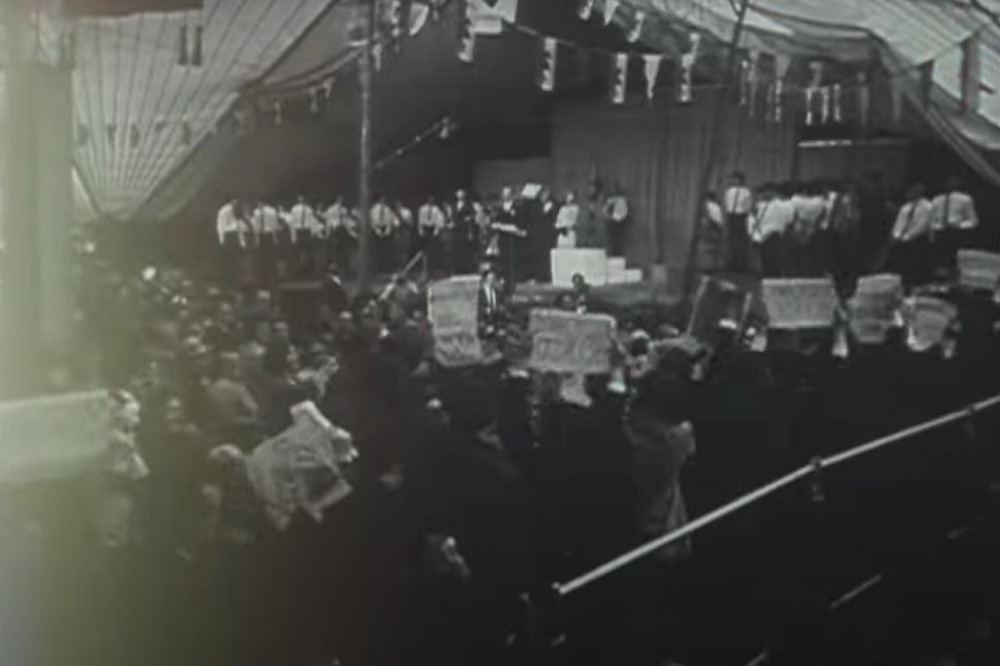
This is then followed up by archive footage of a series of protests that have defined Wales’ journey towards devolution.
There is footage of a protest against the flooding of Capel Celyn, the valley itself being flooded, a pro-Welsh language protest, and Dafydd Iwan emerging from one of his spells in prison for campaigning in the 1960s.
Perhaps most politically controversial at all we see footage of a republican protest against the (now King) Prince Charles at the Urdd Eisteddfod in Aberystwyth in 1969.
Dafydd Iwan was of course a prominent campaigner against the 1969 investiture - an event that is now of particular political relevance.
Following on from that, and in conjunction with Dafydd Iwan singing “er gwaetha’r hen Fagi a’i chriw” (despite Maragret Thatcher and her supporters) we get footage of the General Strike and Miners’ strike in the 1980s.
There is then a quick fire of images of Nye Bevan, Gwynfor Evans and Betty Campbell’s statue being unveiled in Cardiff, a march by the LGTB rainbow wall, and Ron Davies announcing the dawn of Welsh devolution.
This is an overtly-left wing, republican, pro-devolution and progressive and patriotic view of Welsh history. All in all, it’s as subtle in its messaging as Paul Mullin’s boots.
Triumph
Spliced throughout is footage of Wales’ footballing struggles – including Paul Bodin hitting the crossbar when Wales were a spot kick away from the World Cup in 1993.
But also here is footage of the great moment of triumph itself, with Dafydd Iwan’s call to arms at the World Cup qualification final and Wales’ players and fans celebrating that victory together.
In a way, the video celebrates a double victory – that of the Welsh team in finally reaching the World Cup, yes, but also that of what might be described as 'the rebirth of the Welsh nation'.
And from a personal point of view, as he appears throughout the video at various ages and embroiled in various causes, Dafydd Iwan himself having his once minority view of Welshness accepted as mainstream.
The music also subtly does the same job – by including not just Dafydd Iwan’s voice but that of the entire Red Wall singing along.
By doing this, it gives the impression that the entire Welsh nation has now joined in with what was at its beginning a lonely song.
All in all, this is about as overtly a political video as possible that directly links Wales’ history of political oppression with its footballing woes and triumphs.
It interprets Welsh history as one fight against injustice and for recognition, with ultimate triumph awaiting at its end if we the nation keep going.
All in all - let's put it this way - it’s a world away from the goat-cam and fireworks served up by the Welsh Rugby Union on match day.
Support our Nation today
For the price of a cup of coffee a month you can help us create an independent, not-for-profit, national news service for the people of Wales, by the people of Wales.
Get more trusted Welsh news
Choose Nation.Cymru as a preferred source in Google News to see more of our journalism.
