


Opinion
Why King Charles’ doff of the crown to Wales was a fitting bookend to 25 years of devolution
Ifan Morgan Jones
Today marks 25 years since the devolution referendum on 18 September 1997, an anniversary that has gone largely unmarked – perhaps overshadowed by the Queen’s death last week.
But by complete coincidence, King Charles’ first visit to Wales on Friday did serve as a fitting bookend to Wales’ first quarter of a century since we decided to have a parliament and government of our own.
You might think, ‘well, we don’t need Royalty to give our Senedd the seal of approval, so who cares what Charles thinks’.
But what King Charles’ visit did demonstrate is that in reality the British establishment – whatever they might claim – do now recognise that Welsh nationhood is here to stay.
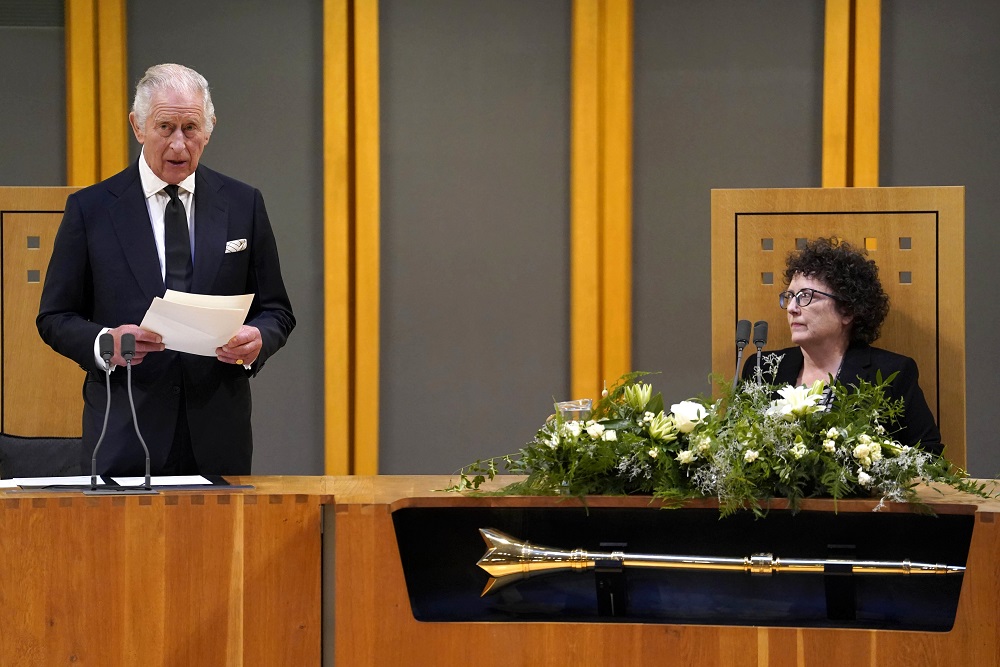
On his visit, King Charles met the Archbishop of Wales, then went to the Senedd, and had a private audience with the First Minister.
It’s worth emphasising that just over 100 years ago, none of these institutions or roles existed. Just 25 years ago, the last two did not.
King Charles’ own words during his visit also made it clear that the British establishment is in no doubt that Wales's nationhood is now the settled will of its people.
Delivering half his speech in Welsh, he referred to Wales as a “special country” and was even moved to mention the Tywysogion that led Wales as an independent nation, pre-conquest.
It was clear that a great deal of thought and effort had gone into his words, and they were all the more remarkable when juxtaposed with the ‘muscular unionism’ of the UK Government.
It showed that while the likes of here today and gone tomorrow politicians such Lord Frost can claim that Wales isn’t a nation, the British establishment at its core understands the reality of Welsh politics.
A Conservative government can get voted out of office, regroup, and come back at the next election. But the Royal Family have to take the long view, for their own survival.
Charles III will be very aware of the history of Charles I and Charles II, and know that the very concept of a British monarchy has had lucky escapes in the past.
He couldn’t gaslight Wales for short-term electoral gain. He had to win Wales’ approval as it is – and that meant aligning himself with what Wales is and what the people of Wales think, not Wales as the UK Government wishes it was.
He knows that the way to keep his kingdom together is to recognise and make feel valued its constituent parts in all their individual distinctiveness.
[mid-content-banner]
Ground up
While there was no doubt a great deal of enthusiasm in Wales for his visit, it will have been the boos that rang out outside Cardiff Castle that would have been left ringing in King Charles' ears.
People will say that this was a small, hard-core crowd of republicans that did not represent the will of the majority.
But it is one of the paradoxes of nations is that their futures are very often shaped by the actions of small, but very enthusiastic, minorities that want to see change.
No one can realistically claim that there was a great deal of enthusiasm for devolution 25 years ago. Only half of the voters turned out at all and the win was as narrow as could possibly be.
In the end, the future of Wales was decided by under 20% of its total population.
And yet here we are 25 years later, with those same institutions fully embraced by the nation’s population. 95% now support devolution existing in some form, according to the latest opinion poll.
That crowd booing the King outside Cardiff castle was small but had an outsized effect, with their discontent echoing across the world.
CNN even described Wales as the most ‘hostile’ of the nations the King had visited. It’s quite a huge turnaround for Wales, known until quite recently for its political quietism, has become a 'more hostile' destination for the Head of State than Northern Ireland and Scotland.
That crowd were of course condemned as being a minority, told to shut up, and called extremists.
But in the 19th century, those campaigning for the disestablishment of the Church of England and Wales were dismissed the same way.
For much of the 20th century, those who wanted a Welsh parliament and government were labelled as a fringe group.
Eileen Beasley couldn’t get her council bill written up in Welsh 70 years ago, and now here was the King of the United Kingdom delivering half his speech in that language.
In a few weeks, the same streets the King rode through will be filled with marchers for Welsh independence.
This King’s visit may have been a show of top-down authority. But its substance showed that nations are built from the ground up.
Support our Nation today
For the price of a cup of coffee a month you can help us create an independent, not-for-profit, national news service for the people of Wales, by the people of Wales.
Get more trusted Welsh news
Choose Nation.Cymru as a preferred source in Google News to see more of our journalism.
