


Fri, 17th July Cardiff 22°
Nation.Cymru wordmark
Advertisement

Opinion

Why it's young people moving out, not retirees moving in, that's a burden on Wales

By NationCymru
Elderly man

Arwyn Lloyd

There’s no avoiding it. An ageing population is costly. Countries such as Japan have struggled with rising government spending because of its changing demographics.

Other countries have sought to plug the gap with in-migration of younger working-age people. So when people in Wales say the net inward migration of pensioners from elsewhere in the UK is a burden on the Welsh budget, they’re probably right, yes?

Well, this is an issue I’ve been grappling with for a while. I’m aware that there is a risk here of those who have concerns on this issue being portrayed as anti-English. So, I really felt the need to get under the skin of this claim and look at what the data told us.

To begin with, let’s look at the claim that there are now more English-born over 65’s in Wales than Welsh-born. It was Martin Johnes the historian who was able to point me in the direction of reliable data via nomisweb.co.uk.

Here are the population figures according to the 2011 Census:
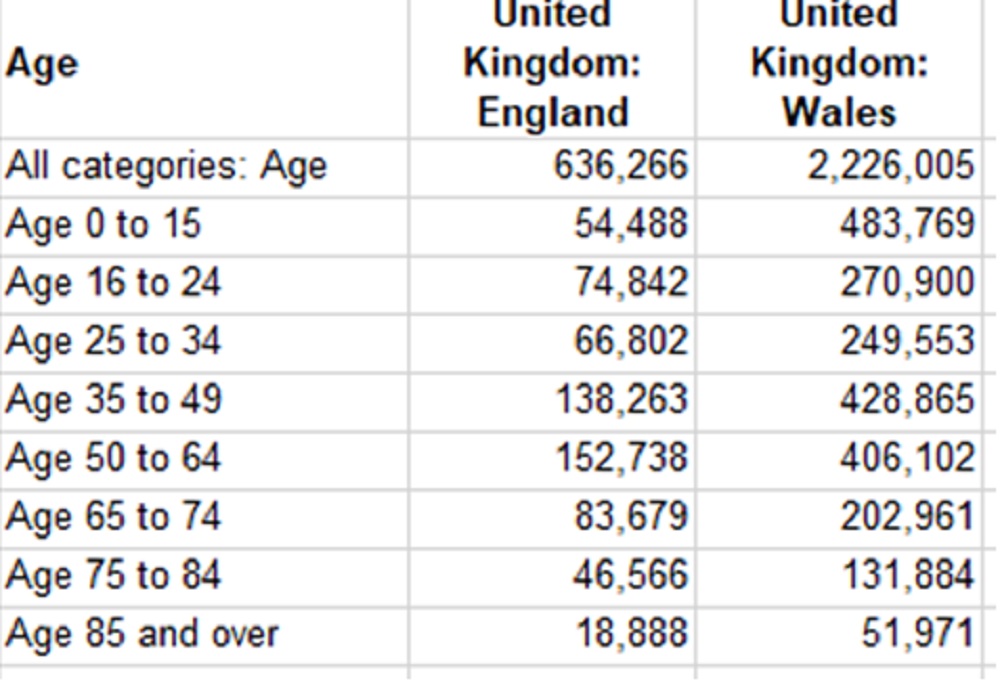
This table shows the population in Wales of those born in England and Wales. From the figures above there were 149,133 English-born over 65’s and 386,816 Welsh-born over 65’s living in Wales.

So, it is clear that the claim that there are more English pensioners than Welsh living in Wales is wrong.

Budget

What it does show, however, is that there is a skew in the demographics. Welsh-born over 65’s account for 17.4% of the Welsh-born total. English-born over 65’s account for 23.4% of the English-born total. That’s a difference of 6%.

This confirms the suggestion that many English folk are choosing to retire to Wales.

So my next question was “what cost does this occur on the Welsh budget?”

At this point it’s worth noting that the data doesn’t differentiate between English folk born in England or Welsh folk born in England so I have to be careful to point out that what follows is an estimate, taking the population figures at face value.

We should also take into account that Welsh folk also move in the opposite direction.
[mid-content-banner]
According to the 2011 Census data, there are 506,619 Welsh-born people living in England. This gives a net movement of people from England to Wales of 129,647.

Next, I looked at the numbers of Welsh-born over 65’s living in England which comes to 142,609.

So there is a difference of only 6,524 in the number of English-born over 65s living in Wales and Welsh-born over 65s living in England.

We can estimate the cost of this to the Welsh budget. According to fullfact.org the average person costs the NHS roughly £2,200 a year. The Nuffield trust gives a median cost for the over 65 of circa £6,000 per year. The maximum state pension is £8,767 a year. The winter fuel allowance is from £100 to £300 per year.

There are other services provided such as prescriptions and bus passes but going on the figures above we can estimate a cost per person of approximately £13,000 per year.

Multiplying this with the net increase in over 65’s gives a total estimated additional cost on the Welsh budget of £84,812,000.

So, a relatively small additional cost. On first sight it is clearly not a major percentage of the Welsh Government budget.

Welcoming

So what is really driving this line of argument that inflow of English over 65’s is incurring a significant cost on the Welsh Government budget? I’d argue that it is really about frustration at young folk being priced out of certain areas and fear of losing the Welsh language.

There are better ways of addressing the language issue. That’s a matter of doing more to help people integrate into their new communities, rather than stopping them coming in the first place.

I note that the recent news report on the Syrian refugee Mohamad Karkoubi achieving a Welsh learner award was much lauded in Welsh Twitter spheres. In my humble opinion, it is no different for any person choosing to live in Wales.

People wanting to retire to Wales can’t be blamed. Who can blame people for wishing to take advantage of lower living costs and a beautiful location in their retirement?

Rather than fretting it would be better if we welcomed our new neighbours and introduced them to our culture and language socially.

I came to the conclusion that the argument that English people retiring to Wales creates a financial burden on the Welsh Government budget to be a fruitless one. Not only is there the danger of prejudice inherent in pursuing that course, it entirely misses what is the greatest factor in Wales’ revenues and spending.

That is that our economy has structural weaknesses that motivate young Welsh people of working age to move elsewhere to pursue more rewarding careers. Altogether this has left a gap in tax revenues and workers in the 30-50 bracket that is costing Wales £billions.

For added context let’s consider the 2019 GERW report, which in chapter 2.1 p.20 states:

“Wales considerably lags behind the UK average in revenue per person from the major direct taxes including Income Tax, National Insurance contributions and Corporation Tax. Revenue raised per person through Income tax and National Insurance contributions was £1,690 lower in Wales in 2017-18. If revenue per person from these taxes in Wales matched the UK average, it would yield £5.3 billion in additional revenue.”

This is clearly a very significant figure in the context of the Welsh Government budget. £84 million is very small by comparison.

Later in chapter 5.4.1 p.75 of the 2019 GERW report, the subject of Wales’ demographics is addressed. The graph shows a lower percentage of Wales’ population being of working age particularly in the critical 30-50 age bracket. The report states that:

“If Wales’ population were to be distributed across individual age groups in the same way as the UK average, total expenditure would be over £1 billion lower and tax revenues would be nearly £500million higher.”

The total expenditure looks a great deal higher than £84 million. Even if we very crudely apply a multiplier for the proportion of English over 65’s we have a figure circa £200+ million. This is still far lower than the £5.3 billion figure GERW gives as a consequence of our underperforming economy.

It is decades of Unionist Conservative and Labour government economic policy with regards to Wales that has failed. That should be the focus for the Indy Wales movement.

Correcting the weaknesses in our economy should be the prime focus of independence as that is what will have the greatest positive impact on people’s lives and making our communities and country financially sustainable.

But in the meantime, we should stop saying retirees moving to Wales are a burden on our economy.

For the price of a cup of coffee a month you can help us create an independent, not-for-profit, national news service for the people of Wales, by the people of Wales.

Get more trusted Welsh news

Choose Nation.Cymru as a preferred source in Google News to see more of our journalism.

Choose Nation.Cymru as a preferred source in Google News

21 comments

Tudor Wms Rees

There is a tendency for those who go away to college to settle within 25 miles of the college they attended as undergraduates when they complete their higher education, often picking up a partner on the way. There is also a tendency for young people leaving school in Wales, to go over the border to England for this education, often being urged to do so by teachers and parents who seek to bathe in the reflected glory of their pupil/child going to a “top” English institution. This depletes us of our youngsters and of the HE funds that flow out of Wales. This phenomenon is much less marked in Scotland

Reply
Adam York

Interesting but.....Young people leaving is the big one.The big failure is any policy attempts,at all, to deal with their housing driver.Unless measures are introduced retirees from England will always outbid local kids for bought,and rents will mirror the UK nightmare.Lower pay in our area would be sustainable if housing costs were comparable,they're really not and worsening.What measures? Rent control,local residency qualification,more use of 2nd home tax,empty home tax but more than anything we have fully devolved planning powers in Cymru ie we can do whatever we like.We currently do nothing (apart from being sad that young people ,often Welsh speakers, leave. Words are cheap,action a bit dearer). PS we've got plenty of innovation and small business drive already not particularly helped by large numbers of duffers arriving!

Reply
Arwyn Lloyd

IMHO the problem of housing costs is a symptom of the weaknesses in our economy. Fix those and we will address the housing issue as a result. If we say incomers are the problem IMHO we've missed the real problem and we run the risk of demonising people for no good reason.

Reply
Rhosddu

Adam Yorke has summed up the real problems that are avoided in this article. Arwyn Lloyd is, admittedly, making a valid point, namely that the influx of English elderly is still just about affordable finacially and that their numbers here are smaller than those of the elderly Welsh -- for the time being. He can have no effective answer, however, to the point made by various subscribers that one direct consequence of this particular aspect of colonialism is unaffordable housing for local people. One other point is that unaffordable housing impacts not on educated young Welsh people, who will seldom if ever find lucrative jobs in a country that is deliberately kept poor, but on those who don't go into higher education, who seek non-professional jobs, and who wish to stay in their area and start a family. We can all agree with Mr. Lloyd, however, that the current UK set-up is to blame, that Westminster have facilitated the problem, that Cardiff Bay is powerless to prevent it, and that the solution lies with independence, or at the very least in Welsh control of English immigration under devolution -- be it the elderly wealthy or the criminal poor transferred here by English inner-city local authorities. Nevertheless, I see much in this article that advocates our turning the other cheek to this aspect of colonialism. Mae'n ddrwg geni, Arwyn, but it's a bit of an insult to propose that we should 'welcome' this population movement, just as it is pointless to make reference to the drop in the ocean represented by the movement of elderly Welsh into England. Are the Welsh buying up all the best English houses in rural England? The problem in Cymru is about far more than the financial cost of accommodating English retirees. It's about wider population transfer and demographic change. Try winning an independence referendum when the demographic balance has finally tipped againt the Welsh. The task of winning the hearts and minds of settlers to embrace Welsh language, culture, and a Welsh political future, is a laudible one, and a necessary one, but why make it even harder by keeping the door open in the way that Arwyn Lloyd seems to recommend?

Reply
Desne Davies

I am the only member of my Welsh born and bred Welsh parents in hundreds of years that was born in England. How can being 'born' in England not make me Welsh? What an insult! So what you're saying in this article you have to be born in Wales to make you Welsh, what rubbish. Its not where you're born that changes your blood line or genes. I am Welsh, my parents now deceased were pure Welsh, as were their parents, and so on and so on. All born, lived in Wales except for when my parents had me. My brother and sisters were born in Lampeter, lived in Lampeter until I was born. But according to your article I'm not Welsh, does this mean I'm not a member of my very Welsh family?

Reply
Arwyn Lloyd

Desne, I'm afraid you've completely misconstrued the intention of the article. It is not to decide who is Welsh or English or any other nationality for that matter. It is purely looking at statistics in order to address the argument that circles in some IndyWales circles that English pensioners are a burden on the Welsh budget. As you can see from the article, I disagree with that contention.

Reply
KK

I don't think for one moment that the article aimed to question ones own identity Desne but rather sought to establish facts and address the impact of retirees on Welsh communities throughout Wales. Even in the 1980s, Wales was often referred to as Costa Geriatrica owing to the high number of retired people moving to the country. With regards to your identity then there are many people who feel the same as you and in my own family I have relatives who despite sounding like someone from the Wurzels consider themselves Welsh. I think it was the prominent Welsh historian Kenneth O. Morgan who once acknowledged that feeling Welsh was as valid as being Welsh born. He should know as he identified as such despite being born and raised in North London.

Reply
Bryn Colion

How did you misunderstand the thrust of the article? Its an alarm about youth emigration from rural Wales....

Reply
KK

It is a problem that affects all of Wales though Bryn. The Valleys have lost youth consistently since de-industrialisation as have rural areas. I've seen major changes in both areas and many similarities including holiday homes, buy to let, lack of quality jobs and an increase in retirees. These aspects need to not only be acknowledged as a problem that affects just one part of Wales but should also be a determining factor in independence. Join the dots and create a cohesive political voice and movement should be the best way forward not treating problems isolated within a wider social context.

Reply
Joanne Davies

One of my closest friends is 34, Welsh-speaking, highly qualified and has tried his utmost to stay in Wales. He simply couldn't find a decently paid job despite his talents and living for over 10 years in Cardiff. He also had stints in Ceredigion and Bangor and found that it's nigh-on impossible to earn more than 35k wherever you go, for roles that pay an awful lot more elsewhere. There is no wealth-creating private sector here and spending too much time in the sinecure that is the Welsh public sector is more damaging to your CV and career prospects than taking a chance elsewhere. He's now lived in Norway, Germany and The Netherlands and his talents are far more respected abroad than back at home. I really don't see a way to fix this. By and large, young people don't want to stay in isolated villages after A'levels. They are mobile and want to see the world. If even our so-called capital can't keep people here, what hope is there? Perhaps we can learn from Luxembourg. It was also a post-industrial mess for years but it was turned into a banking and low corporation tax haven and look at it now! Can't we turn the old Glamorgan and Gwent into a 'Luxembourg' and move our public sector jobs out west and up north so people have a chance to raise families in the communities they grew up in?

Reply
Tudor Rees

We probably need to rear a generation who will, in the words of JFK “Ask not what your country can do for you – ask what you can do for your country,” Our country being Wales, it may initially mean accepting less lucrative employment, and forgoing rapid promotion, but with the benefits of being able to contribute directly to our community in these less-favoured areas.

Reply
Bryn Colion

I think the illusion of thinking highly paid jobs will give you fulfillment is the problem - Welsh believing the London wet dream.....its a lie .... Ive worked in Eastern England on higher wages than Wales...but I was happier with a closer network back home

Reply
Huw Davies

Not really an "either or" question is it ? Reducing everything to a binary choice is falling into the trap that the dunce Cameron stumbled into when fudging his Leave or Remain decision. Many of us Leavers saw that through a far more complex prism than the AngloBrit jingoists that seem so prevalent here in Wales as well as the wider U.K. Any discussion of our situation has to acknowledge both the issues to which you refer along with several others that serve to dig our hole bigger rather than lift us out of it.

Reply
Arwyn Lloyd

It's a matter of scale Huw. If we consider the financial aspect alone we are comparing a cost of perhaps tens of millions with a cost to the Welsh budget because of our GVA and missing workers of circa £7Bn. That's a factor of x100. Even as a purely economic argument pointing the finger at retirees doesn't help. It misses the elephant in the room, namely that Labour & Conservative economic policies are costing the Welsh budget billions in lost revenue. Then factor in the potential for such an argument to turn sour - something that I feel very strongly about - and it's at best fruitless and at worst highly damaging to all concerned. I don't believe we need to scapegoat pensioners when the real "villans" of our story are the governments who have let us down by their policies. That's why I make the point in the article. Our focus as a movement must surely be to show how being a part of the UK as currently composed, with Labour and Conservative governments the norm, Wales is worse off than it should be. How in one of the top economies, in one of the wealthiest continents on Earth can Wales' economy be doing this badly. We need an independent state in order to manage and recover our own economy. Isn't that the message we should put out?

Reply
Huw Davies

You have overlooked my closing point - "Any discussion of our situation has to acknowledge both the issues to which you refer along with several others that serve to dig our hole bigger rather than lift us out of it." Of late we hear of several proposed investments potentially attracting funding from Government whose underlying assumptions do no stand up to rigorous examination. Others have gone before. These suck out funding from the economy yielding a poor return, if any. Such funds could be used to retain talent by enthusing and supporting them to create their ventures, develop careers here in Wales.

Reply
Jonathon Gammond

Great article, Arwyn. Cities are the hotspots for economic activity in post industrial Britain (as they have been for centuries) and consequently most of the graduate job opportunities are in cities. You only have to visit London, Edinburgh, Glasgow, Bristol, Manchester and even Cardiff to name a few places to notice the big difference in the demographics compared to rural counties. The challenges faced by Wales as a whole are very similar to those of rural England, Highland Scotland, Dumfries and Galloway, and Ireland outside greater Dublin. Check out the challenges being faced in rural areas in France, Spain and Italy. No disrpect to the cities of St David's and St Asaph but they don't pack the economic punch of Newcastle or Leeds. The new digital economy will potentially change behaviours, but it will required more connections such as broadband speeds to ensure Wales benefits. At the moment one mile outside Wrexham and you'll be pleased to get a signal to send a text mesage, let alone 4G!

Reply
Bryn Colion

the Uk controls where business enterprises can be created.....they always create a tiny number in areas which dont need employment help ... like Glannau Dyfrdwy/Deeside

Reply
j r humphrys

636,266, tells you everything you need to know about the Welsh Brexit vote, Tory growth, cultural loss. Get, at the very least, a Jersey -type residence system going, or accept the death of your nation.

Reply
John Young

That thought has crossed my mind many times as well. The Welsh leave majority was roughly 80,000. I wonder what the vote among Welsh people was. And it IS a relevant point with such a high percentage of English people living in Wales (22%). Scotland has around 8% and NI around just 3% from memory.

Reply
Steve Lake

Slightly confusing table headings: should they read "Born in England" & "Born in Wales"?

Reply
Jan Johansen

I don't believe Spain is very displeased about all the British and Scandinavian retirees that have chosen to settle there. That is because the pensions they spend in Spain come from other countries, so its a net inflow of cash. If we use the figures in the article above, the net would be about plus £ 2500 per person. Although cost of living differences means that there is a bigger net gain for Spain. If you take a walk in the retirement areas of Spain, such as Magaluf etc, you'll see the amount of economic activity generated is fairly large. Just look at the number of business signs in English or a Scandinavian language. Its a cost for Wales because the pensions are a cash outflow from the same nation. For an independent Wales, English pensioners would be an economic resource, spending English pensions in Wales. And if Wales did not want them, I am sure Spain would woo them pretty quick. They even have a special retirement visa category.

Reply

Leave a reply

Replying to Joanne Davies Cancel

One of my closest friends is 34, Welsh-speaking, highly qualified and has tried his utmost to stay in Wales. He simply couldn't find a decently paid job despite his talents and living for over 10 years in Cardiff. He also had stints in Cere...

Comments are reviewed before they appear.