


Thu, 23rd July Cardiff 20°
Nation.Cymru wordmark
Advertisement

Opinion

Why I support the Welsh Govt's new 20mph default speed limit
By Emily Price
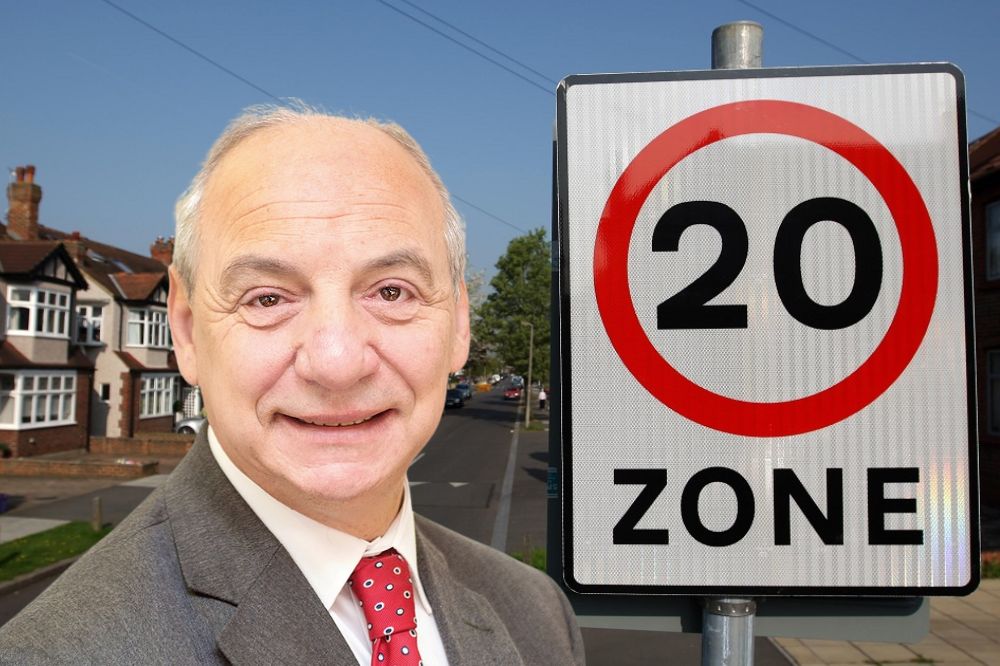
20mph speed limit sign. Photo Dominic Lipinski PA Images. Inset: Mike Hedges MS image by

Mike Hedges MS for Swansea East

I am writing this from my constituency office and not a hospital bed because I drive at 20mph or less on residential roads.

Twice in the last month I would have been in a serious accident if I had driven at 30mph.

The first was on Pleasant Street where my office is situated. Pleasant Street, like lots of roads in streets made up of terraced houses with no off street parking, is essentially a one lane road with passing places in between the parked cars.

A car drove up at 30mph which was inside the current legal limit. I was travelling down at 15mph, and we stopped about a metre apart. If we had both been doing 30mph, a head on collision would have been inevitable.

The second incident was when a car pulled out from a parking area near the Guildhall Swansea. Again I was travelling at less than 20mph and I stopped without a collision. At 30mph I would have had a collision.

There is a consensus that 20mph is a suitable speed limit on estate roads, especially by people who are living on them..

When I travel to my office in Morriston, the distance is almost exactly one mile, but the sat nav tells me it will take 5 minutes which is an average speed of 12 miles an hour.

There are motorways where the speed limit is either 50mph or 70mph and these will not be altered. The problem with the motorways is that there are too many junctions close together in Wales.

The M4 has more junctions in Wales than there are in England despite the English section being much longer.

The road system consists of A roads which are major roads intended to provide large-scale transport links within or between areas.

B roads are roads intended to connect different areas, and to feed traffic between A roads and smaller roads on the network.

Unclassified or unnumbered, which are smaller roads intended to connect together unclassified roads with A and B roads, often link housing estates or a villages to the rest of the network.

These are similar, to ‘minor roads’ on an Ordnance Survey map and sometimes known unofficially as C roads.

[mid-content-banner]

Safe

Unclassified are local roads intended for local traffic. The vast majority - over 60% - of roads in the UK fall within this category.

I regularly drive around Swansea and find that I need to drive at no more than 20mph on estate roads where most are effectively single lane with passing points in between parked cars due to cars parked on both sides of the road.

Areas of older terraced housing and council estates where houses do not have a drive mean that people cannot drive safely at 30mph.

There is parking both sides of the road as people seek to park near their home. Even newer estates where there are drives, cars still park on the road especially where drives are either very steep and have a significant slope going down or coming up.

There are areas with large houses that do not have parking on the road which exist in the more affluent parts of Wales.

Roads that are main roads or A and B designated should not have their speed limit changed - unless passing directly in front of an entrance to a school or through a shopping area.

Whilst individual councils will decide the speed limit of each road, I would expect the change to mainly effect unclassified roads.

I was contacted by a constituent who lives in Manselton on a road which is already 20mph.

They accepted that a 20mph speed limit is needed in residential areas and said that they did not wish a return to 30mph on their own street - but they also said they did not wish the speed limit to be reduced elsewhere.

I have also been told you should drive to the road condition, but as the condition is the same for everyone, why do vehicles travel at different speeds.

I would suggest if people think that 30mph is not appropriate for the road they live on, they should petition the council and if over half of the houses in the street do not want the speed limit reduced - it is not.

My experience with discussing this with people objecting to 20mph is that it is usually not for the road they live on, it is for another road they drive on.

Traffic movement at junctions should improve with a 20mph speed limit, but certainly in urban areas, A and B roads exceeding 20mph safely is currently impossible.

Finally, the key to the new 20mph speed limit working is enforcement - as long as the Police and GoSafe enforce 20mph like any other speed limit, then it will work.

For the price of a cup of coffee a month you can help us create an independent, not-for-profit, national news service for the people of Wales, by the people of Wales.

Get more trusted Welsh news

Choose Nation.Cymru as a preferred source in Google News to see more of our journalism.

Choose Nation.Cymru as a preferred source in Google News

61 comments

David Smith

Thanks Mike for taking us through your experience.

Reply
Vahan

Good points

Reply
Richard 1

I agree with all of that. I think the people who object to the new limits lack imagination - their unthinking assumption is If I can't see a problem there is no problem.

Reply
Philip Davies

Mr Lipinski's anecdotal evidence would not have sufficed for any police or insurance report, so I see no reason for accepting his uncorroborated opinion of the matter. No doubt his ultra-risk-averse approach to motoring would prefer to see only autonomous cars on our roads, although these are not flawless in their safety performance either. No point in suggesting a return to pony and trap since these also presented dangers to life and limb, particularly in busy urban situations. Bicycles, as any cycle race shows, can have terrible accidents without any other vehicles around. No, the only alternative for private transport is clearly 'Shanks's pony' - just as long as we wear those special padded suits when we go out and are not allowed to jog! Oh, and if it rains remember not to take that lethal umbrella with you. It could have someone's eye out!

Reply
Llyn

Philip's rant is a good example of the problem with the opposition to the 20mph limit. The opponents can't come out and say what they really want - to be able to drive at a faster speed around your neighbourhood and to hell with what you think. So instead their opposition comes in the form of angry, evidenced word salads and personal and childish attacks on anyone advocating 20mph.

Reply
Philip Davies

It wasn't a rant, it was a satire - a perfectly rational form of expression. I don't have the hubris to expect anyone here to agree - but all the same 15 upticks where every downtick cancels an uptick seems to indicate that quite a lot of readers 'got it'. As to your wild and reckless haste to knock me down with your ridiculously out-of-control ad hominems - well, suffice to gently say that not wanting to crawl about at the speed of a nervous learner-driver does not automatically make a motorist an irresponsible speed-freak and potential murderer. Nor did I make personal attacks on anyone. You really are an absurd little person!

Reply
Dail y Goeden

The two anecdotes with which Mr Mike Hedges (not "Mr Lipinski" - he was the photographer...) starts his article are indeed "anecdotes" - but they are backed-up, and are provable, with the solid and repeatable laws of physics: stopping distances at different speeds. As for Mr Davies' other concerns - cycle races, horses and motor vehicles, umbrellas with pedestrians, falls during exercise: they are all valid concerns, but none of them is actually relevant to the matter we are discussing here. Nor do any of them cause anywhere near as many injuries and deaths annually in the UK as do urban traffic accidents. That's why we're all trying to find an evidence-based social contract (a.k.a. rational and workable law) about speed and what level of risk we wish to accept. I support Mr Hedges and our Welsh Government.

Reply
CJPh

The inability to accept (or understand) either hypothetical or satirical language, or analogy and deductive reasoning, are massive red flags for me. The comment section here only seems to include these positions on the 1 side: the pro-20mph side. To use a solely actuarial approach focused on maximal safety here should necessitate that we dispense with cars all together. 100% reduction in auto deaths in urban areas! That'd be amazing. The issue is that, instead of focusing on growth-oriented models such as aiding in the auto industry to improve safety measures via technological means, education on proper road safety and pedestrian/cycle safety, exploring the viability of reworking the road system to maximise traffic flow by separating pedestrian areas from road areas, we must take the simplest, least popular and most punitive measures we can. The political class seems increasingly far removed from both the general public and genuine expertise in fields beyond middle management. A real shame to hear this from Mr Hedges - good bloke, awful idea.

Reply

In reply to CJPh

CapM

The points you make could equally apply to not wearing seatbelts or safety helmets. Both of which had their critics before being subject to laws requiring them to be worn. Their use hasn't caused he sky to fall in on us. Reducing the speed limit to 20mph is causing some to get into a tizz but like with seatbelts and safety helmets it will become the new normal and again the sky will not fall in on us. Realistically the anti 20mph group have an even weaker argument than the anti seatbelt and safety helmet activists. They wanted to retain the "right" to risk injuring or killing themselves rather than wanting to retain the "right" to risk injuring or killing pedestrians etc. Also "To use a solely actuarial approach focused on maximal safety here should necessitate that we dispense with cars all together. 100% reduction in auto deaths in urban areas!" We already have such urban areas. They're called pavements!

Reply

In reply to CapM

CJPh

Those critics of road safety laws remain (libertarians who advocate for a culture of seatbelt use that isn't backed by legal fiat and policing), a position that allows for the general principle of freedom to supersede the 'right' to safety. I'm swayed by their position, however I do not think that the rights infringed are egregious enough to supersede the duty of care a driver should be expected to have. Now, if it would be a new legal requirement that we all have to pass driving tests once a week in order to gain legal access to government-owned cars, that'd be too far despite the undeniable extra road safety that'd result. The 20 mph suggestion is closer to the latter extreme example. I don't believe, nor does anyone I've heard that opposes 20mph impositions, that the sky will fall if these rules come into effect. There will certainly be unforeseen knock-on effects that may dwarf the utility (lives saved in traffic collisions) - one that could occur is that increased local traffic may end up slowing both supply chains and emergency vehicles. The subsequent strains and the attendant deaths, whatever the possible outcomes of the reduced limit, isn't something that has been factored-in to any acceptable ethical degree, let alone to a degree that is statistically honest. As for the pavements point - C'mon now! Do no pedestrians get killed by cars whilst they're on pavements? Seems they don't work very well... Indeed, a small number of people die every year in auto accidents whilst in shops or sitting in their front room. As long as there are cars, there will be car-related deaths. Unless you advocate that we make every urban area pedestrian only? If so, the economic effects of this rule, if rolled out nation wide, would be something I'd be very interested in seeing projected. I'd imagine that it would be devastating, causing way more preventable deaths than deaths on the road. Sometimes a univariant goal, coupled with a univariant analysis, results in adjacent harms (goodness knows we've learned that lesson many times over in the last few decades). You think that a universal limiting factor is a mitigating factor for road deaths with little consideration for extrinsic costs, I think that non-mandated culture, better education and technological innovation is better for mitigating for deaths (with attendant loosening of legal fiats... yes, pun very much intended). The proof of the pudding will be in the eating, it seems.

Reply

In reply to CJPh

CapM

Your first two paragraphs basically use 'reductio ad absurdum' logic to argue against 20mph limits. If as you say " non-mandated culture, better education and technological innovation is better for mitigating for deaths" then we wouldn't need any speed limits anywhere. See 'reductio ad absurdum' is an easy and glib way to avoid serious debate. The 30mph limit was set in 1935. The situation has changed and there are many more cars both being driven on residential roads and being parked roadside reducing visibility for both drivers and pedestrians. Also just one of the other differences is that mobility scooters were not around in 1935.

Reply

In reply to CapM

CJPh

AAArgh! It's such a pet peeve of mine when people misuse the fallacies! I can certainly see how you'd come to this conclusion, but look closely at how the argument as presented. I do not equate 20 mph with the absurd position, I say it is closer to that extreme than the other. With the principle of freedom that drives me a lot more you can understand why highlighting the logical endpoint before the break is a legitimate stage in reaching conceptual bedrock. I also presented the other extreme endpoint, but I still do not want that extreme (no laws, total freedom on the roads). The question that naturally springs from this approach, to use a different line of argument but the same conceptual framework, is that if 20 mph still yields too many deaths on the road, would you be in favour of 10 mph? If not, why not - where does the logic fail? As for the nature of changes since the implementation of 30 mph, fair enough. But rather than changing the underlying rule, other changes could be implemented that is specific to those new variables. Special lanes are a good example. Global speed limit changes really does seem to be a massive overreaction. Local changes, agreed to be residents and local gov? All for it, case dependant.

Reply

In reply to CJPh

CapM

"Special lanes are a good example. " In many if not most cases there is no room. There are a number of websites that explain what ‘reductio ad absurdum’ arguments are and how people and organisations use them.

Reply

In reply to CJPh

Philip Davies

Thank-you God for an articulate and informed Commenter who has not yet put his brain in back-to-front.

Reply
Philip Davies

I am sincerely grateful for your correction. I apologise to Mr Lipinski if my satire happens to have embarrassed him in any way. I hope the chances are slim that I have. Indeed, I would not have believed how sensitive the readership of this journal generally are to dissenting voices, had it not been for the imprecations, howls of outrage and vicious hails of red down-ticks my every utterance brings down upon my head! Your attempted scientific vindication of a mere two personal anecdotes - in the sense of 'an account regarded as unreliable or hearsay' - is just plain silly. As some other commenters have already pointed out.

Reply
Utah

To say that the two examples given would've ended up with him in hospital is sheer fantasy. He cannot predict what would've happened had he been going 30mph. How did this delusional man get elected?

Reply
mike hedges

Some sources refer to this stage of a car wreck as the internal collision. Even though a passenger is wearing a seatbelt and the seatbelt stops the person’s body from moving forward, the person’s internal organs remain in motion until they strike bones or other internal organs. For example, traumatic brain injury can occur even though the occupant did not hit their head during the crash. The sudden stop in forward motion causes the brain to strike the skull, which can cause contusions, bleeding, tears, and other damage to the brain. Brain damage can result in permanent disabilities and impairments. A 30 mph crash has the potential of causing traumatic organ damage to the brain, heart, kidneys, liver, and other organs.

Reply
Mark Davies

Simple, he aligns himself with the woke Marxist thinking that is in force within the useless Senedd.

Reply
Mawkernewek

What did Karl Marx write about speed limits then?

Reply
Llyn

So proving my point above that "opposition comes in the form of angry, unevidenced word salads and personal and childish attacks on anyone advocating 20mph".

Reply

In reply to Llyn

Annibendod

It's a rare thing I find myself in agreement with Mike Hedges, in particular given his treacle-like thinking over Welsh Statehood, however on this point he is quite right. It appears to me that many of the commentators here nowadays have found their way over from another nominally Left-wing publication where they particularly like to congregate in the comments sections to complain bitterly about the supposedly "woke" or "marxist" Welsh Government. The comments smell strongly of gammon and chips to me! Deeply ignorant regurgitations of received nonsense, prejudice dressed up as common sense. People who love to scapegoat rather than understand. They are the tools of the capitalist class, lacking the capacity of critical thinking to even entertain a half decent analysis, instead whipping up a mob mentality to satiate their ill-conceived greviances. For the record, it would be perfectly reasonable to describe the Welsh Govt, not as even progressive, let alone woke. A very good book of well researched essays demonstrates the neo-liberal thinking at the heart of the Senedd that has so emasculated its early promise and later growing capacity to make a meaningful difference to our lives. These pub boor commentators know not of what they speak.

Reply
Mark Davies

This blanket 20mph limit is ridiculous ~ 20mph is too fast for 2nd gear and too slow for 3rd and will add to pollution in built up areas.

Reply
Llyn

There is no "blanket 20mph limit".

Reply
Sean Thompson

Mmm...what evidence do you have for your assertion (or is it just a hunch?).

Reply
Ivor Schilling

Anyone who drives with an actual gear stick knows it to be true.

Reply
Paul

There is no blanket 20mph. There is a simple a change to the mandatory speed limit. The default speed limit will be 20 unless the council decides to change it to 30. Where as now the default speed limit is 30 unless the council changes it to 20. Except for outside schools which will legally have to be 20 now, but since most councils have already changed roads outside schools that isn't a big change. NB Mandatory speed limit applies in roads without a speed limit sign where street lights are 100ft apart.

Reply
Philip Davies

If the mandatory speed limit at issue in built-up areas is being generally reduced from 30 to 20mph, it would appear to be a total and inclusive ban in that particular, and widespread, instance. That it is perhaps a loose and journalistic usage is only quibbling, and doesn't make the issue go away.

Reply
Gwenllian

This is too risk-averse. I'm a community carer and don't get paid to travel between visits. It's going to cause so much inconvenience travelling at a snail's pace - noone I know supports it. Fair enough outside schools etc. but this is ridiculous. Seems like just an opportunity to raise revenue through fines.

Reply
Dail y Goeden

I sympathise fully with Gwenllian. I agree that the two problems she reports are valid, and that both need sorting, urgently: (a) Community carers are poorly paid. (b) Payment contracts which ignore the worker's time travelling between visits are badly planned and create perverse incentives (to cut the time spent with "clients" - citizens - and to speed between visits and venues, or to do both). However, neither of these problems will be helped by drivers travelling faster than is safe and reasonable.

Reply
Mawkernewek

Snails move faster than you might think, but I've never seen them do 20mph.

Reply
Philip Davies

Your literal-mindedness is - well: Pedestrian.

Reply
Mab Meirion

This is no less true in holiday seaside resorts, these should all be twenty miles an hour. Both side parking, delivery lorries constantly, kids, dogs, pushchairs, elderly folks appearing from between two lorries no chance to stop doing thirty, and those visitors who assume that just because the locals walk down the middle of the road they can ! Been there, got to know my MP. Bless him, "sorry Mab, I tried but your local council has the last word and they won't play ball"...

Reply
Simon Hughes

From the anecdotal weak evidence produced by this MS it shows a total lack of objectiveness and speaks more of his inability to drive a modern car on today's roads. The evidence for the reduction of the speed limit as a blanket law is extremely weak. This speed limit should be for schools and hospital locations only. The introduction will result in an increase In road rage and it will cost the welsh economy dearly. The cost of implementing the law is also taking away finance from areas such as health care. Secondly, inforcement is next to impossible unless there are speed cameras on every street. Perhaps an investigation into our AMs financial background to ascertain any link to any speed camera company?

Reply
Llyn

Simon there is no "blanket law" as you claim so perhaps it's you with the "weak evidence" and a "total lack of objectiveness"?

Reply
FJholloway

Let's just all stay at home Mike and wrap ourselves in cotton wool. The labour government is a perfect example of the nanny state and why we have too many politicians interfering in people's lives. Time to have a cull of the amount of politicians and put the money back in the NHS. That will certainly save lives!!

Reply
Buk lau

You're an amateur.. if you look ahead you'd be able to see a car coming towards you at 30mph.. Don't penalize those who can drive.

Reply
Mike Hedges

Unlike you I cannot see around bends or over cars

Reply
Allan

Ian Botham was once criticised for fielding in the slips with his hands on his knees, Ian Bothams reply was do not judge others on your own reactions.,

Reply
Philip Davies

Brilliant!

Reply
CapM

The 20mph limit is going to be unnecessary and inconvenient in some places but taken overall it will save lives, reduce hospital and emergency services costs and reduce the costs due to the lost work incidents cause. It'll make pedestrians and cyclists less anxious and so encourage more to walk and cycle. It should also make choosing to use public transport a more attractive option. When it comes down to it much of the motivation against a 20mph limit is people just not wanting to change a long established habit of driving to a 30mph limit. Arguments such as fuel efficiency, lower productivity, increased pollution are in effect being used to try and legitimise a 30mph habit. Similar types of arguments were used by those opposed to banning smoking in public places. Including I think the daft prediction that smokers would erupt in a nicotine rage if they were stopped from smoking where they were used to smoke.

Reply
Dafydd

It's a speed limit and not a speed target, by saying had I drove at or above the limit I could have had a crash doesn't mean the limit is wrong just that the road conditions weren't right for that speed at that time, which is where the drivers judgement comes in. The biggest issue with lowering limits is that it incentivises the idea that it's a speed target, because that the speed most people will end up doing. Having a lower blanket limit also reduces the significance of places already designated with a lower limit, such as around schools, if you go from a 30-20 you start to think what's around that bend the sign is hinting at is it a school crossing, it also ignores times when a little burst of speed can be helpful for managing traffic flow and dangerous situations, twenty might be plenty, but when you need more you'll have to break the law.

Reply
CapM

Speed awareness courses are effective in dispelling those ideas and others besides. Doubtless because those running them have heard all such logic from attendees many times before!

Reply
Tony

20mph in some areas I agree with such as school areas but for the rest of the roads it’s a NO from me, has anybody taken into account that traffic at 20mph will create more congestion hence more confined area pollution the one thing we are trying to avoid. The next will be congestion charge because of pollution or is that the long term plan???

Reply
Dafydd

If he has almost had 2 accidents in a week just navigating the usual then he needs to overreact elsewhere and hand his licence in. Most of us haven't had an accident in a decade and all this despite hammering it about at 30 for well, decades. I suggest he calms down and reads the road better and indeed does 12mph in a busy high street but accept 30 should still be permissible and fine on wide roads with good pavements and few people about. Like many of our new 20 roads... Just wait for Go (stash your cash in a) Safe to start hammering us for 24 at 10pm on a dual carriageway :-( We should reject hyperbole and dogma and 'brave career making decisions' in search of truth and common sense rather than grind Wales to a halt on so many road and economy issues. But those days are long gone despite UK being top 3 in road safety for over a decade. There's no career or pension in that...

Reply
Mike Hedges

Suggest you actually read the article.

Reply
John Davies

Spare a thought for pedestrians. If someone is hit at 20mph, they are likely to survive. If they are hit at 40mph they are likely to die.

Reply
Robert

Dont listen to poison ,it's to much, will not help anything ,just want cars off road

Reply
David Powell

The plural of anecdote is not evidence

Reply
CapM

"The plural of anecdote is not evidence" Actually that is a misquote. The original quote by political scientist Ray Wolfinger is the reverse! ' The plural of anecdote is data.' Isn't the internet great for busting assumptions and righting wrong thinking.

Reply
George Thomas

Will cars being driven slower reduce traffic on account of slower but continuous driving is quicker than quicker driving with lots of stops and starts? Will it reduce road traffic with more people walking/getting a bus? Will it make commuting a much worse experience with people needing to add 10+ minutes driving to their day and thus making people's work/life balance worse? Will it mean more people use bikes (we don't have the infrastructure for this yet) or e-bikes/scooters (usually worse drivers than those using a car)? Will it mean more people use public transport? Well one of the trains I should be able to get into work on time I cannot rely on because it never arrives at my destination when it's scheduled to - both usually late on arrival and slows down too much between stops. What investment into bus networks to make this a better experience? Prices of public transport aren't cheap. What will it mean for businesses? We don't have strong enough position to see businesses close down due to extra costs of transporting goods. So many questions and I'm not convinced by the argument that we should let people decide on street by street basis.

Reply
Philip Davies

It is all just mad communistic Utopianism by twits in power who think far too much of their own importance.

Reply
Rob

Most people drive to the road conditions, don't drive down a narrow street at 30. The man simply refuses to accept anything but what his boss tells him. If he was in hospital he'd have trouble,as most front line medical staff travel distances of over 20 miles.

Reply
Dyn Gwyrdd

It might be good for safety and the normal fine penalty might be OK as a deterrent but the current three points on the licenses is too much. Loads of people will start losing licenses and then their jobs being reliant on cars just to get to work. the points should be lowered from three to one if the speed is not excessive.

Reply
Philip Davies

The real agenda is of course to end private motoring,

Reply
Mark friar

My concern is this lazy councillor drives 1 mile to his office and yet they say ditch the car because we are killing people and the earth. Muppet

Reply
Mike hedges

I am not a Councillor. If am only going to the office I walk but the office is where I go first,ikr and then go to other places from

Reply
Brian

I suppose it will be a lot easier at 20 mph for people to use their mobile phone.

Reply
Philip Davies

lol

Reply
Rob

Hedges are you certain twenty mph is enough? The WG thinking is we all will have EVs in about five years. Fact; EVs are heavy, very heavy, they way almost twice that of car's now on the road. If you hit a pedestrian, at 20mph you have a good chance of killing them. Where are we going to park? Multi storey carparks can't take the weight, I've seen a report that was leaked and carparks will need substantial amounts of money to get them up to standard and safety. I live in Swansea and three years ago and bought an EV. Yes the acceleration was brilliant, but the range was shocking. We got rid of it after about eighteen months, and it was almost worthless. We now have an SUV, just to get round the potholes. Once again the WG haven't thought it through.

Reply
Philip Davies

Ideology- 'the Party Lin'e - has replaced thought. These joke politicians think authority conferred the gift of wisdom upon them. Unfortunately, the popular view is that authority has deprived them of the little wit they ever possessed.

Reply
Philip Davies

This journal is so much pleasanter now it seems to be less of a deafening echo-chamber for people virtue-signalling to each other over the heads of us ignorant plebs!

Reply

Leave a reply

Replying to CJPh Cancel

Those critics of road safety laws remain (libertarians who advocate for a culture of seatbelt use that isn't backed by legal fiat and policing), a position that allows for the general principle of freedom to supersede the 'right' to safety....

Comments are reviewed before they appear.