


Wed, 22nd July Cardiff 23°
Nation.Cymru wordmark
Advertisement

Opinion

Whichever way you spin it, we are a long, long way away from seeing anything happen at Wylfa
By Mark Mansfield
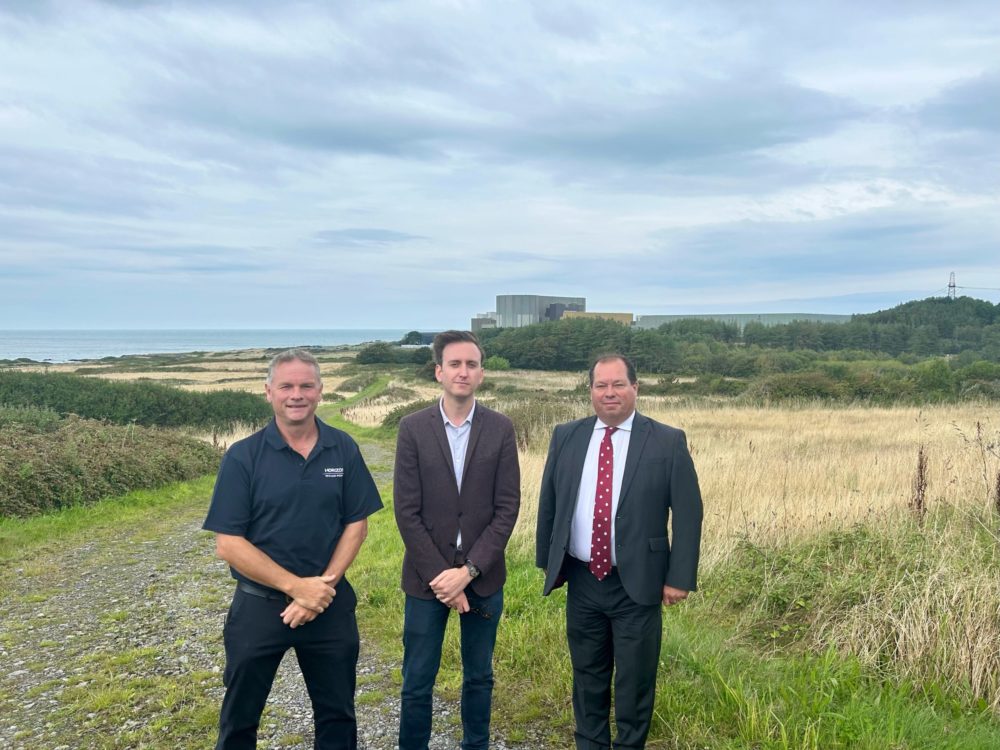
Ieuan with Gerald Jones MP and Stephen Roberts, Horizon Nuclear Power

Ieuan Môn Williams, Labour PPC for Ynys Môn

The first time I remember going to Wylfa was in the 90s on an Ysgol Thomas Ellis class trip. I vividly recall how excited we all were about seeing the inside of the station, the building busy with workers going about their daily lives of operating what was, when built, the most powerful nuclear power plant in the world.

On top of that, for me, was the added excitement of getting to see where my Taid once worked!

Last summer I went on another visit with my friend Gerald Jones MP, and walked around the empty field next door, but this time I found myself standing there with a bitter taste in my mouth.

That is why this otherwise idyllic photo of us together, in reality, makes me really angry, because we shouldn't have been able to stand there in the first place.

We should have been standing in the middle of one of the busiest construction sites in Europe, just feet away from the first reactor of the Wylfa Newydd development, the multi-billion-pound project by which was to transform our Island back to the prosperous place we all know it should be.

Rather than giving the proposed power plant a run-of-the-mill name like “Wylfa B”, the development company Horizon Nuclear Power, which was wholly owned by Hitachi, embraced the local community and culture and called it Wylfa Newydd, a name which has stuck ever since.

Yet, as is well documented, everything fell apart, and the Japanese wasted over £2 billion with absolutely nothing to show for it.

[mid-content-banner]

Theresa May

My memory again this week delivered a vivid recollection of Theresa May dismissing the collapse of the project as "a commercial matter", when in actual fact, it was her Government, the same Conservative Government we have now, which stood idly by and did nothing to save it.

It has certainly been revealing to see the lengths the Government has gone to progress the nuclear project at Sizewell in Suffolk compared to the treatment we received.

The most painful memory, though, is the one where I got the late-night phone call from the Horizon team to say it was all over. That gut-wrenching feeling is one I'm unfortunately never going to forget.

Since Wylfa Newydd fell, there has been plenty of talk about what will happen at the site. Will the Americans come? The Koreans? Or maybe the French? The list goes on. Now, with this week’s latest reports there are plenty scrambling to take credit for what is, in essence, a non-story.

It deeply upsets me to see people trying to claim all the credit for the hard work undertaken by others.

[lower-mid-content-banner]

Unwavering

Let’s not forget that it was Albert Owen, the former Labour MP for Ynys Môn, who tirelessly championed the cause, and ensured that Wylfa was on the list for new nuclear development in the first place.

Albert’s dedication to Wylfa was unwavering, and very early on he recognised its potential to bring jobs and prosperity to the region, and tirelessly lobbied governments of all parties for its development, work which I was lucky enough to see him do first-hand when I worked for him.

He understood, better than anyone, that it’s only through collective effort and genuine collaboration that the promises of Wylfa will be realised, and I’m proud to call him a mentor.

Whichever way you spin it, we are a long, long way away from seeing anything happen at Wylfa, and I for one am sick and tired of hopes being raised over and over again, only for the economic transformation of our Island to be treated as a "commercial matter", or worse, a political football, by this arrogant and cruel Conservative Government.

An unspoken, unwritten social licence for nuclear power exists on Anglesey, and I fear that this has been taken for granted in recent years, fears which I know are shared by many on the Island.

There is an IOU with Ynys Môn's name on it in Westminster, and it's about time the point-scoring ended, and we get on with the job of transforming Anglesey into a place where our young people don't have to keep leaving just to find work.

That is the future we were promised, and that is the future we are owed.

For the price of a cup of coffee a month you can help us create an independent, not-for-profit, national news service for the people of Wales, by the people of Wales.

Get more trusted Welsh news

Choose Nation.Cymru as a preferred source in Google News to see more of our journalism.

Choose Nation.Cymru as a preferred source in Google News

12 comments

Jeff

Perhaps if the money for this is directed to public owned green options, we will be in afar better place even before the last bit of concrete may or may not be poured. Adding a foreign owner into the mix increases our costs, and then there is storage of waste that will need looking after for a very long time. how is hinkley doing?

Reply
Jonathan Dean

The process to select new nuclear locations hasn’t yet been decided, and Wylfa has a lot stacked up against it The Electricity System Operator has yet to publish the national spatial plan. In 2019 the Planning Inspectorate recommended that the then proposed nuclear development be refused due to, amongst a long list of issues, unacceptable impact on biodiversity, local communities and the Welsh language. The newly revised National Policy Statement EN-1 suggests thermal power stations should be located where the waste heat (ca 60% of thermal output) can be usefully used for low carbon heating. Hitachi have already shown that this is not viable at Wylfa. The Holistic Network Design from the Electricity System Operator includes much reinforcement to accommodate offshore wind (now classed as a critical national priority) but includes no spare grid capacity for any new nuclear. It could be argued that Wylfa is one of the worst sites for nuclear development, and attention should focus on sites closer to major demand centres (eg Bradwell, Oldbury) where the grid issues will be less and the waste heat can provide an additional revenue stream.  The reason Hitachi pulled out in 2019 is because as a tech company (who sells nuclear technology) they could never own and operate a nuclear power station. This was made very clear in the public consultations. However they failed to find a buyer! The often repeated story is that they “failed to reach a financial agreement with the government”, which is simply glossing over the truth I suspect the recent news has more to do with the forthcoming election.

Reply
Philip Steele

In the Engineer Ieuan Wiiliams writes: "Frankly, why are we putting ourselves through the constant misery of dealing with anti-nuclear zealots who seem to hate science?' " I wonder what the many Labour voters who have opposed the Wylfa B project for the last 36 years make of that. And the many first rate scientists who have supported the anti-nuclear movement in the best interests of the community. The economic case for renewables is overwhelming, renewables can now do the job without nuclear and without toxic waste, and they can provide exciting job opportunites for young people. Nuclear is yesterday's technology.

Reply
Jonathan Dean

Something which could transform the economic situation on Ynys Môn, and which Westminster could act on RIGHT NOW, is offshore wind The Irish Sea off the north coast of Wales has the potential for four more wind farms the size of Mona (1.5 GW) which is currently in the planning process. This will have to happen one day or the U.K. will struggle to reach net zero, so rather than “one day” why not “right now” From the figures available from BP (the Mona and Morgan developer) this would create a greater number of permanent jobs than a new power station and require less temporary (non local) jobs during construction Holyhead port would be essential for the offshore supply vessels, Valley for the helicopters, and various business parks for the ops and maintenance bases. There is even an advantage of having a freeport (outside the 12 mile limit installation is classed as export) The latest thinking from Ofgem is offshore transmission for offshore wind is faster, cheaper and less disruptive to communities, so the lack of north Wales grid capacity is easily overcome by HVDC cables to Deeside and Pembroke from an offshore substation We could finesse this with a hydrogen plant at Amlwch and a peaking station, but let’s not go mad The thing that makes this really long term sustainable is the key things it needs are wind and the sea, things Ynys Môn has had in abundance since the beginning of time

Reply
Steve Oliver

Far from being the oft-misquoted 'best site' for new nuclear in the UK, let alone Europe (a statement penned only by Horizon's CEO with NO backing argument), significant concerns exist about a plant's potential impact on the environment, local communities, and the Welsh language, as highlighted by the government's own 2019 Planning Inspectorate's recommendation against the previous development proposal. The potential for radioactive accidents and long-term waste disposal are major concerns. The 2011 Fukushima disaster serves as a stark reminder of the risks associated with nuclear technology. The construction and operation of nuclear power plants can harm surrounding ecosystems and biodiversity, as highlighted by the Planning Inspectorate recommendation. Furthermore, the revised National Policy Statement emphasises using waste heat from thermal power stations for low-carbon heating, which isn't feasible at Wylfa. This raises concerns about its overall efficiency and potential contribution to decarbonization goals. Moreover, the grid infrastructure is ill-equipped for Wylfa. The Holistic Network Design prioritises offshore wind, a critical national priority, but lacks spare capacity for new nuclear plants. How anyone purporting to love Ynys Môn can stand in that "idyllic" field beside Wylfa and say it would be better with a nuclear power station built upon it, is beyond all comprehension. While Wylfa evidently has its supporters (not that anyone ever asks us), the site faces significant hurdles in terms of environmental impact, grid capacity, and regulatory limitations. As the debate on new nuclear development continues, a comprehensive assessment of alternative sites and their potential contributions to a cleaner energy future is crucial.

Reply
Jonathan Dean

A quick “fag packet” energy balance shows that if new nuclear stations were built where the waste heat could be usefully used then we would only need half the number of them. A 2 GW (electric) nuclear station wastes 3 GW of heat in the cooling water (usually sea water) If 1 GW of that electricity were used in domestic heat pumps, for decarbonised heating, it would produce 3 GW of central heating … if we just used the 3 GW directly from the power station, we can use the whole 2 GW for charging EVs So build them where the waste heat can be used and we only need to build half the number In Wales the only places where district heating would be viable are the north east (Deeside/Wrexham) and the south west (Swansea to Newport) Taking things a step further, co-locate the nuclear stations with hydrogen production for industrial use eg green steel making (Port Talbot would be ideal) Given that the U.K. has a pretty poor track record for building infrastructure, and nuclear has a pretty poor track record for schedule adherence, getting the most out of those we do manage to build would surely be a winner

Reply
Jonathan Dean

The reason the Hitachi project failed was because the stock exchange would severely punish a tech company had they decided to become a power utility Tech and utilities have entirely different P/E ratios, so Hitachi would NEVER have owned and operated Wylfa. They only bought the project to create a customer for their reactors. Sizewell on the other hand has always been owned by an operator (EDF)

Reply
alys

A strange radioactive dream of the future. For anyone who understands the toxic legacy that a nuclear power station leaves behind - see The Guardian's series on Sellafield 2023 -and the innumerable serious life threatening problems that come with the nuclear industry, the idea of installing round 2 of Wylfa power station is horrifying. You have to have your head stuck very far into the ground to not see the negative sides of the Wylfa part 2 argument. This a technology that threatens our future. It does not pave the way for prosperity as the nuclear industry likes to believe. Look at the storms and severe weather conditions happening across the world look at the data for rising temperatures and sea levels, look at the track record of France' NP stations in heat waves and drought periods . You can't turn an NP power station on and off . The weather is volatile and unpredictable across the world from here on in. The list of negatives is so long i never know where to start. But if you read the glossy brochures by the industry there is no mention of the negatives - broaden your research. Be wise in what you say. This time period is very precious for the future of humanity. The decisions we make now matter so much. I hope you understand that.

Reply
SundanceKid

What a navel-gazing, indulgent and sycophantic article. But what else can you expect from a pro-unionist establishment candidate.

Reply
Andrew Woods

Why don’t politicians move on from nuclear. Just because Anglesey had Wylfa doesn’t mean there has to be another one. If we kept the mindset of “but we’ve always done it that way” we wouldn’t have electric vehicles or mobile phones. Times change. Technology has moved on from nuclear. Hydro, solar, wind. That’s where the money should go. That’s where the jobs are and they are so much quicker to get up and running.

Reply
Jonathan Dean

They need it to subsidise the submarine propulsion supply chain, which at lease the new roadmap makes clear

Reply
Jonathan Dean

“… as is well documented, everything fell apart, and the Japanese wasted over £2 billion with absolutely nothing to show for it.” Actually, if you check the Hitachi share price (as I did), for the day the Wylfa cancellation was made public, their share capitalisation rose by £6 bn, so maybe not absolutely nothing. It also freed up cash to acquire ABB Powergrids (smart grids for renewables) which was what the FT were saying was their best move

Reply

Leave a reply

Replying to Jonathan Dean Cancel

They need it to subsidise the submarine propulsion supply chain, which at lease the new roadmap makes clear

Comments are reviewed before they appear.