


Opinion
What Will It Say?
Ben Wildsmith
We had friends from England visiting this weekend, so I was excited to show them round our corner of Cymru. When people aren’t familiar with the countryside around the Rhondda valleys, they are always surprised at how dramatic it is.
Looking over from the viewpoint on the Rhigos towards Bannau Brycheiniog, or back on Aberdare and Mountain Ash from Maerdy mountain, I feel proud showing it off. It’s a special area to call home.
Likewise, in the evening when we visited Pontypridd Museum for a concert featuring the sublime harmonies of Hazel & Grey alongside the aching, plangent, bilingual songwriting of The Gentle Good, I felt a proprietary swell at the cultural treasures to be found on our doorstep.
The music swirled around the old building for a sell-out crowd who were surrounded by the stunning artworks and historical artifacts that make the museum so special.
Union banners competed with Nan Youngman’s Rhondda streetscape as we waited for the music to commence.
[mid-content-banner]
Sacred ground
There was a little discomfort, though, on our drive; a new phenomenon that sat uneasily with my tour-guide enthusiasm. Climbing up from Tylorstown to Penrhys, I pointed out the rugby club, where miners had levelled the pitch out of a steep gradient after shifts at the face. At the top of the hill, I mentioned that many of my family were buried in the cemetery there, and that it had been sacred ground since medieval times.
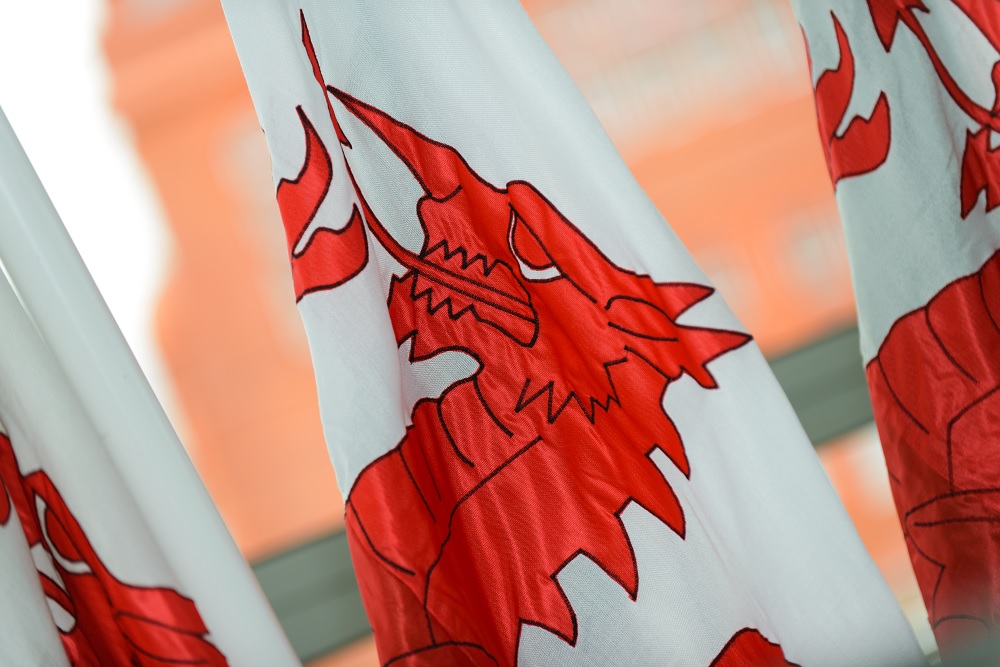
There was a new feature to ‘Little Switzerland’ too. The lampposts around the estate had Welsh flags attached half-way up them. Our visitors pointed these out, they look quite jarring all at half-mast. Had they always been there?
Well, no, they haven’t. When we drove down into the Fawr and continued on to Treorchy, there was another display of flags and these have been there for ages, flying from permanent poles on shops, and defining that vibrant high street as a proudly Welsh community.
Now, I don’t know why flags have suddenly appeared in Penrhys. It might be for the same affirmational reasons that they fly in Treorchy, but it’s hard not to suspect a link to the ‘raise the colours’ movement that has recently seen St George crosses flags flown and painted across England and even into Wales.
Whilst flying a national flag is, of itself, a neutral act, the loud support for this movement from anti-immigration politicians suggests motives beyond benign love of country.
[lower-mid-content-banner]
Xenophobic politics
Recent pronouncements from the fascist ‘Voice of Wales’ group demonstrate a desire to capture the Welsh flag for xenophobic politics. The Union Flag and St George cross have become interchangeable in England, and for these characters, adding Y Ddraig Goch to them would underscore an alliance of nativism and unionism.
So, two sets of Welsh flags, a couple of miles apart from each other, but potentially flown in service of conflicting values.
Peering into the future, it seems we will have to define what our flag stands for in the context of a radically different political landscape.
Labour’s hegemony in Wales has engendered a laziness to our politics. Until now, nobody alive has needed seriously to consider what the ideological character of our nation is.
Whilst internal dissent, from the Liberals, Plaid Cymru, Conservatives, and Greens has existed and been heard, the results have spoken for themselves. Labour’s slow unravelling from radical vigour to establishment complacency has taken a century and during that time its characterisation of Wales has become a dependable cliché.
Self satisfaction
Inoffensively to the left of England, communitarian, inclusive, and progressive, the nation’s political face has been a fixed rictus of self-satisfaction that defies the economic and social ills of many of its residents.
On the way back to the car after the concert we could hear the 1980s night coming to a close in Ynysangharad Park. The folks there had endured driving rain to enjoy Martin Kemp, of Spandau Ballet and Eastenders, perform a DJ set. The thumping bass and lights were far from the genteel evening we’d enjoyed at the museum, but no less culturally authentic, or of the environment: horses for courses.
If, as seems likely, Labour’s paternalistic hold is about to be broken, then we shall need to remake ourselves in its absence. How we imagine our nation, on its own terms, and in relation to the rest of these islands, could define us for another hundred years, or see us disappear altogether into dreams from elsewhere.
When we fly our flag in a decade’s time, what will it say?
Support our Nation today
For the price of a cup of coffee a month you can help us create an independent, not-for-profit, national news service for the people of Wales, by the people of Wales.
Get more trusted Welsh news
Choose Nation.Cymru as a preferred source in Google News to see more of our journalism.
