Opinion
What did you really do in the war, Dad?
Dr Huw Evans
In this article, Dr Huw Evans argues it should be an offence for a person to display an award given in recognition for valour, such as a medal or insignia, with intent to deceive. The term ‘stolen valour’ has become used to encapsulate this behaviour.
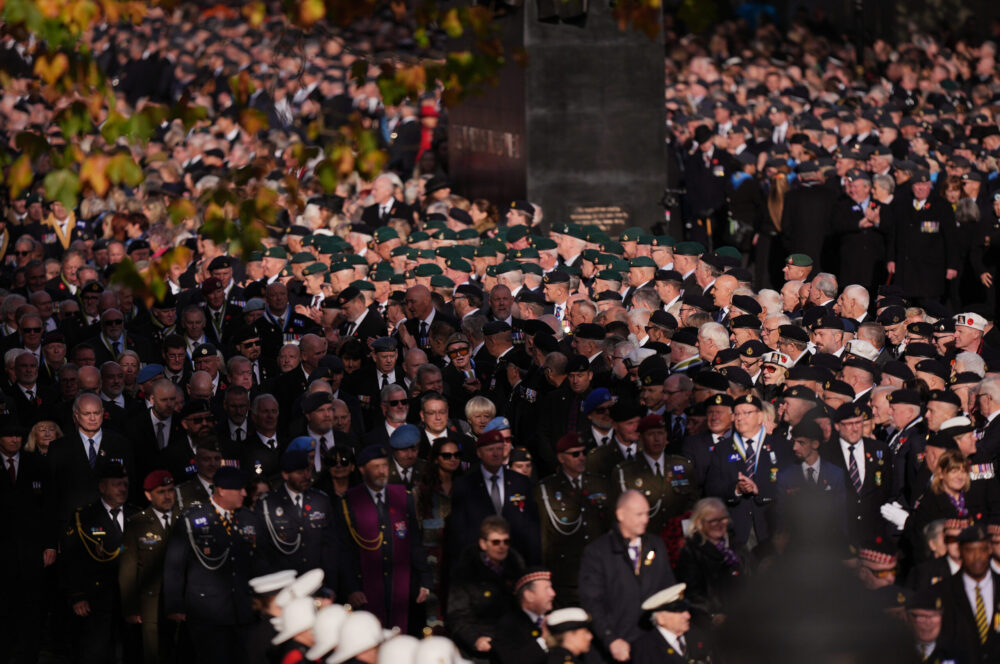
After the annual Remembrance commemorations there are recurring complaints of stolen valour conduct by some participants. On any reasonable basis, an act of stolen valour is morally repugnant. But, on its own, it does not currently amount to an offence.
And just because something is morally objectionable, it does not automatically follow that it should be an offence. A threshold must first be crossed.
Yet acts of stolen valour were previously criminalised in relation to the army (Army Act 1955, section 197) and air force (Air Force Act 1955, section 197) but not (seemingly, bizarrely) the navy. Both were repealed by the Armed Forces Act 2006.
The case of former Northamptonshire Police Chief Constable Nick Adderley shows the gap in the current law. He has been charged with offences of fraud and misconduct in public office. In part they relate, allegedly, to misrepresenting his military service by falsely claiming he had served in the 1982 Falklands War and was thus entitled to wear associated service medals.
The alleged stolen valour aspect itself does not amount to an offence but is supplementary to other things which, when taken together, can amount to an offence.
With fraud by false representation, it must be linked to trying to obtain a financial advantage. In this case the alleged stolen valour conduct is linked to obtaining employment with the police, a financial advantage.
As to misconduct in public office, as chief constable he held public office and so the alleged stolen valour conduct can amount to misconduct in that office.
Awards for Valour (Protection) Bill
There was an attempt to fill the current gap in the law. The Awards for Valour (Protection) Bill was introduced as a private members’ bill in 2016 and sought to establish an offence for a person to wear an award for valour when not entitled to do so and done with intent to deceive.
The bill received UK Government and cross-party support but failed to become law after the dissolution of parliament in May 2017, as the general election was called.
At the time the bill was also considered by the House of Commons Defence Committee. The committee heard evidence from a range of interested parties and concluded:
'...that the unauthorised and deceitful use of military decorations and medals is a harm that is worthy of specific criminal prohibition…
'Such behaviour is not only insulting to the rightful recipients of these awards, but also damages the integrity of the military honours system and the bond of trust and respect between the public and the Armed Forces.'
The committee was also critical of the decision to repeal the previous law criminalising stolen valour conduct for the army and air force. Quite obviously, in the committee’s mind, the threshold justifying the creation of an offence had been crossed.
On that theme, the committee also noted that ‘criminalisation… is commonplace in many other jurisdictions, [and] that a lack of similar protection in the United Kingdom can be viewed as exceptional’.
Despite that cross-party and (it would seem) public support, the draft legislation has not been reintroduced.
Unauthorised use of military uniform
Although the law does not criminalise stolen valour conduct for awards such as medals or insignia, unauthorised use of a military uniform is an offence under the Uniforms Act 1894. The case of Jonathan Carley from North Wales illustrates this position. Following a Remembrance event in Llandudno on 9 November 2025 he was arrested and charged with unauthorised use of a military uniform; the allegation is that he wore the uniform of a high-ranking navy officer without permission.
Note, however, that the 1894 Act is narrow in its application. It deals with the unauthorised wearing of uniforms, not medals or insignia. Neither does it cover misrepresentation about awards.
Overview and next steps
Stolen valour conduct is morally unacceptable. The House of Commons Defence Committee considered this behaviour crossed a threshold and should be criminalised; it insults genuine recipients of those awards and their memory, and undermines the integrity of military honours. Judging by the outcry these cases generate, the committee’s view is probably shared by the public.
There is a gap in the law that needs to be filled. The previous bill started as a private members’ bill but gained cross-party support and, but for a general election, would have become law. There should be a UK Government commitment to legislation. That legislation is not going to be controversial and is unlikely to take up too much Parliamentary time.
But before the reintroduction of draft legislation, there is a need for a review about whether simple replication of the previous bill is enough. For example, as well as awards, stolen valour conduct could be extended to apply to the wearing of uniforms with intent to deceive. The current legislation about uniforms, and which dates from 1894, refers to ‘unauthorised use’. It would make sense to have stolen valour law capturing all potential conduct. The ball is now in the UK Government’s court.
Support our Nation today
For the price of a cup of coffee a month you can help us create an independent, not-for-profit, national news service for the people of Wales, by the people of Wales.
Get more trusted Welsh news
Choose Nation.Cymru as a preferred source in Google News to see more of our journalism.
