


Thursday, 16th July 2026 Cardiff 22° · Clear sky
NationCymru A news service by the people of Wales, for the people of Wales.

Opinion

Welsh rugby’s pivotal moment – which way to turn?
By Mark Mansfield
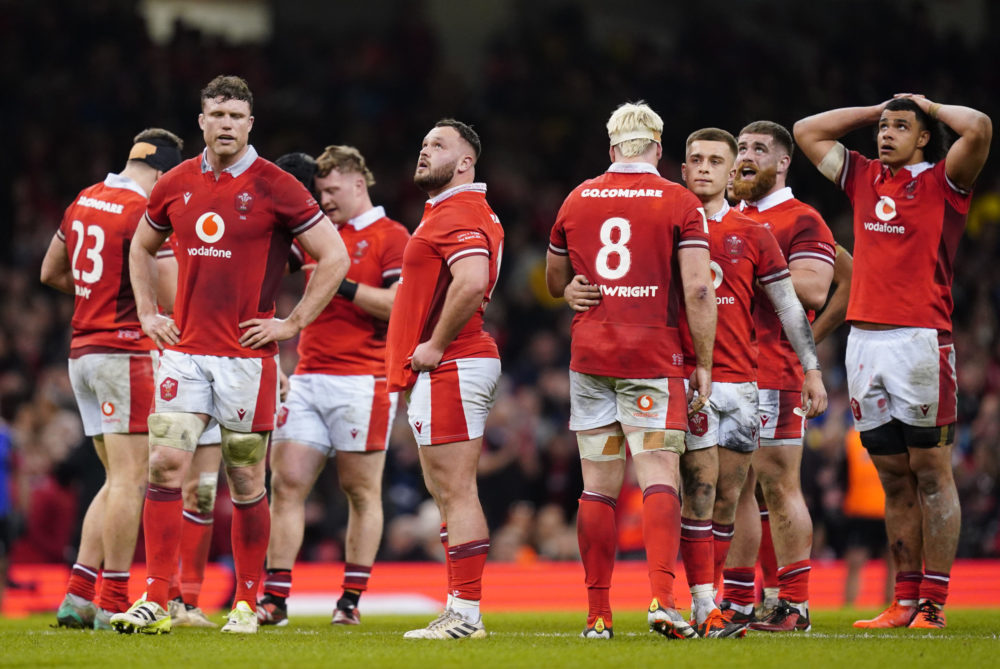
Wales' dejected players after the defeat against Italy in the Six Nations. Photo David Davies/PA Wire.

Jonathan Edwards

I grew up following the great Llanelli RFC sides of the late 1980s and early 1990s, when the men in Scarlet seemed all conquering and Welsh domestic rugby at least in good health.

In 1988, the Schweppes Cup final between Llanelli and Neath enthralled a world club rugby attendance record crowd of 56,000. To my relief the Scarlets won.

The club contests between Llanelli, Swansea, Neath, Cardiff and Pontypridd in those days were gladiatorial. For me as a diehard Scarlet they were more important than an international fixture due to the deep tribal loyalties involved.

A full house at Stradey Park had an electric atmosphere matched only by the excitement of visiting St Helen’s, the Gnoll and Sardis Road as an away fan. What was incredible about the whole structure was that all the teams involved in top class Welsh rugby were within an hour and a half from each other – a golden triangle from Newport in the East, to Llanelli in the West to Ebbw Vale at the top of the Gwent valleys.

The sense of void in those communities that lost their first-class teams on the advent of professionalism must have been profound. A stark warning to what might happen with the new reorganisation: supporter loyalty didn't mobilise en masse from the old to the new entities.

[mid-content-banner]

Revival 

However, regional rugby once bedded in seemed to kick-start a revival in the fortunes of the national team. After what seems a barren period in the 80s and 90s, apart from a few notable successes such as the inaugural World Cup in 1987 when we finished third and the 1994 Five Nations Championship win, the new century saw the national team regain its swagger. We have been truly spoilt with four Grand Slams and two Semi Final Rugby World Cup appearances.

What seemed to be working at national level, however, didn't really feed down to regional level, where successes have been few and far between. I became far more interested in following Swansea City Football Club and the national football team. Rugby alas has had to compete with both Swansea and Cardiff gracing the Premier League and an unheralded period of success for the national football team.

When the national rugby team was competitive and winning, I suppose there was less concern about the seeming financial permacrisis impacting the domestic professional tier. The demise of the national team over recent years has been a major point of inflection - looking from the outside it appears like we are now in an existential crisis for the game in Wales.

The Union has put forward four options and the status quo isn’t on the table. Four teams with unequal funding, three teams with equal funding; three with unequal funding or its preferred model of two teams with equal funding.

[lower-mid-content-banner]

Details

The problem for the Union as they consult on their preferred option of two teams is that there is no detail on what that exactly means. The remaining two teams from the current four or two new entities? If it’s two of the current four, will fans of the two disenfranchised teams swap allegiances? If it’s two new teams, will supporters buy into supporting artificially manufactured entities without any links to past glories?

Then there is the whole question of how the whole structure will fit into the community game and the need to ensure the game at grassroots level is vibrant.

As always when it comes to professional sport, money is king. The weakness of the Welsh economy has had a direct impact on our ability to sustain professional sporting teams.

The Leinster rugby team has a reported playing budget of an eye-watering £14m per annum, undoubtedly helped by the fact that Dublin is the European HQ for a whole host of US multinationals. Average GVA per person (production of goods and services divided by the number of people) in the Dublin area is £136,000 according to the Republic of Ireland’s Central Statistics Office. In Wales the latest Welsh Government stats report Welsh GVA per person at only £25,000. In other words, our friends across the Irish Sea have a far bigger pot to tap into to support sport in their country which impacts not only top-class teams but also the community game.

Competitive

If the Union’s preferred option is adopted, the two professional teams will have an initial budget of £7.8m, which is an improvement on the money available in the current settlement and to be fair matches the English Premiership salary cap. The French Top 14 are instructed to operate within £9.2m per year.

Whatever is ultimately decided might be the last opportunity to provide a future for rugby in Wales where the national team is a competitive global force; where the domestic professional teams can win in Europe and their domestic competition; and where at community level our clubs are producing the players for the future. The big question is will the rugby fraternity be able to unite behind whatever is determined and support the new structure? If not, then the future for our national game seems uncertain to say the least.

Jonathan Edwards was the MP for Carmarthen East and Dinefwr 2010-24

For the price of a cup of coffee a month you can help us create an independent, not-for-profit, national news service for the people of Wales, by the people of Wales.

Get more trusted Welsh news

Choose Nation.Cymru as a preferred source in Google News to see more of our journalism.

Choose Nation.Cymru as a preferred source in Google News

11 comments

Dai Rob

I have been calling for the scrapping of the so-called "regions" for the last 20 years.....laughed at & sworn at by most.....looks like I will have my wish. He who laughs last ................. Too little, too late.....RIP Welsh Rugby

Reply
J Jones

The national team benefitted from a pro level of 4 teams, but it failed because the intended 4 provincial teams were vetoed and replaced by half a dozen clubs forming phoney 'regions' with mergers and stand alone's. Most of the country was then scuppered by them; Gogs, Valleys, so there's little sympathy from the majority of the country excluded by them. Llanelli RFC teams historically included most players from outside the town and many very distant, yet they assumed the supporters would also follow to fill those empty stands at Trostre, as an impoverished town of barely 1% of the Welsh population was never going to be enough. They need to accept that all West Wales should now follow the Irish structure as with Munster, who would also fail if they split their professional resources between one club team in Limerick and once club team in Cork.

Reply
J Jones

The more you read the article, the more the writer actually answers his own question through his own actions! Timeline: A small town gets a pro franchise as a 'region' from Moffets Mess, organised by an over-demanding former bankrupt, adept at taking money from others and failing to pass it on as promised. They sell off their small club ground and become tenants in a larger local authority funded stadium, but being a small town they cannot fill it so success is little and short lived, due to many (including the writer himself) walking away from both the sport and the town, to follow another sport elsewhere. His new football team also cannot sustain itself in the top flight, so is sold off to Yanks, who decide to take money generated by the rugby team sharing that stadium. That rugby team leaves so is now nomadic while the football team loses more revenue, another reason why they will be a lower league team. The fundamental problem is that supporters (who 'support' their team through thick and thin) have been replaced by fans' ('fanatics' of their own short term self interest). This is replicated in the problems of wider society through politics. But will a politician blame his actions and those of his electorate? Much better to divert the blame elsewhere!

Reply
David Richards

One possible solution to this seemingly intractable situation is that gwent dragons merge with cardiff and the ospreys merge with scarlets. With home matches between the two newly created 'super regions' being shared at existing home grounds ie. rodney parade and Cardiff arms park and St helens and parc y scarlet. That could work and might just be enough to retain the loyalty of the existing supporters of the 4 regions. One drawback however being would it be financially sustainable for those 4 stadia to only host half of the new teams games? Maybe to compensate the 4 stadia the wru could stage national competitive matches at these grounds? Wales games against lower tier nations in the newly created nations tournament? Under 21 internationals? Women's internationals? Obviously for such a proposal to work it would need good will - and give and take - from all sides. And regret to say there doesnt appear to be much of that on display from anyone in Welsh rugby at the moment. But a - hopefully equitable - solution there must be because make no mistake we are in the last chance saloon as a rugby nation

Reply
J Jones

Scarlets and Ospreys should re-merge as the original plan for a united West Wales team, East Wales team at Dragons (the only one who actually own their own stadium) with the South Wales team at Cardiff (with incentives to include the valleys rather than that divisive 'capitol city region'). Keep the RGC region as a semi pro development region similar to Connaught, knowing we have a replacement if any of the other 3 throw their dummies out of the pram. Plan the change for next year when the current agreement ends, but keep an eye on the R360 in case it develops into something big. We could enter a 'Cymru' team where our top players would play R360 at the best rugby stadium in the world and around the world, with matches played to accommodate the current internationals schedule.

Reply
David Richards

Thanks for the reply. If 4 teams means the wru spreading cash too thinly then so would 3. Also I can't see any reason why the Scarlets and the ospreys should merge but not gwent dragons and Cardiff? This would wud allow Cardiff and Newport gwent dragons to retain their identity while the scarlets and the ospreys lose theirs - why should that be permitted? Furthermore weve got twenty years of evidence to show that a standalone region based at Cardiff would be 'cardiff' and in no way representative of communities beyond Wales' capital. Like i said if we are to find a way out of this crisis it will require give and take on all sides and im afraid your suggestion doesnt do that.

Reply

In reply to David Richards

J Jones

4 to 3 is enough of a change in one go, then we see how it goes. If the Wales women's team lose to amateur Canada on the weekend the WRU 'should' reconsider the millions shifted to that and forget about funding professional women's teams, watched only by friends and family. The East Wales Dragons have their own stadium and decided to sign the 5 year deal with the WRU. The Scarlets and Ospreys refused to sign so are starting their last season, they have one professional standard stadium in West Wales owned by a local authority, so need to emulate the Munster model rather than look backwards towards two club teams left in the past. Transition is always difficult, so beyond the euphoria of being given a pro franchise there should be time planned conditions on changing from a club identity to the full region/province. Make this transition tied to money, then if the entities still refuse to evolve the option of a Cymru team in the R360 becomes more viable with that same money. If the end game means a Cymru / Wales team playing much more often then at least it brings the whole country together on an a regular basis.

Reply
hdavies15

Argentina has been an economic basket case for decades yet it has in that time evolved into a top tier international side with players drawn from clubs within T14,URC, Prem and now the new 3 provinces that play in the South American competition that proves to be an efficient breeding ground for new talent. In the meantime Wales, as ever divided by petty parochialism and self interest, flounders. 4 regions are spectacularly unable to attract quality backers, relying far too much on the gravy flowing from the WRU. The Union in turn seems to have priorities other than creating strong competitive rugby within the country which had a strength in depth sufficient to generate the manpower needed for 4 regions plus a development region in Y Gogledd. The damage has been done. I doubt whether there is the will or the brain power within the present regime at Union and regional level to re-grow the game. We now have a situation dominated by verbally fluent top dogs who have serious difficulty converting talk into action. That will do us no good at all.

Reply
Peter J

Really good point. It works for Argentina. Trouble is for 6 nations Vs rugby championship. During the 6 nations, players get released from English and french clubs days before matches and don't necessarily get the rest weekends off. Hard to make a national team work with so little time together. I think a better analogy for having players abroad is to compare to Tonga or Samoa! To make it worth, I think the WRU would have to bung the English and french clubs money to rest them during six nations and release early. But then the English and french teams want Welsh players because they're available for the whole year. The rugby championship is effectively off season for northern hemisphere rugby

Reply
hdavies15

Peter my point about ARG is that they are good at developing their emerging talent and have no fear about letting them go away to any other part of the rugby world regardless of obstacles to selection. In the meantime those 3 home based ARG sides - Pampas, Dogos and Tarucas along with the Uruguay's Penarol and Chile's Selknam are upping the quality of their South American competition year on year. Here we have 4 regions who on home turf struggle to match many of the other 12 teams in URC despite having rules designed to stop talent leaking. It all points to a relative deficit in motivation, coaching and organisation.

Reply
Rhyfon ap Tarquin Morgan Evans

I remember the mighty London Welsh. Those were the days.

Reply

Leave a comment

Comments are reviewed before they appear.