
Opinion
Trump state visit won't gloss over difficulties facing leaders
Jonathan Edwards
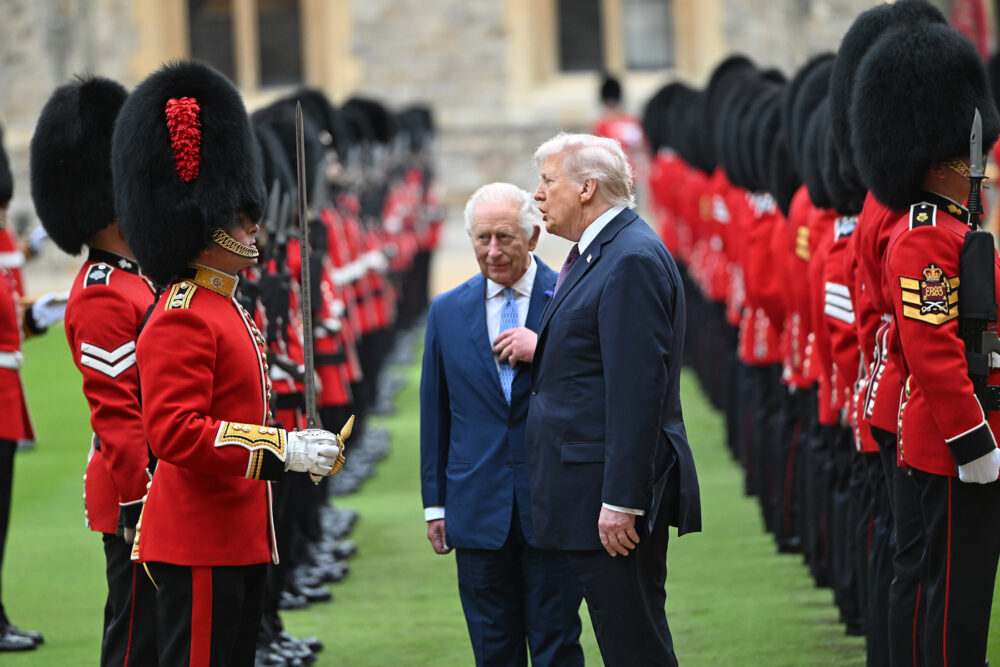
The pomp and ceremony of a state visit by the US President is normally an opportunity for the administrations of both states to above all project the power of their respective offices.
For the US, Presidential visits are portrayed as the host country paying homage, hence the use of the Royal Family which will go down well with US domestic audiences.
For the UK, the visit is an opportunity to promote the myth of the ‘special relationship’ and portray the mirage that it continues to be a major global player.
Strip away the magnificence of Air Force 1 landing in Stansted, the Royal welcome, military parade and F35 warplane flyover and it’s difficult not to conclude that both countries and leaders find themselves in diminished positions.
[mid-content-banner]
US global power
The demise of US global power has accelerated under the current Presidency, despite the strongman persona of Mr Trump. Far from curbing the death and destruction being wreaked by Russia and Israel, these countries are playing the United States for fools.
Mr Trump rolls out the red carpet for Putin in Alaska, and Russia sends waves of military drones over NATO territory and intensifies attacks on Ukraine. The kowtowing to Netanyahu leads to a military strike in Qatar, a key US Gulf ally.
Mr Trump’s economic tariffs similarly have injected even more uncertainty into a global economy whose foundations were already strained following the financial crash of the first decade of the century and the pandemic. Mr Trump’s policies are mostly performative. What he wants is to project domestically that the US determines the global economic rules.
What is more likely is that the rest of the world concludes that the US is having a collective nervous breakdown and political partnerships and business trade will look at other opportunities.
Witness the Shanghai Cooperation Organisation summit in Tianjin last month, and the love-in between China, Russia and India. For many other countries in the world, it’s not difficult to envisage a new world order emerging quickly – one no longer under US dominance.
[lower-mid-content-banner]
Poll ratings
For Keir Starmer, his issues are far more internal in nature. His and his party’s poll ratings are dire, and the start of the new Parliamentary term could hardly have got off to a worse start.
The scale of collapse in support for the Labour Party after only a year in power and following a landslide election victory is eye watering.
This week’s Welsh You Gov poll for ITV Cymru in particular should have Downing Street in a state of complete panic – Labour is now facing an existential threat in arguably its safest heartland.
If the result next May is anywhere near this bad, it is inevitable the contagion of panic in Labour ranks will spread.
Doomed
As Andy Haldane, the former Chief Economist at the Bank of England spelt out in crayon for the Chancellor and Prime Minister this week in the Guardian, Labour is doomed unless it raises living standards in the left behind areas of the UK – communities that have been traditionally Labour voting.
Wales is one such area; however our country is an afterthought in the great Westminster game.
The political challenge facing Mr Starmer should make it centre stage. Six months or so is precious little time to turn around decades of Westminster neglect, but the forthcoming Labour conference and in particular the late November Budget could be the last opportunity for the UK Labour Party to save their Welsh colleagues and themselves.
The next few days will offer some temporary relief for Mr Starmer and Mr Trump, but once Air Force 1 jets off for Washington, the challenges and problems facing both leaders will be waiting for them.
Jonathan Edwards was the MP for Carmarthen East and Dinefwr 2012-24.
Support our Nation today
For the price of a cup of coffee a month you can help us create an independent, not-for-profit, national news service for the people of Wales, by the people of Wales.
Get more trusted Welsh news
Choose Nation.Cymru as a preferred source in Google News to see more of our journalism.