

Opinion
The Welsh independence movement still lacks a leader than can reach beyond its base
Theo Davies-Lewis
Academic reports and marches don’t win elections. Just ask Adam Price.
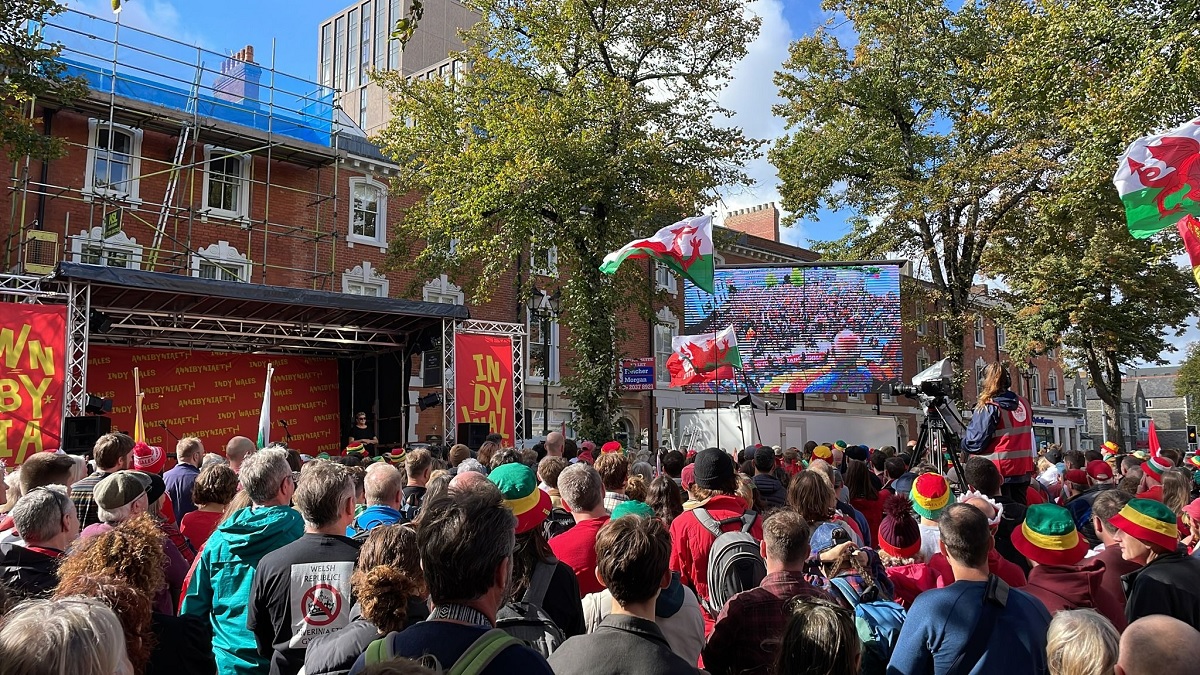
Nor, for that matter, will they turn the tide for Welsh independence. Any of the reported 10,000 people in Cardiff for the All Under One Banner and YesCymru march – those with a pragmatic not nostalgic view of history and current political reality – would admit so.
But gloomy patriots should be optimistic: Welsh independence is a national issue rather than a discussion reserved for Eisteddfodic gatherings in Gwynedd and Ceredigion. In recent times this is due to (1) the continued merging of Labour and Plaid Cymru and (2) the electorally suicidal performance of two Conservative administrations.
Yes, economic crises and geopolitical ructions have reorganised the news agenda, and the debate in Wales is far behind Scotland. But a quarter of the public supporting independence before the debate has cemented itself as a permanent aspect of the national consciousness? A pipe dream even a few years ago.
And now another “game changer”. Dublin City University Professor John Doyle’s report, commissioned by Plaid Cymru, is hailed by Price as debunking claims Wales cannot afford full self-governance. A brief look at the report and the conclusion is obvious: nice to have, but problematic. Professor Doyle estimates that the fiscal gap for an independent Wales would be around £2.6bn rather than the £10bn more that had previously been calculated. True, it tells us (if you needed to know) that Wales is not too poor nor too small to be independent. Yet the grand assumptions on pension liabilities and disregard of defence spending is reckless.
But it is just baby steps. The report, like Saturday’s march, is one of those incremental advances for Welsh nationalists to generate momentum and (some) credibility. On balance, they do that. The report demonstrates how seriously Plaid Cymru, in the words of its former leader Lord Wigley, see their “duty” to explain what independence means. The march, with Dafydd Iwan’s anthem and powerful visuals in the capital city, shows quite literally that Welsh nationalists are still here and growing as a political movement.
The ultimate pragmatists, Welsh Labour, won’t watch from the sideline. The urgency by which a constitutional review was launched last year demonstrates that the ‘wait and see’ approach to Scotland’s future is not sustainable politically. Mark Drakeford has been asked endless hypotheticals by journalists (including this columnist) about what Wales, and more specifically Welsh Labour, would do in the event of Britain’s break-up. The answer is to be confirmed. Though it is increasingly obvious what decision the Labour group in the Senedd would take if asked to be England’s rump or a self-governing entity in its own right.
[mid-content-banner]
Campaigner
Yet it cannot be just me that finds momentum for Welsh nationalism hard to quantify. So much so that it sometimes doesn’t feel like progress at all. Even in moments of perceived strength, for example when launching a forward-looking study, or securing policy change of genuine significance (ie second home controls in the Co-operation Agreement signed by Drakeford and Price), there is… dampness.
A depleted Welsh media landscape is one blame factor. So, too, is the role of Welsh Labour (not Plaid) as the vehicle for national aspiration. Add to that the unravelling of the grassroots organisation YesCymru during the pandemic and there is a perfect cocktail mix of stop-start politics and little cut through.
I know what many will say – no doubt paraphrasing Ron Davies for the umpteenth time – that independence is a process rather than an event. Indeed, polls showing support for independence vary but the percentage points are ticking up slowly. Nationalism in Cardiff Bay is almost as normalised as in Holyrood.
But there is no obvious destination for Wales as there might seem in Scotland, or indeed in Ireland, where despite the legal obstacles and political divisions there is a steady direction of travel and assumed conclusion to the volatility.
Welsh independence is not a day-to-day issue but its proponents need it to be. Compare it to the mid-2010s when leaving the European Union became a topic around breakfast tables nationally, largely because of the fringe-to-stratospheric movement established by Nigel Farage. It wasn’t the Conservative party that delivered 'independence'. It was Farage that articulated “taking back control” to everyday people, and indeed thousands in Wales.
Sea change
Farage did existential damage to the UK but few would disagree on his skill as a communicator and campaigner. Where are the Johnsons, Corbyns and Farages in the Welsh independence movement?
Adam Price is an eloquent and thoughtful speaker in a controlled setting like a Senedd chamber, appealing to a certain demographic base that his party has always enjoyed support from. Michael Sheen, a powerful addition to the independence cause, is too infrequent a contributor to make a tangible impact beyond social media clippings. Performances of Yma o Hyd at Welsh football games – though extraordinary in its wide cultural impact – is no barometer of support for independence.
Debates ought to be grounded in detail but nationalism always prefers emotion and makes exceptions for policy contradictions. Wales is not too poor to be independent but there is no doubt that the process of becoming an independent state would be messy, divisive and, for many, hypnotic. Look at Brexit and multiply it by ten.
There is no need for a charismatic, outlandish politician to make the case in Scotland anymore. The SNP are firmly intertwined in the centre of politics, in part thanks to a man named Alex Salmond who pushed the country to the edge of leaving the UK in 2014.
Welsh nationalism should not seek out charlatans or strong men to lead. The movement does however need to inspire beyond set piece moments that appeal mostly to the same circles and Plaid Cymru’s electoral base. It is a hard task that nationalists have toyed with for years. But the urgency has never been greater.
A sea change is underway in English politics. Scotland is close again to a referendum. A united Ireland may be even more likely. Who – not what – will shape Wales’s destiny?
Support our Nation today
For the price of a cup of coffee a month you can help us create an independent, not-for-profit, national news service for the people of Wales, by the people of Wales.
Get more trusted Welsh news
Choose Nation.Cymru as a preferred source in Google News to see more of our journalism.
