


Fri, 17th July Cardiff 24°
Nation.Cymru wordmark
Advertisement

Opinion

The silence of unions and students in the face of ruthless governance
By Mark Mansfield
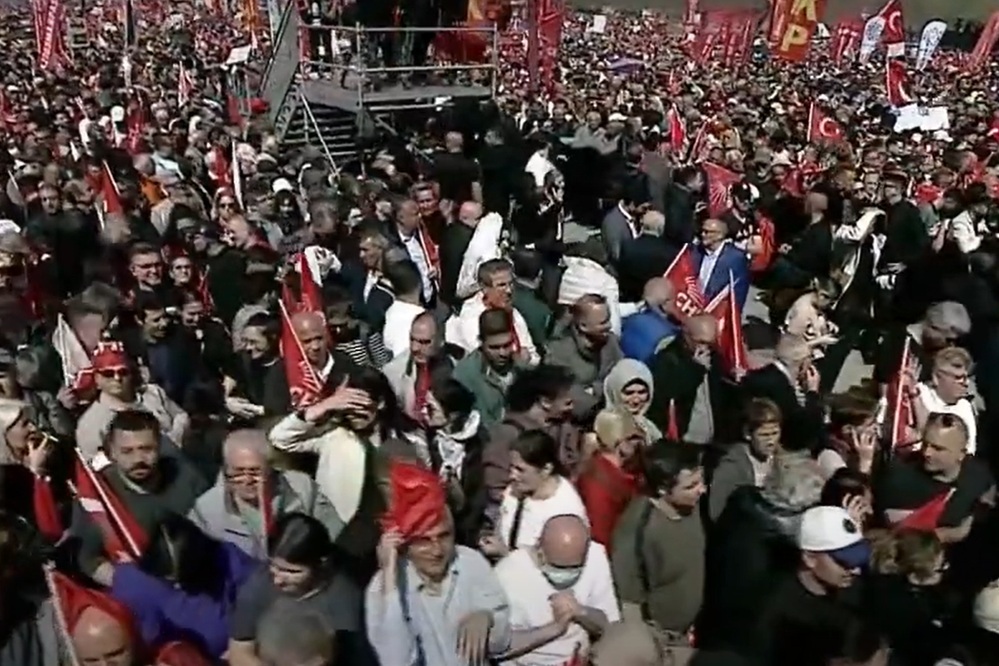
Thousans protest in Turkey after the Mayor of Istanbul was arrested. Image via YouTube

Agit Ceviz

The current UK Labour Government is waging an economic war on pensioners, disabled people, and the working class.

Rising living costs, attacks on welfare, and privatisation are making life unbearable for many—yet resistance is nowhere to be seen.

Trade unions, once a powerful force, have grown too cautious. Strikes are rare, and when they do happen, they lack the boldness of past movements.

Meanwhile, students, historically at the forefront of protests, seem disengaged. Fear, debt, and media manipulation have tamed a generation that should be leading the fight.

Many unions and student movements remain loyal to the Labour Party, even as it drifts further from its roots.

[mid-content-banner]

Radical change

Keir Starmer’s Labour has abandoned radical change, offering only mild reforms while accepting much of the status quo. Yet unions and student leaders remain largely silent, fearing a Tory alternative but unwilling to challenge Labour’s failures.

This loyalty weakens resistance. Instead of demanding real change, unions and students wait for Labour to act—despite clear signs that Starmer won’t reverse austerity or empower workers.

Meanwhile, pensioners, disabled people, and the working class continue to suffer.

If unions and student movements truly represent the people, they must break free from party loyalty and fight for justice, no matter who is in power.

Silence only enables the government’s ruthless policies.

[lower-mid-content-banner]

Resistance

The recent protests in Turkey against Erdoğan started with students taking the lead, showing that youth movements can still spark resistance.

Unlike in the UK, where student activism has weakened due to political complacency and party loyalty, Turkish students took to the streets despite heavy state repression.

If students in Turkey can rise against authoritarianism, why are British student movements so quiet in the face of ruthless government policies?

It’s time for unions and students to remember their role in resistance—before it’s too late.

For the price of a cup of coffee a month you can help us create an independent, not-for-profit, national news service for the people of Wales, by the people of Wales.

Get more trusted Welsh news

Choose Nation.Cymru as a preferred source in Google News to see more of our journalism.

Choose Nation.Cymru as a preferred source in Google News

26 comments

Mab Meirion

Water Cannon... Just you wait and see, the great unwashed are going to get a good hosing down afore long... More prisons, that's the answer Clark, lock us up...!

Reply
Mab Meirion

Clark caves in to Trwmp while the rest fight back...always behind the curve...

Reply
Linda Jones

I agree with much of this article but I would suggest that the apathy amongst student groups and trade unions has spread almost throughout the population. I suppose it must be that things haven't got quite bad enough for enough people for any uprising to take hold.

Reply
Adrian

The days of any form of 'uprising' are long gone. We meekly complied with being locked in our homes for two years under the cosh of Johnson, with Starmer, Drakeford & Sturgeon 100% on board. It's done untold damage to this country yet we just accepted it.

Reply
Joseph Kelly

I think you may be confusing public health restrictions with time in prison, I don't remember being locked in anywhere.

Reply

In reply to Joseph Kelly

Welbru

I do! Allowed out for an hour's exercise a day, but house arrest otherwise.

Reply

In reply to Welbru

Bilbo

There was no time limit in Wales.

Reply
Bilbo

How many hundreds of thousands of deaths would you have accepted in return for doing nothing? Feel free to name a number to show your commitment to freedom.

Reply
Mawkernewek

Part of it is that many who get themselves elected in Students Unions do so in the hope of being the next generation of grown-up politicians. For example England's health secretary Wes Streeting formerly of Cambridge University Students Union

Reply
Bilbo

Under FPTP there are only two types of government possible in the UK: Tory or Diet Tory. In 2011 people were offered an alternative voting system which was roundly rejected. Anyone who failed to support this change is responsible for the status quo. Anyone who failed to support this change because it wasn't good enough is responsible for the status quo. Democracy means accepting the will of the people even if you disagree.

Reply
Paul

I guess we’ll find out after 2026 Welsh election. But in the end there still has to be a realistic party to vote for.

Reply
Bilbo

It'll take time because you need a voting system that allows smaller parties to flourish before smaller parties can flourish as realistic alternatives to vote for.

Reply

In reply to Bilbo

Undecided

It may not take time actually. Welsh Labour insisted on the stitch up that they thought was the closed list system, only to find now that the real beneficiaries may be Reform. Meanwhile, the smaller parties could well disappear all together.

Reply

In reply to Undecided

Bilbo

I mean several election cycles. But I don't see how the closed list system could benefit Labour. Presumably it was only chosen as the most proportional system which is what people think they want from electoral reform while ignoring that it will make people feel more disenfranchised not less. Meanwhile some Reform rabble in the Senedd will be good to humiliate Farage with their inevitable antics and controversy. But there's no realistic scenario where they enter government. All they'll do is soak up enough Con and Lab votes to give us a Plaid-led coalition.

Reply
John Ellis

'In 2011 people were offered an alternative voting system which was roundly rejected.' There's no way of knowing exactly how many voted against the change to the voting system offered back in 2011 for this reason, but I well remember the debate at the time and there's no doubt whatever that some voters didn't back change because the choice was narrowly confined to sticking to 'first past the post' or adopting the 'alternative vote' method. The Tories refused to offer proportional representation as an option, and their Lib Dem coalition partners were daft enough to acquiesce to that diktat.

Reply
Bilbo

Why turn down an improvement? Proportionality isn't the only thing that matters in a voting system. Voter engagement is essential and giving people the power to pick who they really want without wasting that vote would've been a big step forward. It would've allowed more smaller parties to thrive. It would've led to permanent coalitions and the constructive form of "grown up" government that creates. But we ended up with Johnson and Brexit instead.

Reply

In reply to Bilbo

John Ellis

You make a fair point, but I still think the fact remains that the 'alternative vote' wasn't what the Lib Dems - and, indeed, others too who weren't Lib Dems - were calling for. The conservative political right in the UK tends to be significantly more politically canny than those seeking for reforms of the system, which is why the Conservatives lighted on the tactic of offering some change, but not the change for which most advocates of voting reform were campaigning. They calculated that their offer would split the advocates of reforming the system, and they turned out to be right. So I still believe that the Lib Dems were naive in falling for an offer which was significantly less satisfactory than the one which they'd long advocated. The Tories wanted to keep things as they are, and their strategy proved to be successful.

Reply

In reply to John Ellis

Bilbo

And so the left need to ask themselves why they fell into the elephant trap. Because until that's understood it'll keep happening.

Reply

In reply to Bilbo

John Ellis

I think that's fair comment. An 'elephant trap' is pretty much what it was, and the Lib Dems fell into it. I was living in England at that time, and was a Lib Dem member and activist in a constituency previously held by the Tories which the Lib Dems in 1997 had won. That was the beginning of my disillusion with the Clegg-era Lib Dems, and I ultimately left the party.

Reply

In reply to John Ellis

Bilbo

Did Labour back AV? No it didn't. Explain that.

Reply

In reply to Bilbo

John Ellis

My sense has always been that both Labour and the Tories favour retaining FPTP because it generally favours them and diminishes the possibility of rival parties establishing themselves. A belief which they hold in common.

Reply

In reply to John Ellis

Bilbo

London Labour and the Cons have a democratically unhealthy symbiotic relationship. Both parties need breaking up which won't happen until the voting system is changed. It's just a shame that Reform are only interested in change that benefits their billionaire backers, and nothing that improves the lives of ordinary people. You may not be a fan of the Lib Dems anymore but they got closer than anyone to making that change happen.

Reply

In reply to Bilbo

John Ellis

I wouldn't at all disagree with anything that you've said here.

Reply
Y Cymro

The Unions silence on the matter is defending. They fund the Labour party even though implementing draconian policies that will affect the most vulnerable in society. Why, I ask ? What's wrong with their membership? Why do they provide money to an increasingly right wing Labour party whose policies demonise the left, working poor, ones on benefits and the disabled. Be caring not complicit.

Reply
Bilbo

Unions aren't there to represent the poorest and most vulnerable in society. They're there to look after their members.

Reply
Ben Golightly

It would be interesting to hear a trade unionist respond to this article, which raises interesting points. I submitted a letter in reply but it was not published.

Reply

Leave a reply

Replying to John Ellis Cancel

You make a fair point, but I still think the fact remains that the 'alternative vote' wasn't what the Lib Dems - and, indeed, others too who weren't Lib Dems - were calling for. The conservative political right in the UK tends to be sign...

Comments are reviewed before they appear.