


Opinion
The real story behind Labour, Plaid and the ‘stitch-up’ in Wales
Owen Williams
The idea that Labour and Plaid Cymru are “in cahoots” in some backroom conspiracy to stitch-up Wales is not only lazy, it’s cynical, corrosive and entirely predictable.
This is a narrative pushed by certain corners of the right – often the same voices who neither understand nor respect the institutions of devolved government, and who feel more comfortable when politics is a winner-takes-all bloodsport, not a process of consensus-building.
It’s no coincidence that the “in cahoots” line gains traction whenever Labour and Plaid happen to agree.
The narrative is convenient. It allows opponents to dodge serious engagement with policy decisions, and instead reduce legitimate cooperation to the level of playground gossip.
It’s a tactic, not an argument.
[mid-content-banner]
Collaborate
But the truth is far more straightforward: in Wales, progressive parties often collaborate not because they’re ideologically identical, but because the Senedd was designed to work that way.
It is a parliament built for cooperation, not command. And unless you fundamentally misunderstand or reject pluralist democracy, you should welcome that.
Let’s go back to the basics.
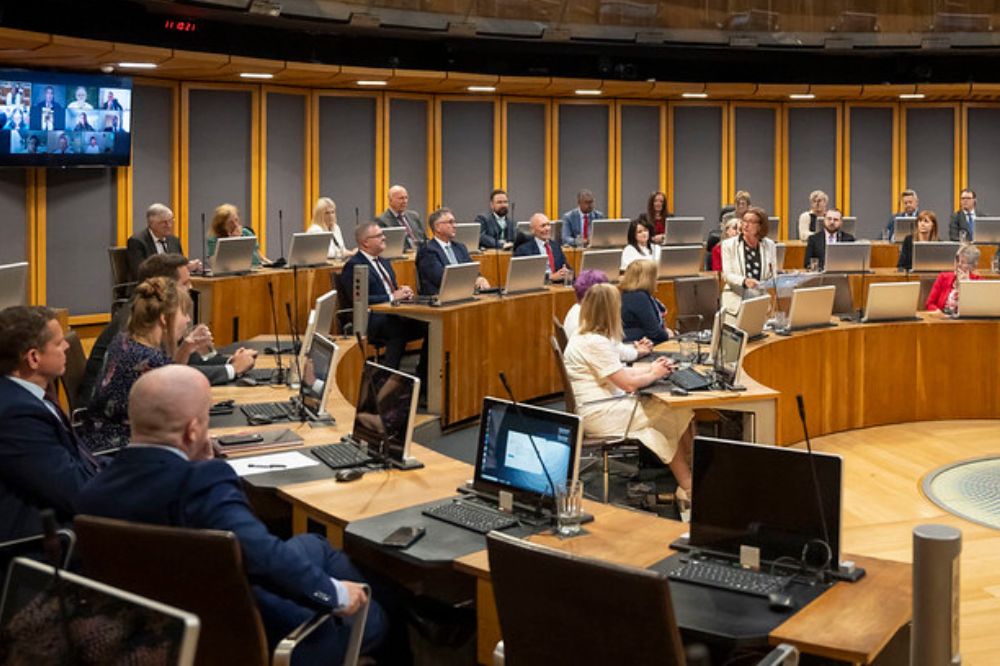
The Senedd is a unicameral legislature. It has only one chamber, unlike the UK Parliament at Westminster, which has two.
That means all law-making happens in a single, directly elected forum. There’s no unelected second house to delay or overturn decisions. No Lords with inherited privilege or political patronage. Just one chamber, elected by the people of Wales.
But perhaps more importantly, the Senedd uses proportional representation.
The Additional Member System ensures that the number of seats each party wins reflects their share of the vote. As a result, it’s extremely rare for one party to win an outright majority – and that’s no accident.
It’s an intentional safeguard against the kind of warped majorities we often see at Westminster, where a government can dominate parliament on a minority of the vote.
That means parties have to work together.
If you want to pass legislation in the Senedd, you build support across parties. You find common ground. You compromise. That isn’t a failing of the system – it’s the system doing exactly what it was designed to do.
So when Labour and Plaid Cymru identify shared ambitions – on road safety, farming policy, food standards or tackling poverty – of course they work together.
That doesn’t mean Plaid is blindly backing Labour. It means both parties are doing what the electorate sent them to the Senedd to do: legislate responsibly.
[lower-mid-content-banner]
20mph speed limit
Take the 20mph speed limit law. This wasn’t a niche, backroom policy. It was first proposed by former Conservative shadow minister David Melding. It was then included in Welsh Labour’s 2021 manifesto – a manifesto endorsed by the electorate when it awarded Labour the keys to government again.
Plaid and the Liberal Democrats supported it when it was debated on the floor of the Senedd, not because they’d signed away their political independence, but because the evidence supported the case for change: reduced deaths, cleaner air, and fewer injuries to children and older people.
In other words, this wasn’t a stitch-up. It was public health policy, pursued through democratic means, and delivered by a government with a mandate.
You really want to know who voted for 20mph? The electorate, that’s who.
If Plaid Cymru were truly in Labour’s pocket, the proposals to reform the Senedd itself would have been waved through without debate. But that didn’t happen.
Mark Drakeford’s push to expand the number of Senedd Members and introduce closed lists led to serious and very public disagreements. Plaid challenged the proposals, negotiated harder terms, and forced significant compromises.
That’s not the behaviour of a party beholden to anyone. That’s what political accountability looks like in a system where no one holds all the cards.
Compare that with Westminster Governments that can enjoy crushing parliamentary majorities with barely a third of the vote.
Backbenchers can be whipped into silence, and opposition parties often have little power to amend or improve legislation. It’s a binary system, built around adversarial politics. You win, you rule. You lose, you’re irrelevant.
In countries with mature democracies that use proportional representation – like Germany, the Netherlands, and many Scandinavian nations – coalition politics is standard.
Consensus
Parties work together not because they’re aligned on every issue, but because they recognise that consensus leads to better, more stable governance.
If anything, Wales is joining a long tradition of democratic systems where pluralism is seen as a strength, not a weakness.
The right’s obsession with the idea of a secretive “Labour–Plaid pact” is revealing.
It exposes how little interest some have in democratic maturity. They prefer outrage to nuance, pantomime to policy. And rather than engage in the hard work of scrutinising legislation or offering better alternatives, they default to cries of conspiracy.
But Welsh democracy deserves better than that.
We deserve a political culture that respects complexity, values cooperation, and doesn’t see compromise as capitulation. What we’re seeing in Wales right now isn’t a conspiracy. It’s a country learning how to govern itself – not through dominance or division, but through collaboration. That should be something to be proud of.
It’s not a stitch-up. It’s what democracy looks like when it grows up.
Support our Nation today
For the price of a cup of coffee a month you can help us create an independent, not-for-profit, national news service for the people of Wales, by the people of Wales.
Get more trusted Welsh news
Choose Nation.Cymru as a preferred source in Google News to see more of our journalism.
