


Opinion
The latest YouGov poll shows a politically fragmented Wales
Ifan Morgan Jones
A new edition of the quarterly Welsh barometer poll has been published, and you can read Professor Roger Scully’s full psephological analysis here. So what does it show?
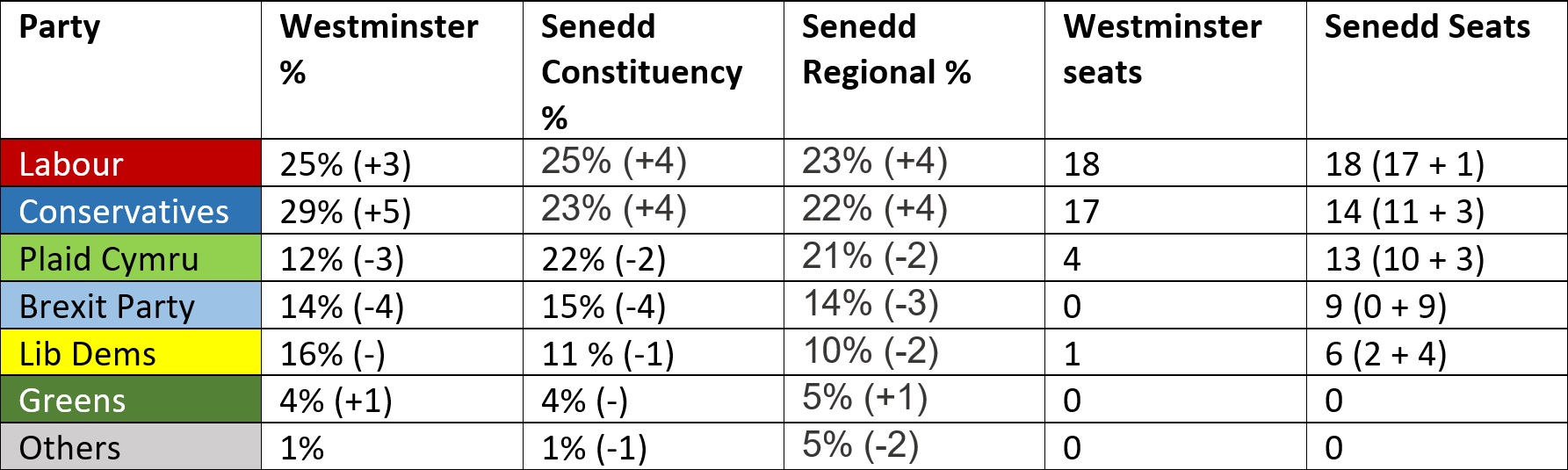
At Westminster, the Conservatives capture Alyn and Deeside, Bridgend, Cardiff North, Clwyd South, Delyn, Gower, Newport West, Vale of Clwyd, and Wrexham from Labour. Plaid Cymru are projected to win Ynys Môn but lose Ceredigion.
At the Senedd, the Conservatives are projected to gain Cardiff North, Gower, the Vale of Clwyd, the Vale of Glamorgan, and Wrexham; Plaid Cymru are projected to gain Blaenau Gwent, Caerphilly, Cardiff West and Llanelli; while the Liberal Democrats are projected to gain Cardiff Central.
However, Professor Scully does warn that “in these unprecedented political times […]all attempts to use opinion poll numbers to project outcome in term of parliamentary seats should be viewed with very considerable caution.”
One of the paradoxes in Wales is that a few of the areas where the Remain parties are expected to taste success, such as the valleys, tend towards being pro-Brexit, and the pro-Brexit Conservatives are expected to do well in quite pro-Remain areas such as Cardiff North!
It would be rather difficult therefore to tell how these projections would actually play out in individual seats across Wales.
[mid-content-banner]
Struggle
So what can we make of this poll?
Not much, you could argue. As a Westminster General Election approaches and the European elections recede, what we’re now seeing – the receding of support for almost single-issue pro-Remain/No Deal parties who would struggle in individual FPTP seats and a bump for the two main parties – seems inevitable.
The headline grabber will, of course, be that the Conservatives are ahead in Wales on the Westminster vote for the second poll in succession, and have doubled their lead from 2 to 4%.
No one has pulled out into a commanding lead, however. The Conservatives’ lead may mostly be because the Leave vote being split two ways and the pro-second referendum vote split two and a half ways between Labour, Plaid and the Liberal Democrats.
The changes here seem to be as a direct result of Boris Johnson’s ability to squeeze the Brexit Party slightly more effectively than Labour, who are at sixes and sevens on Brexit, have managed to squeeze the Remain parties, Plaid Cymru and the Liberal Democrats.
The main difficulty in extrapolating anything from this data, however, is that everything here is subject to change very quickly depending on what happens in the next two weeks regarding Boris Johnson’s negotiations with the EU.
If Wales is taken out of the EU on October 31st with a deal, you would imagine that the appeal of the Brexit Party would become rather more niche than it is at the moment, unless of course the deal is objectively terrible. However, if Boris Johnson fails to leave on October 31st then the Brexit Party could capitalise on that.
If the UK does Leave, one would imagine that the Lib Dems would continue pushing for another referendum, and Plaid Cymru would push for an independence referendum in order to join the EU, so their polling may not be quite as dependent on what happens at the end of the month.
Perhaps the only certainty we can take from this poll, therefore, is that it’s further confirmation that Labour's vote in Wales is softer than it's been at any time in 100 years.
That doesn’t mean they won’t bounce back of course. A poll showed the Conservatives ahead in Wales by 10% two months before the 2017 election and Labour eventually won it in Wales by 48.9% to the Conservatives’ 33.6%.
However, the days of being able to stick a red rosette on a donkey are clearly over. Voters are now happy to shop around.
Disappointed
Plaid Cymru won't be happy to drop a few percentage points, which takes them almost back to their average over the last two decades of devolution.
Despite being the only pro-independence party, they don’t seem to have capitalised at all on the apparent growing support for independence, which would suggest that they are still having trouble convincing people that they are the party for all of Wales and not just Y Fro Gymraeg.
However, this could simply be down to the relentless focus on Westminster over the past three months. General Elections are always tricky for a party that struggle to demonstrate their relevance there.
As with the SNP, if Plaid Cymru do have a breakthrough moment it is always going to be at the Senedd elections. The next are due in 2021, and the Senedd poll suggests that they remain on track for those.
Plaid Cymru’s only realistic aim at the coming General Elections will be not to go backwards in the number of seats, and this poll gives them some hope of doing that.
One thing the poll does show however is that, electorally, some kind of General Election deal between the Liberal Democrats and Plaid Cymru would probably be a good idea.
Unlike in England, here in Wales we have two parties gunning heavily for Remain supporters.
The ideological differences between the parties means that any electoral alliance would be a hard sell (particularly as new Lib Dem leader Jo Swinson seems intent on filling the political territory vacated by Cameron's Conservatives).
However, under FPTP, unless there’s some accord that split could leave both parties facing disappointment at the ballot box.
With Welsh politics so fragmented, those who could find a way of working together could be on to a winner.
However, this poll shows that Welsh politics probably won't be put back together again to anyone's satisfaction until after Brexit is resolved - if it is resolved.

Support our Nation today
For the price of a cup of coffee a month you can help us create an independent, not-for-profit, national news service for the people of Wales, by the people of Wales.
Get more trusted Welsh news
Choose Nation.Cymru as a preferred source in Google News to see more of our journalism.
