


Opinion
The Green Man and the concrete Skyline
Gareth Thomas
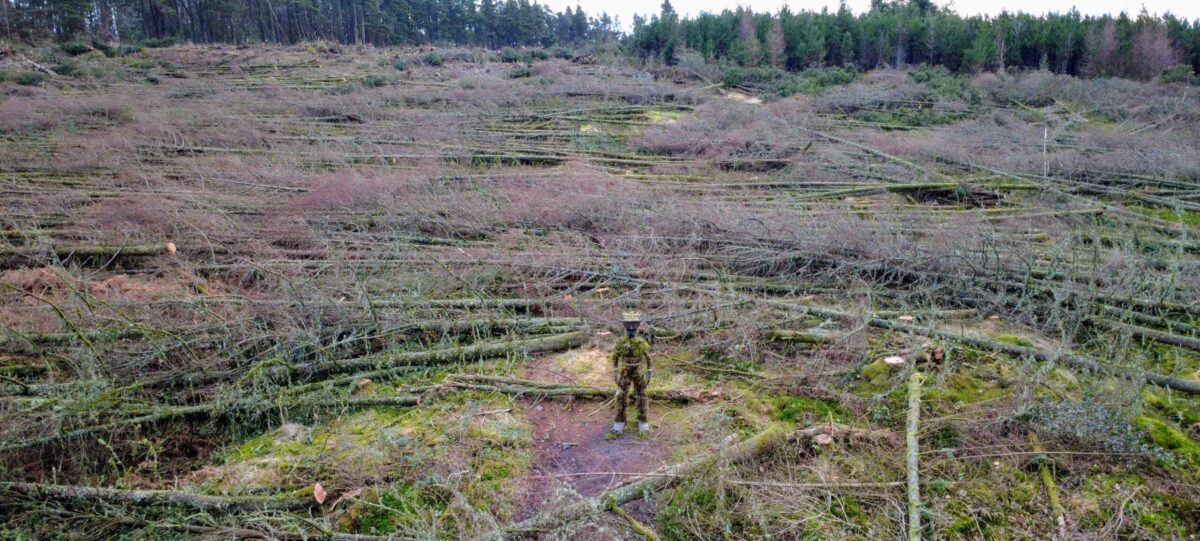
The Green Man sculpture stands on Kilvey Hill overlooking the Swansea Valley. Built in 1998 by Pete Thomas, a local man, he was placed as a sentinel over one of Britain’s earliest large scale post industrial reclamation schemes.
Today, the hillside around him is marked by freshly felled Sitka spruce, cut to make way for Swansea’s Skyline project.
The image now circulating widely across Swansea social media is significant because of what it reveals. The Green Man stands intact while the community woodland that grew up around him is being dismantled.
In that single image lies a question Swansea needs to face, who gets to shape the places local people care for, and who pays when decisions are made at a distance.
The Skyline is a tourism project expected to cost upwards of £12 million public money. It includes a gondola cable car, a zip wire, a 1.6 kilometre luge track, and a hilltop restaurant and bar. It also requires permanent concrete works, including foundations and track structures cut into the hillside.
Swansea Council has backed the project, with support from Labour politicians at local and Welsh level, and it has faced sustained local opposition through petitions, planning objections, protests, and years of public campaigning.
For people campaigning on Kilvey Hill, the sense of distance is visible in the stumps and machinery that churn up the ground they walk past each day.
This is not a symbolic disagreement about abstract priorities. It is a practical dispute about whether the city’s green spaces, and the histories embedded in them, are treated as assets to be cared for or as sites to be repurposed for visitor infrastructure.
It is also a dispute about trust, whether consultation still carries meaning when outcomes appear fixed.
The Green Man was built to mark the Lower Swansea Valley Development Project, an ambitious effort to deal with what was widely described at the time as one of the most polluted industrial landscapes in Europe. Decades of copper smelting had left soils saturated with heavy metals and toxic waste.
Much of the valley resembled a moonscape, stripped of vegetation, with a river so depleted of oxygen that it struggled to support aquatic life. Each summer, the treeless landscape dried out and residents reported the slag dust blowing across nearby neighbourhoods.
The project brought together Swansea Council, Swansea University, the Territorial Army, local schools, and the wider community in an experimental partnership.
Polluted land was capped, derelict buildings were cleared, rivers were treated, and hundreds of thousands of trees were planted. The result was not only technical repair, but a changed everyday landscape. Places that had been written off became walkable again, and the city gained a woodland that many residents came to rely on.
Finding trees that could grow on Kilvey Hill was not straightforward. Early planting efforts in the 1970s failed repeatedly, and tree health did not begin to improve until several years later. Progress came when Sitka spruce proved able to take root on copper slag, supported by improvised soil treatment and repeated trials. Against expectation, a forest grew.
Local schools
Many of the trees were raised and planted by local schools, making the woodland something people felt they belonged to. It eventually became one of the few accessible green spaces on that side of the city, cared for through volunteer days and community events.
That relationship began to change when Swansea Council, with support from the Welsh Government, decided that tourism infrastructure offered a better future. Swansea Council carries high levels of long term borrowing, reported in council accounts as more than £600 million.
Against this backdrop, many local campaigners were surprised that public funding could be committed to support a project delivered by a private overseas contractor, particularly one involving substantial permanent construction on a reclaimed community landscape.
It was against this backdrop that I met Julie James MS in early 2024, when she was serving as Minister for Climate Change. I raised the strength of local opposition and the concern that the project represented a break with the area’s history of community led regeneration.
She told me that consultations had been carried out, that local people supported the project, and that the Skyline would create 116 jobs and strengthen tourism, with the Penderyn distillery at Hafod Morfa cited as part of the wider visitor offer.
I know the distillery well, having worked on the Hafod Morfa Copperworks restoration in a former role at Swansea University.
Production there has recently been paused, with rising alcohol duty, the cost of living squeeze, and wider economic slowdown cited as contributing factors.
Regeneration promises
That pause is a reminder that employment projections attached to redevelopment schemes can be fragile, particularly in uncertain economic conditions, and that regeneration promises can land unevenly once the headlines fade.
My work over several years with fishing and rural communities across South Wales suggests this pattern is not unique. Again and again, people describe being consulted without feeling heard.
Meetings take place, reports are produced, and assurances are given, yet many experience outcomes as already decided. Jobs and economic revival are promised, while the knowledge of those who live and work closely with particular places is treated as an obstacle rather than an asset.
What is happening on Kilvey Hill follows a familiar script, where the language of listening is present, but meaningful influence is not.
Last spring, while working with inshore fishers near Cardigan, one man said to me, “Watch the people with words like sustainability and community in their job titles. They are the ones destroying places.”
At the time, I did not think much of the comment, but it has stayed with me as I have watched decisions about land and water in Swansea’s Council made by councillors with portfolios labelled community cohesion, climate adaptation, environment, regeneration, and culture.
Renewed
The Green Man remains on Kilvey Hill, quietly renewed each year by local hands.
The forest behind him is being cut down.
The council has suggested moving the sculpture. Moving him would be easier than addressing what he represents, a reminder that Wales needs more attentive listening, not less, especially where land, water, and local nature are concerned.
Gareth is a researcher and writer based in Swansea, with experience working on community heritage and environmental projects across South Wales
Support our Nation today
For the price of a cup of coffee a month you can help us create an independent, not-for-profit, national news service for the people of Wales, by the people of Wales.
Get more trusted Welsh news
Choose Nation.Cymru as a preferred source in Google News to see more of our journalism.
