


Fri, 17th July Cardiff 23°
Nation.Cymru wordmark
Advertisement

Opinion

The coming benefit cuts will create more negativity for Labour. Why don't they get that?
By Mark Mansfield
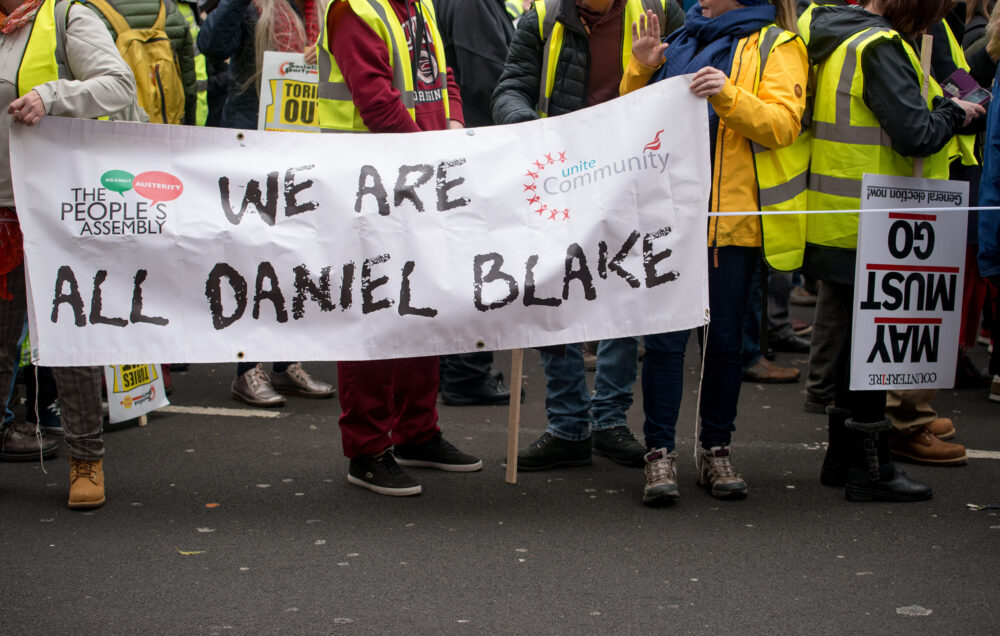
Anti Tory protests in 2019. Photo John Gomez / Shutterstock.com

Martin Shipton

In 2016 the Ken Loach-directed film I, Daniel Blake won the Palme d’Or at the Cannes Film Festival.

It was a compelling piece of social criticism typical of Loach, and of a type we see too little of: as TS Eliot wrote, "Human kind cannot bear very much reality”.

Far from the escapist fantasies beloved of many cinema goers, Loach’s film exposed the cruelty of benefit cuts, especially as they affected people who were unable to work.

Its release seems a long time ago. Jeremy Cotbyn was the Labour leader at the time and Theresa May was the Tory Prime Minister.

[mid-content-banner]

Barbarity

Corbyn told May in the House of Commons that she should watch the film, as he questioned her about the fairness of the welfare system. He named an ex-serviceman who had died without food after welfare sanctions, and said it was time to end the "institutional barbarity against, often, very vulnerable people."

May defended work capability assessment with sanctions, and told Corbyn the Labour Party was "drifting away from the views of Labour voters".

Today Corbyn’s successor as Labour leader, Keir Starmer, is adopting the same approach as Theresa May did in 2016 - leading the charge to cut benefits, with an announcement expected on Tuesday.

Starmer’s modus operandi may be subtly different - he suggests to the disabled that he’s doing them a favour by cutting their benefits and giving them the chance to work - but the outcome is the same. If they don’t sort themselves out, a fair proportion of them will be facing penury.

May’s answer to Corbyn was instructive. The implication was that the majority of Labour’s own voters saw disabled benefit claimants as scroungers who were cheating the system. In fact Work and Pensions Secretary Liz Kendall fed into the “scroungers” narrative in January when she said some claiming sickness and disability benefits were “taking the mickey”.

By choosing to stress such a point, and in particular by failing to produce figures indicating the (limited) extent of fraud, she was in effect inviting people to exaggerate the level of abuse.

If, as May suggested, Labour voters had little sympathy with disabled or sick benefit claimants, it’s because of the relentless claimant-bashing that has gone on for many years in the pages of right-wing tabloids and more recently on social media. In that respect it’s similar to the bile spewed out over decades against the EU that made the Brexit vote possible.

Yet what is the truth about Britain’s disabled? Are they really able to live the life of Riley on the back of undeserved state handouts?

[lower-mid-content-banner]

Myth

Comparisons with other advanced countries in fact demonstrate that the value of welfare payments generally in the UK are anything but generous.

The BBC economics correspondent Andy Verity has drawn on official statistics to explode the right-wing myth.

He writes: “Are we a 'high welfare' country where we pay people too much not to work, meaning the government could save billions by slashing welfare, no harm done? Erm - not exactly. Of 34 advanced economies, we're third from the bottom.

“As highlighted by the think tank founded by John Maynard Keynes and others - the National Institute of Economic and Social Research (NIESR) - the poorest regions of the UK are now worse off than the poorest in countries such as Malta or Slovenia.

“The amount we spend on welfare (benefits, state pensions etc) is not high compared to many other countries and shrank sharply as a share of the economy in the austerity decade 2010-2019 - in spite of an ageing population.

“While the amount spent on universal credit etc rose at the start of the pandemic, Rishi Sunak's decision when it was over to withdraw the £20 a week booster hit six million of the UK's poorest families hard. The payment hasn't kept up with the price of essentials like food.

“As NIESR's analysis shows, many benefit recipients will be left with a shortfall, forcing them to beg or borrow from friends or relatives to obtain the basics. This is one big reason for the rapid growth of food banks under austerity.

“The freezing of housing benefit combined with rapidly rising private rents means that it simply isn't enough to house someone in the vast majority of homes.

“The New Economics Foundation - a progressive think tank - has published analysis suggesting that the government has been downplaying the effect of its proposals to cut the additional payments received by people unable to work due to disabilities or poor health.

“It says halving the gap would result in cutting an extra £3bn in payments to ill and disabled people – taking £146 a month from each person - and with planned cuts to personal independence payments, it could reduce support for ill and disabled people by between £7.5bn and £9bn.

“We know that since the pandemic, there's been a huge rise in long-term illness, including mental illness. Another big factor is Long Covid. To many recipients, cuts on that scale could feel a lot like they're being punished for the misfortune of getting sick.”

Election campaign

The imposition of the scale of cuts that are apparently being contemplated is not a good position from which to launch an election campaign. We’re a year away from the next Senedd election, but many local authorities in England will be staging elections in May.

A poll for Electoral Calculus is suggesting that Reform is on course to win control of eight councils including Doncaster - whose local MPs include Labour Cabinet Ministers Ed Miliband and John Healey - and County Durham, where I used to live and work.

Although Durham County Council was a Labour stronghold for many years, the party was sent into opposition at the last election in 2021, and the authority is currently run by a Liberal Democrat and Independent coalition.

The county has many similarities with the south Wales Valleys, and seems ripe for a Reform UK takeover.

County Durham, like our Valleys, is a classic “left behind” post-industrial area. There’s considerable irony in the fact that, as Labour adopts right-wing policies and is perceived to abandon the disadvantaged, whose interests the party was formed to represent, many who see themselves as abandoned are turning to an even more right-wing party which will secretly regard them with contempt.

The negative rhetoric of Reform and others like them can only be defeated by politicians who offer tangible improvements to people’s lives, political honesty and a credible but inspiring narrative.

The clock is ticking.

For the price of a cup of coffee a month you can help us create an independent, not-for-profit, national news service for the people of Wales, by the people of Wales.

Get more trusted Welsh news

Choose Nation.Cymru as a preferred source in Google News to see more of our journalism.

Choose Nation.Cymru as a preferred source in Google News

37 comments

Mab Meirion

Pillow talk with a dollop of sadism, the scent of choice these days...

Reply
Mab Meirion

The Meddling Classes on narcotics and champagne...The Fat Shanks Effect...

Reply
Mab Meirion

A u-turn is possible, help Clark to become a good person...keep the pressure up... Who is married to who in this cruel government, tell us...

Reply
Mab Meirion

Mr and Mrs Bumble plus how many more husband and wife MPs and civil servants making policy in 'slumber-land'...obscene!

Reply
Steve D.

How true the article is. The only way for those in charge to defeat Reform is to start improving the lives of ordinary people in places like Doncaster and the south Wales Valleys. Labour are in a bad place, the Tories dead in the water. Only Plaid Cymru can operate a successful challenge to Reform. Unlike the right wing party it's based in Cymru and has a Welsh leader. It's policies are for the people of Cymru it's not a party focusing on a war on immigrants with dubious members. Reform is not the party of Cymru and never will be. The party has to convince the people it's the real party of Cymru and it has a year in which to do it.

Reply
Y Gogoniant

Have you ever stopped to ask yourself why Plaid has never gained power? I have. It seems to come down to two issues(as far as I can see) The first being.... The Welsh language. As far as I can tell, Labour and Plaid policies are identical (for the most part) So why does one party succeed and the other doesn't? I think it comes down to language. Very few of us speak it. Many of the people that don't were born the other side of the dyke. They're happy enough to live here, not so happy to have their leaders be 'Welsh nationalists' The second reason being, that the people don't hold Plaids anti-capitalistic hokum in high regard. Or possibly both. Either way, if reform gains substantially in the near future, we all have to ask; 'what do the people of Wales want?'

Reply
Undecided

Agreed. Plaid are not a serious party of government. They are forever calling for “investment” or “funding” without identifying where it is going to come from. What people want is things which actually make their lives at least a bit better, not vacuous promises or political posturing.

Reply
John

In my view, the treasury has come to the view that they can't continue on the current trajectory, where costs are expected to increase by another 40 billion per year by the end of the parliament. To put in perspective, that's similar to the uk military budget- on new welfare spending. They had enough trouble finding 6 billion extra to support Ukraine recently. Clearly they are trying to build a narrative around the cuts, probably based on the various focus groups they have, but fundamentally they've come to the conclusion they can't allow it continue to spiral. what is disappointing is they don't seem to be talking about the ways in which they're trying to get people back into work which seems to be based on COVID impacts and mental health services.

Reply
Rob Pountney

Well, the treasury are quite obviously wrong then aren't they... The treasury COULD come to the view that the rich should be taxed more... After all, almost every other comparable nation manages to better look after their own people, & quite a few that are ostensibly much worse off... Perhaps you're not bothered by the effects of poverty, if not you should be, if not because you care about you fellow human beings, then because it is economically illiterate, treating malnutrition in hospital is much more expensive than providing enough money for PPL to actually live on, every penny you take away from poor people is going to have a multiplier effect on the economy, because they spend every penny they have, rich People on the other hand will merely save less, and saved money does not have an economic multiplier effect.

Reply
John

That quite insulting, and also very misleading. Also quite typical of the poor political discourse in Wales. You know full well I'm not saying that. In practice, 40 bn of support to the welfare means 40bn annual cuts elsewhere - by the end of this parliament. And probably another 60bn by the end of the subsequent parliament. Schools in Wales are already facing significant real terms cuts this real and 5% actual cuts the end of the parliament. Every public service is being squeezed. I'm actually all for more tax increases, but there are consequences to all them, and the vast majority of the public are opposed to them

Reply
Lord Custard

Of course the welfare bill is going to go up if you have 14 years of removing sure start for the young, removing youth clubs, removing GP's, police, raising pension age, having 7 million waiting for operations, and a lot of people with health problems due to the damage from covid. The solution is not to pretend the social problems don't exist and give even more money to the super wealthy, but to tax them an extra 2% to fix the mess of the last 14 years. Unfortunately Starmer and Reeves are not Labour politicians but neoliberals. They just do what they are told to keep the super rich gaining more money.

Reply
TheWoodForTheTrees

Tax evasion and fraud costs the country way more than benefit fraud. Why is that not being tackled first? If the country is so hard up how come we can still afford to subsidise bars and restaurants for MPs and staff in Westminster? Who else in the country gets subsidised alcohol at work! I'm so disappointed with the Labour Government, their priorities are completely wrong. Blaming and worse, penalising disabled and vulnerable people for the country's financial woes is a nonsense. It's unsafe rhetoric which is indeed similar to the smoke and mirrors rhetoric which allowed Brexit to happen. It's fantasy, exactly the same way that plentiful and suitable jobs for disabled people is fantasy. No wonder everyone's depressed. This country is a mess.

Reply
Adrian

There is the small matter of the economy not being able to afford the current eye-watering benefits bill.surely even Labour voters understand that there isn’t really a magic money tree.

Reply
Linda Jones

Dear me. The Treasury could make more by introducing a wealth tax, land tax and transaction tax. The benefits are affordable but the red tories would rather continue to suck wealth up to the rich than help the poorest. Shame on Labour,

Reply
Y Gogoniant

This rhetoric really is stale. Hating the wealthy is not the same as loving the poor madam. Why do you(and others) insist on this tired guff? I want to help raise the poor up, not knock down the rich. People like you are to obsessed with one half of the equation and not attentive of the other!

Reply
Llew Gruffudd

The economy, I don't understand what you mean by it. The economy is a choice, of priority. There's plenty of money in the economy. in the year 2022/23, the latest available figures, HMRC concedes it lost £38 billion in revenue from evasion, avoidance and mismanagement. That's almost twice as much as the infamous black hole. Of that figure £5 billion was written off. That's five times as much as the government took from pensioners fuel allowance A further £4 billion is lost because the tax authority and payer couldn't agree the amounts. That's roughly the same amount of savings from welfare cuts. Figures from HMRC show that UK taxpayers hold £850 billion in foreign accounts, £570 billion in tax havens, with billions more lost for public spending.. A report from the Wealth Tax Commission argued that rather than taxes in income or spending a one off wealth tax on millionaire couples paid at 1% per year for five years would raise £260 billion. There's plenty of money there., but it's much easier to take on pensioners, or the poor or striking workers than all the hassle of chasing down the rich.

Reply
Adrian

Define 'rich' for me: what annual level of household income would you consider makes a family rich?

Reply
Mark

How many of those millionaire couples do you think would hang around long enough to pay the wealth tax?

Reply

In reply to Mark

Llew Gruffudd

I don't believe that a very small reduction in very large amounts of many, will cause them to leave. They cannot move their assets. houses, estates, disrupt their lives, when such a tax won't really affect them..

Reply
Wynn

Actually Adrian there is a magic money tree. They harvest it regularly. The problem is that they give most of the apples to the rich. Have you never wondered how the rich stay rich even during austerity? How Lord (insert name) has held onto his huge estate for four or five centuries? How the UK makes little from the North Sea while Norway made billions? Have you ever thought about how other countries poorer than ours given their population a better standard of living than ours? As to the cost of things, those eye watering costs, which countries do you think we are going to beat in a nuclear war with our four subs? Is it Russia? North Korea? India? Pakistan? USA? If you're so worried about the economy, how about taxing Lord Guff and saving on crap weaponry.

Reply
Adrian

The magic money tree is largely plundered by government and public sector waste. Most of the 'rich' have made their money through their own enterprise, risk, hard work, and already pay a significant chuck of taxes in this country. This country has been living beyond its means for decades: the net public sector debt currently stands at £2.6 trillion and is growing at around £5000 a second.

Reply
Mark

Wrong. Most of the apples are provided by the rich. 60% of income tax is taken from 10% of the population. 30% of income tax is taken from 1% of the population. Are what gratitude do the people paying all this tax get? This is the problem with the 'tax-the-rich' mindset - you only need a very small number of people to leave the country to find that raising tax rates raised less money. Better to leave cash in rich people's pockets - they are very good at spending it; wealth is shared and taxes are collected as they do so.

Reply

In reply to Mark

Bethan

If the rich left the country do you know what would happen? They'd be replaced by the people below them. That's how it works. I don't know why people think the rich leaving is such a big threat. Who cares? Let them go. The only difference that would bring is that eventually, if this became a repeateded, successive patten over years and years and years is that eventually the wealth gap would decrease. You think that there aren't eager young go-getters nipping at the heels of the elite waiting for an opportunity to take their place? If the rich are too greedy to stay anywhere with even remotely civilised, fair and most importantly self-preserving economic models - Bye!

Reply

In reply to Bethan

Mark

By and large, the super-rich have created their wealth by building and growing successful businesses. Their presence doesn't prevent others doing the same thing and their absence doesn't make it easier for somebody else to do the same thing.

Reply

In reply to Mark

Bert

But does the idea of paying proportionally less tax when they become super wealthy actually make it more likely that those who are minded to build and grow successful businesses will do so?

Reply
Blerwm blerwm

Labour's entire strategy now is to be more anti-benefits-claimant, more anti-immigrant and, above all, more militarist than the far right. Why would you vote for Farage's rabble when you can vote Labour, get the same policies, and still feel good about yourself, because you voted for a nominally progressive party? After all, Labour might have hateful policies but they don't use hateful words, and that's what really matters nowadays.

Reply
Simon Hobson

Does not this crumbling of social security signal the need for change to taxation. And, the requirement for a universal basic income (UBI)? I believe so!

Reply
Adam

It's terrifying that UBI's aren't getting more consideration by the powers that be yet, we've literally got around 8 years till the first large batch of job losses to AI. Nothing has been considered yet.

Reply
Bert

Why don't the left-left get that the majority of UK voters are sociopaths who when asked to help the needy more will look at you blankly and ask, what's in it for me? It wasn't the right wing media that cost Corbyn the election. It was all those happy to swallow their paper-selling bile.

Reply
Bethan

Well I don't know about sociopaths, but, I think that humans in general have that trait built into them. It's kind of on a scale. Protect yourself first > then your immediate family (offspring) > then your extended family > then community > then region > nation > etc. People care less the larger the scale gets which is understandable to some extent. We're humans not care bears. It would be unrealistic for people to have the same level of empathy for every person on the planet. Which might somewhat explain the seeming inurgency regarding global climate catastrophe for future generations. I don't think that's a UK specific quality. However, I think culture plays a big part in British mindset. Brits can be callous to the point where it isn't self-serving. It actually becomes self-destructive, and it is less unfeeling, and more unintelligent. Where empathy has been sold to the population by you-guessed-it, actual sociopaths at the top, as a weakness, when in fact it's a basic requirement if you want to live in a functioning, civilized society where we're not all going at each other like pre-Amazon Black Friday opening hours except where everyone is equipped with a deadly weapon and the things on sale are fundamental to your survival. I don't fully understand the cognitive disconnect in the UK amongst the working classes (because lets face it, the wealthy really just, aren't part of any country. They're above nationality. They all live in Wealthopetamia on the floating continent of Wealthia which is fully fortified and laws are considered pesky rules to control the ants below them). The working class though should know, through learned experience, through generational knowledge, through being on the ground, that we are all able to survive in the little contruct that is human society, because we are able to function as a collective, and collaborate with each other even when we just cannot understand or know anything about people who have very different lifestyles, struggles, routines and needs to us. I.e. Taxes! It's not a difficult concept. For example, I don't have children, most of my friends don't have children and are not planning to. The world is overpopulated, we're on borrowed time, outlook bleak. I don't particularly enjoy the company of children that I don't know and I barely enjoy the company of children I do know. They don't work or contribute to society, they're expensive and they can be socially problematic....but I acknowledge that taxes should go towards education, childcare, nutrition. Family stuff, because a) they will contribute in ways that don't immediately pop into my head when I think of the snotty little brats, and b) it's called tax not charity. I don't just get to pick whatever is important or relevant to me, because I recognise that there are tax pounds that DO help me to survive (for now at least, give parliament a few more years and who knows what society will be like). Would I say sociopaths? Well I'm not a doctor but probably not. Would I say some kind of generational brainwashing amongst the working classes in order for them to be whipped, thank their masters and ask for more?..... Mmmm, more likely. Otherwise there is no excuse for that level of mass idiocy.

Reply
Bert

That explains the Sun but not the Telegraph-Mail-Express axis of uniquely British media evil. Their sociopathic tendancies have their roots in centuries of global exploitation. It's a tough gig acting sophisticated and superior when your lifestyle is funded directly or indirectly by immoral means but many generations of the ruling elite and their acolytes pulled it off.

Reply
Lord Custard

A 2% wealth tax on the super rich would raise far more. Boat building in Monaco might suffer, but cutting benefits harms the local micro economy instead. Labour cannot pretend to be a Labour party with Starmer and Reeves in charge. Both need to be removed asap. This is NOT what Labour voters voted for as they well know.

Reply
Mark

A 2% wealth tax would simply result in the super rich going to Monaco (or any of a long list of places willing to host them and their money). A wealth tax might capture a small amount from those that stay, but only by sacrificing all of the other taxes that those who left were previously paying in the UK.

Reply
John Ellis

It seems to me - as I now come inevitably towards the end of a rather long life! - that the UK as a nation is now gradually 'going down the pan'. Economically, the country has struggled, at least since the financial crisis of 2008. And possibly the first indications of all of that might have been creeping over the horizon earlier than that - even though, back in the balmy and bullish era of the Blair days, it maybe wasn't that obvious to a lot of Brits. But now we seem to be condemned to perpetual austerity and continual financial crisis. I don't really see solid signs of things getting significantly better. Maybe, in the very long run, Welsh independence might perhaps prove to offer an ultimate solution to all that. But it's surely worth remembering just how long it took for an independent Ireland to achieve the relative prosperity which it now seems to enjoy. Ordinary Irish folk endured fifty years of pretty much unending austerity; but there was enough anger against the realities of centuries of English dominance for them to accept the cost with relative equanimity. And at least, back when they were a very religious nation, they could rely on the church, and especially the religious orders, to provide health and social services at a minimum cost. None of that specifically Irish history applies to contemporary Wales, to anything really like the same degree. I've lived, on and off, in Wales since 1964, and I simply don't get a sense that most ordinary Welsh folk are likely, in any currently conceivable future, to commit themselves to running the immediate risks that would inevitably attend independence. Perhaps that's a pity, but it's how it still looks to me. Even though, sadly, Wales may well continue to be condemned to being one of the poorest bits of an increasingly straitened UK.

Reply
Baxter

Rather than wonder where it all went wrong I'd turn the question on its head and ask when was it ever good? The UK's wealth amd success was always unsustainale because it was built on an immoral foundation of global resource exploitation. The events that have led us to today, the wars, oil crises, financial crash, are just the events that have forced the UK to wean itself off an illegitimate economy and replace it with a legitimate one. Until the London Government can accept that their job isn't to recreate the past but create a new future we are all condemned to continue this decline. Wales's best hope is to get as much control of the economy as possible to "do things differently".

Reply
John

chin up John, there are some very good and desirable things about the UK; financial services are world leading, as is many areas of advanced manufacturing and ICT, you are largely very successful at attracting high skilled foreign workers and integrating them into society, you do have a political system that allows decisions (even if they're wrong) to be made quickly Clearly there are challenges, like all countries do. In my view, the main problem is politicians are unable to understand and solve those challenges. From experience living abroad, the best way to deal with many of those challenges and the rising polarisation in UK politics (some of which is expressed on these pages) is to drive a growth and jobs agenda that creates optimism and makes a difference to people lives. Which the government is doing, but just not doing well enough and takes time. The competition for new jobs, new businesses has never been greater, but standing still is not an option either On the benefits, 30p in each pound of tax money will be spent on benefits by the end of the parliament if things don't change. In an independent Wales, it would be more like 50-60p. Ireland was completely different set of circumstances than today

Reply

Leave a reply

Replying to Bert Cancel

Why don't the left-left get that the majority of UK voters are sociopaths who when asked to help the needy more will look at you blankly and ask, what's in it for me? It wasn't the right wing media that cost Corbyn the election. It was a...

Comments are reviewed before they appear.