


Opinion
Punishing incumbents
Ben Wildsmith
There have been a series of articles recently talking up the prospect of cooperation between Plaid Cymru and Labour after next year’s Senedd election.
Such arrangements, we’re told, are a unique strength of the Welsh system. Parties are compelled to compromise with opponents and hammer out legislative programmes that are acceptable to the widest possible constituency.
In this way, extremist elements are either marginalised or subsumed, ensuring that the Good Ship Cymru sails a perpetual middle course at a rate of knots acceptable to those with delicate stomachs.
For commentators who have enjoyed a smooth ride courtesy of the status quo, the path ahead seems clear. Labour and Plaid will unite to keep out the vulgar interloper, Reform UK.
Perhaps, to mix it up a bit, Plaid will take the lead in the coalition, but most people will keep their parking space down the Bay and those who are unlucky will likely find positions in quangos or think tanks.
It might be a rough campaign but there’s no need for the political class to worry unduly.
I’m not so sure.
[mid-content-banner]
Assumptions
There are two assumptions at play in the wider UK political scene at the moment. The first is that Keir Starmer’s Chief of Staff, Morgan McSweeney is a political genius whose strategy was responsible for Labour’s huge majority after last year’s general election.
Now that Reform UK seems to be breaking through to be a serious national contender, the second widespread belief is that this signals the end of the two-party system.
What, though, if neither of these assertions are correct?
An alternative reading of recent history is that Labour would have won the last election with any policies or leader within reason.
The Conservatives were so unpopular and dysfunctional by the time that Rishi Sunak took over from Liz Truss that the electorate’s priority was getting rid of them.
In this scenario, McSweeney’s rightward positioning of Labour was incidental to the result.
Whilst Starmerite Labour likes to believe that its ‘changed’ character has won over the broad middle of UK politics, a simpler explanation is that after the corrupt clown show of the last 14 years, people wanted to kick the Tories as hard as they could and Labour were the only available pair of boots.
If that’s correct, then Labour’s ongoing drift to the right is likely to prove disastrous here.
[lower-mid-content-banner]
Despair
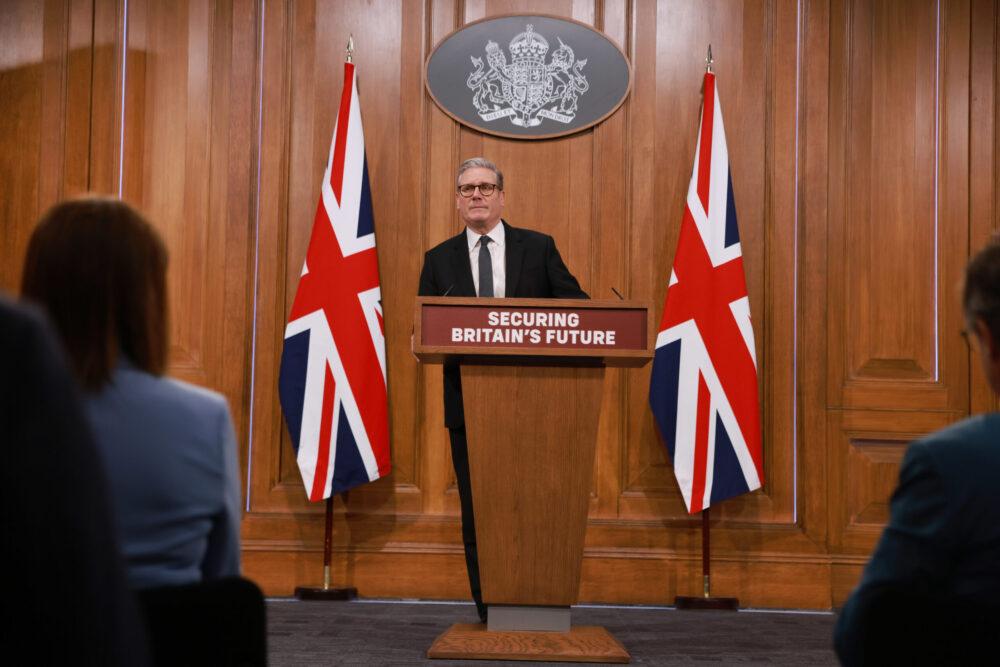
As Starmer invoked Enoch Powell this week, his party in Wales must have been in despair. Currently, the timid Greens are the only party of the left in England.
With McSweeney & Co convinced they have a grip on the soul of the nation; left wing supporters are gleefully provoked and jettisoned as political theatre.
If you think Powell’s words were paraphrased accidentally in that speech, I have a bridge to sell you.
Despite the emergence of Reform UK as a genuine electoral contender in parts of Wales, the nation remains substantially to the left of England.
Plaid Cymru is perceived as to the left of Welsh Labour and is leading in the polls. It may well be, however, that the left/right paradigm is far less important than the instinct to punish incumbents.
In this scenario, talk of post-electoral pacts involving Labour begin to look suicidal for Plaid.
For ideological pluralists, the breakdown of the two-party system is seductive as it fits so neatly into their ideals of governance.
People like binary opposition, though. It is shot through every aspect of human culture. So, could it not be that instead of atomising into several contending parties, the electorate is replacing two exhausted parties with two new ones?
Empty marketing vessels
Nobody, even their politicians, has the remotest idea what the current Labour and Conservative parties stand for. They are empty marketing vessels with nothing distinct to sell.
Recent Labour electioneering has been dominated by negative campaigning, we had to vote for them, or the Tories would get in. Well, the Tories are now an ex-parrot and if we in Wales are to be scared into the ballot box under the threat of Reform UK, then Labour are ill-served by a UK leadership that is taking its talking points from Nigel Farage and its rhetoric from Powell.
My suspicion is that Labour’s current polling figure in Wales will be cut substantially.
After a quarter of a century, that most incumbent of all incumbents will be handed an existential drubbing, just as the Tories were last year.
In those circumstances, Plaid should banish all talk of cooperation agreements, let alone coalitions. The electorate across the UK is clearing the decks, and it won’t take kindly to collaborators.
Support our Nation today
For the price of a cup of coffee a month you can help us create an independent, not-for-profit, national news service for the people of Wales, by the people of Wales.
Get more trusted Welsh news
Choose Nation.Cymru as a preferred source in Google News to see more of our journalism.
