


Thursday, 16th July 2026 Cardiff 25° · Clear sky
NationCymru A news service by the people of Wales, for the people of Wales.

Opinion

Nuclear delusion
By Mark Mansfield
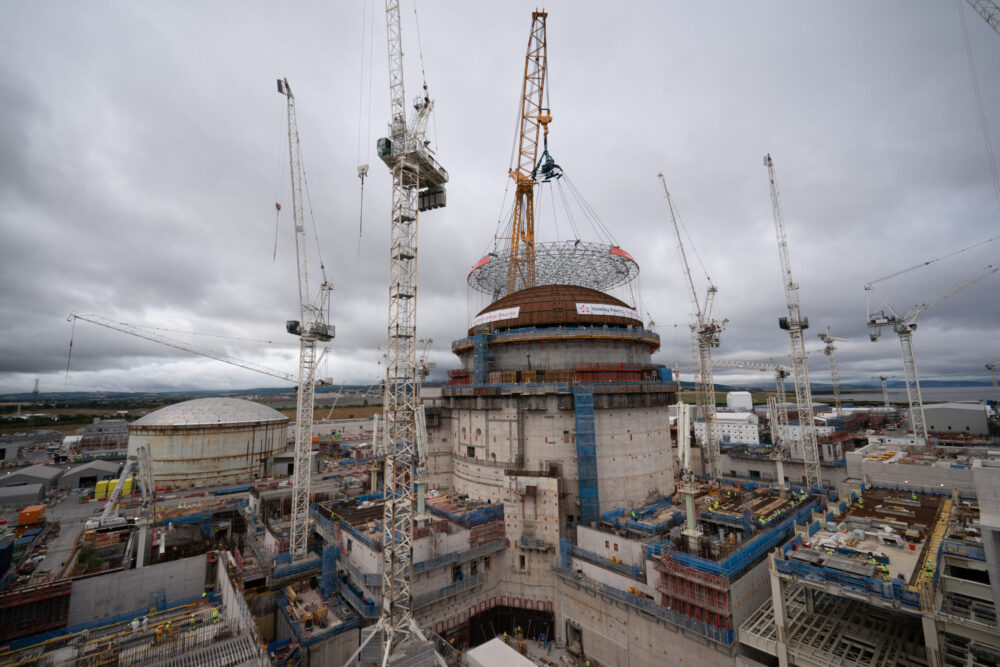
Engineering teams use the world's largest crane - Big Carl - to lift a 245-tonne steel dome onto Hinkley Point C's second reactor building, at the nuclear power station construction site in Bridgwater, Somerset. Photo Ben Birchall/PA Wire

Dylan Morgan, People Against Wylfa B (Pawb)

To coincide with Donald Trump's visit to London on a state visit, The Department for Energy Security and Net Zero has announced a series of partnerships with companies from the United States to build modular nuclear reactors in Hartlepool, Cottam in Nottinghamshire and a microreactor to power the London Gateway port.

They also mislead totally by praising nuclear technology as 'home grown'. Since when is uranium mined in any corner of the British State?

[mid-content-banner]

Uranium

They also claim nuclear power is clean. The mining, milling and refining of uranium is very dirty and very heavy on carbon emissions. The process of mining uranium is also poisonous and is a threat to human and environmental health in the areas where there are uranium mines.

Building nuclear power stations also produces heavy carbon emissions. Their press release doesn't mention nuclear waste at all, and that is a seriously dangerous and dirty problem which will cost very dearly for hundreds of years into the future.

It is completely another matter whether any of these plans will be realised.

The former Chair of the U.S. Nuclear Regulatory Commission, Alison Macfarlane has expressed doubts about modular reactors.

[lower-mid-content-banner]

Waste problems

In a paper she published, she states that waste problems from 'small' modular reactors will be worse than the conventional large ones She adds. "Many studies show the economics of SMRs will be much costlier than that of large LWRs, thereby will not be competitive or profitable."

All of these reactors are plans on paper and Linda Pentz Gunter of Beyond Nuclear in her review of M.V.Ramana'r book, 'Nuclear Is Not the Solution, The Folly of Atomic Power in the Age of Climate Change' refers to the author quoting the football manager, Brian Clough as an analogy describing the folly of 'small' modular reactors:

"We had a good team on paper. Unfortunately, the game was played on grass."

"On paper" is where 'small' modular nuclear reactors should stay.

For the price of a cup of coffee a month you can help us create an independent, not-for-profit, national news service for the people of Wales, by the people of Wales.

Get more trusted Welsh news

Choose Nation.Cymru as a preferred source in Google News to see more of our journalism.

Choose Nation.Cymru as a preferred source in Google News

18 comments

Neil Anderson

There is great danger in the nuclear folly that Pobl Cymru ought to be fully aware of. Participation in England's misadventures have cost us dearly in the past and bring unhelpful legacies. These are minor compared with the nuclear waste already littering our country, and the proposed expansion of nuclear facilities that England wants to roll us into. And the Welsh Government does not speak for us! The short-term threat is two-fold - first, the Nuclear Police have immense power (without accountability, natch) and the new facilities will see larger areas of our country enclosed in high-security cordons. One can imagine what this might do to our freedoms in Cymru... Second, with such a substantial stake in Cymru, would the English actually permit Annibyniaeth? Worse, what would be the point if our country was so tightly bound within the New English Super State? If you support independence for our country, we must all resist the nuclear menace and reject the hyper-industrialisation of datacentres, blue hydrogen, carbon storage (an expensive joke) and the continuing exploitation of our resources, our land and our people. Cofiwch Dryweryn! Cymru rydd!

Reply
smae

The author brings up that mining is very dirty and heavy on CO2 emissions... but there's no other alternative. To make the steel necessary for wind turbines, solar panels... dirty mining is needed, to produce the batteries for electric cars... dirty mining is needed (in copious amounts). As for uranium mining in the UK, while as far as I'm aware it is no longer happening, it has happened in the past, see the South Terras mine in Cornwall, which close less than 100 years ago and it's possible to extract uranium from seawater. Which, last I checked the UK has abundant access to: https://www.nature.com/articles/s44221-024-00346-y (it's renewable, unlike land mined uranium which might run out in approximately 4bn years). Yes nuclear power stations take a lot of resources to build, but once they're in place they provide nuclear power for many years without CO2 emissions (the current problem) they are a net benefit to CO2 emissions over all. The nuclear waste problem is not as much of a problem as the author appears to claim, lets clarify, nuclear fuel is solid when it goes into the reactor and it's still solid when it comes out of the reactor. It's then stored somewhere safe... it doesn't and cannot (due to being solid) leak, most of the incidents of contamination are due to contamination from say earth quakes and water. Spent nuclear fuel can, in fact, be recycled, France does this and there are designs of advanced reactors to further exploit this 'spent' fuel to power more reactors. We no longer have to bury and forget tonnes upon tonnes of nuclear wasted (which could be safely stored down no longer used mines).

Reply
Peter J

It's opinion masked as facts, and not true. If you measure lifecycle emissions of nuclear in gCO2eq/kWh, its better than wind as on par with solar (somewhat depending on locations of the latters); and the mining is a relatively small impact. Uranium mining also produces other byproducts which are necessary for everyday life such as molybdenum, vanadium and a whole host of critical materials. And your right mining is needed for all techs- solar needs silver and silver mining has a much much bigger impact globally than uranium mining does. If you read the press announcement from a few days ago, the author would have seen that both governments will explore uranium deposits from more ethical and less geopolitically vulnerable supply chains. But I suppose if you have a viewpoint and you don't want to change it, why let facts get in the way?!

Reply
smae

Might spoil someone's view I guess... (see an awful lot of that behavior).

Reply

In reply to smae

Peter J

I certainly wouldn't bother engaging with PAWB face to face!

Reply
TomW

Yes it costs CO2 to mine uranium, as it does with extracting coal, gas, and oil. It costs CO2 to build the power plants, as it does with coal, gas, and oil. Nuclear energy is clean at the point of use with two by products of steam and nuclear waste. Steam is much less harmful than acid rain or oil spills decimating ecosystems, and the waste gets buried in the ground in a container in an area the size of a tennis court.

Reply
smae

and the nuclear waste can re-used/recycled well at least if we were french and we're can't have that now.

Reply
Bryce

The biggest problem is time. Hinkley was announced in 2010 and is expected (hoped) to be online in 2031. 21 years. And that's using tried and tested technology, not unproven "experimental" SMRs. In half that time we can solve the storage problem and power everything from limitless renewables.

Reply
Peter J

really interesting point. The problem is renewables aren't 'limitless'. If the world wants to meet net zero commitments, there's not enough silver mines, silicon purification plants or glass manufacturers (!) to meet PV demand. China recently considered a Neodynium export ban due to the high demand impacting their own industries - this material is vital for wind turbine magnets. Batteries as we know are mostly made in China also. We don't know what the world is going to look like in 20 years time. It could very well be a stroke of visionary genius to roll out nuclear and take a lead on SMR development as the UK gvmt is doing

Reply
Bryce

Renewables are limitless in terms of the available energy, not our ability to harness it. And storage doesn't necessarily mean reliance on Chinese rare earths. Batteries can be made from sea water. Excess electricity can be turned into green hydrogen, stored until it's needed and used in existing gas turbines during dark still periods. Why take a punt on SMRs that still leaves us exposed to a finite resource, legacy issues and geopolitics when we could be innovating in energy storage.

Reply

In reply to Bryce

David J

Quite right,and don't forget sodium batteries, made from an abundant element. Electricity can also be stored in pump-storage (ie water battery) schemes, like Dinorwic. All of which, unlike nuclear, can be easily removed if we find a better way in the future.

Reply

In reply to David J

smae

Please point out which valleys will be acceptable to flood. I'm all for water storage and or hydroelectric but the problem is that no one wants to be forced out of their homes and it's a huge deal when it happens.

Reply

In reply to Bryce

smae

Uranium is not strictly speaking... a limited resource. It's true that Uranium extracted from land doesn't replenish itself, but Uranium extracted from sea water does and it would take about 4bn years for us to get through said energy anyway. Chances are we'll be extinct by then.

Reply
Martyn Rhys Vaughan

There are various emerging technologies which can reuse waste from nuclear power stations. There are alternatives to uranium in nuclear power - mainly thorium, which is under active investigation by China. There are very few activities which do not release some CO2 into the atmosphere - breathing is one of them. The fact of the matter is that any advanced industrial civilisation which requires huge amount of power to make its electronic (e.g. AI) systems run reliably cannot depend upon wind and solar. These must be developed further and put into use wherever possible. But for steady baseline electrical production nuclear is essential now and will be more essential in the future. Fusion power won't save us: there is no indication it will ever work. There are indeed delusions - but the belief that nuclear is not needed is one of them.

Reply
David J

Interesting you put fusion in the same paragraph as "alternatives to uranium". They have this in common, that they are always at least ten years in the future. We haven't even begun to consider tidal power seriously, let alone deal with the increasing piles of nuclear waste, so to dismiss renewables as unable to cope with any amount of industrialisation is disingenuous.

Reply
smae

Nuclear waste piles are tiny. A lot is said about them, but they really don't take up as much space as you'd think. We have a bigger issue with common landfills (which emit methane and other gases as they degrade and decompose).

Reply
smae

I dispute that we can't depend on wind and solar. The wind is always blowing somewhere, it's just a case of having the turbines in the right place and a properly joined up grid. Likewise, the sun is always shining somewhere and further, experiments are already ongoing for launching solar collectors into space where last I checked the sun always shines. With that being said, other renewable energy sources such as Hydroelectric, Wave Energy, Tidal Energy, Geothermal, Heat extraction technologies exist and can easily provide required amounts of energy overnight. The use of lagoons can provide an absurd amount of clean energy over time basically acting as a storage as well. I'm not disagreeing with you that Nuclear isn't important (though it's clear we need additional safeguards to resist things like Tsunamis, Earthquakes and military attacks) but it's not right to say we can't manage without it. As for fusion, the reason why people keep putting absurd amounts of money into it is because it keeps showing progress, goals keep getting achieved. The scientific feasibility of fusion has already been proven and Fusion Reactor prototypes are due to be operational by 2027 (SPARC) and 2039 (ITER). There has been a lot of underestimating this tech in the past trying to compare it with fission development, but it's absurdly more complex and progress will depend on whether the finances hold up and the development of supporting technologies. https://climateinsider.com/2025/04/12/from-ignition-to-grid-what-fusion-energy-still-needs-to-deliver-power/

Reply

Leave a reply

Replying to David J Cancel

Interesting you put fusion in the same paragraph as "alternatives to uranium". They have this in common, that they are always at least ten years in the future. We haven't even begun to consider tidal power seriously, let alone deal with t...

Comments are reviewed before they appear.