


Opinion
'No debate' has damaged Welsh democracy
Sarah Tanburn
Voices who do not follow the line of established, funded partners cannot gain audience with government.
Criticism of the pre-determined agenda is silenced.
Such suppression of dissent counts against any Welsh claims to inclusion and social justice and is a sore failing in a maturing social democracy.
It would not be hard to fix the structural failings. Groups funded to promote civic society must be accountable for plurality of opinions as well as diversity of representation.
Senedd members in all parties should speak with honesty and knowledge - and understand that a few individual anecdotes are not a substitute for longitudinal study. Civil servants preparing policy advice are expected to seek out a range of views and know what constitutes a robust evidence base.
Our elected representatives must remember that upholding the reality of sex is worthy of respect in a democratic society; further, our democracy rests on recognising and engaging with opposing stances. Inclusiveness is not a substitute for pluralism and the alternative to resolution is not amorphous kindness but authoritarianism.
[mid-content-banner]
Based on the evidence
‘No debate’ was the angry mantra for years. Questions about health care, education, candidature, lesbian erasure, or sport were all condemned. It was hateful to say that language such as ‘cervix-havers’ did not help communication about preventative interventions. Pointing out risks of injury or unfairness when male-bodied people join a women’s rugby team was said to deny trans women’s existence. We have moved on a little, not least thanks to the Scottish imbroglio, itself partly caused by SNP pursuit of gender self-identification.
People still argue about the specifics. Just last week Senedd finally debated the Cass Report into gender-related health care for young people. (You can read the report here.) It was commissioned by NHS England, but all such cases in Wales are referred to English services, so it is just as important for us.
I am not going to analyse Cass in detail. Plenty of others have done that. I commend the views of the British Medical Journal, which was unequivocal in its editorial, published the day after Cass’s report. The Society for Evidence Based Gender Medicine also wrote about it here. Calls for ‘compassion’ which omit the basic scientific evidence (or lack of it) are misplaced: there is nothing compassionate or kind about promoting treatments which cause irreversible harm.
Instead, I want to talk about what the whole sorry saga illustrates about the state of Welsh democracy.
[lower-mid-content-banner]
Two degrees
In a small country, people are often closely linked through schools, worship, family ties and more. There are strengths to such webs, informing the friendliness and welcome which pervades so much of Wales. But – and it is a big but – not when it creates enclosed political elites, impenetrable to the outsider, the newcomer, or the dissenter.
In 2022, Dr Elin Royles (Aberystwyth) and Prof Paul Cheney (Cardiff) explored attempts to grow civil society from 1999’s devolution. (Their essay is in the collection ‘The Impact of Devolution in Wales’, which I reviewed here.) They looked at improvements in representation and presence in the corridors of power and the mechanisms WAG used, including funding for key communities historically excluded. They identified concerns about ‘increasing power inequalities between professionalised organisations with well-developed lobbying capability … and those with limited resources.’ Studies as early as 2012 asserted ‘institutional lethargy’ by Welsh Government relying on those organisations with whom they had close relationships rather than extending policy development and delivery beyond ‘the usual suspects’.
Royles and Cheney go on to explore the behaviour of those organisations, which from the beginning included Stonewall Cymru, in the face of Welsh Labour dominance. They state, ‘closeness of organisations to government heightens political patronage [and] risks …compromising their independence.’ Most significantly, their study shows that ‘informal, often intra-party, processes and networks were extremely important in engagement with government… creating insider and outsider organisations.’
Who knows whom?
This has directly affected sex and gender politics in Wales. Just three examples illustrate the point.
In 2021 Welsh Government set up an ‘Expert Panel’ to discuss their Plan to promote LGBTQ+ inclusion and services. A Freedom of Information Request stated the ‘volunteers were drawn from discussions with LGBTQ+ organisations in Wales.’ The Chair, shown as ‘independent ‘in that response, was Chair of Pride Cymru for seven years and a Labour activist in her constituency. There was – crucially - no attempt to ensure diverse opinions.
Grassroots groups, notably Lesbian Gay & Bisexual Alliance Cymru (LGBAC), repeatedly asked to be involved, most recently just two months ago in response to a further statement by the Minister. These requests have been completely ignored or directed only to the public consultation.
In March, feminist organisation Merched Cymru published ‘Hung Out to Dry’, a detailed study of how schools approach gender questioning pupils. Their report should be studied by politicians, councillors, parents, and anyone concerned about how our schools teach sexuality and gender. So far, not one politician has asked to meet with them and discuss the issues.
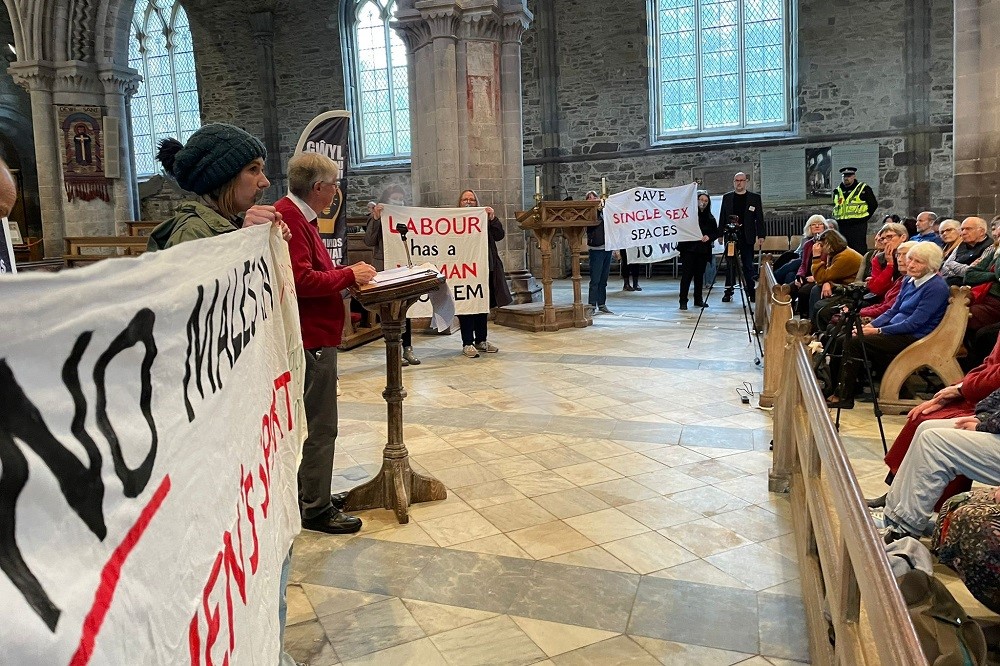
Last week, the Senedd Committee on the Reform Bill heard evidence from Women’s Rights Network Wales about the stealthy introduction of selfID in the government’s proposals. It is startling to realise that this is the very first time a gender-critical group has been able to publicly engage with Senedd processes without picketing, abuse or ghosting.
Most egregiously, on 1 May, Jane Hutt was asked by that Reform Bill Committee whether she had consulted women’s groups with concerns. She covered herself by asserting engagement with ‘established networks’ – exactly those networks which have ejected women from hustings, refused meetings and insulted gender critical voices.
Many groups with concerns about the direction of travel by Welsh Government on these issues have found it impossible to participate in democratic processes. ‘Established networks’, Ms Hutt, are groups who tell you what you want to hear in exchange for continued funding.
Both sides are not the same
It is disingenuous of Senedd members to talk as if the toxicity in this debate was evenly distributed. It is women’s meetings which are barracked. It is lesbians and gay men speaking up for same-sex attraction who are vilified and abused. Parents, teachers, clinicians and others cannot protect in the best interests of those they care for. Time after time, it has been the expression of gender-critical views which have cost people their jobs. Yet those same views have been upheld in Court, mostly recently in the exemplary and aggravated damages awarded to Rachel Meade.
We do not hear about similar cases required by those arguing for selfID – because they do not happen. No-one is being hounded out of their work because they support basic human rights, or even for supporting gender self-identification. I do not accept that ‘misgendering’ is literal violence: not when the streets of Cardiff are regularly littered with stickers saying ‘Terfs get the Wall’ of ‘F-k off Terf Scum’.
Laziness or fear?
Constituents have been to their surgeries, written to Senedd members about specific measures, and even demonstrated at events. These efforts have been going on for over four years, to my certain knowledge. Those responsible, even the past and current First Minister, were aware of these issues long before the Cass Report was published.
In the Cass Report debate, Rhian Passmore called for all views to be represented in the Senedd. That would be a welcome change. Reflecting the general trend in Wales, most supporters of gender-critical groups are either Labour or nationalist, but today feel politically homeless, so simple partisan bashing helps nobody.
Yet groups such as Merched Cymru, Women’s Rights Network, LGBAC, Labour Women’s Declaration and Outspoken Women are not being invited to the table, not asked to be part of round tables and evidence sessions. Why do they find it impossible to access Ministers? Why are their cogent concerns ignored?
Charitably, perhaps Ministers do not have time to ensure they have heard all points of view. Or are too lazy to listen beyond the clamour made by Stonewall and its allies. Maybe they are simply scared -which would be a sorry admission for any lawmaker. Now is the time to come to the table.
Support our Nation today
For the price of a cup of coffee a month you can help us create an independent, not-for-profit, national news service for the people of Wales, by the people of Wales.
Get more trusted Welsh news
Choose Nation.Cymru as a preferred source in Google News to see more of our journalism.
