


Wed, 22nd July Cardiff 23°
Nation.Cymru wordmark
Advertisement

Opinion

Matching state pension to the national living wage would help pensioners maintain their dignity

By Mark Mansfield
Image by ScouserUK from Pixabay

Chris Parry, Principal Lecturer in Finance, Cardiff Metropolitan University

A question that is perennially asked by financial experts is: “can the government (in other words, the taxpayer) afford to keep increasing pensions?” But in my view, the real question should be: “what is the purpose of the state pension?”

This isn’t an economics question, it’s a moral question. And, as a society, we are poor at discussing moral questions.

report from the Office for Budget Responsibility earlier this year stated that in the current financial year, the state pension will cost around £124 billion. This is more than the £105 billion education budget and more than double the £52 billion defence budget.

The level of the UK pension is safeguarded by the triple lock, which was first introduced in the June 2010 budget. It means annual increases in payments are made in line with earnings growth, price inflation (currently 4.6%) or 2.5% – whichever is highest.

With another triple lock increase of 8.5% in pensions due in April 2024, the state pension will rise to £221.75 per week (£11,531 per annum). This is only £20 per week less than the personal allowance everyone can earn before having to pay tax or national insurance.

[mid-content-banner]

Inflation

Assuming wages exceed inflation and 2.5% in line with the last five year averages, then the pension up-ratings could be in the region of 5% in 2025 and 2026. This will see pensioners, who have no other income, having to pay tax – in some cases, a decade after they last paid income tax.

So, how do we ensure that retired people are able to have a comfortable standard of living once they stop working? As a starting point, we can consider principle 15 of the European pillar of social rights, which was set out in 2017 by the European Union and maintains: “The right of workers and the self-employed to a pension commensurate with contributions and ensuring an adequate income. The right to equal opportunities to acquire pension rights for both women and men. The right to resources that ensure living in dignity in old age.”

[lower-mid-content-banner]

Comparing incomes

The national living wage is two thirds of UK average earnings and should be the minimum to cover “adequate income” and “dignity in old age”. The salary obtained by an adult working 37 hours per week at the national living wage is currently £10.42 per hour. This will increase to £11.44 per hour from April 2024.
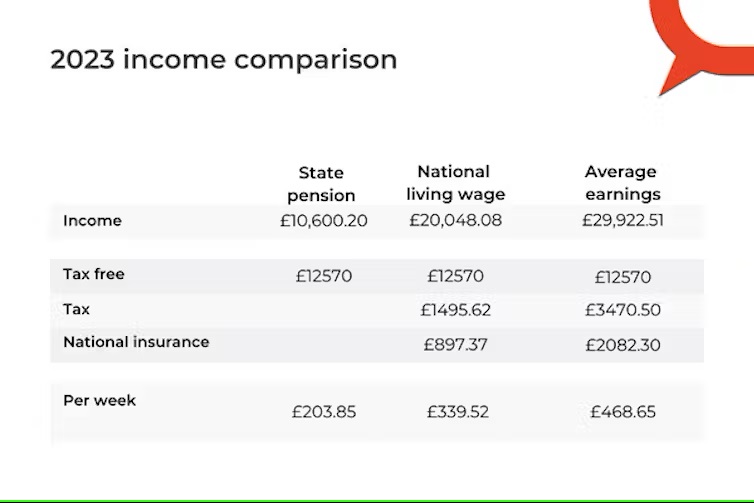
Were the UK pension matched with the national living wage, it would be set at a figure of £22,308 per year, and pensioners’ income would be vastly different as of April 6 2024.
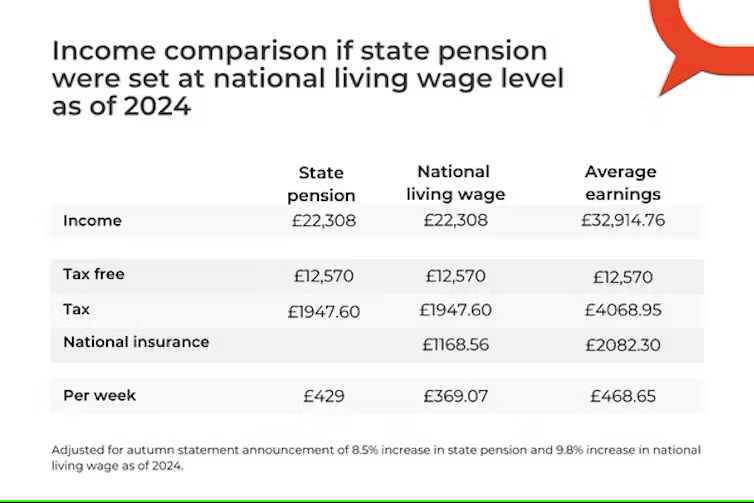
Even after paying more than £1,900 in tax, the poorest pensioner would be still be £225.15 per week better off than they are today. And the extra disposable income could be recycled into the economy through increased expenditure, with knock-on impacts in indirect taxes such as VAT.

A European comparison

recent survey by pension advice firm Almond Finance UK shows the UK is currently 16th out of 50 countries in terms of the best pension offering across Europe. Spain tops the survey, with Belgium in second place and Luxembourg third.

Bringing the state pension in line with the national living wage would move the UK up to fourth position, ahead of Bosnia and Herzegovina, Cyprus, Lichenstein, France, Denmark and Switzerland.

Such an increase would raise the annual cost to the Treasury from the current £124 billion to £236 billion. And such a large increase in expenditure would require more taxes or more borrowing, which would accrue more debt interest in turn. But this sum could be reduced by £13 billion by charging pensioners national insurance.

In a response to an online petition in August, which called for the state pension to be matched to the national living wage, the government said it had “no plans to increase the state pension to equal 35 hours a week at the national living wage”. It went on to describe the state pension and national living wage as having “different purposes” and said that a direct comparison could not be drawn between the two.

With the focus on cutting both business rates and national insurance in the autumn statement, it’s worth considering how those measures will help to ensure that pensioners live in dignity in old age.

This article was first published on The Conversation
The Conversation

For the price of a cup of coffee a month you can help us create an independent, not-for-profit, national news service for the people of Wales, by the people of Wales.

Get more trusted Welsh news

Choose Nation.Cymru as a preferred source in Google News to see more of our journalism.

Choose Nation.Cymru as a preferred source in Google News

7 comments

Neil Anderson

As a pensioner, I declare an interest! Chris Parry's excellent article places emphasis on where it should be - treating elderly people with respect and allowing them dignity. A moral issue if not anything else. And that goes for everyone else as well. The 'living wage' is not adequate given today's cost of living. There are many who are poorly paid. While more taxes and/or more borrowing (and possibly interest on it) would be anathema to the Treasury and the government, hell-bent on reducing the value of what we are all paid, no action is likely. But there is another weapon in the armoury of a government not ideologically hidebound nor wilfully blind. Apart from notes and coins, the government creates all money. It could simply authorise higher rates. There is never an economic rationale for austerity, which is a wholly political choice. That government, post-independence obviously, would utilise all available tools to manage inflation (2% would not be bad, especially in permanent deflated Cymru), including a wider range of progressive and clever taxes. Besides, the propensity to consume is high among low earners, and the rise would probably pay for itself. Independence has much to offer the people of Cymru, independence of mind more so. And even the UK Government utilises Modern Monetary Theory - when it suits. Refer to the Bank of England Quarterly Bulletin (Spring 2014) on money creation...

Reply
Jeff

Funny how wealth never trickles down, despite the claims from the Cons. It aways trickles up. This leaves millions close to the edge whilst the small percentage of richh will never have to worry ever again.

Reply
Steve Woods

It's not so much an upwards trickle, but more of a torrent.

Reply
John Davies

There is no way of funding this. Giveaways to billionaires are much more important, so the money isn't there.

Reply
David Smith

Whilst Chris makes a thought provoking contribution, I reminded of the views of my deceased mother, Hilda, who at 90 year old was a very active member of Welsh Governments National Partnership Forum for Older People (2000-2007) One view strongly advocated state pension income to the exclusion of other matters. Another, which Hilda strongly advocated, was that vulnerable older people require good public services. For example, good Primary Care and GP's with a grounding in gerontology; Community Pharmacy and effective medicine reviews; Public Transport to help overcome isolation; access to community support services rather than help with a shower in a 15 minute visit at the unearthly hour of 7.30 am after a sleepless night; quality chiropody and physiotherapy services to aid mobility; access to tasty meals on wheels or a luncheon club & a timely Ambulance Service. All essential ingredients required in an increasingly ageing society. I am sure we can all agree health and wellbeing cannot simply be measured in terms of cash alone and that collective social provision, including well paid quality NHS and social care staff, need to be considered when debating these issues. All these aspects are essential when considering dignity and respect for older vulnerable people.

Reply
Padi Phillips

Most of those things sound like what we should be expecting and demanding for everyone, not just those of us who are ageing, things that any civilised society would without question be providing! I'm a bit unsure about the general thrust of the argument to make the sum of the national minimum wage. At present the only reason why income tax could be applicable it because the tax free threshold hasn't been increased for some years, which has meant that more and more poor people now pay income tax as well as the various stealth taxes they already pay (tax for the wealthy on the other hand...) I'm someone who fairly recently claimed my state pension. I have a small local authority pension that amounts to a few hundred pounds a year on top of that, but I'm still considered 'poor' enough to be able to claim both Housing Benefit and Council Tax Reduction, which means that most of my rent and Council Tax is paid by HB and CTR. This actually amounts to about an extra £6k a year on top of my state pension, and whilst circa £17k a year isn't a king's ransom, it is nonetheless more than enough to have a comfortable life - and I have no problem indulging my interests, on which I pay consumption taxes, TV licence fees and contributions to various causes as well as funding my rapidly growing personal library. I eat very well, (too well, must exercise more!) and certainly don't freeze or have to sit in the dark, thanks partly to various schemes from the DWP and power utilities, (£500 Winter Fuel Payment from the DWP this year, and I think also £150 Warm Homes Discount from my utilities supplier.) I dare say I'd qualify for a reduction in my water bill too, but mine's metered and doesn't amount to more than about £300 a year, so I just pay it. I also have a bus pass, which I use a lot, so that saves me a huge amount annually, and I have in the past used it to travel up and down Wales whilst on holiday as it's valid on TrawsCymru services too. As it is I have trouble spending all I have coming in and have to keep a watchful eye on the sum in my bank account not exceeding a certain amount as that would trigger a minor bureaucratic nightmare with the local council. About the only rational reason to change the current system would be in the interests of simplification and the abolishing of most of the various benefits that those currently living on, or just a little more than a basic state pension are entitled to claim. That would, in my opinion, be a very good reason to change the system, but the bugbear with any system controlled by politicians is that the fortunes of pensioners could change, and on a political whim pensioner could be literally left out in the cold which was a common experience well into the 1980s before the Tories thought they could bribe the aged, though not this one. The trouble is, it's not going to be long before the Tories and those like them realise that the cohort of crusties that votes for them is literally dying out and that the upcoming generations are no longer inclined to vote Tory as they get older.

Reply
Sarah Good

Both of these things should be possible in a healthy economy. But successive governments (even moreso this last 13 years) has been robbing the state and selling off our assets to cover their own incompetence and fraud. We need a strong government that says taxes are going up (even for the megacorps), to give you the services a first world country needs. Everybody wants more money in their pockets, me included. But as a nation, we have to pay for the things we want, like affordable public transport, a funded NHS, something resembling NHS dentistry etc. When the state provides these, the individual doesn't have to make their own provision and in the long term it makes life more affordable and creates wealth. EG if we had a functioning, affordable public transport system (Spoilers: We don't) there would be less pollution because fewer cars on the road, fewer accidents, a more mobile workforce, fewer people needing to own cars to go places, increased tourism because people can just hop on a train without taking out a mortgage to do so and so onwards and outwards. Cui Bono? Omnis!

Reply

Leave a reply

Replying to Neil Anderson Cancel

As a pensioner, I declare an interest! Chris Parry's excellent article places emphasis on where it should be - treating elderly people with respect and allowing them dignity. A moral issue if not anything else. And that goes for every...

Comments are reviewed before they appear.