


Opinion
Life In the Fast Lane
Ben Wildsmith
I had to go on a driver awareness course this week. I chose to do it online and settled in for the three hours with very little joy in my heart.
My cohort included fellow miscreants from England and, because of the speed limit changes, Wales was receiving more attention than we usually expect. Every other sentence ended with, ‘except in Wales’.
It was quite pleasing, in a way. It often feels that we are compliant here to the point of invisibility so Welsh distinctness being repeated like this was refreshing. For once, we’re the awkward squad.
The course itself turned out to be interesting. In one section, the trainer encouraged us to imagine the emotional impact of a road accident on different people involved in it. As well as the direct victim, these included their friends and relatives, the wider community, bystanders, emergency services personnel, and people connected with the offending driver. It was an exercise in empathy, which is a facet of humanity that rarely reaches us via officialdom.
[mid-content-banner]
Trauma
Everyone took the exercise seriously, sharing their fears of causing such a ripple-effect trauma. It was a random group of nine drivers who had been caught speeding slightly over the limit. Nothing cohered us beyond that, but the polite decency on display was at odds with the anger and division that we are led to believe exists on these islands.
The course was delivered in such a way as to encourage a friendly, reflective atmosphere, a space where people could admit fault without fear of derision or condemnation. The very opposite, in other words, of what’s fostered on social media platforms.
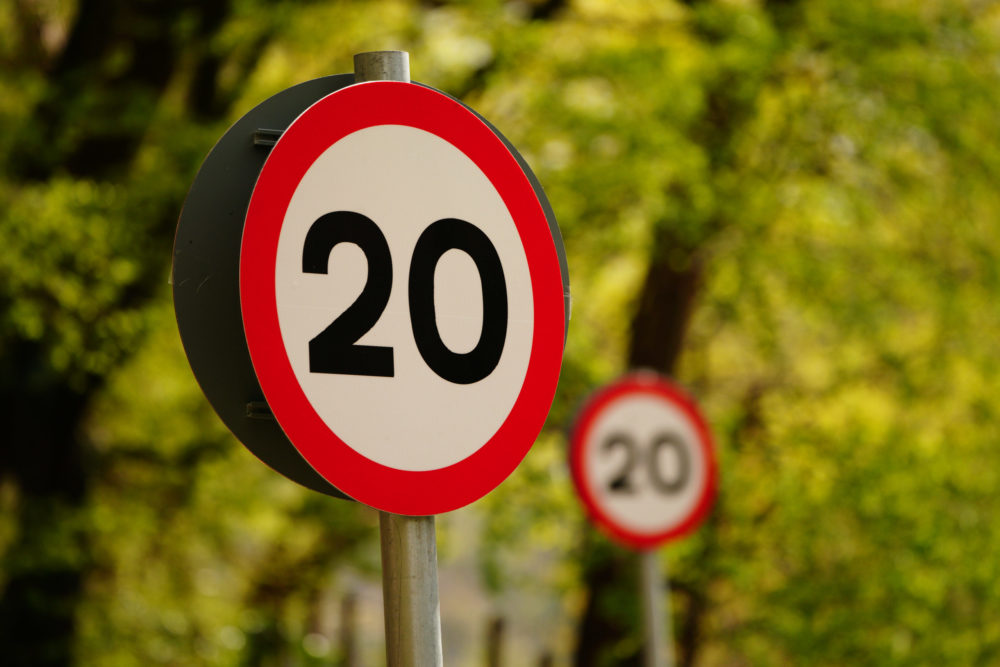
My offence was for driving at 24 MPH on a 20 MPH limit road. It wasn’t in a built-up area, or by a school so it’s safe to say that the English drivers on the course would have been legally permitted to drive exactly as I did, on a similar road, without sanction.
That seems a bit unfair, doesn’t it? It prickles to think you are being penalised under stricter rules than other people. One of the reasons, however, that Wales is mentioned so frequently in the course material, is that the statistics arising from our 20 MPH limit are so striking. The drop in fatalities is being used to illustrate the relative dangers and benefits of driving at different speeds to drivers around the UK. We are, quite clearly, in the vanguard of changes that will be adopted elsewhere.
When the letter arrived, informing me that I’d been caught speeding, I managed a wry smile, eventually.
[lower-mid-content-banner]
Civil disobedience
I’m on record here as supporting this legislation when the argument over it threatened to tip into civil disobedience. So, now I was on the wrong side of it, I had no viable position but to suck it up. Never mind that it had been on an entirely empty road where visibility was perfect and signage scarce. Forget the injustice of everyone else on the course being allowed to do what I did, it’s irrelevant, I told myself.
The law has been proven to work, and I supported it, so bad luck, just pay the course fee and do better.
When our new speed limits are brought up politically, it is invariably by figures who offer a bundle of complementary opinions. Along with opposition to the speed limits comes aversion to measures on climate change, anti-discrimination initiatives, and progressive taxation. We are so used to seeing these packaged as a unified manifesto that we’ve ceased to question what it is that coheres them.
The answer is that progress on these issues demands that people accept perceived personal disadvantage in service of the greater good. From receiving a speeding ticket, to sorting the recycling, to losing privilege, and paying for improved services, people are taking a hit.
It used to be the job of politicians to inspire the populace so that people were willing to play their part. Kennedy’s ‘Ask not what your country can do for you,’ speech imagined society as a shared enterprise.
'Woke'
We are nowadays plagued with a class of politician whose chief skill is to plausibly excuse people from their responsibilities. Anything that is inconvenient can be waved off as ‘woke’.
Years of scientific research are opposed not with contending theories, but the laughing emojis of voters who have been told they don’t have to bother themselves understanding. Instinctive prejudice is mis-sold as ‘common sense’ that allows for easy solutions and the glib dismissal of anything that requires us to improve ourselves.
I enjoyed my course, in the end. It was a calm little corner of civic society in which everyone did their best and treated each other well. I’m driving more carefully this week.
Support our Nation today
For the price of a cup of coffee a month you can help us create an independent, not-for-profit, national news service for the people of Wales, by the people of Wales.
Get more trusted Welsh news
Choose Nation.Cymru as a preferred source in Google News to see more of our journalism.
