


Opinion
Green GEN is interested in making money, not protecting Wales' unique landscape
Sarah Eyles
In March 2025 I attended two of the Green GEN Cymru (GGC) Towy-Teifi proposed grid line route (predominately using pylons) consultation events. The first one was in Llandybydder on Thursday March 20 2025.
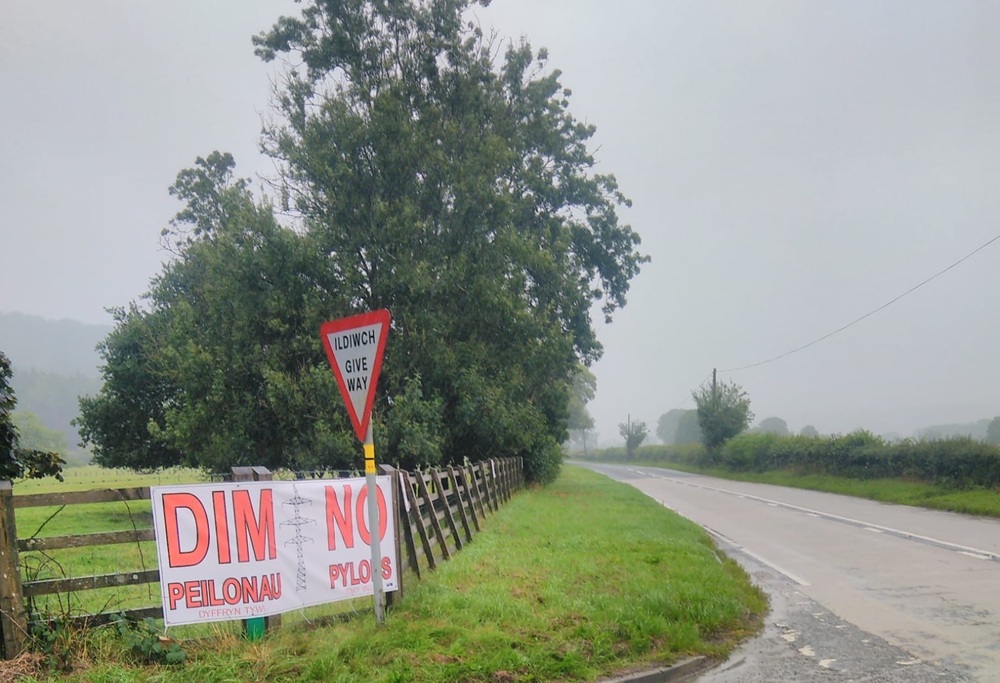
There were many Teifi Valley Against Pylons and anti-windfarm signs outside the venue, including one saying: ‘bury the powerlines or bury the project’. There were probably around 100 people who were present during the two hours that I was there, and you could cut the anger with a knife.
I spoke to one woman who owns a farm which has been in her family for seven generations. She told me that the GGC proposed route had been slightly changed from last year, and that now five pylons will be cutting her farm in half. She was visibly upset, and devastated that her children and grandchildren might not get to enjoy the farm intact, and that the beauty and functionality of the land that has been in the family for so many generations will be destroyed.
She told me that she had asked one of the GGC representatives present, ‘How would you feel if you were in my position?’ They had callously answered: ‘I wouldn’t know, I live in a city.’
I saw a group of friends at the consultation who many years ago had bought a mill together and had lovingly converted it into separate houses for their families. They told me that the proposed route was now going directly past their multifamily residents, and that a pylon would be within metres of their home.
At the Llanpumsaint consultation on Friday March 21 my first question to GGC was:‘What feedback from your consultation last year have you incorporated into your plans?’
The first GGC representative I asked went to fetch someone else to answer the question. This seemed to be their modus operandi. There appeared to be no one employee who had an entire overview of the project and its various implications. This felt strange, as those who will be impacted by the proposed development are intimately aware of the multiple consequences to their properties and businesses, and to landscape and wildlife.
The representative who came to speak to me said, ‘Following feedback we have changed the route slightly.’
‘And now you have alienated even more people,’ I said. It was as if they were colonialists who had looked at a map of Wales and considered that it was empty (null, unused, unoccupied) and therefore better deserving of their stewardship as a self-proclaimed ‘productive power’.
‘Every square metre of land in Wales is someone’s home, ancestral land, smallholding, business or is home to wildlife,’ I said. ‘Whichever way you move this pylon route it will devastate people’s lives and destroy precious habitat.’
The second change he said had been incorporated was burying 5km of powerlines near Merlin’s Hill. Given that Merlin’s Hill is an ancient site, with SAM No.=CM231, this was most probably mandated, and not in response to our consultation feedback.
SAMs are archaeological sites or ruins under the Ancient Monuments and Archaeological Areas Act 1979 and are protected by law. This affects only 5km out of the proposed 52km of pylons on the Towy-Teifi route.
That was it. No other changes. He then asked what changes I would have liked to have seen. ‘Everyone is asking for you to put the powerlines underground. Why can’t you do that?’
‘I will have to fetch our engineer to talk to you about that,’ he said.
I asked the engineer: ‘Why are you not burying the powerlines on the entire Towy-Teifi route? It is the only acceptable solution for the communities who will be negatively impacted by your proposed pylon developments. I understand that recent studies show that the lifetime cost of pylons is comparable with the lifetime cost of burying the powerlines underground using cable-plough technology.’
Cable-plough technology is an efficient method of burying high-voltage powerlines, as opposed to using pylons. The cable-plough lays cables underground in a single operation by cutting into the earth, installing the cable and backfilling in one motion, causing only minimum disturbance to the land.
‘Pylons are much less expensive than burying the powerlines,’ the engineer replied.
‘So what comparision study are you using to prove that? Is that the National Grid commissioned study from 2012?’ I asked. ‘Because cable-plough technology has moved on since then, and is now the standard in many countries. In the 2012 study the costs for burying powerlines were based on trenching methods.’
Traditional ‘trenching’ methods of burying powerlines require a sizable trench to be dug and then refilled and is more expensive and causes more disturbance to the land than cable-ploughing.
‘I don’t need to look at a comparison study,’ he said. ‘I know, because the cost of cables [per metre] for undergrounding is more expensive than the cabling used for pylons.’
‘But we’re talking about the lifetime cost, and you can’t base that on the capital cost of the cabling,’ I replied. ‘There are multiple data items and variables that you have to take into account to calculate the lifetime cost of something.’
‘I’m an engineer and I know’, he said. ‘And if you keep interrupting me, I’m going to walk away and stop talking to you.’ Which, thankfully, is what he then proceeded to do.
Having worked as a data analyst for over 20 years, and with a father who was an engineer, I was dumbfounded at this engineer’s apparent ignorance. You cannot establish the lifetime cost of something based on the capital cost of one component. It is like saying that the lifetime cost of an electric car is greater than a petrol car because the battery in the electric car costs more than the battery in the petrol car.
My next question was about the methods that Carter Jonas, the property consultants who GGC employ, have used to try to gain access to land that forms part of the proposed pylon route, for the purpose of surveys.
I said to the Carter Jonas representative: ‘On your website you state that Section 172 [the right to enter and survey land] can only be used by an acquiring authority, which is typically a public entity. Is GGC a public entity with an acquiring authority?’
‘We checked with our solicitor, and because we have an Independent Distribution Network Operator [IDNO] licence, yes we are an acquiring authority,’ she answered.
This seemed like thin ice. A ‘public entity’ is defined as ‘a formally established organisation that is, at least in part, publicly funded to deliver a public or government service’. That doesn’t sound like GGC, who are a private company who want to make as much profit as possible.
I said: ‘There have been instances of you harassing landowners. In one case you kept visiting a vulnerable farmer, who has mental health challenges, at all different times of day. The man became very distressed at your continuous approaches, when he clearly stated that he refused your request for access to his land. There have also been reports of you going onto land without the owner’s permission. What do you have to say about that?’
She repeated: ‘We checked with solicitors and we have legal rights from Section 172 which we will pursue’.
There are some things in life that are legal but to most people will be seen to be morally abhorrent. Section 172 is legislation that even on Carter Jonas’ own website they say is ‘compulsory purchase’, but without the normal checks and balances.
I understand that there is an application to the Magistrates Court by Green Generation Energy Networks (ie GGC) for a warrant to use force to enter land under s173, at a court hearing in Llanelli at 12pm on Monday April 14.
I then asked what studies GGC had done to identify the impact on tourism and how they will mitigate the blight of the proposed pylons. The GGC representative said: ‘We haven’t done that study yet, but will do so when the planning application is submitted’.
‘But how can you propose these pylon sitings without knowing how they will impact such an important industry?’ I asked.
He appeared to have no answer to this but said: ‘There are pylons in Pembrokeshire and yet tourism still thrives there.’
‘Yes, but the Pembrokeshire pylons are not in the tourist destinations, ie the coast and the National Park. But in this part of Wales tourists come to enjoy the beautiful hills, valleys, forests, rivers and mountains. And this is where you are proposing to site the pylons.’
My next conversation was with a young man at the ‘welcome’ desk. I asked him how he thought the local residents would benefit from this pylon line. ‘People can connect to it for power,’ he said.
‘But your proposal is for a 132kV line. For 3-phase for a farm or factory, for example, you would ask National Grid for a connection to an 11kV or a 33kV line. A direct connection from a 132kV line would be prohibitively expensive, if it is even possible.’
‘But also, people can use this electricity in Wales,’ he said. ‘‘But Wales is already a net exporter of electricity. It produces more than it uses,’ I replied.
Finally, one member of staff, with a rare flash of honesty, told me: ‘If the law changes, then we will have to change our strategy. But until then we will continue with our pylon plans, and unless it becomes mandatory to bury the powerlines, we won’t do so.’
I saw little or no empathy shown by GGC towards me and other people at the two consultations I attended, although we are, allegedly, stakeholders. The ‘Gunning principles’ are a set of legal guidelines for public consultations in the UK and state that ‘Consultations should take place when proposals are still at a formative stage, meaning a final decision hasn't been made or predetermined’. It seems to me that GGC have already decided that they will use pylons and not put the powerlines underground, and they are not interested in our feedback.
‘Consultation’ is defined as ‘the act of exchanging information and opinions about something in order to reach a better understanding of it or to make a decision’. This was not a consultation. It was a ‘tick-box’ exercise required by the Welsh Government.
I can only hope that the Welsh Government changes its policy and mandates burying powerlines, or that there is a welcome change of guard in the Senedd next year.
GGC’s profits represent our loss in terms of reduced property prices, ruined land, loss of tourism, decimated wildlife habitat, disruption to the quiet enjoyment of our lives and the destruction of the beautiful landscape in which we have chosen to live.
I left the event disappointed but not surprised. GGC are a company that have proven yet again that they are only interested in their profit margins. The answers that they provided to my questions were full of half-truths, obfuscation and wilful ignorance.
The GGC leopard has definitely not changed its spots since the last consultation in 2024. Yet again they are ignoring our feedback, which is clear and unequivocal: bury the powerlines on the entire route, or bury the project.
Support our Nation today
For the price of a cup of coffee a month you can help us create an independent, not-for-profit, national news service for the people of Wales, by the people of Wales.
Get more trusted Welsh news
Choose Nation.Cymru as a preferred source in Google News to see more of our journalism.
