


Wednesday, 15th July 2026 Cardiff 28° · Clear sky
NationCymru A news service by the people of Wales, for the people of Wales.

Opinion

Forget Streeting, Starmer’s sinking his own ship (with a little help from Rachel Reeves)
By Mark Mansfield
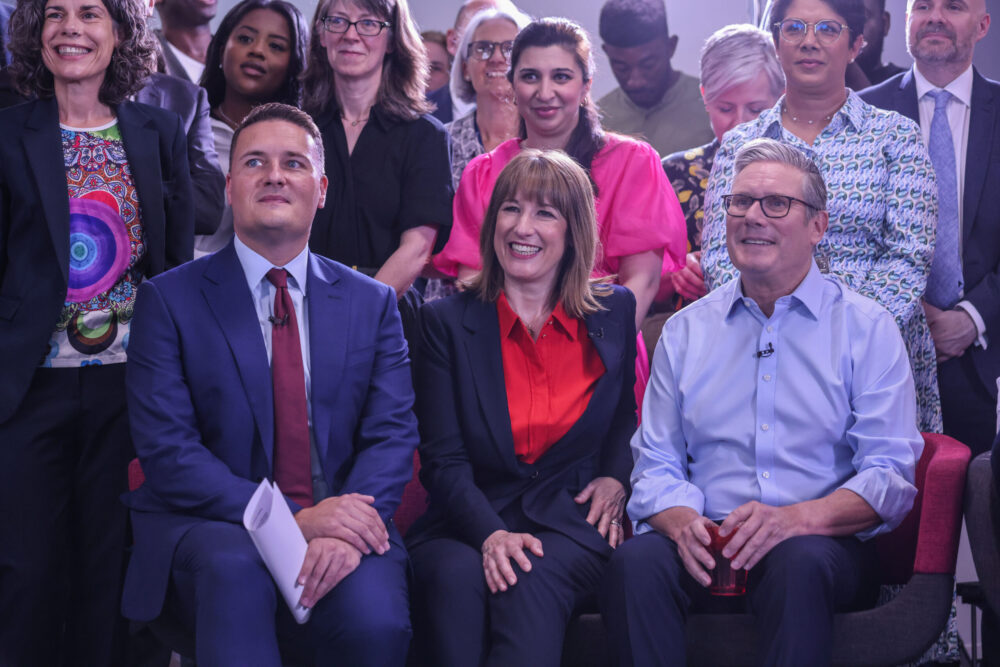
Health Secretary Wes Streeting, Chancellor of the Exchequer Rachel Reeves and Prime Minister Sir Keir Starmer at the launch of the government's 10-year health plan. Photo Jack Hill/The Times/PA Wire

Desmond Clifford

UK Budgets have become strange affairs. These days, something called the Office for Budget Responsibility (OBR), an independent public body sitting outside government, publishes a forecast report alongside the Chancellor’s budget.

The central feature of this report is a figure noting the budget deficit, the gap between what the government raises and what it spends. Currently this figure is around £20bn, not a negligible sum but hardly extravagant either in the context of UK Government finance.

The British Government raises money in two ways: tax and borrowing. They’ve been borrowing more than usual in recent years – to pay for Covid, among other things – and the “debt to GDP ratio”, one of the measures economists care about, is higher than usual for Britain.

In this financial year the Treasury will spend something over £100 billion just on the interest payments on Britain’s debt. For context, that’s four times larger than the entire Welsh Government annual budget, currently around £26bn.

The question arises: is this the best way to run the nation’s tuck shop? No, is the simple answer.

Politicians have built a system where the Chancellor is at the mercy of the OBR and its distorting fascination with a single annual figure. The starting point for every budget now is to come up with a fiscal fix which meets the OBR deficit stat.

This is inefficient and anti-democratic. It doesn’t matter who voted for the Government, or what their expectations were, the Chancellor must satisfy the OBR before she even thinks about anybody else.

That’s why you never hear a report on Rachel Reeves without a reference to the “bond market”, the crowd the UK Government borrows its money from. If you thought Rachel Reeves works for you, forget it – she works for Mr Bond.

The problem is that this approach squeezes out politics. Some people think that’s a good thing, but if budget decisions are driven by technocratic concerns first, then a very obvious question is begged. Why elect a government with a Chancellor of the Exchequer?

Technocrat

We could go the whole hog and appoint a first-rate technocrat to manage the nation’s economy – Merfyn King or Martin Lewis, for example. Either would be excellent. They could give the UK Government an annual block grant based on a technical assessment of what they think the country can afford.

Tempted? Hmm. It’s not democracy, is it? The D-word, to which most of us remain stubbornly committed, works when we elect people with a plan and they carry it out.

The Chancellor and her boss the Prime Minister didn’t exactly help themselves by ruling out, during the election campaign, the possibility of raising Income Tax, VAT or National Insurance.

She did, in fact, raise NI last year but squirmed out of it by saying her promise never meant the employers contribution, only the employees. A sophistry, surely, and obviously a tax on jobs; unsurprisingly, unemployment went up this very week.

The manifesto promises were stupid, by the way. Why on earth box yourself in?

The three taxes account for 75% of all UK revenue and, without them, Chancellors are reliant on jiggery pokery linked to pensions and tax thresholds to raise money.

Rachel Reeves has put herself in a bind. I repeat: she has put herself in a bind.

Political capital

Last year was supposed to be the tough budget, using the government’s massive majority as political capital to front-load bad news before relaxing progressively through the parliament on the proceeds of growth (btw, how’s that going…?).

She mucked up royally, you’ll remember, scrapping winter fuel payments for pensioners without warning or mandate; a combination of poor manifesto planning and not looking beyond election day, plus dumb politics once in office.

For all her and Keir Starmer’s combined intelligence – I imagine they’d both pass the eleven plus – the sum of their political nous is lower than the Bank of England base rate. They had a plan for the election but not, it seems, for government. Plaid Cymru, take note.

According to Sunday Times columnist Jason Cowley, and others in the know, Reeves intended to abandon her election pledge and increase income tax by 2%.

In a cunning plan worthy of Baldrick, she planned to pair this with a reduction in National Insurance contributions. These changes would have affected higher paid workers while remaining more neutral for lower incomes. Apparently, this scheme belonged to Swansea West MP, Torsten Bell, the man who knew the answer to everything until he became a Treasury Minister.

Rachel Reeves herself hinted to all and sundry in the heaviest possible terms that she intended raising income tax. It turns out she was having a laugh, stopping just short of donning a clown mask and shouting, “Fooled You!”.

What a way to run the nation’s fiscal policy! Is this how you build trust with a public, even the Labour-supporting part of it, which feels defensive, let-down and stuck on a life raft without paddle or compass?

Even her friend Mr Bond responded by increasing the price of borrowing (it’s important to register that the price of borrowing relates directly to Mr Bond’s confidence in UK Government decision-making).

If Reeves had gone through with Plan A and raised income tax, then she would have exploded a torpedo under this government and marked its effective end.

No government can survive such a blatant breach of its election manifesto. In filling the relatively modest revenue hole identified by the OBR, she would have written Nigel Farage’s next election manifesto for him.

Why she placed herself, and the Prime Minister, in this position is beyond my grasp.

Income tax

For what it’s worth, I’m very much in favour of income tax as a revenue source. It’s easy to collect, can be targeted according to income and, crucially, avoids inflation.

I was mystified when they ruled it out during the election. But they did, and no one made them do it.  So, they’re stuck with it.

Yet another terrible week for Starmer. Lots of bad stuff beyond their control happens to Prime Ministers. What’s remarkable with Starmer is the extent to which he brings it on himself.

For all his apparent joylessness, he seems fundamentally unserious. His original shadow Chancellor was the softly spoken and cerebral Anneliese Dodds, who quietly resigned from government a few months back in despair at its general uselessness.

Starmer dumped her in favour of the more showy but reckless Rachel Reeves. Like her boss, she seems unmoored from any true sense of politics.

At least the Chancellor’s u-turn knocked Wes Streeting off the front page. Starmer’s pre-emptive briefing against a leadership move resulted in the humiliation of his having to phone Streeting with an apology.

You couldn’t make this up. Surely Streeting should be the man apologising – unless Starmer’s people made it all up, in which case they should be out the door?

It’s hard not to conclude that this government is hopeless. Scarcely a single minister has made real public impact, at least not for good reasons.

If they look better than their appalling predecessors, so would Minnie Mouse and Pluto. I say this without pleasure.

Like a lot of people, I expected better.

John Major

People may recall the election of 1992.  Neil Kinnock was set to win until the last moment when John Major snatched victory. Within months, however, Britain crashed out of the European currency mechanism in one of Britain’s worst humiliations.

Major remained in office (“but not in government”, someone quipped) for another excruciating four and a half years – but his effective premiership ended that day in September 1992.

Isn’t this where Keir Starmer’s heading?  The hole he’s digging gets bigger by the day. I’m not sure that Clement Attlee and Nye Bevan on a tandem could save him now.

What should happen next?  The Chancellor will not now ignore the manifesto she paraded before the country barely 18 months ago.

Good. This time she’ll have to draw revenue from the nether world of taxes not ruled out during the election.

Expect a Budget of obscurely shifting tax thresholds and pension-grabbing. Next election, they should take courage and not rule anything out beforehand.

People who vote Labour expect difference, not Conservative government with a slightly softer heart.

Second, it’s time to look again at the OBR’s mission. There’s merit in objective forecasting, but to focus the entire fiscal approach on a single figure in a single year is distorting and, frankly, strange.

What government needs is a set of data, not a single figure litmus test, and we, the public, need to be presented with a fiscal strategy covering the full lifetime of a government.

At each Budget they should be able to demonstrate progress towards their strategic policy goals, including convergence over time with the OBR debt forecast.

To do that you need, obviously, a government with a strategy and policy goals in the first place. If Starmer has any, he’s kept them to himself. They can’t go on like this. Rachel Reeves’ mad income tax plan would have exploded a torpedo under the government on 26 November. They’ve walked away from that.

No torpedo then, but an alarm clock, and it is set for 7 May next year.

For the price of a cup of coffee a month you can help us create an independent, not-for-profit, national news service for the people of Wales, by the people of Wales.

22 comments

TheWoodForTheTrees

This is all true and very well explained but I'd like to go back a bit further for context. For 14 years the Tories peddled the notion we could have a functioning country and State without paying for it. A blatant lie because in fact they didn't care what happened to the State. They didn't care what happened to the safety net for health, social care, disabled people, elderly people, poor people. Rich people don't need it you see. And that was their primary concern, that rich people got richer and paid less tax, while pretending a defunded State could and would look after the rest of us. They pretended, they lied and unbelievably a lot of people believed them. This is the background to the Labour Party manifesto making promises about no tax rises. A lot of people still believed the Tories, that you can have it all and you don't need to pay for it. I wish the Labour Party had spent more time educating people about the reality of the country's finances rather than hemming themselves in with unrealistic contraints. But they didn't, they're still not but I believe that's what they need to do. Now.

Reply
Smae

The Labour Party evidently had no idea what the finances actually looked like, their manifesto was entirely based on what the Houses of Parliament had been told. If there had been the money that the tories had said there was... (instead of the same pots of money being spent twice or in some cases thrice)... I don't think Labour would be in this pickle. That's... too optimistic, let me revise. They would still be in a pickle because of the immigrant stuff and because of all the attacks on the people they're supposed to represent... they might however have a bit of breathing room to play around with some policies.

Reply
Undecided

I can’t agree that Labour had no idea what the finances looked like. It’s just not credible. The country’s overhanging debt, unsustainable welfare budget and other factors have been obvious since the pandemic. Rather Labour chose to ignore it all, just to get elected. They are now paying the heavy price.

Reply

In reply to Undecided

Davie

Trumps demand for massive extra defence spending was unforeseeable.

Reply

In reply to Davie

Undecided

Really? The US administration has been complaining for years that European NATO countries don’t contribute enough. Trump was on it before last year’s general election.

Reply

In reply to Davie

Mawkernewek

Even so the UK could have just said no thanks.

Reply

In reply to Undecided

Tucker

The largest welfare payments are for in work benefits. Force companies to pay a living wage instead of subsidies from the treasury.

Reply

In reply to Tucker

Undecided

And then they cut jobs as we have seen with the employer NI increases.

Reply

In reply to Undecided

Colin

It was necessary to fill the one million vacancies created by kicking out hardworking Europeans.

Reply
coldcomfort

Minor issue since he's not going to be made supremo, but has anyone ever asked Lord King whether he still thinks Brexit was such a great idea, and if so, why? And what grounds are there for thinking he'd be excellent?

Reply
TheWoodForTheTrees

Only excellent if running the economy is left completely to technocrats and that's not mooted as a good thing.

Reply
Smae

What Labour failed to do was define "Working people" because they wanted to be all things to all people. They should have set a limit of say anyone under 55,000 threshold and then kickbacks for anyone in a key profession (by this I mean Doctors/Nurses and Armed Forces, I do not mean police, MPs/Councillors, Legal/Judicial, teachers or head teachers, civil servants, trades people etc who sometimes are paid above this amount). That way they could properly increase income tax etc on the highest earners or businesses and they could even look at raising VAT on luxury products (as in if you handbag is worth more than 250, you should probably be paying way more tax than someone paying 30...). They could still define what they mean if they wanted to, but they're too scared of losing votes.

Reply
Davie

Rather than pick an arbitrary number where someone is now wealthy enough to pay more that just creates an unwinnable argument, it would be easier to use the average salary as a threshold, so that anyone earning less than most people is protected and anyone earning more than most people pays a bit more.

Reply
Davie

U-turns aren't the political kryptonite they used to be since Boris Johnson normalised them. The media and the masses permanently lost interest in flipflopery after his 50th u-turn.

Reply
Dai Ponty

With all that has gone on with Liebour one thing is certain like the tories they do not care about Wales WELSH M P<S DO NOT STAND UP FOR WALES WE ARE ROBBED RIGHT LEFT AND CENTRE by all parties

Reply
Padi Phillips

To be honest, no sooner had the Starmer and Reeves show started I got a very strong impression that they were nothing other than Reform UK's best recruiting agency. On taxation they should not even have mentioned income tax, but really emphasised the need for a wealth tax, and the proper taxation on the profits of global corporations (as well as abolishing the absurd amounts of corporate welfare spent every year: that alone would release a lot of money) a land value tax (because no one has yet found a way to squirrel away land in the Cayman Islands) which would curb the activities of land banks, probably reducing the price of land, which is a major consideration. But no, hitting pensioners hard was the plan, removing a very useful sum of money from a group in society that contains, just as does wider society, some of the poorest in the country. Sure, hairs could be split, as there are those who 'don't need it' but universal benefits are cheap to administer, means testing isn't cheap and can easily wipe out any financial benefit- and besides which, wealthier pensioners pay taxes on their incomes, so the WFP is clawed back that way. 50 years ago none of this needed explaining, and get this, even the Tories under people like Heath not only understood this, but bought into it as well. Reeves then went for the disabled so that she could spend more on defence. Why is it that it's always the poorest who have to suffer? I quite get that middle-income people as sick to death of being a tax cash cow, so leave them alone and tax the greedy bastards of the 1%. those who have seen their wealth increase massively through the transfer of wealth. There is talk of a paltry 1% tax on wealth over £10 million and 2% on those with a billion or more. Why not make that figure 10% and 20% respectively? Or, at the very least, tax that wealth at the same rate as base lending rate, plus inflation (that seems similar to what my internet provider is allowed to do)? This would raise a truly significant amount to be used to address the key concerns of the majority of us, and, more crucially, undermine the right-wing crackpots of Reform UK who would be an utter disaster should they get anywhere near government which, the way the Starmer and Reeves show is going would seem almost to be a done deal. I'm not even sure that this current Labour administration can be said to have a softer heart than the Tories. Thus far it has been a Labour government that removed the WFA and then decisded to double down on the sick and disabled and who, glaringly, failed to remove the Two-Child Limit, thus keeping around half a million kids in poverty. But Reeves has from on that kind of thing... When in opposition as Shadow Employment Secrtary Reeve's proclaimed that Labour in government would be tougher on the unemployed than the Tories... This at the height of the Tory assault on the poor and vulnerable that saw thousands illegally sanctioned and some vulnerable people quite literally starving to death. Those of use who lived through the 70s don't necessarily look through rose tinted spectacles, we know about the strikes, and the industrial unrest, but we also knew the cause of that. Many of the strikes as the decade progressed were in support of pay claims from those trying to maintain a standard of living at a time of very high inflation, and so perfectly rational Life wasn't perfect, but it was good and generally getting better for most, except for perhaps the wealthiest, but even they weren't doing badly: they were still rich, just not so obscenely rich. There was a general sense of hope, that the future was good. There was Cold War, of course, but in retrospect that time seems weirdly reassuring: competing ideologies imposed a kind of stability (and in a real sense, was there that much of a difference in the way economies were run, East or West? Much of the UK's, and certainly Wales' industries were state run, and however badly absolute capitalists might claim things were run, ordinary workers by and large did okay working in those industries. There was even a widespread understanding of the need for change, but the UK has never been good at properly investing in the economy. There was little homelessness and an entire third of the population lived in housing owned by the local state - council housing, not all good, but some, excellent. Rents were also affordable - and so were mortgages and house prices were sane as few regarded a house ans anything more than a home. Usually there was only one breadwinner, who earned enough to not only pay the rent or mortgage, but to also pay for a holiday. The NHS functioned, and getting a doctor's appointment was a matter of routine, not an 8am phone lottery. Was it perfect in the 70s? Far from it, but while things in many ways are better now, perhaps we need to look back and reassess why some things, the fundamentals of life, were better back then. Fair taxation was at the core of that - maybe some of the income rates might appear high, but as the saying at the time went, 'You've got to be earning it to pay it' said in the full knowledge of what our taxes were spent on -by and largely us. We no longer have that sense, and this is at the core of the economic, political and social crisis that faces us.

Reply
TheWoodForTheTrees

So well said.

Reply
Peter J

A lot of commentators seem to think that ruling outincome tax rises before the election was a massive mistake, but I don’t remember many highlighting this pre-election. I know because I was one of the few who said this was a mistake! If they hadn’t done then the right wing press would’ve labelled them corbynite tax advocates and they probably wouldn’t have won such a big majority, or one at all given the relative closeness in the end. In hindsight, I actually think they did the right thing-it was so important to get rid of the tories

Reply
Colin

And a lot of commentators seem to think that Labour simply couldn't lose because the Cons were in such a mess. They need to ask Neil Kinnock what he thinks about that.

Reply
Tucker

Hows Nige's tax avoidance schemes coming along Ady Wady?

Reply
Adrian

You're hiding behind a false equivalence Tucker me old mate Tax avoidance is legal, and sound business practise: if you have an ISA you're avoiding tax. Tax evasion, however, is illegal: Rayner broke the law.

Reply
Davie

What evidence do you have that she knew she should pay it?

Reply

Leave a reply

Replying to Undecided Cancel

And then they cut jobs as we have seen with the employer NI increases.

Comments are reviewed before they appear.
