


Wed, 22nd July Cardiff 17°
Nation.Cymru wordmark
Advertisement

Opinion

Farmers need to to get behind the Sustainable Farming Scheme
By David Owens
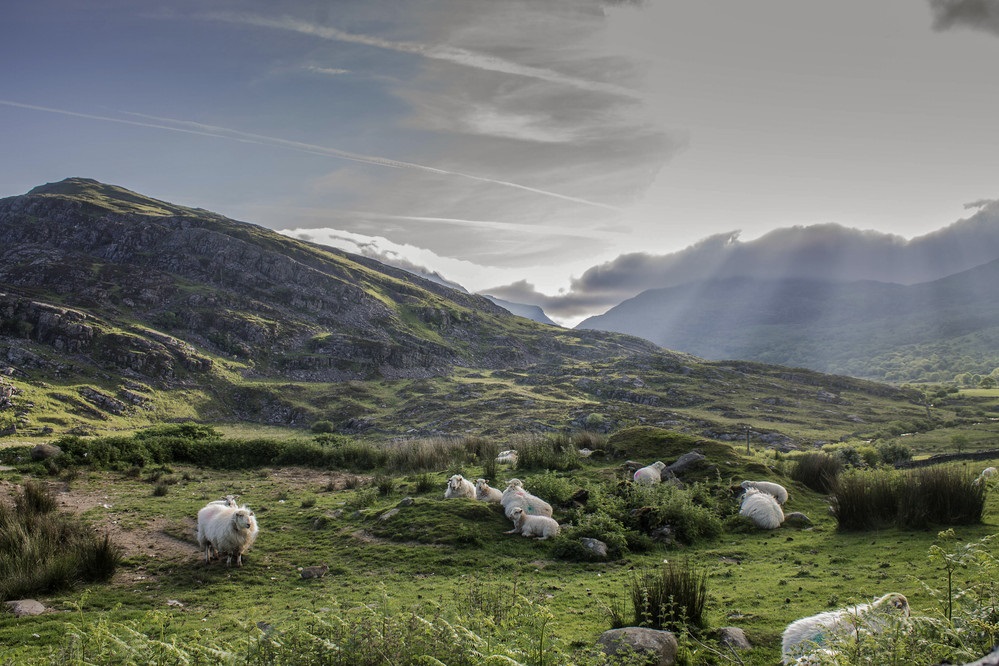
Picture by Hybu Cig Cymru

Dr Malcolm Smith

Worried about competition from cheap food imports. Their prices pinned down by supermarket monopolies. Fields and crops deluged with climate change induced deluges of rain. No wonder our farmers feel backed into a very bleak corner of the countryside.

Now they have to consider the Welsh Government's Sustainable Farming Scheme (SFS), its proposed replacement for the subsidies known as the Basic Payment Scheme they have been accustomed to courtesy of half a century of the EU's Common Agricultural Policy. And they are not happy. Not happy at all. In a very unusual display of aggression, our farmers are even adopting the tractor blocking techniques of their Continental counterparts.

[mid-content-banner]

But farmers have to face reality. And like much else in the face of crises in our natural environment, farming must change too. The generous subsidy payments they have long happily accepted from the EU - which came with few environmental constraints - are very largely responsible for Wales's nature crisis. On how many upland Welsh farms does the haunting call of the Curlew still resound? Lapwings displaying in the air above damp lowland pastures are today a rarity. And vibrantly coloured Yellowhammers sing from the tops of few farm hedges. So many once typical farmland birds have largely vanished. With them a vast array of invertebrates, hay meadows full of flowers, amphibians and much else has gone too.

Today our countryside is one of the most wildlife depleted in the world. Farming occupies around 90% of our land. A million hectares - that's half the land area of Wales - is intensively managed grassland of virtually no wildlife value. And the fertiliser and slurry runoff which contributes to the growing pollution of our streams and rivers is killing their life too.

The SFS will provide farmers with subsidies but, in return, they have to deliver a range of environmental benefits as part of the deal. The days of free lunches are over. They will be required to farm more sustainably with less reliance on chemical sprays and fertilisers. They are required to nurture wildlife habitat on their land and create more of it, redressing the huge losses of wildlife fuelled by the EU supports. And, because farming occupies most of Wales, farmers need to play their part in addressing the climate crisis by taking carbon out of the atmosphere and holding it in trees, peatlands and other habitats on the land they own and manage.
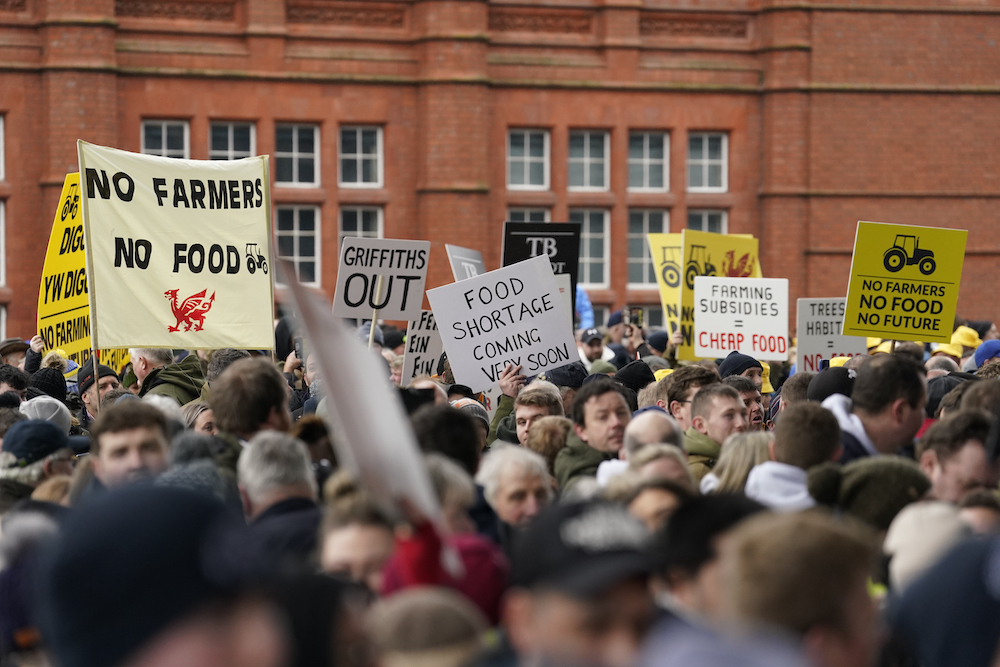
Farmers protest outside the Senedd in Cardiff over planned changes to farming subsidies. Andrew Matthews/PA Wire

Trees, it seems, aren’t welcomed by most farmers. The SFS requires those joining the scheme to put 10% of their land under woodland or trees, their huge leaf area absorbing carbon from the atmosphere, thereby helping to address climate warming. This 10% can include scattered trees and any existing woodland already on the farm. Most Welsh farmers are not woodsmen. But some value woodland to help shelter their livestock, provide the occasional piece of timber and nurture habitat for wildlife. Perhaps a more flexible approach to this contentious measure would be for the SFS to require 5% of each farm to be tree covered with an option to plant more.

“Pepper-potting” small areas of woodland around the countryside is far less valuable for wildlife than creating large forested areas. So encouraging collaborative applications from consortia of adjacent farms – maybe with a bonus subsidy payment – would be a better option to redress our nature crisis. It needs to be native broadleaved woodland. More ugly straight lines of North American conifers in the countryside would offer very little wildlife gain.

[lower-mid-content-banner]

Farmers are equally concerned over another obligation if they sign up: an additional 10% of their land must be wildlife habitat, existing and/or created. Combined with the 10% tree cover, they wrongly believe, takes 20% of their farm out of food production. It’s wrong because almost all wildlife habitats require some management. It might be light livestock grazing or maybe a hay cut, sustainable land management not intensively farmed but it’s very likely that this 10% will be in farm use nevertheless.

What’s vital is that the SFS attracts as many farmers as possible to join. Maybe larger lowland farms can manage without subsidies. But can small, mostly family run upland farms survive without the cash it will bring? And if we are to return long lost wildlife to our farmland, cut pollution and contribute to curbing climate warming, more and more intensification of farming has to stop and go into reverse. Of course we need farmers to produce wholesome food. But not by continuing to destroy our natural heritage in the process.

Dr Malcolm Smith is a former Chief Scientist at the then Countryside Council for Wales and led the team which designed Tir Gofal, the first agri-environment scheme in Wales. He also authored 'Ploughing a New Furrow: A Blueprint for Wildlife Friendly Farming', and has been a Board Member of The Environment Agency representing Welsh interests.

For the price of a cup of coffee a month you can help us create an independent, not-for-profit, national news service for the people of Wales, by the people of Wales.

Get more trusted Welsh news

Choose Nation.Cymru as a preferred source in Google News to see more of our journalism.

Choose Nation.Cymru as a preferred source in Google News

13 comments

Dai Rob

Cytuno. 100%

Reply
Linda Jones

Easier said than done as many farms wont survive the lowering of income and we also need the food. Maybe tackle the supermarket problem first before piling on theses changes. Supermarkets make £billions in profits which they could share with farmers.

Reply
Arthur

The housewife simply isn't paying enough to cover the ever increasing costs on the farmers. The second war 'cheap food' policy ( we will never be short of food again!) means that ever lower prices have been baked in to food ( no pun intended). We should respect the process of cultivating food ( I understand UK is only around 50 % self sufficient), we should not waste as much as we appear to be doing. In a cost of living crisis and climate crisis, answers will be complex but we should definitely be applying a carbon tax to imports e.g importing soy from Brazil so they cut down even more of the Amazon forest - crazy ! We have become spoilt for choice and expect produce out of season. Grow and supply locally I say.

Reply
Jeff

Massive markets are open to farmers through CPTTP. Just ask Kemi. Oh, we cannot cos they refuse show the deals in detail, which will result in all likelihood in cheap imports. Tried buying Welsh lamb lately? Might have to move over to squirrels as one farmer suggested. We replace the massive benefit that was the EU with a minor player in markets now (that is us, the UK, a minnow compared to the EU) and we are expected to fund farmers to the levels that the EU did. This is a problem. I am not sure the formers of the government will have a plan to fix this past rejoining the EU. But if my taxes are going to go to help farmers, then I want a benefit. Any farmers sticking banners up in their fields next GE that are for a pro Brexit politico, stop and think about that first. And we can start with planting trees on shooting estates.....

Reply
Dai Tymawr

Unfortunately, this article is typical of the thinking that has led Welsh Agri policy down it's current blind alley - a siloed and parochial view, blinkered by the conceptual constraints of past agri-environment schemes, and unwilling to fully comprehend the rationale and necessity for primary sector and foodsystem support and intervention in advanced economies. Further, it utterly fails to acknowledge the externalities imposed on distant foodsystems and landscapes if domestic productivity reduces, utterly fails to address the fact that past agri-environment interventions have helped cause/exacerbate nature decline and systemic intensification, and does nothing to address the inequities of an economic model that is built on the mass availability cheap food (sold at or below the cost of production) and the approx 16% additional household spend that 'frees up' for exploitation by other sectors of the UK economy. Once again in Wales, we're stuck with policy 'experts' who cut their teeth pondering the small corners of what made up <15% of our past CAP derived budget, ignorant of the rationale for the other 85% policy intervention. The issue isn't so much that the SPS is thoroughly bad (although parts of it are), it's that the Agriculture (Wales) Act 2023 contains insufficient flexibility to deliver the full gamut of policy interventions, incentives and levers required to keep the foodsystem and Welsh agriculture operational at anything other than a paltry level of 'managed decline', and the SFS is a work-in-progress agri-environment micromanagement scheme masquerading as a full agricultural policy. As for the pretence of 'global responsibility' through tree planting for carbon capture, in the absence of any measures to actively reduce fossil fuel dependency (despite the industry practically begging to be allowed to take on the fossil fuel sector, considering they have the land mass to roll out renewables at scale and can actively grow direct carbon neutral replacements for what Texaco currently pump out of the ground) and a policy void where there should be a Rural-industrial strategy focussed on green growth and decarbonisation - it's laughable (you can almost hear the bean counters cheer as the can gets punted another one and a half millimetres down the road towards climate breakdown!). Let's not pretend that the SFS is the only possible game in town, and farmers need to 'get behind it'. Wales deserves so much better than this at every possible level. Time to get the drawing board back out, put the SFS and it's proponents back in their silo (where it can be worked up into a deliverable agri-environment scheme that sits under the umbrella of a far broader policy and support framework), redraw the primary and secondary legislation in a way that sheds the current obvious grubby thumbprints of Whitehall -esque thinking, look at what other UK nations (c'mon, the county over the Dyke is agriculturally and economically the least similar to Wales) and others with whom Welsh farming is in direct market competition with, and come up with a policy that doesn't look so much like a moderately talented Welsh Baccalaureate student's summer project.

Reply
Dai Tymawr

Oh... And if I hear the term 'generous subsidies of the past' on more time, without an immediate reference to the fact that those who got the most in an upland context were the ones who, under Malcolm's CCW tenure, were essentially paid to stop farming and just sit on vast economically, agriculturally and culturally barren upland acres (which coincidentally did almost nothing for nature either!), and productive upland farms (which Malcolm pretends to be concerned for) were left with what was basically a below-value compensation scheme for the fact that food and primary product prices bare no relation to their value or cost of production, I might explode. If I hear that phrase coming from the keyboard of someone that's spent most of their life on the public payroll, who's faced almost no personal financial risks as a result of their decisions and opinions, has a lovely pension, and has paid off their mortgage to an extent that permits them not to worry about the price of food (maybe even stopping off at the farmers market once a month, or choosing to pay the extra 21p for a 2litre bottle of Morrisons milk), the blast radius of my personal explosion will be likely to take out most of Pembrokeshire.

Reply
Howard Dare

Misinformation destroys the credibility of the author. He claims that Tir Goval was the first agri-environment scheme in Wales. Well, I transitioned into Tir Goval from the habitat scheme and there may have been other schemes before that. Having been in agri-environment schemes since the mid nineties, my farm is so nutrient depleted that it is totally unviable without the support it has been having. Yet it looks like support might be reduced by 70%. Morons, like the author, set themselves up as experts when in fact they are self promoting ignorami. My whole farm is habitat and has been classed as such since I joined the habitat scheme. The variety of orchids in the hay fields are wonderful, but, after nearly forty years of nurturing are likely to disappear this year. I'm particularly proud of a small patch of over 200 greater butterfly orchid which I protect until it has seeded. Morons like the author have no idea of the cost of running a farm for habitat. The Welsh government is suggesting 0.2 to 0.4 livestock units per hectare is the target stocking rate for acid grassland. All my pasture is acid grassland. I also have well over 10% trees. Let's look at the costs, because the moron author obviously hasn't a clue. Insurances are over £2000. Machinery maintenance well over £1000 and the tractor has needed replacement for many years. Diesel over £500. Contractors costs for haylage and hedge cutting around £2000.. Animal health costs over £500. Fence repairs over £1000. Taking down dangerous dead ash trees average £1000. Soil Association organic certification £500. Pedigree costs for sheep and cattle native breeds £200. Depreciation of bull and ram must be over £300 a year. There's around £9000 before I look at farm building maintenance, accountancy, and other necessary expenditure. That's for a 108 acre hill farm. Livestock returns are tiny. Market for small hill lambs has disappeared. They used to go to Spain. Highland bullocks take four or five years to mature and are loss making. Well, I am going to have to graze the orchid rich hay meadows because contractor costs work out at £40 for each bale! Byebye several varieties of orchids. I hope the ignoramus moron writing the article is proud of his input to that outcome.

Reply
Dai Tymawr

The first Agri-environment scheme trials (ESA scheme) happened in the mid 1980s, so the author has over-egged his credentials. Tir Gofal was preceded by Tir Cynnal, which was the first scheme designed in-house by Welsh Gov/CCW, so even in that context he's exaggerating in order to sway the audience. Tir Gofal wasn't a terrible scheme, especially in the days before Welsh Gov took full responsibility for managing it, but it's inflexibility and tick-box approach to habitat prescriptions, grassland inputs and grazing levels were destructive in a number of cases (something we all know, but they've never admitted). The obsession with unsustainably low stocking levels on moorland, zero winter grazing, and no-input hayfields were especially blunt, and have led to hay meadow degradation, in-by (field) intensification/overgrazing, a reliance on imported bagged feed, and upland Molinia encroachment. For the 'designer' of the scheme to write about 'generous subsidies' when he knows full well that the regulations insisted that payments could only be based on cost incurred/income foregone is deliberately misleading the reader. The fact is that when you analyse the accounts of farms who've participated in schemes like the one he designed, and calculate the cumulative loss to their productivity and income from consecutive agri-environment scheme participation, you realise that even the cost incurred/income foregone calculations were wrong, and those farms are now carrying an ongoing and increasing loss that they've never been compensated for (and have no way out, because even if they borrowed money to get out of the hole, the regulations around land previously covered by agri-environment schemes would stifle the necessary recovery strategy). People like Malcolm hard-baked into the system the idea that caring for the environment had to mean a reduction in agricultural productivity and a perpetual decline in farm incomes, made farmers utterly dependent on state funding for their continued survival, utterly failed to grasp the global picture and the challenges of increased instability and climate change, and pitted nature against farming - it's a false binary, and one he's still pushing (while 'representing Wales' in the Environment Agency - and being remunerated for his time in doing so). Some of these people need to realise that both nature and the rural communities that live amongst it aren't in decline despite their best efforts, they're partially in decline because of their best efforts. Time to stop flogging that horse!

Reply
CapM

"The days of free lunches are over." Not really the sort of statement to use if convincing farmers that participating positively with the SFS is necessary. The key to sustainable farming isn't really controlling the actions of farmers but getting consumers to pay the real cost of sustainable farming either directly, indirectly or more likely a combination of both. In addition we now need land that is currently used for farming to ameliorate climate change and flooding, safeguard biodiversity, provide positively to society's wellbeing etc as well. We need measures that manage and limit the actions of those throughout the food industry including consumers. With an independent Cymru that would be a challenge. As part of a UK with it's big business influenced politics it looks to me like the farmers of Cymru are going to be set up as the scapegoats.

Reply
Dai Tymawr

Not so much scapegoats as maybe deliberate collateral damage within a transition designed to safeguard the interests of big businesses and the English financial sector whilst doing absolutely nothing of any real impact to address climate or biodiversity collapse (but pretending that's what it's all about) - the scapegoating is a means to an end, not an end in itself. Throughout this transition we will be able to rely on the embedded reflexive Thatcherism and profound ignorance of Welsh Gov and their advisors (like Malcolm) to ensure they play their largely unwitting part as a befuddled provincial administrative mechanism who believe their role is to oversee the process of managed decline benevolently bestowed upon them by their betters.

Reply
Glwyo

If I may be so bold: if we're saying that 10% of farmland should be turned over to woodland (which may or may not be a good idea in the long run) and there is a very specific way that land must be managed and organised, wouldn't it make more sense for the government to buy that land outright and manage it itself? Paying farmers not to farm seems like it would be more expensive.

Reply
Jonathan Edwards

My irony detector is not 100% today. In case you're not being ironic, and for readers who might struggle with this: bad for the State to own land, to dispossess people. If the State is paying under a Scheme, the Scheme can be altered or taken away but the farmers still have their land. The big challenge for a free Wales will be to provide food, energy and health to the Welsh in such a way as to cover the costs of these. The Government of a Free Wales' job would be: legislate to set up the schemes, provide seed capital and subsidies to correct post-code or class/social anomalies. Personally, I think the Schemes should use hypothecated revenue ie pay for themselves and leave the State out of it whereever possible. These things are too important to leave to, say, the present Labour Party in Wales

Reply
Glen

So what percentage of upland Wales is covered by ugly, regimented rows of non-native conifers that are absolute deserts for wildlife? Windfarms aren't exactly nature friendly either

Reply

Leave a comment

Comments are reviewed before they appear.