


Opinion
Do we really know how many people in Wales speak Welsh?
Dr Huw Evans, lecturer in law, Cardiff Metropolitan University
The article explores issues of concern arising from the two main data sources that calculate the number of Welsh language speakers in Wales: the official census of England and Wales (the census) and the Annual Population Survey (the APS).
Promotion of the Welsh language is central to Welsh Government policy. The Welsh Language Strategy (WLS) sets out an overarching policy and aims to have a million Welsh speakers in Wales by 2050.
As to the calculation of the number of Welsh speakers, the WLS states:
We consider the census to be the authoritative source on the number of Welsh speakers in Wales and it is the basis for our aspiration of a million Welsh speakers.
However, there may not be any more censuses as there is an Office for National Statistics (ONS) consultation about obtaining data differently in future. In that event, it seems that this creates a problem as the ‘authoritative source’ for calculating Welsh speaker numbers will have been removed.
[mid-content-banner]
The census
The first census was held in 1801 and has been repeated every ten years since, except for 1941 because of World War II. Questions about Welsh language capacity were not included until 1891.
The census has been the prime source for measuring the number of Welsh speakers in Wales since 1891, a practice continued by the WLS. The 2021 census figures show Wales has a population of 3,107, 500, out of whom, 538,000 aged three or above speak Welsh (17.8% of the population).
But although the Welsh Government regards the census as ‘authoritative’, things are not as clear cut as might first seem. Census returns are self-reporting, and a respondent has to assess if they, and others on whose behalf they respond (eg, a child aged three), are Welsh speakers.
In many cases this will be obvious, but may not in others (e.g., concerning an adult learning Welsh as a second language). Because of assessment inconsistencies between respondents, honest responses might produce differences in respect of people of similar linguistic ability.
Therefore, the numbers reported cannot be regarded as definitive. If there are ways to improve the robustness of the data, these must be explored.
[lower-mid-content-banner]
The Annual Population Survey
The APS is an annual UK wide survey, which in Wales includes materially the same census questions on the Welsh language. The survey in Wales involves around 35,000 people. For the year ending 30 June 2023, the APS estimated that 29.2% of people in Wales aged three or older were able to speak Welsh (around 889,700 people). The comparable figure for the 2021 census was 538,300, as mentioned.
There is a significant difference between the two and these are not stand-alone figures. That difference has consistently applied and, overall, has increased since 2001.
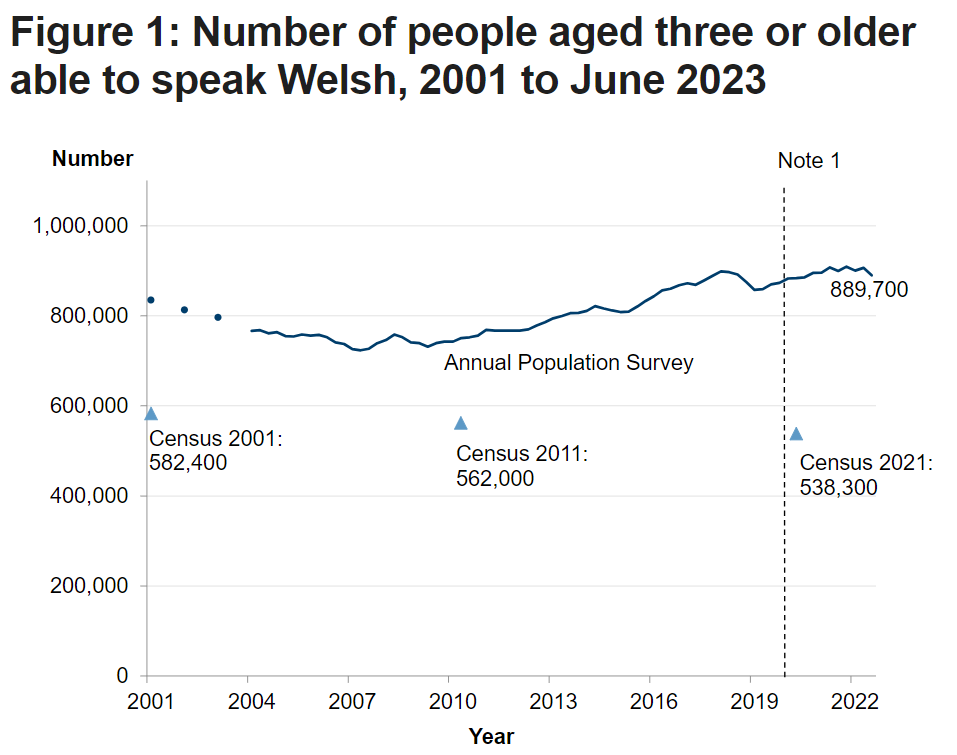
The APR is also a self-reporting exercise, but the data is gathered by telephone interview (prior to the Covid pandemic it was in person). One suggestion by the Welsh Government Chief Statistician is that because of canvasser input this may produce a more consistent response concerning Welsh language ability, suggesting that the census figures represent an underreporting. Conversely, the APS is far less representative of the people of Wales than the census, which supports an argument that the census figures carry greater weight. Either way, the contrast can undermine the integrity of each data source.
The difference between the two data sources has not yet been explained sufficiently. There is an ONS and Welsh Government joint work plan on coherence of Welsh language statistics and, hopefully, this will contribute to remedying the deficiency. The exercise is also looking at other relevant data sources such as the National Survey for Wales.
Future of the census
The ONS has consulted on replacing the need for a census every ten years by a ‘sustainable system for producing essential, up-to-date statistics about the population’ by collecting data from a multitude of data sources.
The consultation specifically mentions Welsh language statistics and that the ONS is working with Welsh Government to identify appropriate alternative sources to the census.
Data integrity and ‘truth’
The discrepancy between the census and APS data begs the question about the integrity of the data provided from each source, especially as the discrepancy is long-standing and continuing.
Data should inform policy decisions about the Welsh language but if there is doubt about the data, this undermines policy decision making and the associated (non) allocation of resources. As mentioned, there is now an attempt to explain that discrepancy. This is welcome but why has it taken till now?
As to what happens next, the discrepancy between the data sources needs to be explained and consequential action taken to ensure greater overall integrity. This must happen regardless of the ONS consultation outcome. The integrity of all data sources needs evaluation, as well as securing the future integrity of those sources that are then used.
In an age where factual accuracy is increasingly challenged and tested, it does not help if differences between data from multiple sources are not adequately explained. It obscures where ‘truth’ may lie, which then undermines informed policy formulation and implementation about the Welsh language.
Article 10 of the European Convention on Human Rights concerning freedom of expression mentions that the right includes the exchange of information. Implicit in that position is that relevant information (or ‘data’) must be available and accurate as a bedrock for a vibrant and functioning civil society. This includes available and accurate data about Welsh speakers.
The number of Welsh speakers outside Wales is not within the scope of the article but the need for accurate data will be similarly necessary in that context.
Support our Nation today
For the price of a cup of coffee a month you can help us create an independent, not-for-profit, national news service for the people of Wales, by the people of Wales.
Get more trusted Welsh news
Choose Nation.Cymru as a preferred source in Google News to see more of our journalism.
