


Wednesday, 15th July 2026 Cardiff 18° · Clear sky
NationCymru A news service by the people of Wales, for the people of Wales.

Opinion

Corbyn's wish to centralise power in the British state is a threat to Welsh nationhood
By NationCymru
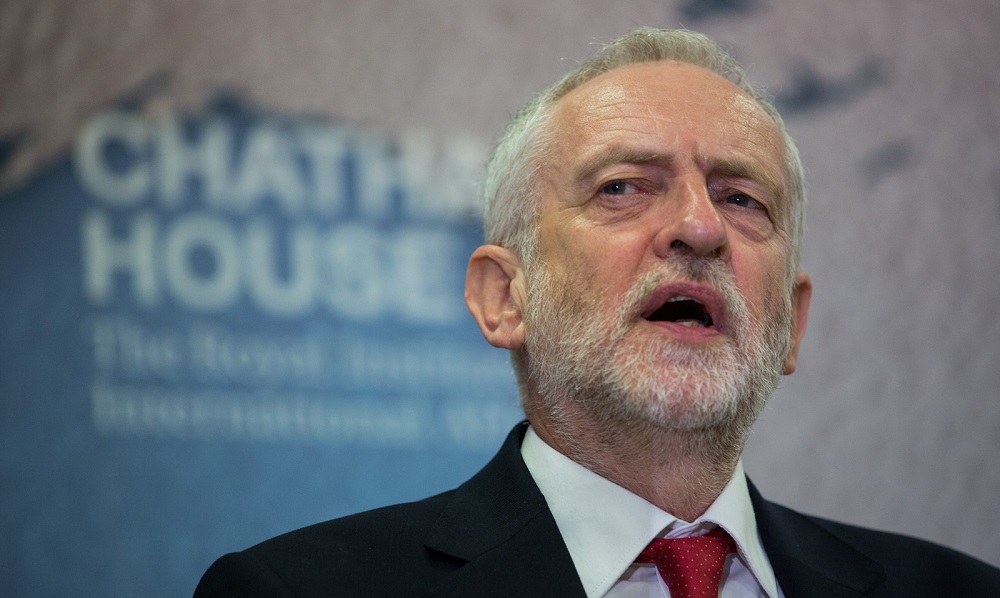
Picture: Chatham House (CC BY 2.0)

Steffan Lewis AM

Corbyn’s speech at Labour’s recent conference confirmed that Welsh nationhood is under threat from both British Statism and British Nationalism.

The late Dr Phil Williams, would often tell of how he came to find a home in the national movement via a brief flirtation with the British Left.

In his book ‘A Voice from the Valleys’ he describes how at one British Left meeting he listened to speakers talk about how Britain could “lead the world in socialism”.

He saw that the same self-indulgent need to see the British State “lead” or dominate globally infected the Left as much as the Right.

The politics of the contemporary British State (or more accurately ‘England and Wales’) is polarising around a new false choice: British Statism represented by Corbyn’s Labour and British Nationalism lead by the Brexit-obsessed Tory party.

But both apparently competing paradigms represent precisely the same threat to Wales: both propositions lead to the same destination; a Wales asset-stripped, politically weakened and culturally over-run.

Imposing London’s will

Corbyn’s policy platform, expressed in Brighton, seeks the centralisation of power over resources, utilities and public services away from Wales and Welsh communities and into the hands of British Ministers.

This is consistent with the Tory approach of using Brexit as a means of legislating to take away powers from our already feeble institutions so that Welsh control over resources, the economy and public services is limited, at best.

When Mr Corbyn talks of ‘nationalisation’ his nation isn’t England, it’s the UK. Think of how ‘nationalisation’ of utilities (such as water) from a not-for-profit Welsh company for example, to a London minister might work out.

That would result in a modern-day Bessie Braddock draining Wales against its interests.

Centralisation is key to Corbyn’s dream of an emboldened British State and for that reason he is opposed to the UK remaining in the European Single Market on a permanent basis. He would rather impose UK frameworks on rural affairs, state aid and natural resources upon us than continue to comply with European rules or recognise our right to decide for ourselves.

The temptation in the current context is to attempt to distinguish between Labour and the Tories but there is a commonality between them that poses the greatest threat to Welsh nationhood: the reshaping of the British State in order to centralise power in London and impose their will, using a dislike of big corporations on one hand or foreign institutions on the other as justification.

Swallowed up

The British State is in a state of crisis; it is no longer a global military power, it is approaching a debt of two trillion pounds, it has lost its closest ally due to that nation’s protectionism and it is about to leave the biggest trading bloc on earth at a huge cost.

These are circumstances where the case for Wales must be made.

The Tories response to the UK crisis is to re-invent a British nationalism and reaffirm Westminster’s sovereignty over us and use its many outlets to belittle and insult our distinct identity and culture.

Labour’s response is to create a centralised state to steam-roller over any divergence or distinctions we may seek to peruse for ourselves.

The last UK general election saw a re-emergence of the old two-party politics, with both parties welcoming the opportunity to present an old-fashioned left/right phoney war. For us in the national movement to try and engage on those terms would be futile and, more importantly, contrary to the national interest.

It’s not enough to simply describe where we sit on the political spectrum. We must be loud and clear about our nation and its future being our over-riding priority.

We must reshape our politics for the purpose of Wales flourishing as the British State withdraws unto itself – either through the path of Corbyn statism or Tory nationalism - or Wales will be swallowed up with it.


Support our Nation today

For the price of a cup of coffee a month you can help us create an independent, not-for-profit, national news service for the people of Wales, by the people of Wales.

34 comments

Sam

This post on first glance seems to be extrapolating calls for public ownership as a power grab towards London. I'm very in favour of public ownership and so are the majority of the Welsh public. Has Corbyn said that he will take no account of devolution when taking water, railways, energy etc out of private ownership? I agree that Corbyn doesn't give nearly enough thought to what Scotland & Wales are doing (arguing against a legal jurisdiction is a good example) and how reshaping the state and economy will interact with devolved governments, but isn't this is what the promised constitutional convention is for? I can well believe Corbyn's team haven't given any thought yet to how nationalisation would work in a federal UK for example, but we need more evidence than what's on display here to say this is a conspiracy rather than a cockup. The national movement isn't going to get far trying to paint Labour the same colours as the Tories when they are currently the most distinct in decades. It just isn't going to work.

Reply
Trailorboy

You are asking for a lot of faith. I remember it being hard for anyone to pin down his views on Brexit - he hinted enough to appease both sides, but gave the general impression of being in favour. The same on the customs union, where the party seems to have come to a position, but it's not clear if Corbyn is fully on-board. On the Wales issues, the relationship with Carwyn doesn't seem a bed of roses - the body language between the two at times has been interesting to say the least and he was opposed initially to having specific Welsh or Scottish members on the NEC, but then got outvoted as I recall. To say things are cock-ups or merely oversights, down to lack of enough thought, in itself implies a lack of interest or importance in these things at the very least and leaves the door open to thinking that perhaps he has a view that we wouldn't like, but cares not to express. Simple clarification of his views on Wales and Scotland, Federalism etc from the man himself, would answer these questions, but I think his style is not to express any opinion that could divide the opinions of labour voters - on some things he keeps his real views very well hidden. This flies against his approach to the Tories where he's happy to express his opposition to this and that, in quite definate terms. For some of us, there will be deep suspicion until we here what he really thinks and if that doesn't happen then I'll assume it is because he attaches no importance to it at all and it has no priority, which is equally negative in my mind.

Reply
Edeyrn

Federalism is the same London dominance you are trying to escape.....confederations are whats needed

Reply

In reply to Edeyrn

Trailorboy

Fair point - I said that because I don't see anyone from either a conventional Labour or Tory perspective ever potentially offering anything more than Federalism. Even Federalism would only ever happen if it was already deemed a "fait accompli" to save the union and not through any conviction.

Reply
Sam

All very fair points - but we need to do our best to have an accurate picture of the dynamics in politics if we want to intervene in them, so without defending the English left's lack of interest in the nations, the difference between that and an active plot to take away powers from Wales is an important one. It doesn't seem sensible to me to sow a narrative like this that if it works at all, is just undermining support for a more democratic economy. Surely a better idea to say that any public ownership needs to be administered from Wales and Scotland? It seems more like an argument pro-devolution Conservatives would make.

Reply
glasiad

"We must be loud and clear about our nation and its future being our over-riding priority. We must reshape our politics for the purpose of Wales flourishing ..." I totally agree. Considering you are paid a good salary to do this, when are you going to start? Technocratic tinkering with the system, arguing over allocation of inadequate funds, imposition of yet more rules, regulations and bureaucratic red tape is simply not going to accomplish much. We need you to start understanding how the system works. We need you to call out the wealth-extracting cancerous tumour called the financial sector that is driving all of us into increasing debt and poverty. You need to start proposing alternatives to the debt-based money system if you really want Wales to flourish. In short, we need smart and courageous politicians who understand the problems, stand up to powerful exploiters, demand economic justice and real democracy. Anything less is simply not enough. If you don't know what I'm talking about Steffan, you're not alone. A survey discovered the vast majority of MP's don't even know where money comes, see: http://positivemoney.org/2014/08/7-10-mps-dont-know-creates-money-uk/ If you really want Wales to flourish, learn how the system really works. Then use your influential position to informs others. Help instigate a democratic revolt against debt-slavery and austerity. Put aside sophistry and speak the truth plainly and clearly. Call a spade a spade. To help, I would suggest you start with these works: http://amzn.to/2hKRJ5v http://amzn.to/2fR58se http://amzn.to/2yIB323 http://amzn.to/2hLAeCk

Reply
ERNEST

I cannot see how Corbyn's socialism is going to work when Russia (as on the former Russian empire) tried it for 70 years, and with their 'never give up attitude' found it did not work. We are in the position of what the Baltic states found they were in the 1990s. They eventually got their independence determination of their people, political action, their own media, and through membership of the EU.

Reply
sibrydionmawr

How many times must it be spelled out that the system that existed in the Soviet Union was not socialism. The economic system there was state capitalism, and whilst there is a superficial resemblance with the current Labour Party policies, there is one huge difference: democracy, of a sort. Personally I think that state ownership is a tad better than ownership by out and out capitalists, in that with nationalised industries any surpluses generated come back to the country, and are shared by all, but it would be much better were the job done properly and industries socialised as per 'The Miners' Next Step' which advocated economic syndicalism where those that work in industries own and control them, and not the state, where, as we saw under Thatcher and her successors, once state owned industries can be easily sold off to private concerns. What could be more logical than to have whole industries run by the people best placed to do it; hospitals and health care run by health care workers, public transport run by public transport workers etc, instead of monumental bureaucracies that cause more problems than they solve, and act as obstructions to efficiency.

Reply
CambroUiDunlainge

Ideas on paper are rarely reflected in reality. Not that I disagree with what you're saying beyond that. I think there's a balance somewhere but capitalism by nature breeds an untrustworthy greed. Maybe part state ownership is the sweet spot for concerns of the people like electricity and water. Thats about the limits of my Socialism I think. My political alignment tends to reside more in realms Cynicism.

Reply

In reply to CambroUiDunlainge

Dafis

State ownership unfortunately leads to the emergence of elitist cliques who wield power within any industry or enterprise that is owned by the "public". There is ample evidence of such cliques already in the British and Welsh public sector. As for surpluses generated being returned to the country and shared by all - I don't think so. The elitists running these shows will always find ways of diverting available funds either into pet projects or into additional "rewards". We don't have people in this country willing to forego perks. Even Uncle Ho, more spartan than most, was partial to odd bits of extra from time to time. As for Capitalism, well its competitive virtues have been well and truly compromised by allowing the creation of massive corporate structures and complex taxation regimes which have huge evasion ( otherwise known as "mitigation" ) built into them. Free enterprise based on small ventures can add value in the mixed economy but the emergence of exaggerated corporate virility symbols may be good for the few who sit at or near the top but it's pretty shitty for everyone else. So called business leaders milking millions while entry level workers are expected to operate on flexible or zero hour contracts. That's one hell of a metaphor for progress. What really hammers home the point that neither extreme form of economy is good for us is that they seem to co-exist so sweetly !! Small is good - it applies to business and economy as much as it does to nation states.

Reply

In reply to Dafis

sibrydionmawr

I'm no fan-boy of nationalised industry, and any support I would give to it would be hesitant indeed, but just sometimes it's a slightly better option than the alternative. Your caveats are well founded, but there I think is where most people seem to misunderstand - nationalisation isn't socialism, but state capitalism, and as such can be a worse enemy to the workers than smaller scale, privately owned undertakings where organised labour can at least play off one scheming capitalist bastard against another. Try doing that with the state, (or huge corporation, which virtually amounts to the same thing) and you will end up facing riot police, or the army in extreme situations. Much better that industries are under the control of those who work in them.

Reply

In reply to CambroUiDunlainge

sibrydionmawr

I think that many syndicalists would agree with your cynicism, which is partially why they favour this kind of control of industry. It's borne of a deep mistrust of both capitalists and the state! I'm aware that the proposals in the Miners' Next Step were never enacted, but there have been glimmerings elsewhere in the world, such as the short time in Republican Spain where the anarchists of Catalonia and elsewhere took over the economy and ran it to the benefit of both workers and wider society with huge improvements in efficiency and productivity. This wasn't allowed to continue, as, of all organisations, the Communist Party wanted to keep the middle-classes onside, and this meant that they sided with petty capitalist interests against the anarchists. More recently there has been the example of the empresas recuperadas of Argentina, which came into being as a result of the huge meltdown of the economy in 2001. They are struggling, but this is probably due to having to exist in a capitalist controlled world that isn't exactly conducive to such radical interventions by workers!

Reply

In reply to sibrydionmawr

Capitalist and Welshnash

You sound like an angry first year student. It's 2017. The 20th century is over. Syndicalists? Really? Miners' Next Step... in 2017? Anarchists? Like Somalia much? the Communist Party? Nothing like genocide against your own citizen. petty capitalist interest? The people who give people jobs to aspire to their dreams are not petty. isn't exactly conducive to such radical interventions by the workers! .... diolch byth dydy e ddim! Thank goodness it's not.

Reply

In reply to Capitalist and Welshnash

sibrydionmawr

You clearly didn't read what I wrote. The 20th century may well be over, but the economic forces that affect all our lives are still the same as they ever were.. Explain what is so wrong with syndicalists? Do you even have the first inkling what syndicalism is? The Miner's Next Step was merely an outline for a better economic system where the workers received their full share of what they produced. Your understanding of anarchism is also clearly that of the illiterate and simple minded, and Somalia is an example more of capitalism gone mad. The situation there is complete chaos, the anithesis of anarchism. I'm no communist, but your reference to it being genocidal is a bit rich. Sure, there were monsters such as Stalin, Mao, and Pol Pot, but even the scale of slaughter they and their regimes were responsible for pales into insignificance when you consider that your preferred ideology kills far more people than those regimes did in total every five and a half years. Yeah, you may be right, capitalism may create wage slave opportunities that allow workers to dream, to hope in vain, but that's about all - very few will ever be able afford or achieve their dreams under that system. What would be so wrong with radical interventions by the workers? Anything that removes capitalist parasites is to be applauded.

Reply

In reply to sibrydionmawr

CambroUiDunlainge

Capitalists are as much parasites as anyone else belonging to any other political ideal. Maybe its not the ideal but a certain kind of person? Democracy was supposed to end tyranny... but we've seen democracy churn out a few dictators - we've had a few good leaders in the world, a few good Kings as well. Those with the will to manipulate and control the system cannot be held back whether their intentions are good or bad - they will always find a way. Then the hubris of sticking to one form of government and political ideology believing that it is the right and only way will end up costing a few million people their lives. It's not a particular ideology or government we should be concerned with but a certain kind of person. Anarchism... requires a wider consensus... if an anarchist state came under attack it would need hierarchy and organisation in order to fight back or its game over. Then its no longer an anarchist state... but like all nations becomes defined naturally by Hence why point above. I believe capitalism drives innovation - but having medium to large businesses part owned by the state gives a genuine reason for the state to invest in new ideas (like they already do) while also benefiting from the innovation in the long run - both from the innovation and financially. It gives the state a stake in companies and companies a stake in the country. By the state having a stake in capitalist ventures it gives the people a stake in it too. Also prevents us ending up like the USSR or modern USA with its oligopolies. Maybe I've just talking shit. But I figure it'd keep things economically in flux so that everyone benefits enough to take the steam out of both sides of the room. Then all we need is to see an end to career politicians.

Reply

In reply to CambroUiDunlainge

CambroUiDunlainge

"becomes defined naturally by the wider community of nations. Which is how all modern nations came to their present day identities." Bit crap with this today, fits the end of the first paragraph.

Reply

In reply to CambroUiDunlainge

Edeyrn

People should own their own workplaces and get their profits from their labour....there I said it......really crazy radical aaaah *sarcasm* :D

Reply

In reply to CambroUiDunlainge

sibrydionmawr

No, I wouldn't say that you've talked shit, as you have described things as they are. About the only disagreement I have is with the notion of an anarchist state - the two are antipathetic. Anarchists do not believe in the state. Logic would dictate that a hierarchy would be necessary in a crisis, and most anarchists would agree, as they are well aware that in certain situations there are people whose natural abilities enable them to take control of situations as they arise, they are the cool heads who take over when everyone else is running around like chickens with no heads. But that 'leadership' is never allowed to become entrenched, and is restricted to that very limited situation. Orwell expressed some surprise at how effective the anarchist columns were at the battlefront in the Spanish Civil War when there was no apparent hierarchy in the usual sense. They were far more effective than their conventional equivalents, the Republican Army. This is particularly striking, as the anarchists were let down seriously, as they threatened every form of hierarchical power and vested interests other than those of the ordinary people. Most people are naturally anarchist, but don't realise this, and even if they do, they usually lack belief in the abilities of themselves and others to run a society. There is much anarchism in our daily lives anyway, as for much of it the rule of law is an irrelevance, even if it exists. You seem to be under something of a misapprehension about anarchism, it doesn't mean disorder or chaos, but order and living by rules, rules freely negotiated between members of society without any kind of hierarchy. Most anarchists regard mainstream democracy with extreme scepticism, as it's representative democracy, and usually ends up representing the interests of anything but the ordinary people who vote. Indeed, if you look at the well know anarchist symbol the Circle A. It represents Anarchy is Order. The term is almost universally misused, and it's strange that hardly anyone seems to look up the term in a dictionary, which, whilst it will give a current usage definition, will also give a root meaning 'an' i.e without, and 'archy' the state of being without a leader, or king Mainstream democracy is also tainted with capitalist interests, as corporations, i.e. legal persons, are entitled to political representation too, and we all know how effective lobbying on behalf of vested interests is - certainly trounces the interests of mere ordinary voters. Most anarchists refuse to vote, (I'm not one of them, but I constantly wonder why I bother - but it keeps the morons happy) and are more into extra-constitutional political activity. And yes, democratic means have been hijacked and used to install tyrannical regimes. Anarchism is an attempt to do away with tyranny. And before anyone comes out with the absolutely mindless criticism of anarchism that they don't believe in utopias, stop and think for just a moment - anarchists don't believe in utopias either, as they are all tyrannical, even the benign and well intended, as they are someone else's idea of an ideal. The kind of democracy that anarchists believe in is grass roots, where the widest participation possible is encouraged and any 'representative' is in actual fact a delegate subject to instant recall by those who elected them for any reason. Perhaps if we restructured mainstream democratic institutions so that only human voters could apply influence, those that represent us subject to instant recall as well as being subject to a limited number of times they can seek re-election, and that all activities of democratically elected bodies and government itself were subject to transparency of operation we would end up with better governance. Worth a thought? Anarchism is largely untested in any conscious sense, but most of us practice it every day in many ways, and there are many practical everyday examples of anarchy in action, if we did but know it. The Wales Air Ambulance might not strike as an obvious example, but think about it for a moment. It's a big, multi-million pound operation that isn't funded by big business, or government or state, but by the efforts of ordinary people who care about their society who have come together, freely, (no one is forcing them to do it) to create an inspiring service. Ditto the RNLI and many other organisations that are the creation of people operating outside the realm of the state. I'm an anarchist, but that doesn't mean I would be in favour of a revolution, as they tend to go badly wrong, very quickly for most people. Think of any revolution, and it's immediate consequences. Most sensible anarchists, (and yes, they do exist) favour a gradualist approach, as they are aware that it will take a very long time to persuade people that they can indeed take over their societies from such unnecessary encumbrances such as government and hierarchies and things like kings: https://www.youtube.com/watch?v=t2c-X8HiBng For those who want something a bit more in depth, there is this: https://libcom.org/files/AlexanderBerkman-ABCofAnarchism.pdf

Reply

In reply to Capitalist and Welshnash

Edeyrn

you ignorance on political ideology is rising to the surface dear capitalist and welshnash...........if you think Somalia is a form of anarchism people are suggesting...you are either deliberately smearing it or being deliberately ignorant Somalia's problems stem from many things including the destruction of its primary industtry...the fishing industry by international factory ships destroying the local stocks - no incomes lead to extremism and veeering to religious radicalism in such poverty

Reply
Capitalist and Welshnash

The 1970s proved Corbyn's ideas do not and cannot work. The greatest prosperity comes from a mixture of allowing enterprise, promoting individual freedom and charity, boosting community responsibility through education, ensuring people have healthcare and establishing more localised democracies. With Brexit upon us, we cannot afford to suffer the recessions which Corbyn's policies (or lack of policies) would cause a generation, two generations from now. If it is a choice between Corbyn and Theresa May, I will choose Theresa May. But, thankfully we do have Plaid Cymru here in our country, despite them being far too Leftist for my liking. As the member Steffan Lewis rightly points out, both Corbyn's and May's visions will be catastrophic for Cymru. And I hope he has the wisdom to put centrist ideas forward in his policy, and steer our country between these two jagged cliff edges we are approaching via xenophobic Brexiteers and 1970s hippy socialists.

Reply
sibrydionmawr

Corbyn is a centrist. It's only the general shift in the past 40 or so years to the right that makes him appear as being to the far-left. Far from being 'socialist' most hippies have turned out to be proponents of small-scale capitalism. Their radicalism was, by and large Bohemianism that is anathema to serious socialists. How can you say that the present economic system produces the greatest prosperity, when all the evidence is to the contrary? It may well produce prosperity in terms of GDP, but all that usually means is that the rich have become richer, because the system is predicated upon them being able to exploit the poor.

Reply
Capitalist and Welshnash

You said, 'Corbyn is a centrist'. HAHAHAHAHAHAHAHAHAHAHAHAHAHHAHAHAHHAHAHAHAHAHAHAHAHAHAHAHAHHAHAHAHAHAHHAHAHAHAHAHHAHAHAHHAHHAHAHAHAHHAHAHAHHAHAHHAHAHHAHAHHAHAHHAHAHHAHAH!!! Ha ha ha. Ha ha ha.

Reply
Keith Parry

How ever worthy the gains from Plaid's deal with Labour it will be seen as an endoresennt of Labour, Corbyn and the union.

Reply
Cymru Rydd

Steffan Lewis is bang on the money here. Let's not be drawn into this phoney left/right narrative which has hoodwinked the public in the UK for so many years, and which seemed to reappear as such a feature of the recent election. In Wales, the Welsh national interest must come before any ideological baggage imposed upon us by the Briitish state and its media lackeys. For me, putting Wales first means we can seek to incorporate everyone ideologically- wherever they happen to be on the political spectrum personally. That's the beauty of the smallness of Wales- we have the potential to become an extended national family to all intents and purposes who can care for each other and look out for each other in all aspects of life.. I see no contradictions at all in being a Welsh nationalist first and foremost, who sees some virtue in anarchist ideas( people working together in flat structures and a move away from the hierarchical, top-down power model) conservative ideas( importance of family, community and rootedness, and entrepreneurship) Green ideas( valuing our precious land and caring for our environment) Socialist ideas( perhaps some limited nationalisation of rail services as a public good) Liberal ideas( the importance of free speech and safeguarding individual rights) etc, etc. All of these different ideas can come together and complement each other so long as we focus relentlessly on the Welsh national interest over and above everything else!

Reply
Trailorboy

And somehow people will continue to call nationalists narrow minded and blinkered idealists. The missing bit for many politicians these days is the objective and the final destination. Convictions and ideologies are fine, but where are they leading to?..To me those that are stuck in idealogical political dogma ruts -socialist, capitalist, anarchist, conservative, liberal etc are not only blinkered, but handcuffed and directionless - allowing themselves to be constrained to the extent that they will often ignore common sense when it flies in the face of their chosen ideology.

Reply
Dafydd Thomas

Yes indeed. It's worth a read of Joe Stiglitz piece on Singapore. A small country can pull together. There they realised that a key to future success was investment in education of children. Here we are cutting back on expenditure on education 2018/19 while England is maintaining their expenditure. After the worst education results in 10 years in Wales. This is criminal. We need politicians who can recognise a problem, or we will never address them. Our situation is infinitely better than Singapore when they started out, what to do is not that difficult if you have the political will. The Labour Party in Wales is looking in all directions. They complained about the imposition of austerity while voting for it. Is that schizophrenia.

Reply
Wrexhamian

"Bang on the money" - that was exactly my reaction to Steffan Lewis's post. Corbyn is no different from Neil Kinnock in his Westminster-centric approach, and, in terms of our hopes for a future Welsh bilingual sovereign state, he is an irrelevance. His British perspective, which excludes recognition of the cultural, social and economic nature and specific needs of Wales and Scotland, is the reason why, in a country (Scotland) where nearly half the electorate voted for independence, Labour were trounced by the SNP in the subsequent general election. Unfortunately, Wales's mindset is still that of the 1960s in terms of Labour's hegemony, so we have a mountain to climb. I hope that Steffan Lewis will be able to inject some meaningfulness into Senedd debates by highlighting the problems that are specific to Wales and which are a direct consequence of her lack of autonomy and her forced economic dependency on England/Britain. Such issues should start becoming the staple of these debates, but no Plaid AMs seem prepared to bring them up.

Reply
Leigh Canham (@leighcanham)

Jeremy Corbyn is a hypocrite. He is the typical arrogant British imperialist who will assert his 'nationalist' head and poke his nose in the affairs of other countries across Europe, yet deny those same freedoms closer to home! He is just one of the reasons I'll never vote Labour.

Reply
Tame Frontiersman

20 years ago, one of the arguments that won over sceptical Labour supporters to devolution was that a government in Cardiff would be able to protect Wales against a future Conservative government in London. How well is it doing? Now here we are considering a red on redder future, A devolved assembly has to cope with 1) unsympathetic policies of central government. 2) unfavourable currents in the world economy. Independence reduces the number of challenges by one,

Reply
Dafydd Thomas

You mean independence halves the number of challenges and difficulties.

Reply
Sam

I'm just a bit mystified by using public ownership as a bogeyman to drive a wedge between Plaid and Labour, especially given Plaid is usually pretty supportive of the concept. We all know that Wales suffers from a history of its wealth and natural resources being sent over the border and the profits being made there too. Our water until recently was owned by an American multinational, our trains provide income for the German state, huge proportions of Welsh people's disposable income is spent in chain stores HQed in London or further afield. Surely public ownership is a way to keep money in Wales, and if Labour gets in to power soon and does this at a UK level it just makes it easier to take these things on when independence hopefully happens?

Reply
Dafydd Thomas

Forget labour doing anything. We in Wales have to do it. As Rhodri Morgan said in his autobiography the labour government in London gave the Welsh government a Hard time. Expect no better in future. We must learn from the past.

Reply
Trailorboy

I'm a big fan of public ownership of lots of things, from utilities to Trains and Health, but that doesn't make me a fan of Jeremy Corbyn and defining the nation in nationalisation is a very important point of difference I believe between what JC would insinctively want and what is best for Wales..

Reply

Leave a reply

Replying to Trailorboy Cancel

You are asking for a lot of faith. I remember it being hard for anyone to pin down his views on Brexit - he hinted enough to appease both sides, but gave the general impression of being in favour. The same on the customs union, where the...

Comments are reviewed before they appear.
