


Opinion
An independent Wales should ditch GDP and focus on what really makes people happy

Duncan Fisher
The time will come when the people of Wales will make a choice about independence. To a large extent, that choice will be made on the basis of conjectures about the future economy.
YesCymru has started to prepare for these debates, exploring different aspects of economic development that are important to people’s lives. What could be achieved through independence that is unattainable otherwise?
At the first YesCymru debate at the Temple of Peace in Cardiff, on Saturday 16th November, I made a contribution to this endeavour. I proposed that an independent Wales could ditch GDP growth as the core principle of economic development.
There is no prospect of such a move on the part of the UK as a whole, but this is not as unrealistic as it seems. Wales has already taken a major step towards putting wellbeing considerations into law, through the Well-Being of Future Generations Act. New Zealand has just gone the whole hog and ditched GDP altogether. And, of course, the threat of climate change absolutely requires the abandonment of GDP growth at the earliest opportunity.
GDP is a lousy measure of economic progress. Simon Kuznets, who invented national income accounting in 1934, said to the US Senate, “The welfare of a nation can scarcely be inferred from a measurement of national income.” The most eloquent tirade ever made against the measure, by Robert F Kennedy in 1968, is well worth a listen.
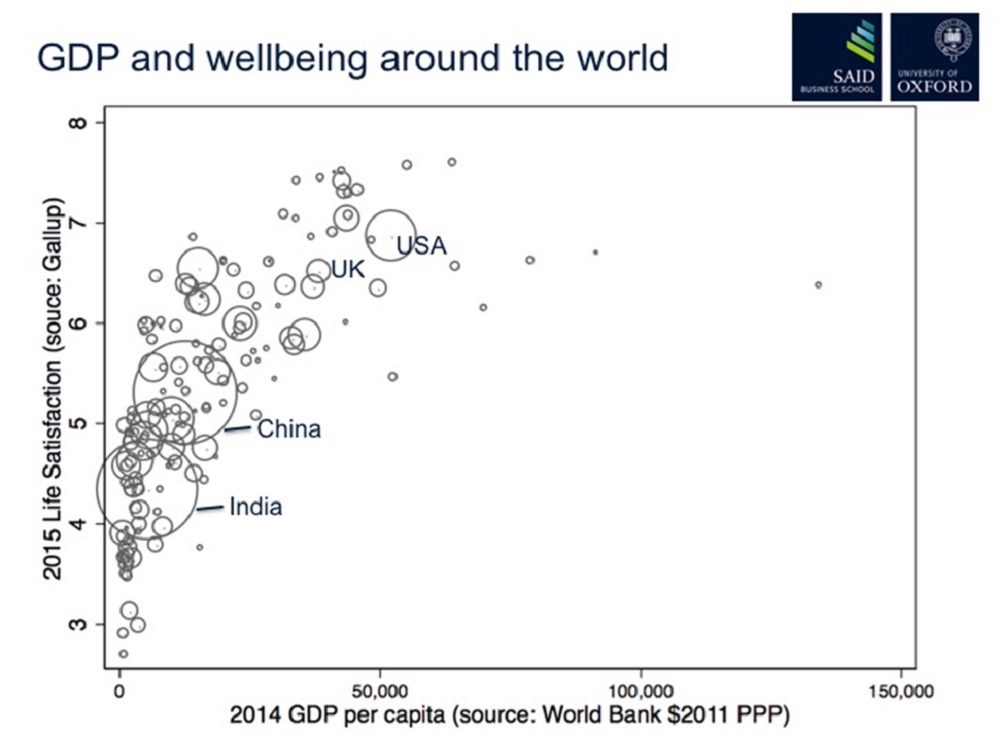
At our level of development, more GDP per capita does not mean people feel better off. This graph mapping life satisfaction against GDP per capita illustrates how things level off once you get to where we currently are.
This matters politically, because right now, people are feeling miserable and this is generating political chaos. Increasing GDP is not going to help.
In the run-up to Brexit, whilst GDP was gradually going up, measures of life satisfaction were steadily going down.
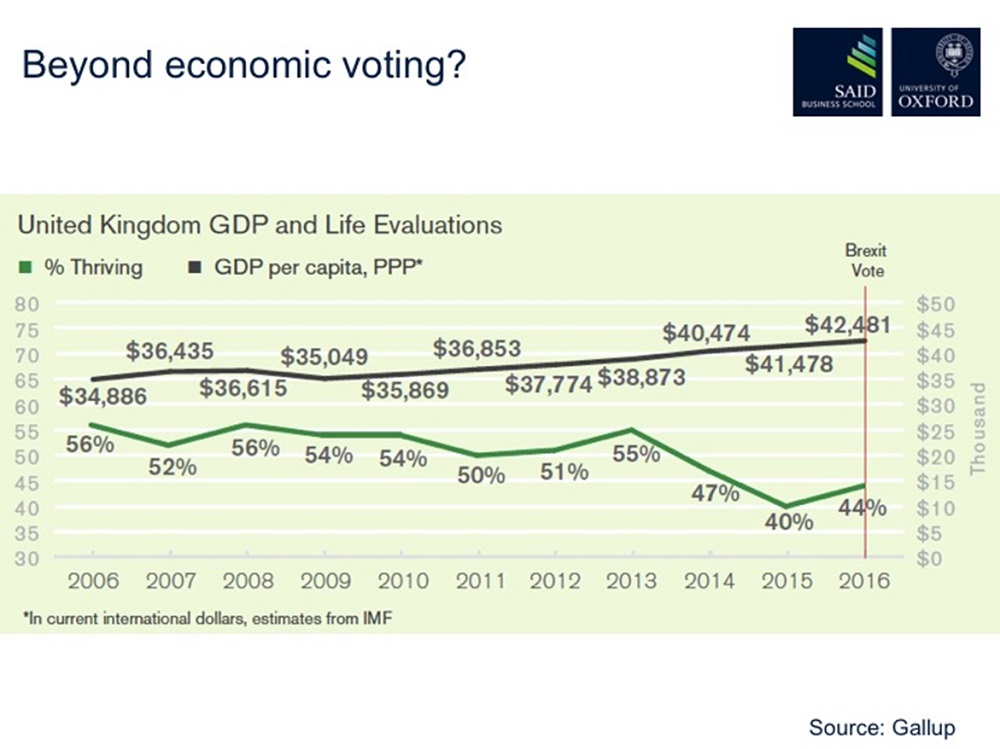
The same trends were seen before the Arab Spring and recent analysis of Trump voting shows it was greatest in those areas where people were least happy.
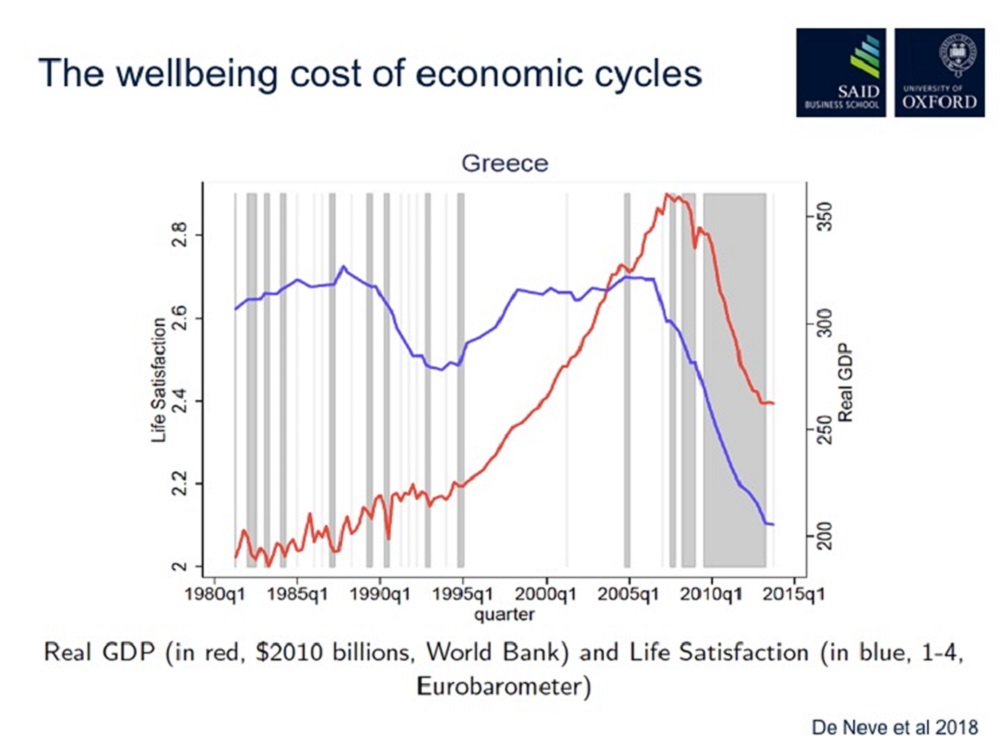
Economists have shown that, whilst GDP going up does not add much to happiness, GDP going down is dramatically linked to people feeling more miserable. This graph depicts the movements of GDP and life satisfaction in Greece through its recession.
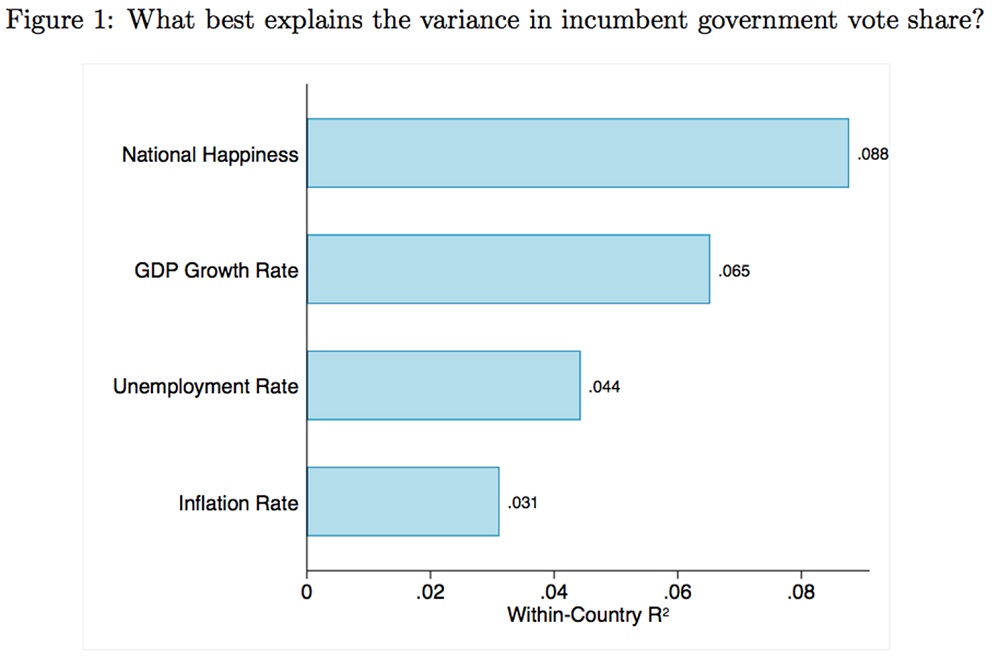
If misery drives political chaos, what of happiness? It turns out that, across Europe, when people are happier, incumbent Governments are more likely to get re-elected. This correlation is stronger than the GDP growth rate and also stronger than the unemployment and inflation rates.
So I propose that an independent Wales could pursue happiness instead of GDP. This may sound a bit wacky in a society dominated by a capitalist ideology which emphasises economic growth above all else.
But this has all been worked out internationally in great detail. Since the 2008 global financial crisis, there have been some big steps forward. In Europe, the 2008 Report for European Commission by Joseph Stiglitz, Amartya Sen and Jean-Paul Fitoussi highlighted the urgent need to focus more on wellbeing.
The UN launched the World Happiness Report in 2011, and a year later in Bhutan the report, Defining a New Economic Paradigm: The Report of the High-Level Meeting on Wellbeing and Happiness. In 2015 the global Sustainable Development Goals were agreed. In 2018, 238 academics call for a Sustainability and Wellbeing Pact, and the OECD published Beyond GDP: Measuring What Counts for Economic and Social Performance.
The OECD Better Life Index sets out 11 measures that research shows time and again really matter to people – jobs, income & work-life balance; health, safety and housing; community belonging and civic engagement; environment and overall life satisfaction.
[mid-content-banner]
Control
New Zealand has built on this system, adapting it to its own situation through substantial public consultation. This process added a 12th measure, cultural identity, on account of the urgent issues faced by the Maori and Pacific Islander communities. In addition, New Zealand added measures of ‘future capital’, which cover climate change.
In 2019, New Zealand published its first Wellbeing Budget 2019. It puts three new national priorities in top place: mental health, child wellbeing and Maori & Pacific Island communities. Then come the things one would expect in a budget, such as productivity, economy and investment. Finance laws are being changed so that annual budgeting is now organised around wellbeing outcomes - “actually what the public is asking for”, as Prime Minister Jacinda Ardern has put it.
Wales has the same kind of values as New Zealand and other small countries actively developing wellbeing economics, such as Scotland and Iceland, as evidenced by the fact that we already have the Well-Being of Future Generations Act.
Independence would give us the controls of the economy needed to follow the trail that New Zealand is blazing.
If people really believed that a new economy would improve what they really care about – jobs, health, social connections, safety and housing – then they would be more likely to vote for it.

Support our Nation today
For the price of a cup of coffee a month you can help us create an independent, not-for-profit, national news service for the people of Wales, by the people of Wales.
Get more trusted Welsh news
Choose Nation.Cymru as a preferred source in Google News to see more of our journalism.
