


Tuesday, 14th July 2026 Cardiff 26° · Clear sky
NationCymru A news service by the people of Wales, for the people of Wales.

Opinion

A Grand Coalition could be the only way out of the current crisis
By NationCymru
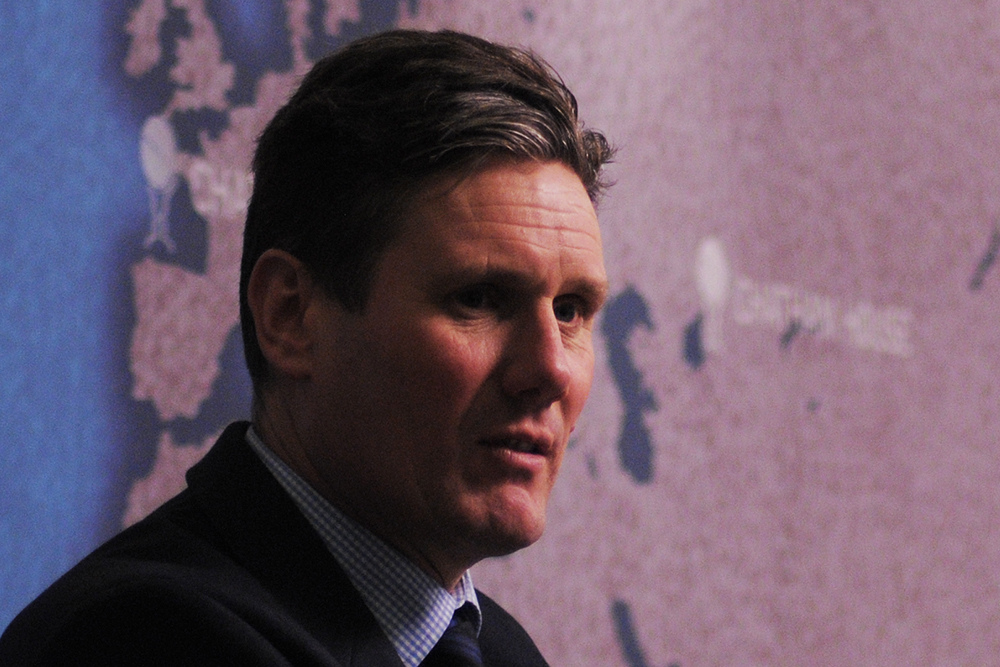
Could Sir Keir Starmer lead a government of national unity?

Dyfrig Jones

Reading today’s papers, it appears that June 11th is our National Day of Hot Takes. And, not wishing to feel left out from this important celebration of opinionation, I present to you my humble offering.

It is, in the tradition of the great hot take, simplistic, self-important and fantastical. It will be horrendously outdated in a matter of days. And is steeped in what you might term Borgen-ism: liberal centrist fantasism, based on the Danish political television drama where common sense prevails in the face of popular misjudgement.

Those of you that participate in the Welsh political twittersphere will be aware of a spat between Plaid Cymru (of which I am a member) and Labour that has been re-tweeted ad nauseam over the past few days.

It involves both the Welsh Labour Press account, and the account of Lee Waters, the Labour AM. Both decided to tweet comments that mocked Plaid Cymru’s assertion that we had had a successful election campaign, and that this was a good result for us.

Many Plaid Cymru members responded, not to defend the campaign as much as to accuse the Labour party of ingratitude – their view being that many Plaid Cymru supporters had voted tactically for Labour in this election, and were being thanked with condescension and derision.

I have my doubts about the extent to which the Labour result in Wales was due to Plaid Cymru voters lending their support to Labour – but that is for another article. What I think this particular twitter spat reveals is a more fundamental truth about last week’s election.

It is one in which every single party simultaneously had both a good and a bad result. This was Schrodinger’s election.

We, in Plaid Cymru, did have a good election – gaining Ceredigion, taking us from three to four seats, equalling our highest seat total ever. But we also failed to come close in our key target seats, and saw our share of the Welsh national vote fall to its lowest level in 20 years.

But likewise, Labour in Wales had both a good and a bad result. Yes, the figures are spectacular, with a huge share of the vote, and gains in vote share and seat numbers. But this was due to the popularity of Jeremy Corbyn, a leader whose authority in the Westminster parliament has been consistently undermined by prominent Welsh MPs.

The Welsh Labour campaign was based upon distancing themselves from Corbyn. They will undoubtedly claim that this was a vote of confidence in Carwyn Jones and his devolved government – but this is an act of spectacular self-delusion.

It was the Jez wot won it for Labour in Wales. They now face the challenge of working with a leader in Westminster that, on the whole, they loathe – but who has delivered Blair-like levels of popular support.

The only winners

This, of course, is not an uniquely Welsh situation. You can point to any of the parties of ‘Great Britain’ and say the same.

The SNP lost a far greater number of seats than expected, including Alex Salmond and Angus Robertson’s – but they remain the dominant party in Scotland.

The Lib Dems gained four seats, brought Vince Cable back into parliament, but lost both their former leader, and the whole of Wales.

On a British level, Labour exceeded all expectations, pushed the Tories into a minority government – but still managed to come a distant second in terms of overall seats.

And while the Tories took first place, their attempt to solidify their position of leadership has, instead, turned it to jelly.

The only party that currently looks like winners are the DUP. Having handed Theresa May her majority, it seems that they will now be allowed to reign supreme in Northern Ireland.

Vocal opposition to this sordid deal has, so far, concentrated on the DUP’s medieval attitude to women and sexual minorities. Of greater concern, to my mind, is the implications that this has for the peace process.

What incentive is there for the party to resume power-sharing in the devolved administration, if they are simply able to dictate terms directly to the Northern Ireland Office? And if there is no devolved power-sharing, what incentive is there for republicans to maintain the peace?

It seems unlikely that this deal will hold, and there is already talk of another election this year.

For those of us that have been out knocking doors over the past few months, we know that there is no appetite for this from either the electors or the candidates themselves. Is there, therefore, an alternative?

Unity

This is where I ask you to indulge my Borgen-ism.

Each party can point to ways in which it has won, but each has also undeniably lost. The voters have not unequivocally handed either major party the keys to Downing Street.

The left is calling for Theresa May to resign; the right is saying that they will never accept a government led by Corbyn.

So what if the Westminster found itself a Birgitte Nyborg, capable of brokering a deal that united all parties, in the national interest?

Clearly, neither Corbyn nor May could be prime minister, which begs the question: who would take their place?

There are figures in each party that are capable of finding common ground both with their own party’s core constituency (or in Labour’s case, insurgent wing), and the opposing parties.

Sir Keir Starmer has remained loyal to Corbyn, but also commands the respect of mainstream conservatives.

Anna Soubury was the first to publicly criticise Theresa May, post-election, and to position herself on something approaching the party’s center ground. In doing so, she has probably made herself unelectable as leader, but may serve as a stalking horse, opening the field for others who wish to claim the One Nation mantle for themselves.

Loyalty to the previous leader is arguably less important in the historically regicidal Tory party, and the post-Thatcher party has shown itself willing to pluck leaders from relative obscurity.

This might be an advantage in finding a new leader palatable to, and capable of working with, the opposition – certainly, none of the current runners and riders are particularly promising in this respect.

But what of this fantasy government’s policy programme?  From the Tories’ side, it would involve accepting that austerity has failed; not only by deepening poverty and social division, but also failed to reduce the deficit.

It is hardly a capitulation to the far-left to accept that those governments that embraced a mild no-keynesian approach to the financial crisis have weathered the financial storm far better than the UK.

Labour have already, to a degree, capitulated to a core Tory demand, by accepting Brexit fundamentally on their terms.

John McDonells’ “Jobs Brexit”, keeping the UK outside the Single market, seems to accept the central logic of the Tories’ plan – that we should establish our own regulatory regime – despite the difference in the regulations that both parties would wish to see put in place.

The Brexit-Lexit consensus between the two main parties would, of course, make it difficult to bring the smaller parties of the left – my own included – into the fold. But a commitment to constitutional reform could offer sufficient enticement.

A genuine commitment to reforming the electoral system might entice the Lib Dems; as long as they could forgive the sins of the past. A shift towards greater powers for the devolved governments might bring the SNP and Plaid Cymru on board.

And considering the potential difficulties that the Sailsbury Convention presents in the event of a hung parliament, now could be the ideal opportunity for all parties to move forward with democratising the House of Lords.

The only way?

This may well be a flight of fancy, an absurd piece of speculative fiction.

But while a government of national unity is by far the least likely outcome, it may be the only way of averting two much likelier crises.

If the Tories bring the DUP into government, we may well see a fundamental fracturing of the political order that has held fast for a quarter century.

The post-war social democratic consensus gave way to the current neo-liberal one; on what foundation will the next political age be built, if its architects are a Tory party possessed by the ghost of UKIP, in league with the DUP?

Labour are now talking of attempting to bring down the government, but are also refusing to countenance a coalition of the left.

Defeating the Tory-DUP deal without offering a realistic alternative will only lead to another general election.

With the Brexit clock ticking, and no real certainty about the way in which the country would swing if asked to vote again, it is uncertainty that we can scarcely afford.

Fantastical as it may seem, a Grand Coalition may be the only realistic way out of our current crisis.


Support our Nation today

For the price of a cup of coffee a month you can help us create an independent, not-for-profit, national news service for the people of Wales, by the people of Wales.

7 comments

Rich Speight

I've being having the same kind of thought experiment about a German-style grand coalition over the last couple of days - but the Tories will never join in and their liberal wing won't split. Anyway, if there's another election Labour will win a majority at Westminster. Your analysis of Labour isn't quite there, in my experience it was the combination of local campaigning for respected MPs (see Ynys Mon) , the "Welshification" of the offer and the Corbyn effect (especially in South Wales) that meant we were so successful.

Reply
Dafydd ap Gwilym

Sorry, but (sorry) wtf are you on about?! This does nothiing to promote this site as a voice piece for Cymru, talking about Danes, Germans and Sir Whogivesafek British titled person. Who, actually, like these very comments, epitamises all that is wrong with the UK and keeps messing with the minds of the unenlightened Cymreig! It just goes to show that change means changes, not of foreign politics, but national mindsets and I'm afraid this si slipping back toward what I thought this site was taking us away from! .

Reply
NationCymru

Hi Dafydd. It's not the intention of this site to drive the conversation in a particular direction, only to be a platform for it.

Reply
Dafydd ap Gwilym

Appreciateand nice to know, diolch Ifan. I do apologise for my rather curt response, but it is due to, nearly 2,000 years of furstration! If you see what I mean?!

Reply
Dyfrig Jones

@Rich Speight The question for Tory MPs (and everyone else), is whether they prefer a coalition with the DUP, another General Election, or a third option. The major stumbling block to the third option that I present here is, of course, Corbyn himself. With him as leader, you're right that it is nigh on impossible for this scenario to play out. But were both May and Corbyn willing to accept that they are both polarising leaders that are obstacles to progress, then we may be in a different world. Highly unlikely, I know - but let me daydream about it. On your analysis of the Labour result in Wales, I see your Ynys Mon, and raise you Arfon. Here, we had "local campaigning for [a] respected MP" - I know that you, and many other local Labour members respect Hywel Williams and the work that he has done. Yet he came within a hair's breadth of being ousted by a paper candidate who lives in London. But on this, I think we can agree to disagree. Thanks for the comments.

Reply
Dyfrig Jones

@Dafydd ap Gwilym Apologies for being insufficiently insular for your version of Welsh nationalism.

Reply
Dafydd ap Gwilym

Annwyl Dyfrig, Apologies for being misunderstood by someone I have not discussed anything with, who 'pops in' and, in passing, fires off an unwarranted broadside before moving on. Insular is not me, that's not the way I roll. I am all inclusive and everyone that knows me in reality or 'virtually', here or on other Cymreig sites I am registered with, would laugh at your ignorance (in the literal meaning of the word). When we consider everything wrong with the world we see that the main protagonist is capitalism and like communism has had its day. So, we then have to rethink what to do next, not look back and reform, restructure and definitely not reinstate anything from the past couple of thousand years that just does not work. So, let's look at other countries around the world. There are many who are changing their approach to economy, industry, lifestyles and how they see themselves within the global community etc., especially, in this era of rapid man-made climate change. They are not only taking onboard the already established and proven technologies of renewables, but also the sustainability of all life. Not in isolation, but on a global scale. Many of these appear quite radically new and some updated and refined versions of what we already have, such as Finland with their 'Circle Economy' (Recycling). Sweden is moving over to a 'make do and mend' approach and many other countries are changing other aspects and looking well into the future. We could go outside of this particular sphere and look at how the Netherlands, for example, are closing prisons due to lack of 'guests'. Perhaps one of the best examples of a country exisitng and doing quite nicely, within a deteriorating capitlaist world, who is totally changed its approach and mindset to be able to move forward with, for example, the aid of wind power, which their railways are now run on. These are just some of the necessary changes we need to look at and how Cymru itself can possibly benefit from them, bearing in mind our population, existing industries and our varied landscape. Cymru, a new country, a new concept for our future, our culture and our people. As a distinct and separate nation in what little land we have left of all that our ancestors used to have. Not insular, but also a part of a better global community. I for one, know how difficult it is to actually bin all that we have ever been told, everything we thought was true and who we've been told we are by the various people who came saw, stole and settled our ancestral land. Whether the Roman, Anglo-Saxon or Norman they have never been satisfied with just that, but also had to write a blanket history not only denying the truth, but also hiding it away purely to validate their prescence in these isles. Primarily saying, they only did, exactly, what we did before them, which was invade and settle. And all this not just to justify their existence here, but also their domination over us. Well that is so far from the truth! We are currently finding more evidence coming to light that is correcting this history of propaganda that has lasted, as I've aready hinted, nearly 2,000 years. It turns everything we have been led to believe, on its head. Which to me, as a 51 year student of the general history and prehistory of these lowlands, highlands and islands, means I have to not only get my head around it, but also update that section of my library! I would suggest further reading by two of my main mentors over the years. Britain Begins. Oxford. Written by Barry Cunliffe Britain BC. Harper Collins. Written by Francis Pryor The fact is we are indigenous to these isles. Being the descendants of those gatherer hunters whose communites developed after the last Ice Age and in possible partial isolation after the remaining piece of the landbridge (Kent/Calais area) disappeared under rising seas. Farming had already began to develop in isolation within these isles prior to further innovations, which came from the east (Steppe region), arriving here. When it did it obviously enriched what had already developed, who knows (as yet) our ancestors may have sent new ideas back across the channel. This certainly happened with objects from stone to metal over a long period. This is not so far fetched as you may first believe because, once an island and no longer a bulbous peninsular of the continental mainland other things developed in isolation too. There was a noticeable difference between the eastern half and the western half of what Greek and Roman writers called Albion, therefore our ancestors where known as Albiones. However, what they called themselves we may never know, but I guess we should never say never! The eastern half was closer to and mainly looking toward the continental mainland, whereas the western half in a north south seafaring perspective. The latter being known as the Atlantic Arc. The Arc of trade was from the highlands and islands of what is now Scotland all the way to the northern and western areas of the Iberian peninsular. This includes all the islands and western fringes of mainland areas in between. Including what is now Ireland, north western England, Isle of Man, Cymru, the whole of the Cornbian peninsular, (my own humble area of expertise), to Brittany, Galacia, Asturia and parts of Portugal. As sea farers the western people traded not only along the Atlantic Arc, but also in a west – east movement sailing into and across the channel. From the continental coast it was up and along the rivers into the heartland taking their goods and also their language with them. It was a lingua franca, a kind of universal language born out of the western regions along the Arc (not quite pin pointed yet) and used for trade, this lingua franca everyone knows as 'Celtic'. Celtic was born here or elswhere on these western fringes and spread into, not out of Europe. Cymreag, like other modern western fringe languages, can trace its pedigree all the way back to this lingua franca. See. Ancient Celtic Place-Names in Europe and Asia Minor. Blackwell Publishing. Written by Patrick Sims-Williams. So, I hope that answers your wrong impression of me being insular. You see my ancestors may have developed in partial isolation, but unlike the English and those that label themselves 'British' today, who are overtly insular in their rhetoric and actions, my ancestors (as I am) were inclusive and outward looking. Finally, to comment on your post ending, 'welsh nationalism'. Let me break it down into two parts. . Firstly, I am not 'welsh' as you put it, I am Cymreig, a person of a country of fellow countrypeople. The disrespectful and offensive, to me and many others, word 'welsh' in all its various forms and spellings comes from the Saxon word wealas meaning 'foreigner'. I am therefore certainly not a foreigner in my own land! Secondly, nationalism or the implication that I am a nationalist (which simply means someone who loves, is proud of and believes in their country) has become a rather derogatory word, a 'boogyman' term and label used by the English and those 'British' who believe in the forced union of my people to this foreign power. Anyone they and their increasingly neo-fascist press see as looking toward and finally breaking away from the clutches of that foreign power. Looking toward their rightful freedom, they are disrespected and labelled 'nationalists'. I have the sentiments of a nationalist then, but I am Cymreig!

Reply

Leave a reply

Replying to Dafydd ap Gwilym Cancel

Sorry, but (sorry) wtf are you on about?! This does nothiing to promote this site as a voice piece for Cymru, talking about Danes, Germans and Sir Whogivesafek British titled person. Who, actually, like these very comments, epitamises a...

Comments are reviewed before they appear.
