


News
Will public money be used to build a second mainline station in Cardiff?
Martin Shipton
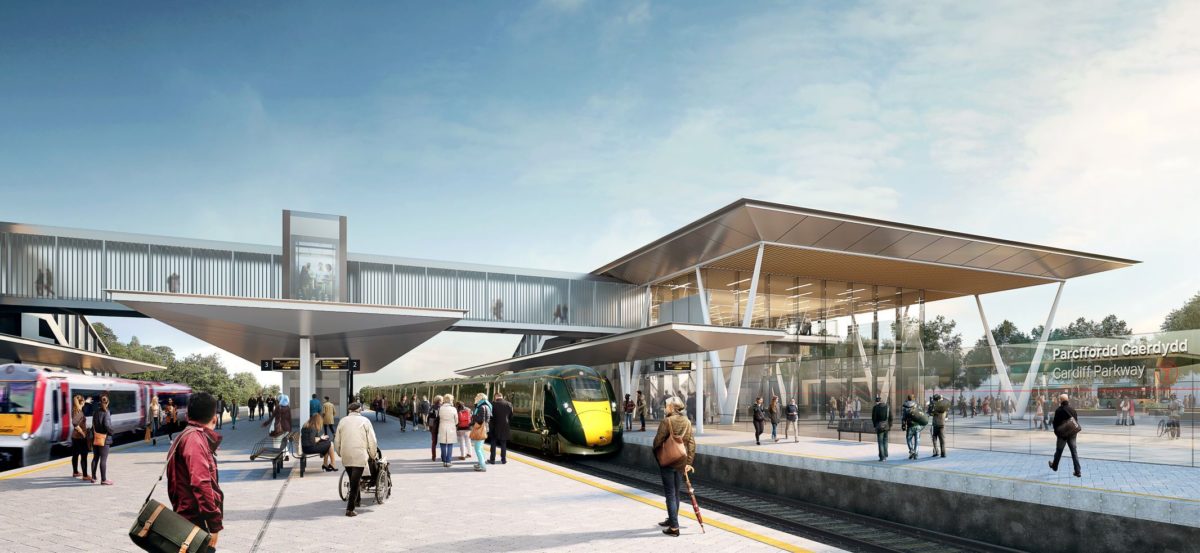
Cardiff Civic Society has raised further concerns about controversial plans to build a mainline railway station on the eastern outskirts of the capital.
The station, which would be called Cardiff Parkway, forms part of a scheme to expand a business park at St Mellons that has been heavily promoted by former First Minister Vaughan Gething, the MS for Cardiff South and Penarth. Mr Gething has described the station and business park development as “the largest economic growth project in Wales today”.
However, Great Western Railway has rejected the idea of having a second station stop in Cardiff, arguing that it would negate the time savings achieved by electrifying the main line to London. It has also been argued that the proposed site of the new station is not near enough to St Mellons to discourage people from driving.
Earlier this year, however, the Welsh Government approved a planning application for the project to proceed, rejecting an argument put forward by Cardiff Civic Society that if permission was granted, the station should be built first.
Although Nigel Roberts, the businessman behind the development, originally stated that it would not require public funds, Ken Skates, the Cabinet Secretary for Transport, recently confirmed that the UK Government would be providing funds to enable an upgrade of the railway line that would enable new commuter stations to be built between Cardiff and the Severn Tunnel.
And last week, Rolls Royce Submarines announced that it would be increasing the number of people employed in its office on the adjacent business park from 40 to 120.
However, Lyn Eynon, the planning lead of Cardiff Civic Society said the picture was not as rosy as was being painted.
He made the point that the presence of Rolls-Royce Submarines was to support the AUKUS partnership between Australia, the UK and the US to supply and deliver nuclear-powered attack submarines.
Mr Eynon said: “AUKUS is not guaranteed to go ahead despite Trump's apparent support. In any case, I’m not enthusiastic about further growth in Welsh military output being positioned as our ‘engine for growth’.
“[Welsh Secretary] Jo Stevens has claimed: ‘This development will bring highly skilled job opportunities and economic growth to the people of Cardiff’, but Steve Carlier, the President of Rolls-Royce Submarines, says: ‘The Cardiff satellite office opening shows Rolls-Royce Submarines' intent on attracting the brightest and best from across the UK’. How many of these jobs will be taken by people living in Cardiff today? Few if any skilled jobs will come to St Mellons, in my view.”
Semiconductor hub
Mr Eynon said the UK Government’s £160m Cardiff Capital Region Investment Zone funding was to develop a semiconductor hub in Newport, plus ‘a science and technology park to become the focus point for R&D activity and investment in Cardiff’ The location for that has not been determined. Cardiff council’s zoning suggests it should go to north Cardiff, but I expect the Cardiff Parkway business park to be a prime candidate, despite Jo Stevens continually boosting it as private investment.
“Cardiff council has long complained about the Welsh Government wanting all parts of Wales to benefit from business rates revenue. It has lost that argument, but it has now reemerged as a Cardiff Capital Region bid.”
Mr Eynon added: “I doubt that the Welsh Government will get a memorandum of understanding with Rolls Royce to come to Cardiff Parkway. Such an MOU would anyway have no contractual value. It is evident from Carlier’s comments that he is a long way from any commitment - he’s just saying friendly words to keep in with the Welsh Government. Insofar as he is interested, it is as much for St Mellons’ links to Bristol and London as for the merits of Wales. It would fit better into the Western Gateway initiative that the UK Government has scrapped.
“The hope that building a station would not cost significantly more than the £120m estimated in 2019 is optimistic. New construction costs have risen by a third over the past six years. Given that it will be years before this happens and that building work always costs more than quoted, £200m does not look an unreasonable estimate of the eventual cost if it is ever built to mainline standards.
“I don’t know how it can be argued that Cardiff Parkway has on its doorstep a far higher population density than any of the five new stations advocated by Lord Burns [who undertook an inquiry into alternative ways of reducing traffic congestion following the decision not to build the M3 Relief Road at Newport]’, given its location on the city edge. Cardiff East (Rover Way – Newport Road junction) will be at the heart of dense population, as will Somerton in east Newport. Neither of those will have easy access to the M4, unlike Cardiff Parkway. The M4 has always been Cardiff Parkway’s hidden asset that fits badly with its environmental claims.
“As Eluned Morgan recognises, there is not enough allocated money for the Burns stations, let alone Cardiff Parkway. Jo Stevens’ claim that Cardiff Parkway would be ‘a railway station that will be privately funded with no public sector money’ was always bluster.”
Support our Nation today
For the price of a cup of coffee a month you can help us create an independent, not-for-profit, national news service for the people of Wales, by the people of Wales.
Get more trusted Welsh news
Choose Nation.Cymru as a preferred source in Google News to see more of our journalism.
