


News
Welsh offshore windfarms 'will create more than 5,000 jobs' claims Jo Stevens
Martin Shipton
New offshore windfarms off the coast of Wales will create thousands of jobs and power millions of homes by the mid-2030s, according to Secretary of State for Wales Jo Stevens.
Turbines up to 300m tall are expected to be constructed in Port Talbot and Bristol and then towed out to sea to sit on platforms.
According to Ms Stevens, the project could create as many as 5,300 jobs, although it is as yet unclear how many would be in Wales.
The project, which is jointly run by the Crown Estate, Equinor and Gwynt Glas, is expected to be completed by the mid-2030s, with several wind farms to be constructed.
Ms Stevens said: “These are going to be the biggest offshore floating wind farms in the world, and they’re going to be off the coast of Wales.
“It is going to create thousands of jobs, power four million homes and bring down energy bills.
“This is really, really good news for Wales, and especially for young people and people wanting apprenticeships, because there are guarantees within the process that there will be specific apprenticeships and jobs for young people.”
[mid-content-banner]
Redevelopment
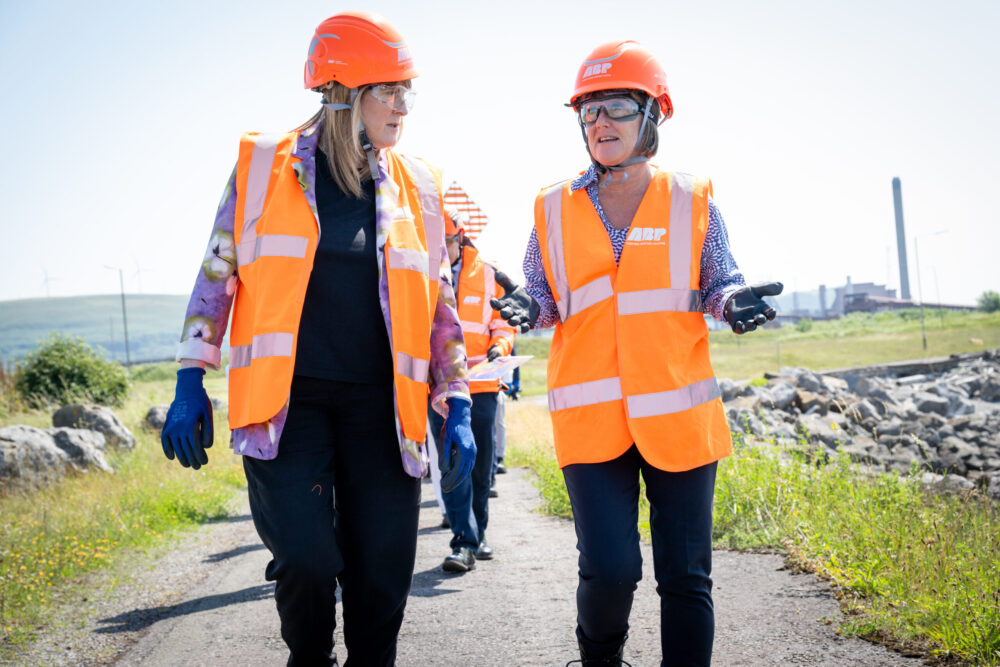
Ms Stevens’ visit to Port Talbot followed the announcement of funding for the redevelopment of the town’s port as part of Chancellor Rachel Reeves’ Spending Review last week.
The Crown Estate – which manages the seabed around England, Wales and Northern Ireland – is making a £400 million investment in the UK’s offshore wind supply chain.
While profits from the Crown Estate go to the Treasury, it is owned by the monarch and run independently.
The Crown Estate owns the seabed out to 12 nautical miles and around 65% of the Welsh foreshore and riverbed.
Management of Crown Estate assets has been a controversial issue in Wales, with Welsh Labour at the Senedd calling for management to be devolved as it has in Scotland. All 22 local authorities have backed the call for the Crown Estate to be devolved.
However, the UK Labour government has refused to allow the Welsh Government to take control, and Ms Stevens claimed the offshore announcement vindicated Westminster’s position.
[lower-mid-content-banner]
'Vote of confidence'
She said: “Today’s announcement is a real vote of confidence in floating offshore wind as a new technology and industry. This will be the biggest floating offshore windfarmsf in the world.
“In order to deliver that and deliver those thousands of jobs and the billions of pounds of investment, you have to have certainty, and investors need to know that the situation is certain.”
She insisted it was not a question of whether the Welsh Government could be trusted with the Crown Estate.
Llinos Medi, Plaid Cymru’s energy spokesperson in Westminster, pushed back against Ms Stevens, arguing Scotland is developing 19 offshore wind projects under the devolved Scottish Crown Estate.
“Until we devolve the Crown Estate, the process of extracting wealth from Wales’ natural resources will continue,” Ms Medi said.
“The Labour First Minister of Wales made a big pitch that she would not let Westminster ‘take our wind’.”
Last month First Minister Eluned Morgan said that devolution of the estates would allow Wales to profit from renewable energy in the Celtic Sea, “We saw them take our coal. We saw them take our water. We will not let them take our wind, not this time, not on my watch.”
Ms Medi said: “It’s clear that those efforts have not been effective, as the fees and profits from this announcement will be given to the Treasury in Whitehall rather than being retained for the Welsh public purse for the benefit of our communities.”
Transformative
Energy Secretary Ed Miliband said floating offshore wind will be “transformative” for economic growth in Wales and the south west of England.
He said: “The Celtic Sea has huge untapped potential to support our mission to become a clean energy superpower, so we can get energy bills down for good.”
Reacting to the announcement, Eluned Morgan said it was a “really significant announcement”, branding it the birth of a new global industry.
“This is a brand new approach to energy, it’s cutting-edge technology,” she said.
“People are going to have to work out how effective this is, how do you do it properly.
“I have been speaking to a lot of these energy companies and a lot of supply chains to say ‘base yourself in Wales’.”
Director of RenewableUK Cymru Jessica Hooper said: “We welcome this announcement of the first two large-scale floating wind sites in the Celtic Sea, as this technology has the potential to be transformative for the Welsh economy. Wales is poised to play a leading role in offshore wind. Over the next decade alone, there is up to £32bn in economic value at stake, a £4.8bn opportunity for Welsh businesses, alongside more than 3,000 well-paid jobs..
“Despite challenging market conditions, we’re pleased to see a successful outcome for Equinor and Gwynt Glas — a joint venture between EDF Renewables UK and ESB — marking an important first step in building a much-needed pipeline of projects in the Celtic Sea. To maximise the benefits of this technology and the investment in local facilities and supply chains we need long-term visibility on future leasing rounds and support in the upcoming clean power auction to start building out projects in Welsh waters and across the UK This will provide certainty for developers and investors to scale up new floating wind supply chains and ensure that workers have the right skills to make Wales a world leader in this cutting-edge technology”.
Significant
RenewableUK’s Deputy Chief Executive Jane Cooper said: “Awarding leases to the first two sites for floating wind projects in the Celtic Sea marks a significant step forward for this innovative technology which is set to play a major role in the UK’s future clean energy mix. Ports in south Wales and the south west of England have the potential to manufacture and assemble floating turbines, including giant platforms the size of football pitches, creating thousands of highly-skilled jobs. There will also be long-term opportunities in operations and maintenance, supporting local supply chains and providing sustained employment throughout the lifecycle of these projects.”
“But this is just the start – the UK already has one of the largest floating project pipelines in the world, so we have an opportunity to deliver green economic growth at scale. Our analysis shows that by 2050, floating turbines could provide a third of the UK’s offshore wind capacity with 40 gigawatts fully operational - enough to power every home in the country. By then, our research shows that the UK’s floating wind industry could employ 97,000 people, contributing £47 billion to our economy by building and supplying projects here as well as exporting our cutting-edge technology worldwide".
Welsh Liberal Democrat Leader Jane Dodds said: “New jobs are always welcome, especially in areas like Port Talbot, but as long as Labour refuse to devolve the Crown Estate to Wales, the money raised from these renewable projects will continue to flow out of Wales and go directly to London instead of directly benefiting Welsh communities.
“I’m also worried that the government hasn’t done enough to promote a supply chain for wind turbines that benefits Welsh workers, with most of the components for turbines being imported from Germany and Denmark rather than being manufactured here in Wales.”
Lack of detail
The Welsh Conservatives welcomed Labour’s latest announcement on offshore wind energy but criticised the lack of detail and guarantees surrounding its implementation.
Shadow Cabinet Secretary for the Economy and Energy Samuel Kurtz said: "The Welsh Conservatives have long championed the potential of floating offshore wind in the Celtic Sea. While today’s announcement represents just a small step within a broader strategy first advanced by the previous UK Conservative government, it is nonetheless a welcome development.
"To truly seize this opportunity and unlock the full economic potential for Wales, it is essential that Welsh ports are placed at the forefront for the assembly, operation, and maintenance of these wind farms. This must be supported by a coordinated effort to ensure a skilled local workforce, and a resilient supply chain are in place, without which the promised prosperity and job creation will remain out of reach."
Support our Nation today
For the price of a cup of coffee a month you can help us create an independent, not-for-profit, national news service for the people of Wales, by the people of Wales.
Get more trusted Welsh news
Choose Nation.Cymru as a preferred source in Google News to see more of our journalism.
