


Sun, 2nd August Cardiff 19°
Nation.Cymru wordmark
Advertisement

News

Welsh invention prevents indoor pollution from wood burning stoves
By Stephen Price
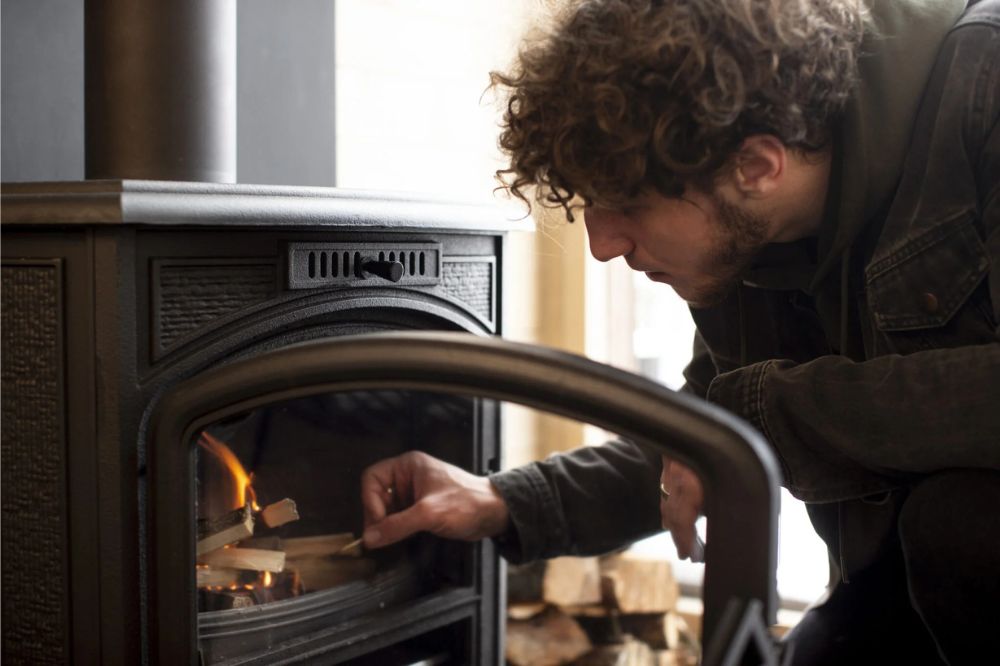
A traditional wood burning stove. Image: Island Pellet Stoves

A Welsh engineer from Cardiff has invented a new type of domestic woodburning stove to eliminate indoor pollution from wood burning stoves.

Marc Howell, who studied engineering at Cardiff University followed by years working as an engineer in the automotive and semiconductor industries, spent seven years working in his garage near Cowbridge, Vale of Glamorgan to perfect new patented technology that provides a real wood burning stove experience but without the risk of indoor air pollution.

This was the driving force for Marc, the founder of Island Pellet Stoves, who could not only see the benefits of sustainably heating a home with wood, but he could also see the potential conflict of its air quality impact on health.

“Burning wood just had to be made more efficient and less polluting” said Marc “through our experiences of reducing emissions from larger scale wood pellet systems we knew there was a way to create the real wood fire experience that is so desirable in the UK but yet do it cleanly and not at the cost of harming health’.”

It was wood pellets that are manufactured from timber industry sawdust and are produced into dry, regular-shaped pellets containing less than 1% ash and less than 10% water that were the key to the challenge.
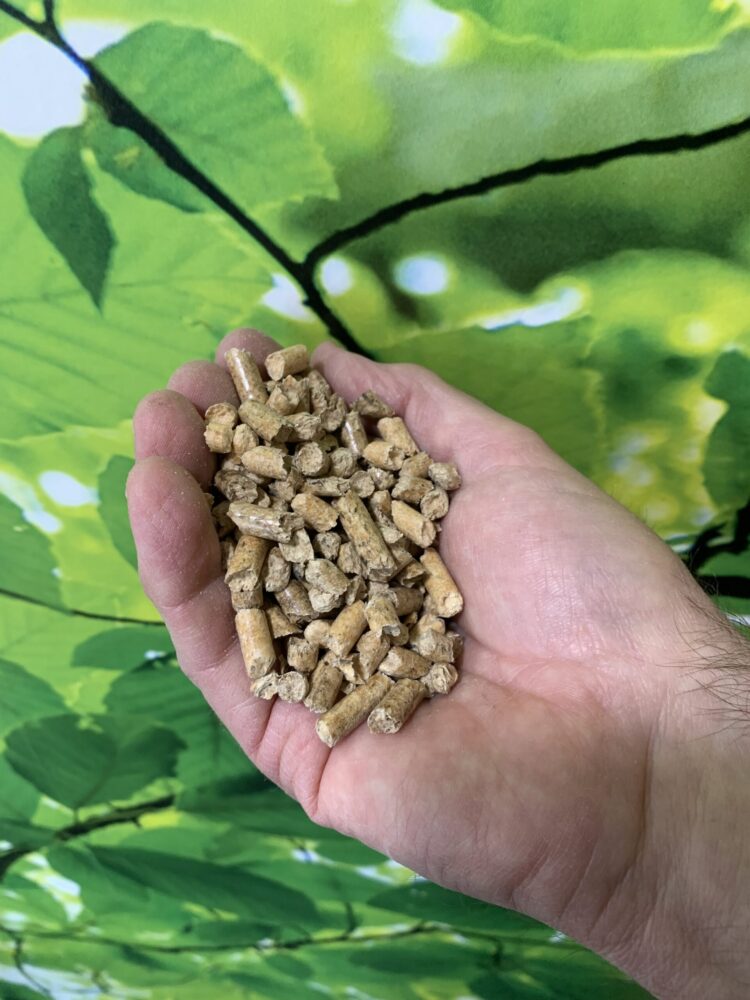
The wood pellets

A computer-controlled stove, that automatically lights the wood pellets and controls the feeding of the pellets with precise levels of pre-heated air, allows greater control of the combustion process and was found to be the way to significantly reduce the emissions and increase the overall efficiency of using the energy from the wood pellet fuel.

The air used for burning the wood pellets is pre-heated to a high temperature by the exhaust gases using a “balanced flue” as is commonplace with domestic gas boilers.

The stoking or feeding of the pellets from the on-board storage hopper to the “burn-pot” is done automatically with a computer-controlled “Archimedes screw” and so there is no need to open the stove door during operation (as there would be with a log-burning stove) and so the risk of harmful pollutants entering the home is eliminated.

Welsh manufacturer

A recent report commissioned by DEFRA (The UK Government’s Department for Food and Rural Affairs) and published in Feb 2025 called “Emission Factors for Domestic Solid Fuels” has confirmed through their testing that the pellet stoves made by Island Pellet Stoves Ltd are around 20 times cleaner than a modern log-burner for emissions of particulates.
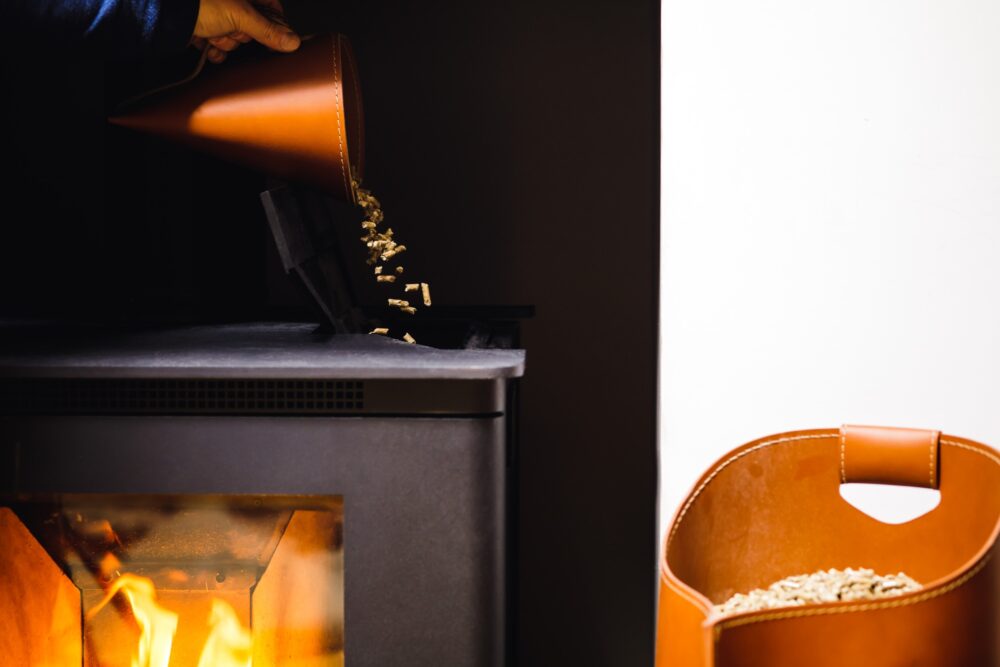
Filling Lundy model with wood pellets

Marc, who considers himself simply a “man in the shed” inventor might just have cracked the problem so we can continue to enjoy wood-burning but without the harmful side-effects.

Island Pellet Stoves Ltd is the UK’s market leader in pellet stoves and proudly designs and manufactures its stoves in Wales.

For the price of a cup of coffee a month you can help us create an independent, not-for-profit, national news service for the people of Wales, by the people of Wales.

Get more trusted Welsh news

Choose Nation.Cymru as a preferred source in Google News to see more of our journalism.

Choose Nation.Cymru as a preferred source in Google News

29 comments

Frank Hill

If wood burners were a working class affectation rather than a middle class one, they'd be banned by. now

Reply
Mk1

Look at all the old chimneys they ripped out of council house at massive expense to the tax player

Reply
Foggy

Fact: There is more pollution from cooking a Sunday roast! What about all the pm2.5 from EV car tyres? Burning wood is untaxed hence it is firmly in the governments sights! We can't have people keeping warm and not being taxed for the privilege! Next they'll be a tax on firewood and wooburning stoves. Your stove will need a registration certificate, plus annual checks. Should do that anyway of course, but we can't have you doing it yourself, unless you are a registered stove inspector! All chimney sweeps will need to join a registration scheme of course, at cost, with annual membership fees too. There will be household fees for stove registration and the annual membership fees for the governments mandatory 'safe stove scheme! This will finance council inspectors of course, who will come and fine you if you dare to burn unlicensed wood in an unlicensed stove! There is so much rain in this country that I doubt pm2.5 has much of a chance to enter anyone's lungs before it is washed back into the ground, from whence if came!

Reply
DSI

Your fact isn't true. Definitely more pollution from a wood burning stove. Myth 1: Frying eggs or grilling produces more PM₂.₅ than a stove, so stoves are harmless. Fact: Cooking does cause short indoor PM₂.₅ spikes, sometimes higher than roadside levels. But stoves emit continuously, add to outdoor air, and drive neighbourhood PM₂.₅. Comparing a kitchen spike with city-wide emissions is misleading. Wood smoke contains high levels of organic carbon, black/brown carbon, and trace metals. Studies in UK homes showed Ecodesign stoves reduce PM₂.₅ vs open fireplaces, but still produce sustained exposures (≈ 14-40 µg/m³) indoors. Myth 2: The toxicity of particles from cooking is comparable or worse, so wood smoke isn’t a health risk. Fact: While cooking particles can irritate, wood smoke includes more complex organic compounds like levoglucosan, high black carbon, and certain metals which penetrate deeply and have chronic effects. Toxic composition of wood smoke is worse in many markers. Myth 3: If a modern Ecodesign stove is used correctly, its indoor emissions are always negligible. Fact: Proper fuel & ventilation help, but even Ecodesign stoves produce measurable indoor PM₂.₅, UFPs and BC when burning, especially in smaller rooms and with longer burn durations. Real-world conditions reduce the “ideal” reductions seen in lab tests. Myth 4: Cooking pollution proves stoves aren’t a public-health problem. Fact: Cooking is mainly an indoor exposure issue. By contrast, wood smoke raises ambient PM₂.₅ across communities, contributing to thousands of premature deaths. Both matter, but one doesn’t cancel out the other. Myth 5: Because cooking and wood smoke both produce particles, the source doesn’t matter much. Fact: Composition matters — organic compounds vs inorganic ions, black carbon vs metals all differ in toxicity. Studies show wood smoke has higher load of long-term harmful components. Myth 6: Comparing cooking peaks with stove emissions is a fair measure of risk. Fact: Peaky cooking events are short and local. Stove emissions are less intense but more continuous and contribute to outdoor ambient PM₂.₅. Long-term exposure matters more for public health, and wood smoke contributes to neighbourhood pollution. Myth 7: Because cooking and wood smoke both produce particles, the source doesn’t matter much. Fact: Composition matters — organic compounds vs inorganic ions, black carbon vs metals all differ in toxicity. Studies show wood smoke has higher load of long-term harmful components Myth 5: Therefore we should promote stoves, not ban them. Fact: Modern stoves are cleaner than open fires, but real-world emissions remain high. Indoor cooking advice is important, but it doesn’t remove the need to reduce wood smoke pollution. ✅ Bottom line: Yes, domestic cooking causes sharp indoor PM₂.₅ spikes; but measured data shows pollution from even modern Ecodesign stoves produces sustained indoor and ambient PM₂.₅ exposures containing harmful chemical components like black carbon, metals and wood smoke tracers. Risk isn’t just about peaks, it’s about frequency, duration and composition. Wood burning contributes to city-wide air pollution and health harm. Using cooking as a deflection minimises the proven impact of wood smoke on communities.

Reply
Brychan

Your claims are false DSI. If it were true you'd have linked to the scientific studies, absent from your comments.

Reply

In reply to Brychan

DSI

These ones? DEFRA/Ricardo (2025) Emission Factors for Domestic Solid Fuel: uk-air.defra.gov.uk/assets/documents/reports/cat07/2502130943_Ricardo_EFDSF_Report_WP3_Issue4_FINAL_v2.pdf Island Pellet Stoves: “Occasional dust/ash can escape during de-ashing and re-fuelling”: www.islandpelletstoves.co.uk/wp-content/uploads/2024/05/Lundy-5-Operation-Manual.pdf DEFRA/Ricardo (2025) Emission Factors for Domestic Solid Fuels: uk-air.defra.gov.uk/assets/documents/reports/cat07/2401030934_Ricardo_EFDSF_WP1_Report_v1.4.pdf PubMed (2020):pubmed.ncbi.nlm.nih.gov/31253828 University of Sheffield: sheffield.ac.uk/news/indoor-wood-stoves-release-harmful-emissions-our-homes-study-finds woodburning.london/wp-content/uploads/2023/11/London-Wood-Burning-Health-Impact-Evaluation-Technical-Report.pdf Looking forward to seeing the scientific studies to back up your claim. It must be false as they are absent from your comment.

Reply

In reply to DSI

Brychan

You deliberately conflate regular wood burning stoves (out of date 2020) to attack this Welsh innovation which is different. Also the report from the London Borough of Camden and the London Borough of Islington has not considered it. Makes me wonder what your beef is with this technology and who pays you to dish the dirt. You are also wrong about the dust when manually emptying the ash. There's a mechanism to do this.

Reply

In reply to Brychan

DSI

At DSI we have "beef" with wood burning, because it reduces air quality, which contributes to health issues. There is no safe level of PM25. It's also not carbon-neutral. We quite like to be able to breathe properly. This stove does not prevent indoor pollution. It only reduces it. The problems with outdoor pollution still remain. And that's the part we have issues with. Everybody is free to poison themselves if they want, but you shouldn't force others to breathe the pollution you create. Also you must have missed the part where I quoted a line from the manufacturer of the stove. “Occasional dust/ash can escape during de-ashing and re-fuelling”: Here's the first fact-check we posted on this article. Myth 1: This invention eliminates indoor pollution from wood burning stoves. Fact: No wood-burning or pellet stove can fully eliminate emissions. Even sealed systems still produce bursts of pollutants during ignition, refuelling, ash removal, or via small leaks. The DEFRA / Ricardo Emission Factors for Domestic Solid Fuels report confirms pellet stoves have much lower particulate emissions than log stoves, but do not claim zero emissions. Myth 2: Pellet stoves are ~20× cleaner than modern log burners in particulate emissions, so they’re effectively “clean.” Fact: That ~20× figure is based on certain lab test conditions for PM emissions under ideal scenarios. But it doesn’t account for all pollutants, like carbon monoxide, VOCs, ultrafine particles, or real-world operation such as imperfect fuel or maintenance issues. Real-life scenarios see variation. Myth 3: Because the system is sealed and controlled, it removes the risk of harmful pollutants entering the home. Fact: Sealed and controlled reduces, but does not eliminate, the risk. Studies show that using wood stoves, especially older or non-certified ones, correlates with higher indoor PM2.5 and black carbon levels in homes. Myth 4: This invention solves the air-quality/health problem of wood burning. Fact: It addresses only one piece (indoor emission exposure). The broader public health burden is significantly driven by ambient / outdoor particulate pollutionresulting from wood combustion in many homes. Indoor exposure is mostly reduced only for the stove user. While this technology may improve air quality inside the home where the stove is used, neighbouring homes and outdoor air are still heavily impacted. Estimates of annual health costs tied to domestic wood burning in London are around £173 million due to PM2.5 and NO₂ impacts. Even “cleaner” stoves contribute to that shared burden. https://s.w.org/images/core/emoji/15.0.3/72x72/2705.png Bottom Line This technology can reduce emissions and exposure but does not eliminate them or resolve the wider air-quality problem from domestic wood burning. The article’s “pollution-free” framing exaggerates its real impact. Indoor exposure reductions are real but not perfect. Spikes and leaks still occur in real homes. The larger issue of ambient air pollution and collective health burden remains unaddressed by any single “clean” stove.

Reply
Wynn

I think you're wrong here DSI. I have no option but to use wood burning stoves - I live off grid in the Highlands. I have four particulate monitors and only on a couple of days per year does any of them register PM2.5s outside of good range, and even then it's marginal. The only time we have a particulate problem is when my wife is making a fry up because she likes her tattie scones burnt. Properly operated and maintained stoves are not a problem. This man's invention may make them even more efficient.

Reply

In reply to Wynn

DSI

As we said in the Fact-Check: Composition matters — organic compounds vs inorganic ions, black carbon vs metals all differ in toxicity. Studies show wood smoke has higher load of long-term harmful components. Do humans eat wood? No. So why would the emissions from cooking be the same as wood smoke pollution? DEFRA/Ricardo (2025) Emission Factors for Domestic Solid Fuel: uk-air.defra.gov.uk/assets/documents/reports/cat07/2502130943_Ricardo_EFDSF_Report_WP3_Issue4_FINAL_v2.pdf Island Pellet Stoves: “Occasional dust/ash can escape during de-ashing and re-fuelling”: www.islandpelletstoves.co.uk/wp-content/uploads/2024/05/Lundy-5-Operation-Manual.pdf DEFRA/Ricardo (2025) Emission Factors for Domestic Solid Fuels: uk-air.defra.gov.uk/assets/documents/reports/cat07/2401030934_Ricardo_EFDSF_WP1_Report_v1.4.pdf PubMed (2020):pubmed.ncbi.nlm.nih.gov/31253828 University of Sheffield: sheffield.ac.uk/news/indoor-wood-stoves-release-harmful-emissions-our-homes-study-finds woodburning.london/wp-content/uploads/2023/11/London-Wood-Burning-Health-Impact-Evaluation-Technical-Report.pdf

Reply

In reply to DSI

Brychan

Why do you quote studies that pre-date this Welsh invention? Issues cured by innovation.

Reply

In reply to Brychan

DSI

The first fact-check I posted covered exactly these stoves. (It seems to have been deleted) Myth 1: This invention eliminates indoor pollution from wood burning stoves. Fact: No wood-burning or pellet stove can fully eliminate emissions. Even sealed systems still produce bursts of pollutants during ignition, refuelling, ash removal, or via small leaks. The DEFRA / Ricardo Emission Factors for Domestic Solid Fuels report confirms pellet stoves have much lower particulate emissions than log stoves, but do not claim zero emissions. Myth 2: Pellet stoves are ~20× cleaner than modern log burners in particulate emissions, so they’re effectively “clean.” Fact: That ~20× figure is based on certain lab test conditions for PM emissions under ideal scenarios. But it doesn’t account for all pollutants, like carbon monoxide, VOCs, ultrafine particles, or real-world operation such as imperfect fuel or maintenance issues. Real-life scenarios see variation. Myth 3: Because the system is sealed and controlled, it removes the risk of harmful pollutants entering the home. Fact: Sealed and controlled reduces, but does not eliminate, the risk. Studies show that using wood stoves, especially older or non-certified ones, correlates with higher indoor PM2.5 and black carbon levels in homes. Myth 4: This invention solves the air-quality/health problem of wood burning. Fact: It addresses only one piece (indoor emission exposure). The broader public health burden is significantly driven by ambient / outdoor particulate pollutionresulting from wood combustion in many homes. Indoor exposure is mostly reduced only for the stove user. While this technology may improve air quality inside the home where the stove is used, neighbouring homes and outdoor air are still heavily impacted. Estimates of annual health costs tied to domestic wood burning in London are around £173 million due to PM2.5 and NO₂ impacts. Even “cleaner” stoves contribute to that shared burden. https://s.w.org/images/core/emoji/15.0.3/72x72/2705.png Bottom Line This technology can reduce emissions and exposure but does not eliminate them or resolve the wider air-quality problem from domestic wood burning. The article’s “pollution-free” framing exaggerates its real impact. Indoor exposure reductions are real but not perfect. Spikes and leaks still occur in real homes. The larger issue of ambient air pollution and collective health burden remains unaddressed by any single “clean” stove.

Reply

In reply to DSI

Wynn

Hi DSI I looked at your links, the Sheffield study states that stoves (and a fire) when in use had particulates between 27.34 ug/m3 and 195.83 ug/m3 - a big range there - at one end marginally over the WHO 'safe level' of "25 ug/m3 over a 24 hour period". And no offense, but one of the experts is described as a criminologist. The New England Pregnant women study states in it's conclusion: "Homes with wood stoves, particularly those that were older and non-EPA-certified or burning wet wood had higher concentrations of indoor air combustion-related pollutants." It's hardly unexpected is it? Its like saying fags produce more smoke than chewing gum. The London Woodburning Project is hardly an impartial orgainisation (its aim being to stop woodburning stove use) and the methodology is questionable relying on a literature review and estimates albeit based on a US scientific method. Nobody is saying inhaling particulates is not bad for your health which is where the LWP goes with this, but it's the stoves we're talking about and I just look at my monitors - and there's no estimates there just real life air quality measurements - and they do not show any of the levels mentioned in these studies.  Stoves also rely on how you use them, and the link you show to the Lundy Operational Manual actually is an illustration of this, as you quote  “Occasional dust/ash can escape during de-ashing and re-fuelling” - CAN is the key word. I am not saying that stoves are super clean but where do you get energy from?  Not all of it is clean. Powerstations nuclear, gas, coal, biomass, only wind and hydro are trully clean, I can't offer you a study but there's a lot of dirty energy floating about in the UK: https://assets.publishing.service.gov.uk/media/688890c3a11f859994409132/UK_Energy_in_Brief_2025.pdf Give me a bit of smoke any day rather than a Three Mile island, Chernoble or Fukushima. Nuclear and radiation accidents and incidents - Wikipedia

Reply

In reply to Wynn

DSI

Thanks for taking the time to look at the sources. There are a few technical points in your reply that need correcting. First, the WHO PM2.5 figure you quote (25 µg/m³ over 24 hours) is outdated. The WHO updated its Air Quality Guidelines in 2021. The current guideline is 15 µg/m³ as a 24-hour mean and 5 µg/m³ as an annual mean. Using the older 25 µg/m³ value materially understates exceedance. On the current guidance, 27.34 µg/m³ is almost double the WHO limit, and 195.83 µg/m³ is more than thirteen times higher, so these are not marginal exceedances. It’s also important to clarify that WHO guidelines are not “safe levels”. WHO is explicit that there is no safe threshold for PM2.5 and that health risks increase even below guideline values. The guideline represents a risk-reduction target, not a level below which harm does not occur. There’s also an issue with applying outdoor air-quality standards to indoor exposure. WHO limits are designed primarily for ambient outdoor air. The Sheffield study, along with DEFRA/Ricardo and other peer-reviewed work, examines indoor concentrations, where exposure is prolonged and short-term spikes occur during refuelling and de-ashing. Those peaks are particularly relevant for health, especially for children, older people and pregnant women. Regarding the Sheffield study itself, the measured particulate data stand on their own. The academic background of one contributor does not invalidate direct PM2.5 measurements taken with standard air-quality instrumentation, and the findings are consistent with wider UK and international literature. Finally, the pregnancy study you mention actually supports the concern being raised. It shows higher indoor pollutant concentrations in homes with wood stoves, particularly older appliances or where fuel and operation are sub-optimal, conditions that DEFRA/Ricardo (2025) confirms are common in real-world use. Manufacturer manuals also acknowledge particulate release during normal operation such as refuelling. In short, the issue isn’t whether combustion produces particles, that’s undisputed, but that using outdated WHO limits and treating them as “safe levels” understates the scale and relevance of indoor PM2.5 exposure from wood-burning appliances. I agree that how a stove is used matters, but the wording in the Lundy operational manual doesn’t weaken the point being made. It supports it. “Can escape” reflects that particulate release during refuelling and de-ashing is a recognised and expected operating condition, not a rare malfunction. DEFRA/Ricardo (2025) explicitly notes that real-world emissions are higher than laboratory test values precisely because normal user behaviour (refuelling, start-up, fuel variability, draft conditions) is not captured in certification testing. The issue isn’t whether stoves can be clean under ideal conditions, but that normal use produces short indoor PM2.5 spikes, which matter for health, especially indoors, where exposure is direct and prolonged. Comparing this to national energy generation misses the point. Power stations are regulated, monitored and located away from people’s lungs. Domestic stoves emit inside living spaces, creating a completely different exposure risk. So this isn’t about claiming all energy is clean. It’s about recognising that avoidable indoor combustion has a distinct and well-evidenced health impact that can’t be waved away by pointing at the grid. No energy source is totally clean, but wind, hydro & solar are the cleanest by far. We could power everything with those sources, and we should. Hopefully it will never be a choice between smoke and a nuclear disaster.

Reply
Paul

Is my wood burner doing me more harm than my lack of Radon protection in my floor?

Reply

In reply to Paul

DSI

Yes

Reply

In reply to DSI

Paul

That’s ok then as my wood burner is my only form of heating at the moment and I have been a bit concerned about radon gas but I don’t need to worry about that now

Reply
Brychan

This false narrative from DSI Environmental of Lancashire may explain why that company is under a compulsory strike-off. Just peddling debunked theories. Stop trashing a successful Welsh innovation. The product being showcased in the article has obtained all the UK and EU certifications on emissions and efficiency and it might be wise not to claim otherwise. Suggest you read the article.

Reply
Harry

I am fed of this country always bashing the public over something. In comparison to when I was a child the number of wood burning stoves is minimal. When I was young virtually every house was heated by open coal fires. Two or three per household. It's nothing like that now. I read a report approx 12 months ago that stated half of all pm pollution in the UK is blown in from Europe. Add to that our home grown pollution from cars, industry etc what percentage of pm in this country is actually from wood burning stoves. And don't forget while some households use wood burning stoves they are not polluting via their gas boiler vents. Not everybody can afford the extortionate cost of a heat pump system or electric has. This witch hunt by the eco clan has to stop. Go and find better solutions to saving the planet that just loading it onto the public.

Reply
Petej

I'm not sure where you got the idea half of PM pollution is blown in from the EU? The prevailing wind in the UK is Southwest, which would mean it comes in from the Atlantic. You would need half a year of East/Southeast wind to accomplish your opinion. In addition the EU develops more clean energy than we do in terms on Nuclear Power. Which equals zero emissions. I suggest your report is flawed.

Reply
Harry

France is the only country with huge amounts of nuclear energy. Germany went through a program a good few years ago to reduce its nuclear base. So Europe isn't as clean as you state. You dodged the question on what percentage of pm in the air in the UK is attributable to just UK wood burning stoves. Additionally you may have notice that the mild weather we are experiencing now is because the wind direction is coming up from the south, from Europe.

Reply
Jill

Having a computer operated wood burning stove defeats the point of having one for many people. When there are power outages wood burning stoves are the only means of providing warmth and in some cases hot water to a household, as gas boilers require electricity to operate. Sounds more like a biomass power plant. Jog on.

Reply
Paul

I agree with you wholeheartedly but you’ve got to admit it’s a good advert for Island Pellet Stoves.

Reply
Martin Ross

My wood burner operates under a slight vacuum and if I open the door slowly, no smoke or fumes enter the house. These pellet stoves are two or three times the cost of a normal wood burner including installation. I can't see any facts on their website. I would like to know the efficiency and emmissions. The pellets are bound to be expensive. I was buying a builder's sack (one cubic meter) of dried logs for £40. But the computer control would be nice. I see it has a fan, so that will add to the running costs.

Reply
Martin Ross

The report you mention does not give any emission figures for pellets! "The DEFRA / Ricardo Emission Factors for Domestic Solid Fuels report confirms pellet stoves have much lower particulate emissions than log stoves" No, it doesn't. I suspect you did not read the report - it is very long.

Reply
Richard

Strange nobody mentions the smokeless zones initiative (1956) that has been upgraded several times since. If the authorities are to ban sealed wood burning stoves shouldn’t they first ban all open fires and burning garden an household rubbish outdoors? One contributor often mentions his ‘facts’ the relate to city use of wood burners but most are probably used in rural areas.

Reply
Peter

Balcas has been making these pellets for years, it’s nothing new.

Reply
Anonymous

I wonder if Marc applied for international patent coverage - the USA is a huge market and is comparatively cheaper to file in and maintain patents than in Europe. I hope so.

Reply
DRL

Electric powered Pellet stoves no good during a power cut. No Energy no heat.

Reply

Leave a reply

Replying to Wynn Cancel

I think you're wrong here DSI. I have no option but to use wood burning stoves - I live off grid in the Highlands. I have four particulate monitors and only on a couple of days per year does any of them register PM2.5s outside of good range...

Comments are reviewed before they appear.