


Sun, 16th August Cardiff 19°
Nation.Cymru wordmark
Advertisement

News

Warnings of tax rises after Downing Street welfare U-turn
By Mark Mansfield
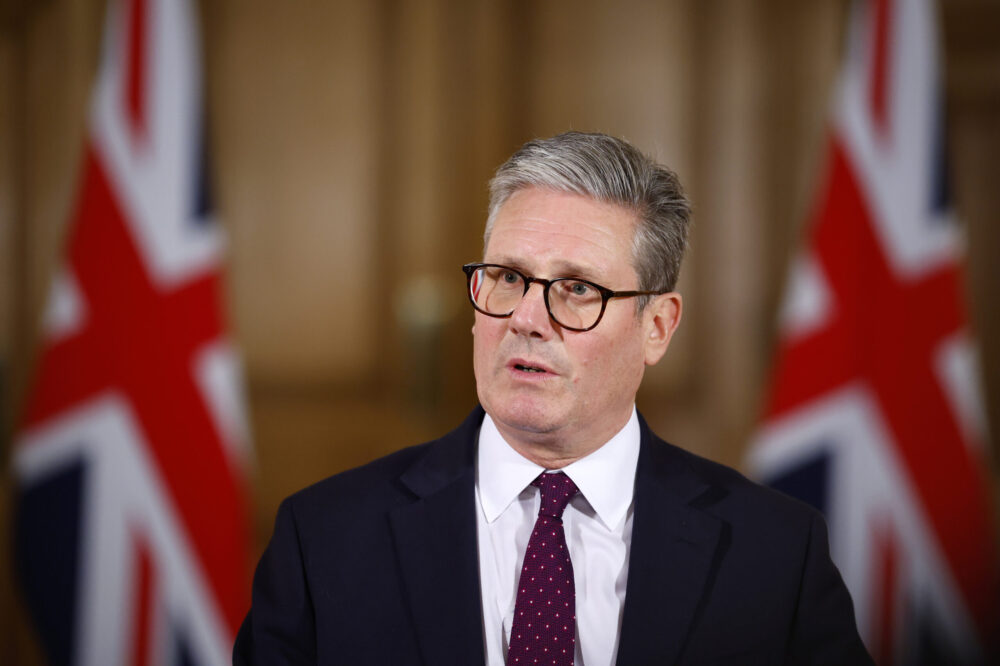
Prime Minister Sir Keir Starmer. Image: Benjamin Cremel/PA Wire

There are predictions of tax rises in the autumn budget after Sir Keir Starmer U-turned on welfare reforms in the face of a backbench rebellion.

The Prime Minister said that the concessions strike “the right balance”, but think tanks have warned that the changes announced in the early hours of Friday morning have made Rachel Reeves’s “already difficult Budget balancing act that much harder”.

Downing Street declined to rule out the possibility of increases in the autumn, telling reporters on Friday that “tax decisions are set out at fiscal events”.The concessions on offer include protecting personal independence payments (Pip) for all existing claimants, while all existing recipients of the health element of Universal Credit will have their incomes protected in real terms.

The Institute for Fiscal Studies (IFS) said on Friday that the changes make tax rises in the budget expected in the autumn more likely.

Associate director Tom Waters said: “These changes more than halve the saving of the package of reforms as a whole, making the Chancellor’s already difficult Budget balancing act that much harder.”

[mid-content-banner]

£3 billion

Ruth Curtice, chief executive at the Resolution Foundation, said that “the concessions aren’t cheap, costing as much as £3 billion and more than halving the medium-term savings from the overall set of reforms announced just three months ago”.

She added: “This adds to the already mounting pressure to deliver fresh consolidation in the Budget this autumn.”

The Resolution Foundation noted that extending a freeze in personal tax threshold by one year would save “£4 billion a year”.

Asked about how the climbdown would be funded, Downing Street said on Friday that “There’ll be no permanent increase in borrowing, as is standard.

“We’ll set out how this will be funded at the budget, alongside a full economic and fiscal forecast in the autumn, in the usual way.”

Asked whether they could say there would be no tax rises, a Number 10 spokesman said: “As ever, as is a long-standing principle, tax decisions are set out at fiscal events.”

Some 126 Labour backbenchers had signed an amendment that would have halted the Universal Credit and Personal Independence Payment Bill in its tracks when it faces its first Commons hurdle on July 1.

The list of Labour MPs putting their name to the amendment had been growing throughout the week, as Downing Street said that they would be pressing on with next week’s vote.

After the late-night U-turn, Sir Keir said that “the most important thing is that we can make the reform we need”.

“We talked to colleagues, who’ve made powerful representations, as a result of which we’ve got a package which I think will work, we can get it right,” he added.

“For me, getting that package adjusted in that way is the right thing to do, it means it’s the right balance, it’s common sense that we can now get on with it.”

While leading rebels believe the concessions are likely to be enough to win over a majority, some remain opposed to the plans in their current form.

[lower-mid-content-banner]

Eligibility issues

Dr Simon Opher, who represents Stroud, said in a statement that he is glad the Government “are listening”, but that the changes “do not tackle the eligibility issues that are at the heart of many of the problems with Pip”.

“The Bill should be scrapped and we should start again and put the needs of disabled people at the centre of the process,” he said.

It is also understood that talks are under way over rebel attempts to lay another amendment next week as they seek to delay the plans, as reported by The Guardian.

The fallout also threatens to cause lasting damage, with some backbenchers having called for a reset of relations between Number 10 and the parliamentary party.

Frustration

Speaking to the PA news agency, a number of Labour backbenchers expressed deeper frustration with how Downing Street has handled its backbenchers since last year’s election.

The Government’s original package had restricted eligibility for Pip, the main disability payment in England, as well as cutting the health-related element of universal credit.

Existing recipients were to be given a 13-week phase-out period of financial support in an earlier move that was seen as a bid to head off opposition.

Now, the changes to Pip will be implemented in November 2026 and apply to new claimants only, while all existing recipients of the health element of universal credit will have their incomes protected in real terms.

The concessions on Pip alone protect some 370,000 people currently receiving the allowance who were set to lose out following reassessment.

For the price of a cup of coffee a month you can help us create an independent, not-for-profit, national news service for the people of Wales, by the people of Wales.

Get more trusted Welsh news

Choose Nation.Cymru as a preferred source in Google News to see more of our journalism.

Choose Nation.Cymru as a preferred source in Google News

12 comments

Amir

2% wealth tax on millionaires would be ideal. Leave the poorer folk alone for now.

Reply
Boris

Time to abolish state pension payments for millionaires and non residents.

Reply
Peter J

Tax rises were inevitable before the changes to WFA and health related benefits. The public finances are grim, and going to get worse over the parliamentary term. And when taxes rise, with continued worsening in public services, Reform are going to have a field day

Reply
Neil Anderson

Tax rises are not inevitable, Peter J. And the public finances are only grim if seen through the contorting lens of neo-liberalism. The economy does not have to be run the way it is by these incompetent ignoramuses. They have a deeply mendacious political agenda. Don't vote for them - Labour or Tory, and Reform promise to be much worse.

Reply
Adrian

Well…you get what you vote for.

Reply
Neil Anderson

It is clear that that Andrew Bailey, Rachel Reeves, Keir Starmer, Nigel Farage, et al, are trapped in the little boxes that characterise neo-liberal 'thinking'. All governments with a fiat currency (eg. the UK) do not need to tax in order to spend. Ask yourself, what exactly would they be taxing if there was no spending? In fact, spending precedes tax. There is a (relatively unimportant) connection between expenditure and revenue on an electronic ledger somewhere but the reality is that the government creates funds whenever it spends, as authorised by parliamentary approval of a budget. This expenditure powers the private sector, not the other way around. The government may also borrow, but why do that if interest is also being paid? Creating their own funds is by far the cheapest and easiest way of funding government expenditure. And it doesn't require arcane camouflage like Quantitative Easing (QE). But taxation plays a crucial role in balancing the economy (sic). 'Balancing the books' is a shallow exercise for governments (though not for households and businesses) that merely restricts their freedom and prejudices our people, usually, since Thatcher, for wholly political reasons. Reeves makes a fool of herself by citing her silly fiscal rules as necessitating a particular policy, say, reducing benefits, when the government can always create the funds required. Austerity then has been a wholly unnecessary policy, deeply damaging our society - and our economy. Sensible investment by government (hospitals, schools and increased benefits, for example) has a positive multiplier, generating growth. Reckless, counter-productive and/or reduced expenditure can have zero and negative multipliers, taking wealth out of the economy. Armaments are a case in point - very negative, undermining growth in more productive areas - say, food supply. Neo-liberal policies generate unhealthy social engineering that favours the wealthy and the over-rewarded at the expense of those least well-off. It must stop, and it will stop... Now running out of cheap resources and cheap labour to exploit (yes, you and me!), neo-liberalism is running out of steam and of time. A new economic model is awaiting. It requires only that we sweep away the Tory-Reform-Labour cabal that conspires against our well-being. 2026 is our time to start fighting back!

Reply
Peter J

This is deeply misinformed. What your talking about is not 'neo liberal' thinking, it the fundamental system that every country in the world follows, with exception to Zimbabwe in 2000s and the weimar republic, Maybe you can draw a parallel to the massive loans taken during COVID, but these ultimately led to high interest rates, worsening public services and quite probably the rise of populism.

Reply
Neil Anderson

Alas not, Peter J. But you might like to specify exactly what is 'deeply misinformed'...? Or do you mean all of it? Although neo-liberal capitalism' may well be 'the fundamental system that every country in the world follows' (er, to a greater or lesser degree), it is based on a set of fallacies. (cf Murphy, P https://www.taxresearch.org.uk/Blog/2025/06/16/economics-is-crap/, or try Steve Keen...). Or you might like to consider the predictive power of the neo-con establishment's models, so aptly questioned by Elizabeth II after the banking collapse in 2008 - 2009? Much of this fundamental misconception has been compounded by the economic illiteracy of successive Chancellors of the Exchequer, Treasury and the Bank of England (apart from their Quarter 1 review 2014). Please note that about 80% of the world's economists are microeconomists. Their worldview is likely to be constrained accordingly. I do have a degree in economics but consider it largely worthless. By way of contrast, my thinking has been informed by Keynes, the successful 1945 - 1976 era (see J K Galbraith), David Graeber, the BoE Q1 review, Stephanie Kelton and Richard Murphy. Another pertinent article by the latter is https://www.taxresearch.org.uk/Blog/2025/06/22/mmt-magic-myth-or-reality/. Incidentally, the world mean quality of life was the highest it has ever been in 1976. Then deregulation began... Please come back to me when you are up to speed.

Reply
Neil Anderson

I omitted to mention that balancing the economy means, inter alia, using taxation (er, a fair and responsive taxation system when we get one of those!) to manage inflation. Sensible policy would provide for 1 - 3% annual inflation (with increases in wages and benefits to compensate), and interest rates of 2 - 3%.

Reply
Boris

Just on your suggestion that any country with a fiat currency has the ability to create limitless amounts of money, there is a limit which is based on trust. If that trust is irreversibly damaged, the currency can become worthless. In the beginning there was no trust at all and coins you swapped for the goods you sold had to be made from valuable materials and have an equivalent value to your goods before you let them out of your sight. Then came banks which issued coins and notes that didn't have any intrinsic value but were backed by gold in the vault, and anyone who got nervous could exchange their notes and coins for gold. If that bank issued more notes the value of those new notes and those already in circulation was reduced because the amount of gold in the vault backing them hadn't changed. Of course those banks could also invest that newly printed money in ways that grew their own gold reserves but if word got out they'd printed far more than they had gold to back the trust was broken and there'd be a run on the bank as people tried to get their gold before everyone else and the bank would collapse. Then came fiat currency which wasn't backed by gold in a vault but by trust in the state issuing it. But that's not limitless either because you're still expecting that government to back your notes and their ability to do that is linked to the strength of their economy. Like the gold in a vault, the more money you print the smaller share of the economy underpinning it and the less each note is worth. That's causes inflation because more money is now needed to buy the same goods. But as with gold in a vault, the "gold" of a state's economy can be increased by printing money and using it to permanently grow GDP. But print too much too fast before the economy can grow, or spend it in ways that don't boost growth, and you'll lose the trust and the value of the currency will collapse.

Reply
Neil Anderson

Yes, of course I agree, Boris, currency issue cannot be limitless. The key question is how effectively the taxation regime can recover excess liquidity and control inflation. It would be very unlikely for trust in the central bank (issuing currency on demand from the government) to lose trust completely. Though I admit that mine is distinctly contingent! As for trust in the government, that seems to be more resilient than it ought to be! Protected by a corrupt electoral system currently as well. Growth in material consumption is not an essential element of trust. More health, leisure, education, culture, quality food, clean environment would do.

Reply
Karl

Cut the loopholes used by Tufton street and Reform ltd. Time the bexit scum paid for their crimes and destruction of our GDP. Ex -pat's like Tice need t ofeel the pain

Reply

Leave a reply

Replying to Peter J Cancel

This is deeply misinformed. What your talking about is not 'neo liberal' thinking, it the fundamental system that every country in the world follows, with exception to Zimbabwe in 2000s and the weimar republic, Maybe you can draw a parallel...

Comments are reviewed before they appear.